

The most expensive part of your Victorian development project isn’t the consultant’s fee; it’s the three month delay caused by a poorly prepared Request for Further Information (RFI) from Council. You’ve likely experienced the frustration of unpredictable consultant pricing and the technical maze of AS 2890.1 requirements. It’s a common reality for developers who find that a low initial quote often leads to hidden costs or reports that fail to meet VicRoads or local council standards. Having assessed over 10,000 sites across Australia, we understand that precision and compliance are the only ways to avoid these costly setbacks.
Understanding the traffic impact assessment cost vic is essential for accurate project feasibility in 2026. This guide outlines the primary factors driving these costs and explains how to secure a compliant, council-ready report without hidden surprises. You’ll learn how a fixed-price quote and direct access to the senior engineer performing the work ensures your application passes Council scrutiny the first time. We cover everything from vehicle swept path assessments to parking demand analysis to keep your project moving forward on schedule.
Key Takeaways
- Identify the specific Victorian Council triggers that necessitate a formal TIA within the current planning framework.
- Benchmark your project budget against the 2026 pricing framework to understand the current traffic impact assessment cost vic.
- Evaluate how land-use complexity and requirements for technical software analysis, such as SIDRA or AutoTURN, influence your fixed-fee quote.
- Learn to avoid the financial burden of Council Requests for Information (RFIs) and expensive construction retrofits resulting from poor design.
- Discover why a principal-led approach ensures your report meets all Victorian regulatory standards without the need for costly revisions.
Table of Contents
- Understanding Traffic Impact Assessment (TIA) Requirements in Victoria
- Traffic Impact Assessment Cost VIC: 2026 Pricing Framework
- Primary Factors Influencing Your TIA Report Pricing
- The Hidden Costs of “Cheap” Traffic Reports
- Why ML Traffic Engineers is the Logical Choice for VIC Developers
Understanding Traffic Impact Assessment (TIA) Requirements in Victoria
A Traffic Impact Assessment (TIA) is a technical engineering report required by Victorian planning authorities to evaluate how a proposed development affects the existing transport network. It’s a mandatory document for most permit applications where a change in land use increases vehicle movements or alters access. Understanding Impact Assessments in a traffic context is vital for developers to ensure safety, efficiency, and compliance with the Victoria Planning Provisions. Understanding the traffic impact assessment cost vic starts with identifying the specific triggers set by local councils and the Department of Transport and Planning (DTP).
To better understand this concept, watch this helpful video:
Victorian councils distinguish between a minor Traffic Statement and a comprehensive TIA. A statement typically suffices for small-scale projects with negligible traffic increases. A full TIA is required for larger developments and includes detailed SIDRA modeling, intersection analysis, and swept path assessments. Project complexity is the primary driver of the traffic impact assessment cost vic for 2026 projects. At ML Traffic Engineers, the consultant who provides your quote is the expert who does the work. This ensures technical accountability throughout the planning process.
When is a TIA Mandatory for Your Planning Permit?
In Victoria, specific thresholds trigger the requirement for professional traffic reports. These include:
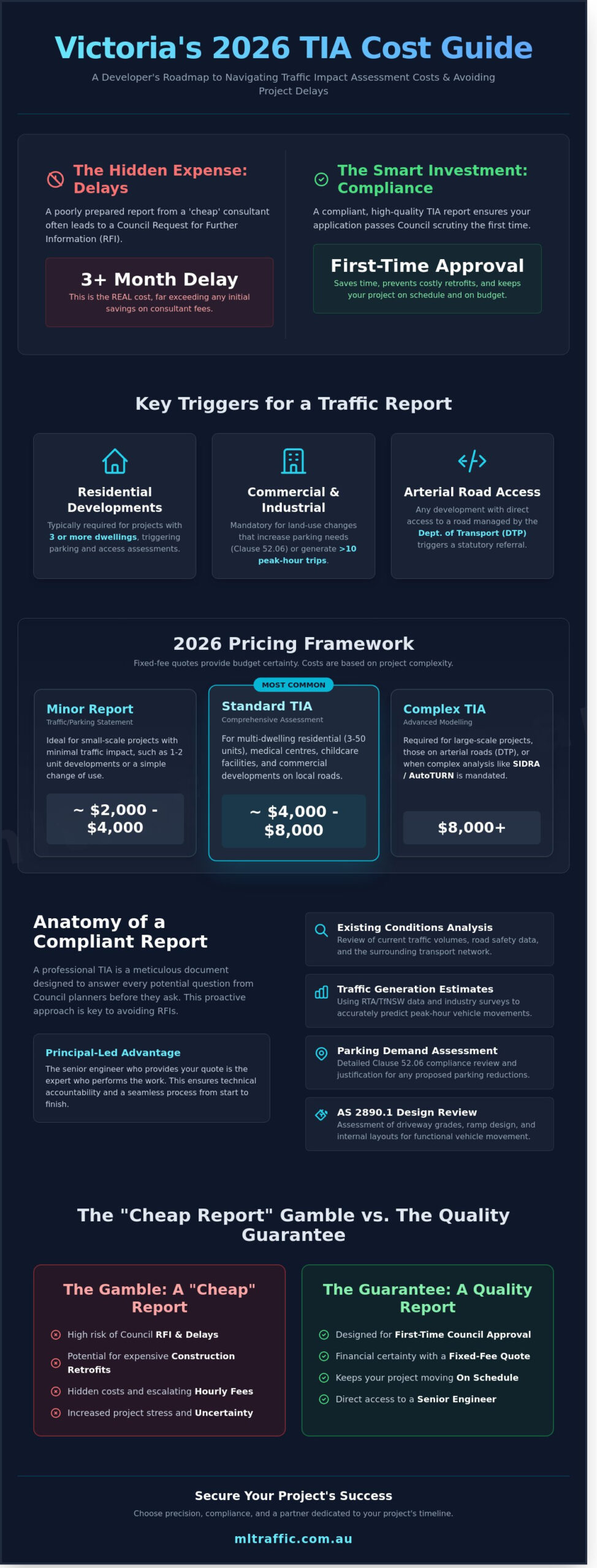
- Residential developments: Most metropolitan councils, such as Moreland or Boroondara, apply a “3+ dwelling” rule of thumb. Any project with three or more units usually requires at least a parking demand assessment.
- Commercial and industrial changes: A TIA is mandatory if a land-use change increases the statutory parking requirement under Clause 52.06 or generates more than 10 peak-hour vehicle trips.
- Arterial road access: Developments abutting roads managed by the DTP (formerly VicRoads) trigger a statutory referral. These require rigorous assessments of sight-lines and turn-lane warrants.
The Components of a Council-Ready TIA Report
A professional TIA must be meticulous to avoid Requests for Further Information (RFIs). Our traffic engineering services focus on delivering reports that meet all statutory requirements. Key components include:
- Existing conditions analysis: We examine current traffic volumes and road safety data from the last five years within the immediate vicinity.
- Traffic generation estimates: We use industry-standard data, including the RTA Guide and independent surveys, to predict peak-hour impacts.
- Parking demand assessments: This involves a detailed review of Clause 52.06 compliance and, if necessary, empirical evidence to justify a parking reduction.
- Design review: We assess driveway ramp grades and internal layouts against AS 2890.1 standards to ensure functional vehicle movements.
Traffic Impact Assessment Cost VIC: 2026 Pricing Framework
Determining the traffic impact assessment cost vic requires a clear understanding of the current Victorian planning environment. Most reputable traffic engineering firms in 2026 operate on a fixed-fee basis for development applications. This model offers developers financial certainty. It eliminates the risk of escalating hourly rates during the initial application phase. Fees are structured around the complexity of the proposed land use and the specific requirements of the local Council or Department of Transport and Planning.
The depth of a report correlates directly with project risk. A high-risk project, such as a major intersection modification, requires more rigorous data than a standard residential build. Professional engineers align their methodologies with the standards set by the Institute of Transportation Engineers to ensure the report withstands Council scrutiny. At ML Traffic Engineers, our policy remains consistent. The traffic consultant who provides the quote, does the work. This ensures accountability and technical accuracy from the first site visit to the final submission.
Typical Pricing Brackets for Victorian Developments
Project scale is the primary driver of consultancy fees. Below are the estimated price ranges for 2026 Victorian projects:
- Small-scale (3-10 dwellings): A$2,500 to A$4,500. These assessments focus on parking demand, driveway ramp grades, and compliance with AS 2890.1.
- Medium-scale (Mixed-use): A$5,000 to A$9,000. These projects require detailed trip generation analysis and often include swept path diagrams for service vehicles.
- Large-scale (Major industrial or shopping centres): A$10,000 and above. Fees at this level account for complex SIDRA modelling, extensive traffic counts, and intersection capacity analysis.
What Is Included in a Professional Quote?
A professional quote provides a transparent breakdown of the engineering process. It isn’t just a fee for a PDF document. It covers the technical labour required to secure a permit. You can view our full range of traffic engineering services to see how these components fit your specific project needs. A standard quote includes:
- Site inspections to verify sight-lines and existing road conditions.
- Procurement and analysis of traffic data or parking surveys.
- Technical report writing including Vehicle Swept Path Assessments.
- Internal quality assurance by senior engineers with over 30 years of experience.
- Post-submission support to address initial Council queries or Requests for Further Information (RFI).
Consultancy rates also reflect the level of qualification. Engaging a registered professional engineer ensures that the traffic impact assessment cost vic covers a document that is legally and technically robust. This reduces the likelihood of costly delays or VCAT appeals later in the development cycle.
Primary Factors Influencing Your TIA Report Pricing
The total traffic impact assessment cost vic depends on the specific technical requirements of your development application. A small-scale residential project typically generates fewer than 10 vehicle trips during peak hours, requiring a simpler assessment. Larger commercial or industrial sites involving over 50 daily vehicle movements necessitate extensive modelling to satisfy Victorian planning authorities. The complexity of the land use determines if a basic Traffic Impact Statement (TIS) suffices or if a full Traffic Impact Assessment (TIA) is mandatory. You can view our full range of traffic engineering services to understand which report type fits your project scope.
- Proposed vehicle movements: Higher trip generation rates increase the study area size and the number of intersections we must analyze.
- Intersection analysis: Assessing a single driveway access is faster than modelling three adjacent signalised intersections.
- Software requirements: Fees increase when engineers must run complex simulations for network capacity and delay.
- Historical data: The volume of existing traffic data we must process from the surrounding network affects the total hours billed.
Technical Complexity and Modelling Requirements
Technical analysis often requires SIDRA Intersection software to evaluate the degree of saturation and average delay. This modelling is a standard requirement for projects impacting arterial roads under the Austroads traffic assessment guidelines. We also conduct swept path analysis using AutoTURN software to ensure waste collection vehicles and delivery trucks can maneuver safely within the site. This involves checking vehicle clearance against AS 2890.1 standards. Assessment of sight distances and driveway ramp grades is another critical factor that ensures compliance with council safety mandates and prevents costly design revisions later.
External Costs: Traffic Surveys and Data Collection
Direct costs often include third-party traffic data collection. Pneumatic tube counts for 7-day volume data usually cost between A$450 and A$900 per location. Manual intersection counts during peak hours, typically 7:00 AM to 9:00 AM and 4:00 PM to 6:00 PM, require physical staff and carry higher fees. Parking saturation surveys are frequently required for developments seeking a reduction in standard parking rates. These surveys must occur over several days to provide a representative sample. If we can source existing data from the Department of Transport or recent nearby projects, we can reduce your total traffic impact assessment cost vic by A$500 to A$1,500.
The Hidden Costs of “Cheap” Traffic Reports
Selecting a consultant based solely on the lowest traffic impact assessment cost vic often triggers secondary expenses that far exceed the initial savings. A budget report that lacks technical depth typically results in a formal Request for Information (RFI) from the Council. In Victoria, an RFI can stall a planning permit application for 28 to 56 days. During this period, holding costs for the land continue to accumulate. If your consultant charges additional fees for RFI responses, a “cheap” A$2,500 report quickly becomes a financial burden.
Victorian statutory planners identify template-based reports immediately. Generic statements that don’t address site-specific constraints, such as nearby clearways or complex intersection geometries, are frequently rejected. This leads to a cycle of revisions and wasted time. Professional reports require a detailed analysis of the specific site context to avoid these administrative bottlenecks.
Council RFIs: The Silent Profit Killer
A poorly prepared report almost guarantees a Council RFI. This adds significant delays to your project timeline. Most budget consultants exclude RFI responses from their initial fee, meaning you pay extra for revisions that should’ve been correct in the first draft. Total project delays caused by inadequate traffic data can cost developers between A$5,000 and A$50,000 in interest and lost opportunity costs depending on the project scale. Ensuring AS 2890.1 compliance in the initial submission is the only way to maintain your schedule. You can view our technical standards in this AS 2890.1 guide.
- Typical RFI delay: 4 to 8 weeks.
- Consultant re-work fees: Often A$150 to A$250 per hour.
- Impact: Stalled construction starts and pushed-back settlement dates.
Construction Implications of Bad Traffic Advice
Inaccurate traffic advice leads to physical errors on-site. If a “cheap” report miscalculates driveway ramp grades, you may face concrete demolition costs. Retrofitting a non-compliant ramp after the initial pour can cost upwards of A$15,000. Undersized parking bays or inadequate swept paths create long-term legal risks and may lead to a breach of permit conditions. These errors are expensive to rectify once construction has commenced.
The value of doing it right the first time is measurable in the thousands of dollars saved on avoided retrofits. Working with an experienced traffic engineer ensures that the geometry of your car park meets Australian Standards before you break ground. We focus on providing accurate, compliant designs that pass Council scrutiny without the need for costly structural changes later.
Ensure your project stays on track.
Contact our senior engineers for a compliant traffic assessment quote today.
Why ML Traffic Engineers is the Logical Choice for VIC Developers
ML Traffic Engineers offers a direct, senior-led approach to traffic engineering that larger firms cannot match. Since 2005, we’ve completed over 10,000 successful site assessments across Victoria. This extensive history means we understand the specific nuances of Victorian Council requirements and the Department of Transport and Planning standards. You aren’t paying for corporate overheads or junior staff training when you hire us. You’re paying for technical expertise that moves projects toward approval.
Our transparent, fixed-fee quoting model eliminates financial uncertainty for developers. We provide a definitive price for your traffic impact assessment cost vic at the start of the engagement. This approach ensures there are no hidden administrative overheads or surprise hourly charges. Our experience covers a vast range of land uses, including:
- Multi-deck residential apartments and mixed-use developments
- Childcare centres and educational facilities
- Medical centres and allied health clinics
- Industrial warehouses and logistics hubs
- Retail precincts and hospitality venues
Accountability: The Person Who Quotes, Does the Work
Many large consultancies use senior directors to win a bid, then pass the actual technical work to junior staff. This practice often leads to errors and lengthy RFI (Request for Further Information) cycles from Council. At ML Traffic Engineers, the consultant who provides your quote is the one who performs the assessment. You’ll have direct mobile access to Michael Lee and Benny Chen to discuss project strategy at any stage.
This principal-led model ensures meticulous attention to detail in Car Park Design and Demand Assessment. We focus on compliance with AS 2890.1 and local planning schemes to minimize the risk of permit refusals. Our hands-on involvement means we identify potential access issues or parking shortfalls early in the design phase, saving you significant time and money during the planning process.
Get a Competitive Quote for Your Victorian Project
Speed is critical in the development industry. We provide fast turnaround times for standard applications, typically delivering comprehensive reports within 5 to 10 business days. Our service includes end-to-end support, from initial site design to final approval and VCAT representation if required. We’ve built a reputation for reliability over 19 years of operation in the Victorian market.
Managing your traffic impact assessment cost vic starts with an accurate, project-specific fee. We don’t use generic pricing; we assess the specific complexity of your site to provide a fair and competitive quote. Contact ML Traffic Engineers today to speak directly with an expert and secure a fixed-fee proposal for your next development project.
Secure Your Project Approval with Precise Traffic Engineering
Navigating the 2026 Victorian development landscape requires more than just a permit application. Your traffic impact assessment cost vic is an investment in risk mitigation. Cutting corners with budget reports often results in costly Council RFIs and redesigns that exceed any initial savings. Successful developers prioritize compliance with AS 2890.1 and AS 2890.2 from the outset to avoid these bureaucratic bottlenecks. Our data shows that accurate swept path analysis and parking demand assessments are the primary drivers of report acceptance rates in Victoria.
ML Traffic Engineers brings over 10,000 sites of nationwide experience to your project. You won’t deal with junior staff or account managers. Each assessment is handled by a principal engineer with between 30 and 40 years of individual industry experience. We ensure every driveway ramp grade and sight-line assessment meets rigorous Australian Standards. The consultant who provides your quote is the expert who does the work; this provides a level of accountability that larger firms can’t match.
Don’t let technical oversights stall your 2026 development timeline. Request a Fixed-Fee TIA Quote from Our Principal Engineers today. We look forward to helping you achieve a seamless planning approval.
Frequently Asked Questions
How much does a Traffic Impact Assessment cost in Victoria for 2026?
A standard traffic impact assessment cost vic for 2026 typically ranges from A$3,500 to A$8,500 for mid-scale residential or commercial projects. Small-scale developments might start at A$2,500, while high-density precincts or major shopping centres often exceed A$15,000 due to complex modeling requirements. These figures reflect current 2026 market rates for qualified traffic engineering consultants who provide RPEV certified reports.
What is the difference between a Traffic Impact Statement and a TIA?
A Traffic Impact Statement (TIS) is a concise report for low-impact developments, such as a 5-unit townhouse project or a small medical clinic. A Traffic Impact Assessment (TIA) is a comprehensive technical document required for larger developments that generate over 10 peak-hour vehicle trips. TIAs involve detailed intersection analysis, SIDRA modeling, and long-term transport planning data to satisfy Victorian Council requirements.
How long does it take to complete a TIA report for Council?
Completion times for a TIA report generally range from 14 to 28 days. This timeline includes 7 days for mandatory traffic volume surveys and 10 days for engineering analysis and report drafting. Complex sites requiring Department of Transport and Planning (DTP) consultation may extend this period by an additional 14 days to ensure all regional road network impacts are addressed.
Will I need a TIA for a small 3-unit townhouse development?
Most Victorian Councils don’t require a full TIA for a 3-unit townhouse development. You’ll likely need a Car Parking Demand Assessment to address Clause 52.06 requirements instead. If the site has narrow access or limited sightlines, a brief Traffic Impact Statement might be requested to confirm safety for the 3 additional vehicle movements and ensure compliance with AS 2890.1 standards.
Does the TIA cost include the price of traffic surveys?
Professional fees typically exclude the cost of physical traffic surveys. You should budget an additional A$900 to A$2,200 for tube counts or video intersection surveys depending on the project scale. We manage the sub-contractors directly to ensure the data meets Victorian Council standards, but these are billed as external disbursements to keep the traffic impact assessment cost vic transparent for the developer.
Can I use a previous traffic report for a new planning application?
Victorian Councils rarely accept traffic reports with data older than 24 months. If your previous report was issued before 2024, the traffic volumes and local road conditions have likely changed. You’ll need an updated assessment to reflect current 2026 traffic patterns and any new developments nearby that affect the local road network capacity and parking availability.
What happens if Council issues an RFI regarding the traffic report?
When a Council issues a Request for Further Information (RFI), your traffic engineer must provide a technical response or amended plans within the specified timeframe. We review the specific concerns, such as swept path clearances or parking gradients, and update the report. This process ensures the application remains compliant with the Victorian Planning Scheme and avoids unnecessary delays or permit refusal.
Why do Victorian Councils require SIDRA modelling for certain sites?
Councils mandate SIDRA modelling when a development significantly impacts intersection performance. This software calculates the Degree of Saturation and average delays for vehicles at specific junctions. If your project adds more than 10 vehicles to a single movement during peak periods, SIDRA provides the empirical evidence needed to prove the local network can handle the additional load without failing.
Which areas do you cover?
We service all suburbs of Melbourne metropolitan area, such as Abbotsford, Aberfeldie, Aintree, Airport West, Albanvale, Albert Park, Albion, Alphington, Altona, Altona Meadows, Altona North, Ardeer, Armadale, Arthurs Seat, Ascot Vale, Ashburton, Ashwood, Aspendale, Aspendale Gardens, Attwood, Avondale Heights, Balaclava, Balwyn, Balwyn North, Bangholme, Bayswater, Bayswater North, Beaconsfield, Beaumaris, Bellfield, Bentleigh, Bentleigh East, Berwick, Bittern, Blackburn, Blackburn North, Blackburn South, Bonbeach, Boronia, Box Hill, Box Hill North, Box Hill South, Braeside, Braybrook, Brentford Square, Brighton, Brighton East, Broadmeadows, Brooklyn, Brunswick, Brunswick East, Brunswick West, Bulla, Bulleen, Bundoora, Burnley, Burnside, Burwood, Burwood East, Cairnlea, Camberwell, Campbellfield, Canterbury, Carlton, Carlton North, Carnegie, Caroline Springs, Carrum, Carrum Downs, Caulfield, Caulfield East, Caulfield North, Caulfield South, Chadstone, Chelsea, Chelsea Heights, Cheltenham, Chirnside Park, Clarinda, Clayton, Clayton South, Clematis, Clifton Hill, Coburg, Coburg North, Cocoroc, Coldstream, Collingwood, Coolaroo, Craigieburn, Cranbourne, Cranbourne East, Cranbourne North, Cranbourne South, Cranbourne West, Cremorne, Croydon, Croydon Hills, Croydon North, Croydon South, Dandenong, Dandenong North, Dandenong South, Deer Park, Delahey, Derrimut, Diamond Creek, Diggers Rest, Dingley Village, Docklands, Doncaster, Doncaster East, Donnybrook, Donvale, Doreen, Doveton, Eaglemont, East Melbourne, Edithvale, Elsternwick, Eltham, Eltham North, Elwood, Emerald, Endeavour Hills, Epping, Essendon, Essendon Fields, Essendon North, Essendon West, Fairfield, Fawkner, Ferntree Gully, Ferny Creek, Fitzroy, Fitzroy North, Flemington, Footscray, Forest Hill, Frankston, Frankston North, Frankston South, Gardenvale, Gladstone Park, Glen Huntly, Glen Iris, Glen Waverley, Glenroy, Greensborough, Greenvale, Guys Hill, Hadfield, Hampton, Hampton East, Hampton Park, Harkaway, Hawthorn, Hawthorn East, Heathmont, Heidelberg, Heidelberg Heights, Heidelberg West, Highett, Hillside, Hoppers Crossing, Hughesdale, Huntingdale, Hurstbridge, Ivanhoe, Ivanhoe East, Jacana, Kalkallo, Kealba, Keilor, Keilor Downs, Keilor East, Keilor Lodge, Keilor North, Keilor Park, Kensington, Kew, Kew East, Keysborough, Kings Park, Kingsbury, Kingsville, Knoxfield, Lalor, Langwarrin, Laverton, Laverton North, Lilydale, Lower Plenty, Lynbrook, Lyndhurst, Lysterfield, Macleod, Maidstone, Malvern, Malvern East, Maribyrnong, McCrae, Meadow Heights, Melbourne, Mentone, Mernda, Mickleham, Middle Park, Mill Park, Mitcham, Mont Albert, Mont Albert North, Montmorency, Moonee Ponds, Moorabbin, Mooroolbark, Mordialloc, Mornington, Mount Waverley, Mulgrave, Murrumbeena, Narre Warren, Narre Warren North, Narre Warren South, Newport, Niddrie, Noble Park, Noble Park North, North Melbourne, Northcote, Notting Hill, Nunawading, Oak Park, Oaklands Junction, Oakleigh, Oakleigh East, Oakleigh South, Officer, Ormond, Pakenham, Parkdale, Park Orchards, Pascoe Vale, Pascoe Vale South, Patterson Lakes, Plenty, Point Cook, Port Melbourne, Portsea, Prahran, Preston, Princes Hill, Reservoir, Richmond, Ringwood, Ringwood East, Ringwood North, Ripponlea, Rosanna, Rosebud, Rowville, Roxburgh Park, Rye, Sandhurst, Sandringham, Scoresby, Seabrook, Seaholme, Seddon, Seaford, South Kingsville, South Melbourne, South Morang, South Wharf, South Yarra, Southbank, Spotswood, St Albans, St Helena, St Kilda, St Kilda East, St Kilda West, Strathmore, Sunshine, Sunshine North, Sunshine West, Surrey Hills, Sydenham, Tarneit, Taylors Hill, Taylors Lakes, Templestowe, Templestowe Lower, Thomastown, Thornbury, Toorak, Tottenham, Travancore, Truganina, Tullamarine, Vermont, Vermont South, Viewbank, Wantirna, Wantirna South, Watsonia, Watsonia North, Werribee, Werribee South, West Footscray, West Melbourne, Westgarth, Wheelers Hill, Wildwood, Williamstown, Williamstown North, Windsor, Wonga Park, Wyndham Vale, Yallambie, Yarraville.
Disclaimer
The content on www.mltraffic.com.au, including all technical articles, guides, and resources, is provided for general informational and educational purposes only. It is not intended to constitute professional advice in traffic engineering, transportation planning, development approvals, or any other technical or legal field.
While ML Traffic Engineers makes every reasonable effort to ensure the accuracy, completeness, and timeliness of the information published, we do not provide any warranties or representations (express or implied) regarding its reliability, suitability, or availability for any particular purpose. Any reliance you place on the content is strictly at your own risk.
In no event shall ML Traffic Engineers, its directors, employees, authors, or affiliates be liable for any direct, indirect, incidental, special, consequential, or punitive damages (including, without limitation, loss of profits, data, or business opportunities) arising out of or in connection with the use of, or inability to use, any information provided on this website.
The articles and guides on this site are not a substitute for engaging a qualified, registered professional traffic engineer (such as an NPER or RPEQ engineer) to assess your specific project requirements. For tailored advice, compliance assessments, or traffic engineering services, please contact a competent professional.
This disclaimer may be updated from time to time without notice. By accessing or using this website, you agree to be bound by the most current version of this disclaimer.
