

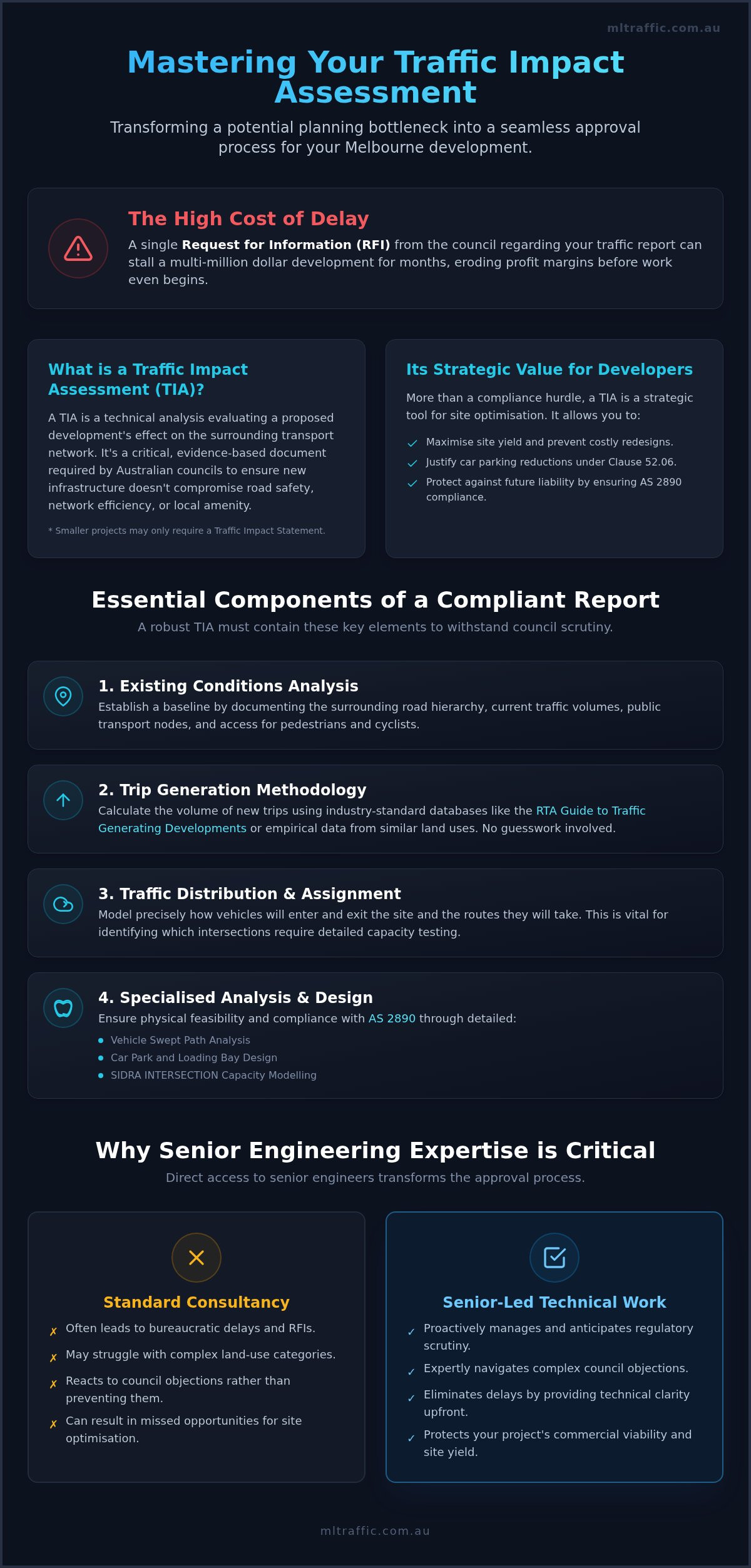
A single Request for Information regarding your traffic report can stall a multi-million dollar development for months, eroding your profit margins before the first sod is even turned. Most developers recognise that council approval hinges on technical precision, yet many still struggle with conflicting Australian Standards and uncertain traffic generation rates. Securing a traffic impact assessment melbourne requires more than just ticking boxes. It demands a strategic approach to engineering that anticipates regulatory scrutiny and prioritises site yield.
By mastering these complexities, you can transform a potential bottleneck into a seamless planning approval process. This guide provides the technical clarity needed to ensure your application meets AS 2890 requirements while protecting your project’s commercial viability. We’ll detail the essential components of a robust assessment, from vehicle swept path analysis to parking demand, and demonstrate how senior-led technical work eliminates the bureaucratic delays that often plague standard consultancies.
Key Takeaways
- Understand the strategic role of a TIA in demonstrating a development’s effect on the transport network to meet rigorous Australian Standards.
- Identify the essential data required for a compliant traffic impact assessment melbourne, including trip generation methodology and existing road conditions.
- Learn how to proactively manage the planning approval process to avoid common council Requests for Information (RFIs) and project delays.
- Discover how specialised swept path analysis and car park design ensure your site layout is physically feasible and compliant with AS 2890.
- Recognise why direct access to senior engineering expertise is critical for navigating complex land-use categories and council objections.
Understanding the Role of a Traffic Impact Assessment (TIA)
A Traffic Impact Assessment (TIA) is a technical analysis that evaluates the influence of a proposed development on the surrounding transport network. Securing a professional traffic impact assessment melbourne provides the technical foundation for a successful planning permit. It serves as a critical evidence-based document for planning authorities. Australian councils require these reports across various land-use categories to ensure that new infrastructure doesn’t compromise the existing road hierarchy. While a full TIA provides an exhaustive review for large-scale projects, smaller developments might only require a Traffic Impact Statement. Both documents share the objective of maintaining road safety, network efficiency, and local amenity.
To better understand the technical workflow behind these assessments, watch this helpful video:
When is a Traffic Report Mandatory?
Planning schemes specify several triggers that make a traffic report compulsory. Common examples include a change in land use that alters the traffic profile of the site or increases in gross floor area that exceed local planning thresholds. Significant increases in trip generation often necessitate an Intersection Capacity Utilization analysis to prove that nearby junctions can handle the extra load. Developers must provide these reports during the initial town planning application or as a formal response to a Request for Information (RFI). Failing to provide a robust traffic impact assessment melbourne at the outset often leads to avoidable delays.
The Strategic Value for Developers
A TIA isn’t merely a compliance hurdle; it’s a strategic tool for site optimisation. Engaging an expert early allows for the identification of access issues or driveway constraints before the design’s finalised. This proactive approach prevents expensive redesigns later in the process. Detailed traffic data is also essential when justifying car parking waivers or reductions under Clause 52.06 of the planning scheme. By demonstrating that peak demand can be managed through existing infrastructure or alternative transport, developers can maximise their site’s yield. A comprehensive TIA protects a developer from future liability regarding road safety by ensuring all designs adhere to AS 2890. You can find more details on our specific traffic engineering services to see how we assist with these requirements.
Essential Components of a Compliant Traffic Assessment Report
A compliant traffic impact assessment melbourne must adhere to a rigorous structural framework to withstand council scrutiny. The report begins with a detailed analysis of existing conditions. This includes documenting the surrounding road hierarchy, current traffic volumes, and proximity to public transport nodes. We evaluate the site’s accessibility for pedestrians and cyclists to ensure a multi-modal approach. By establishing this baseline, we can accurately measure the relative impact of the proposed development. This process aligns with established Transport Impact Assessment (TIA) guidelines used across various jurisdictions to maintain national consistency.
Determining trip generation requires a methodology rooted in industry-standard databases such as the RTA Guide to Traffic Generating Developments or empirical data from similar land uses. We don’t rely on guesswork. Instead, we apply specific rates to the development’s scale, whether it’s residential units, retail floor space, or industrial warehouse capacity. Once the volume of new trips is calculated, we perform traffic distribution and assignment. This step models exactly how vehicles will enter and exit the site and which routes they’ll take through the local road network. Accurate assignment is vital for identifying which intersections require detailed capacity testing.
Traffic Generation and Distribution Modelling
Technical precision in modelling is non-negotiable. We utilise SIDRA INTERSECTION software to conduct capacity testing on critical junctions. This analysis determines if the existing infrastructure can accommodate peak hour traffic flows without significant increases in delay or queuing. For unique or non-standard land uses where database rates may not apply, we collect empirical data from comparable sites. This evidence-based approach is essential for justifying your project’s impact to skeptical council engineers. If you require technical support, our team provides comprehensive traffic engineering consultancy to ensure your data is robust.
Parking and Loading Requirements
Statutory requirements dictate the minimum provision for car, bicycle, and motorcycle parking. Our reports compare these requirements against the proposed supply, identifying any shortfalls that require a parking waiver justification. Beyond car spaces, we detail the requirements for on-site loading and waste collection. This includes ensuring that heavy rigid vehicles (HRVs) or garbage trucks can enter and exit the site in a forward direction. All designs must achieve strict AS 2890.1 car park design compliance to guarantee physical feasibility and user safety.
Navigating Planning Approvals and Avoiding Council RFIs
Councils frequently issue Requests for Information (RFIs) when a traffic impact assessment melbourne lacks technical depth or fails to address specific local planning overlays. Common triggers include ambiguous parking layouts, missing swept path diagrams, or inadequate justification for parking reductions under Clause 52.06. Proactive communication with council transport planners during the pre-application phase often clarifies expectations and reduces the risk of these setbacks. Addressing fundamental issues like sight distance and driveway gradients early in the design phase prevents the need for significant structural revisions later. Engaging a professional traffic engineer ensures that your application is technically robust and prepared for rigorous departmental review.
Addressing Sight Distance and Road Safety
Sight distance is a non-negotiable safety requirement at every property access point. We calculate Safe Intersection Sight Distance (SISD) based on the specific speed environment and road geometry of the site. If a council identifies a high-risk area or complex intersection, they may request a formal Road Safety Audit to be conducted by an independent specialist. Documenting these safety measures within the TIA report involves providing precise measurements and clear diagrams that prove compliance with Austroads and AS 2890.1. Providing this level of detail upfront demonstrates a commitment to public safety and simplifies the assessor’s review process. It’s essential to account for all road users, including pedestrians and cyclists, to ensure the proposed access doesn’t create new hazards.
Managing Council and Authority Negotiations
Developments impacting major roads often require referral to the Department of Transport and Planning (DTP). These officials apply strict criteria to any new access points or changes to existing traffic flow. Managing these negotiations requires technical authority and a deep understanding of state-level transport policy. If a project proceeds to a planning tribunal, such as VCAT, the quality of your expert evidence becomes the deciding factor in the outcome. Referencing the City of Melbourne’s traffic management plan guidelines helps ensure that construction-related impacts are accounted for before the build begins. Technical accuracy is your primary defence against costly legal delays and potential project rejection. Our senior engineers lead these discussions directly, ensuring no technical detail is lost in communication.
Integrating Swept Path Analysis and Car Park Design
A traffic impact assessment melbourne remains incomplete without verifying the physical feasibility of vehicle movements. Swept path analysis provides this proof. We use specialised software like AutoTURN to simulate vehicle turns, ensuring that the proposed site layout accommodates the specific design vehicles required by council. This technical simulation identifies potential conflict points between vehicles and structural elements like columns or walls before construction begins. For industrial developments, integrating swept paths for heavy vehicles is critical. We model the movements of Heavy Rigid Vehicles (HRVs) and Articulated Vehicles (AVs) to confirm that loading docks and internal circulating roads function safely.
Technical adherence to Australian Standards is the benchmark for council approval. It’s vital to distinguish between AS 2890.1, which governs off-street car parking, and AS 2890.2, which covers commercial vehicle facilities. Residential designs typically focus on the B99 vehicle template, representing the 99th percentile of cars on Australian roads. Ensuring a B99 vehicle can enter and exit a parking space in a maximum of three movements is a standard council requirement. For deeper technical insight, refer to our complete guide on swept path analysis.
Optimising Car Park Layouts for Yield
Strategic traffic engineering input often increases the number of viable parking spaces on a site. We evaluate car park layouts to identify efficiencies that architects might overlook. This includes the assessment of tandem parking arrangements and the integration of mechanical parking systems or car stackers. While these systems maximise yield, they require careful swept path verification to ensure access remains functional. Pedestrian safety within these environments is equally important. A compliant layout must include:
- Clearly defined pedestrian crossings and walking paths.
- Adequately maintained sightlines between drivers and pedestrians at conflict points.
- Physical separation where high-volume vehicle movements occur.
- Full compliance with disabled parking access requirements.
Our senior engineers perform these assessments directly to guarantee your site layout is both efficient and compliant. Contact us today for a professional vehicle swept path analysis to secure your project’s approval.
Why Senior Engineering Expertise is Critical for Your Project
The technical integrity of a traffic impact assessment melbourne relies entirely on the experience of the engineer performing the analysis. Many larger firms delegate technical work to junior staff, with senior principals only providing a final signature. This model increases the risk of errors and fails to anticipate complex council objections. We operate on a personnel continuity promise. The senior expert who initiates your project performs the actual technical work. This ensures that every swept path analysis and parking assessment benefits from over 15 years of consultancy experience. Direct access to leadership eliminates communication gaps and results in more robust reports that withstand departmental scrutiny.
Junior-led reports often overlook subtle regulatory requirements or fail to justify parking reductions effectively. These oversights lead to repetitive RFIs and costly project delays. A senior engineer identifies these potential bottlenecks during the initial site assessment. Having a single point of contact from inception to approval provides the accountability developers require. It ensures that the technical strategy remains consistent throughout the planning process. Senior-led reports are inherently more reliable because they incorporate lessons learned from thousands of previous applications across diverse land-use categories.
The Value of a Personalised Consultancy Approach
Our hands-on approach contrasts with the impersonal nature of larger consultancies. We prioritise direct accountability in every traffic engineering certification we issue. When a senior principal conducts the assessment, they bring a deep understanding of site-specific constraints and regional planning overlays. This specialised knowledge allows for more effective traffic solutions that maximise site yield without compromising safety. Accountability is not just a promise; it is a professional standard. You can learn more about our expert team and our 15-year history of successful project delivery to understand the depth of our technical capability.
Ensuring National Compliance and Professional Standards
Adherence to national regulatory standards is the foundation of our practice. We ensure every report complies with AS 2890.1 and AS 2890.2, as well as all relevant Austroads guidelines. Senior engineers play a vital role in providing expert witness testimony if a project proceeds to a planning tribunal. Their technical authority carries significant weight in legal settings, providing the evidence needed to resolve disputes with road authorities. Technical precision is the most effective way to ensure a seamless approval process. Contact us today for a fixed-fee proposal on your next traffic impact assessment melbourne to secure senior-led expertise for your development.
Securing Your Development’s Planning Approval
A successful development application relies on a strategic engineering approach that anticipates council scrutiny before it occurs. By prioritising precise swept path analysis and rigorous adherence to AS 2890 standards, you eliminate the technical ambiguities that often lead to costly Requests for Information. A robust traffic impact assessment melbourne serves as your project’s technical foundation, ensuring that driveway grades, parking supply, and intersection capacity are validated by empirical data and senior oversight.
Our consultancy model provides direct principal involvement, meaning the senior expert who initiates your project is the one performing the technical work. With over 15 years of specialist traffic engineering experience and a proven track record with councils nationwide, we deliver the reliability needed to navigate complex planning overlays and authority negotiations. Technical precision is the most effective way to protect your site yield and ensure project viability. Request a Fixed-Fee Traffic Assessment Proposal today to secure your project’s path to approval. We look forward to helping you achieve a seamless planning outcome.
Frequently Asked Questions
What is a Traffic Impact Assessment (TIA) report?
A Traffic Impact Assessment (TIA) report is a technical document that evaluates the impact of a proposed development on the surrounding transport network. It provides planning authorities with an evidence-based analysis of traffic generation, parking demand, and road safety. The report ensures that the development doesn’t compromise the existing road hierarchy or the amenity of other road users. It’s a critical component for obtaining planning approval for diverse land-use categories.
When is a traffic report required for a development application?
A traffic report is required when a development application triggers specific criteria within a local planning scheme. Typical triggers include a change in land use, a significant increase in gross floor area, or the creation of new access points to a main road. Councils also request these reports for developments expected to generate substantial traffic volumes. It’s often mandatory for residential, commercial, and industrial projects to ensure compliance with AS 2890.
How long does it take to complete a traffic impact assessment?
The timeframe for completing a traffic impact assessment melbourne typically ranges from one to three weeks, depending on project complexity. Smaller Traffic Impact Statements may be finalised sooner, while larger TIAs requiring detailed SIDRA modelling or empirical data collection take longer. Establishing existing conditions and coordinating with council transport planners are key factors in the timeline. Providing accurate architectural plans at the start of the process helps avoid unnecessary delays.
What are the key components of a compliant TIA report?
A compliant TIA report must include a detailed analysis of existing road conditions, trip generation estimates, and traffic distribution modelling. It also requires an assessment of parking demand versus statutory supply and a review of vehicle access points. Reports must demonstrate adherence to AS 2890.1 and AS 2890.2 standards. Inclusion of swept path diagrams and sight distance assessments is essential for proving the physical feasibility and safety of the proposed site layout.
Does every development need a swept path analysis?
While not every minor development requires it, most applications benefit from a Vehicle Swept Path Analysis to prove physical feasibility. Councils frequently request these diagrams to ensure that design vehicles, such as garbage trucks or B99 cars, can enter and exit the site in a forward direction. This analysis is critical for sites with tight access, basement parking, or loading docks. It provides the technical certainty needed to avoid costly redesigns after construction begins.
How much does a traffic impact assessment cost?
The cost of a traffic impact assessment varies based on the scale and complexity of the proposed development. Factors influencing the fee include the number of intersections requiring analysis, the necessity for SIDRA modelling, and the requirement for on-site traffic counts. Most professional engineering firms provide a fixed-fee proposal after reviewing the initial project brief and architectural plans. This ensures developers have cost certainty for their planning budget while receiving senior-led technical expertise.
Can a traffic engineer help with parking waivers?
Yes, a traffic engineer is essential for justifying parking waivers or reductions under Clause 52.06 of the planning scheme. By conducting a Car Parking Demand Assessment, we can provide empirical evidence that the actual peak demand is lower than the statutory requirement. This might involve surveying similar land uses or demonstrating the site’s proximity to high-frequency public transport. Professional justification often allows developers to maximise site yield by reducing the required parking provision.
What happens if the council issues an RFI for my traffic report?
If a council issues a Request for Information (RFI), your traffic engineer will provide a formal technical response to address the specific concerns raised. This may involve updating the traffic impact assessment melbourne with additional data, refined SIDRA modelling, or revised swept path diagrams. Senior engineers lead these negotiations to ensure that the council’s transport planners receive the technical clarity they require. Responding promptly and accurately to an RFI is critical for keeping the planning approval process on track.

Disclaimer
The content on www.mltraffic.com.au, including all technical articles, guides, and resources, is provided for general informational and educational purposes only. It is not intended to constitute professional advice in traffic engineering, transportation planning, development approvals, or any other technical or legal field.
While ML Traffic Engineers makes every reasonable effort to ensure the accuracy, completeness, and timeliness of the information published, we do not provide any warranties or representations (express or implied) regarding its reliability, suitability, or availability for any particular purpose. Any reliance you place on the content is strictly at your own risk.
In no event shall ML Traffic Engineers, its directors, employees, authors, or affiliates be liable for any direct, indirect, incidental, special, consequential, or punitive damages (including, without limitation, loss of profits, data, or business opportunities) arising out of or in connection with the use of, or inability to use, any information provided on this website.
The articles and guides on this site are not a substitute for engaging a qualified, registered professional traffic engineer (such as an NPER or RPEQ engineer) to assess your specific project requirements. For tailored advice, compliance assessments, or traffic engineering services, please contact a competent professional.
This disclaimer may be updated from time to time without notice. By accessing or using this website, you agree to be bound by the most current version of this disclaimer.
