

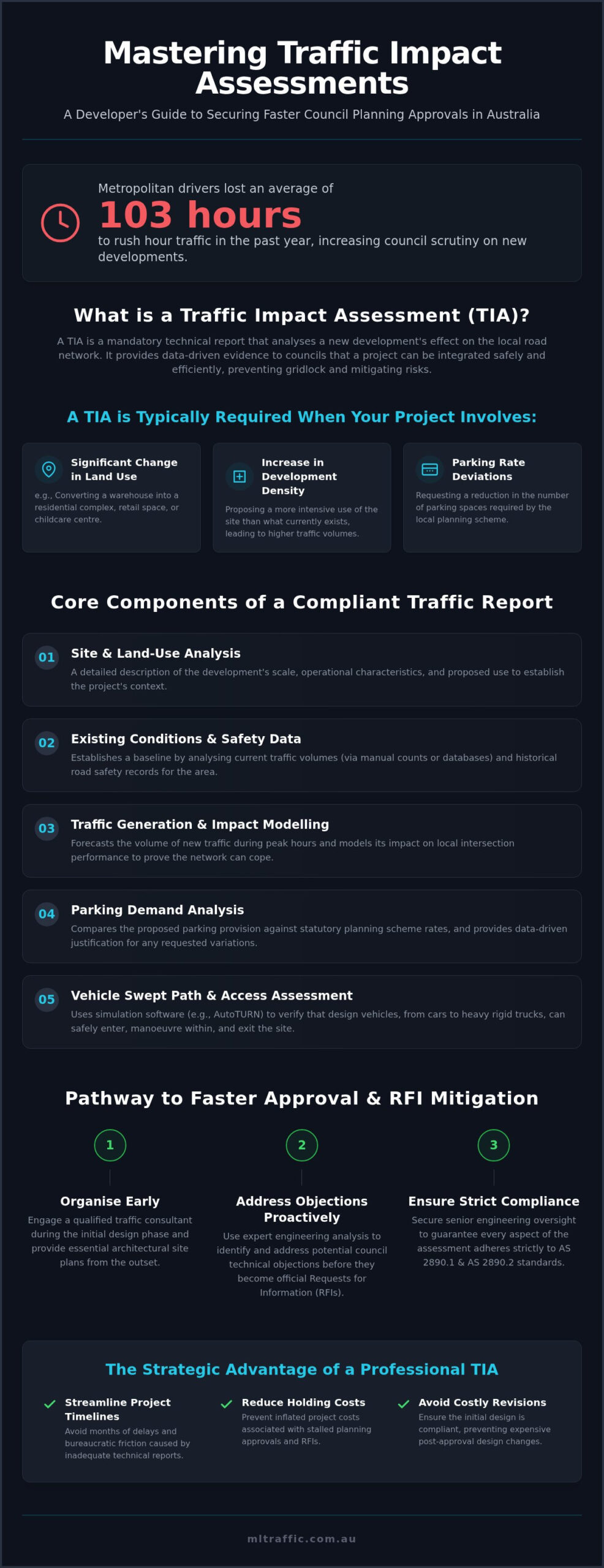
Metropolitan drivers lost an average of 103 hours to rush hour traffic over the past year, leading local councils to apply unprecedented scrutiny to new development applications. You likely understand that an inadequate technical report is the fastest way to trigger a Request for Information (RFI) or a flat rejection, yet navigating the intersection of national Australian Standards and complex planning schemes remains a significant hurdle. A poorly executed traffic impact assessment melbourne can stall a project for months, inflating holding costs and complicating essential access design.
This guide serves as a technical roadmap for mastering council expectations and the rigorous requirements of referral authorities. You’ll learn how to secure faster planning approvals by delivering a compliant, professional report that addresses every critical metric from the outset. We provide a detailed preview of the essential components required for success, including vehicle swept path analysis, AS 2890 compliance for car park design, and the necessity of senior engineering oversight. By following this framework, you can ensure your development moves from the planning phase to construction without unnecessary bureaucratic friction or costly design revisions.
Key Takeaways
- Understand why a Traffic Impact Assessment (TIA) is a mandatory technical requirement for local council planning approval and development applications.
- Identify the core components of a compliant report, including land-use analysis and existing road safety data, to ensure your traffic impact assessment melbourne meets all regulatory standards.
- Learn how to proactively mitigate the risk of council Requests for Information (RFIs) by addressing technical objections through expert engineering analysis.
- Streamline your project timeline by organising essential architectural site plans and engaging a qualified traffic consultant during the early design phase.
- Gain a strategic advantage by working directly with senior principals who ensure every assessment adheres strictly to AS 2890.1 and AS 2890.2 requirements.
What is a Traffic Impact Assessment (TIA) for Australian Developments?
A TIA is a comprehensive technical document used to determine the volume of traffic a development will generate and how that traffic integrates with the existing road network. It’s an essential component of the planning approval process, ensuring that new land uses don’t degrade road safety or transport efficiency. What is a Traffic Impact Assessment (TIA) effectively bridges the gap between architectural vision and civil reality by providing empirical evidence that a site can function without causing gridlock. For developers, a professional traffic impact assessment melbourne is the primary tool for mitigating council concerns regarding congestion and safety.
The assessment doesn’t just look at the street outside. It scrutinises internal site design, including how vehicles enter, circulate, and exit the property. This involves assessing driveway ramp grades, sight distances, and vehicle swept paths to confirm that everything from a standard passenger car to a heavy rigid vehicle can move safely. By analysing both internal and external factors, the report ensures the project is viable and compliant with national Australian Standards.
The Strategic Purpose of Traffic Impact Reports
A TIA provides a data-driven framework that allows authorities to approve projects with confidence. By identifying potential traffic growth and its effect on intersection performance through detailed modelling, the report establishes whether existing infrastructure can cope. It’s also vital for justifying parking variations. If your project provides fewer spaces than the statutory requirement, a TIA uses demand assessments to prove the proposed number is sufficient. This evidence-based approach turns a subjective planning debate into a technical discussion centred on facts, often preventing costly design changes later in the process.
When is a TIA Required by Council?
Authorities typically trigger the requirement for a TIA when a proposal involves a significant change in land use or an increase in development density. For instance, converting a warehouse into a multi-residential complex or a childcare centre will fundamentally change traffic volumes. You’ll also need one if your proposal deviates from standard parking rates defined in the local planning scheme. Often, this requirement emerges during a formal Request for Information (RFI) if the initial submission lacked sufficient technical detail. Engaging an expert early to conduct a traffic impact assessment melbourne prevents these delays and ensures the design complies with AS 2890 from the start. You can view our full range of traffic engineering services to see how we assist with these specific technical requirements.
Key Components of a Compliant Traffic Report
A professional report begins with a granular site description and land-use analysis. It must detail the proposed development’s scale and operational characteristics. This includes assessing existing traffic conditions and road safety data to establish a baseline. The report should include manual traffic counts or utilise existing database records to provide an accurate representation of current intersection performance. You need to model traffic generation for peak hour periods to demonstrate how the local network will perform under increased load. These Key Components of a Compliant Traffic Report are fundamental to any successful traffic impact assessment melbourne.
Parking demand analysis is equally critical. It requires a direct comparison between the proposed provision and the statutory requirements of the local planning scheme. If a variation is sought, the report must justify the shortfall using empirical data or surveys of similar sites. This meticulous approach ensures that the development doesn’t result in parking overflow onto public streets. Senior engineers examine peak demand periods to ensure the design remains functional under maximum occupancy. We focus on providing defensible data that withstands council scrutiny.
Vehicle Swept Path and Access Assessment
Ensuring functional site access is a mandatory technical requirement. We use AutoTURN software to simulate vehicle movements, confirming that the site layout accommodates the specific design vehicle. This simulation is vital for verifying that heavy vehicles and waste trucks can safely enter and exit the site in a forward direction. Compliance with swept path analysis requirements prevents operational failures and council refusals based on poor site circulation. The assessment must account for the turn radius of the largest vehicle expected to service the development regularly. This level of detail is what distinguishes a compliant report from a generic one.
Car Park Design and AS 2890 Compliance
Every car park layout must be certified against AS 2890.1 (Off-street car parking) and AS 2890.2 (Off-street commercial vehicle facilities). The assessment evaluates driveway ramp grades to prevent vehicle scraping and checks sight distance requirements at property boundaries for pedestrian safety. Understanding AS 2890.1 explained is the first step toward a compliant design. Our senior principals personally review these technical details to ensure your plans meet national regulatory standards. We focus on column placements, aisle widths, and bay dimensions to maximise efficiency while maintaining safety. If you require expert verification of your site plans, you can contact our senior engineering team for a detailed review.
Navigating Council Requirements and RFIs
Council planners frequently issue a Request for Information (RFI) when technical data is either missing or fails to meet the strict requirements of AS 2890. A comprehensive traffic impact assessment melbourne anticipates these triggers by addressing site density and access constraints from the outset. Common RFI triggers include unclear vehicle swept paths, inadequate sight distance at property boundaries, or unsubstantiated parking variations. Your traffic engineer isn’t just a report writer; they act as a technical advocate. The same expert who prepares your initial report will handle the RFI response, ensuring no technical detail is lost in translation. This continuity ensures the application moves past the initial assessment phase without stalling.
Addressing Intersection and Network Impacts
Proving minimal impact on local flow requires rigorous intersection analysis. We evaluate how your development’s trip generation affects the degree of saturation and queue lengths at nearby junctions during peak periods. If the network is already strained, we may need to evaluate the need for traffic guidance schemes or specific infrastructure upgrades to mitigate the added load. Our senior principals directly liaise with road authorities to resolve access disputes, particularly when a traffic impact assessment melbourne indicates potential friction with declared roads. This technical negotiation ensures your project remains viable without compromising the broader transport network’s safety or efficiency. We focus on providing defensible data that limits your liability and project risk.
Parking Demand vs. Council Provisions
Statutory parking rates in local planning schemes are often conservative and may not reflect actual site requirements. We utilise car parking demand assessments to justify a lower-than-standard provision by providing empirical evidence from surveys of similar land uses. Our analysis considers “green travel” factors, such as proximity to high-frequency public transport and the provision of high-quality end-of-trip facilities. This data-driven approach aligns your report with the Statement of Environmental Effects, demonstrating a commitment to sustainable transport outcomes. For a detailed breakdown of these technical methodologies, review our definitive guide on traffic engineering. By grounding your application in engineering principles rather than assumptions, you significantly reduce the likelihood of a council refusal based on parking shortfalls.
How to Organise a Traffic Impact Assessment
Organising a traffic impact assessment melbourne requires a systematic approach to technical data collection and engineering analysis. The process begins with the provision of comprehensive architectural site plans and a clear definition of the proposed land use. You must supply accurate floor areas, unit counts, and operational details to allow for precise trip generation calculations. Engaging a qualified traffic engineer during the conceptual design phase is critical. This early involvement ensures that the site layout is functional before you commit to a formal planning submission.
The technical workflow involves several key stages:
- Gathering detailed architectural plans and basement layouts.
- Conducting on-site traffic counts and parking occupancy surveys.
- Simulating vehicle movements using specialised software.
- Finalising the technical report for inclusion in the development application.
Initial Site Assessment and Design Input
Early intervention identifies “fatal flaws” that could lead to council refusal. We assess driveway locations and property access points to ensure they meet safety standards and don’t interfere with existing infrastructure. Our senior principals provide direct consultation on car park design, focusing on aisle widths and ramp grades to ensure compliance with AS 2890. This initial review protects the project timeline by ensuring the design is compliant from the outset. By addressing access constraints before the architectural plans are finalised, you avoid the need for expensive revisions during the RFI stage.
The Technical Reporting Phase
The reporting phase synthesises field data with engineering simulations. We draft the formal traffic impact assessment melbourne, incorporating swept path diagrams for heavy vehicles and intersection modelling for peak hour periods. If your project involves complex construction logistics or impacts on the public realm, we prepare a traffic management plan to address potential disruptions to the local road network. Every report is reviewed by a senior principal to ensure technical accuracy and adherence to national standards. To ensure your project meets all regulatory requirements and avoids unnecessary delays, contact our senior engineering team for a technical review of your site plans.
Strategic Engineering Solutions with ML Traffic Engineers Australia
ML Traffic Engineers Australia provides specialised consultancy with over 15 years of industry experience. We deliver compliant reports that facilitate planning approval by removing the technical friction often found in complex applications. Unlike larger firms that delegate technical tasks to junior staff, our senior principals personally perform the technical work. This ensures your traffic impact assessment melbourne is grounded in deep expertise and professional accountability from the first draft to the final submission. Our personnel continuity promise means the expert you meet at the project’s inception is the same one performing the engineering analysis, ensuring no technical detail is lost between departments.
We avoid unnecessary bureaucracy. Our focus remains entirely on conveying competence through demonstrated knowledge of the planning system and national regulatory standards. This direct approach ensures that every vehicle swept path analysis and parking demand assessment is accurate, defensible, and prepared to withstand rigorous scrutiny. We provide a direct line to our senior leadership, removing the gatekeepers common in larger consultancies. This structure allows us to respond rapidly to project changes and referral authority queries with authoritative, evidence-based advice.
Expertise Across All Land-Use Categories
Our project history spans an exhaustive range of land-use types. We’ve delivered successful outcomes for child care centres, medical clinics, and high-density multi-unit residential developments. Our experience extends to retail hubs, hospitality venues, and industrial sites with complex logistics requirements. We understand the specific traffic generation rates and parking demand profiles unique to each sector, allowing us to anticipate council concerns before they become formal objections. You can learn more about ML Traffic Engineers Australia and our commitment to technical excellence across diverse project environments.
Ensuring Council Approval Success
A meticulous approach to compliance is the foundation of our success. Every car park design and access assessment is certified against AS 2890.1 and AS 2890.2 to eliminate technical errors that trigger costly RFIs. Our communication is professional and authoritative, providing expert evidence that carries weight with planning authorities. This results-oriented philosophy minimises project delays and ensures your traffic impact assessment melbourne is a strategic asset for your development application. If you require a compliant report for your next project, contact ML Traffic Engineers Australia for a detailed fee proposal.
Secure Your Development Approval with Expert Traffic Engineering
Mastering the technical requirements for a traffic impact assessment melbourne is the most effective way to eliminate planning delays. You’ve seen how precise vehicle swept path analysis and strict adherence to AS 2890.1 and AS 2890.2 prevent the common technical errors that lead to council RFIs. By justifying parking variations with empirical demand data and ensuring site access is safe, you position your project for a faster approval process.
ML Traffic Engineers provides over 15 years of specialised consultancy experience. Our senior principals perform all technical work personally, ensuring your project benefits from deep expertise rather than junior delegation. We maintain a personnel continuity promise; the expert who starts your assessment is the one who sees it through to completion. This direct, authoritative approach provides the reliability you need to navigate complex transport planning requirements. Contact ML Traffic Engineers for a fixed-fee TIA proposal to ensure your next project is compliant and results-oriented. We look forward to facilitating your development success.
Frequently Asked Questions
What is the difference between a Traffic Impact Assessment and a Traffic Statement?
A Traffic Impact Assessment is a comprehensive technical report required for developments with significant trip generation or potential network impacts. It involves complex modelling of intersections and peak hour traffic flows. Conversely, a Traffic Statement is a concise document for lower-impact proposals. It focuses on basic site access and parking compliance without the need for extensive external network analysis. Selecting the correct report type prevents unnecessary costs and planning delays.
When is a Swept Path Analysis required for my development application?
Swept Path Analysis is mandatory for any development application where vehicle manoeuvrability is a technical concern. This includes basement car parks, loading bays, and sites serviced by heavy rigid vehicles or waste trucks. We use AutoTURN software to simulate these movements, ensuring vehicles can enter and exit the property in a forward direction. This technical verification confirms that your site layout complies with national safety standards and functional operational requirements.
How long does it typically take to complete a Traffic Impact Assessment report?
The duration of a traffic impact assessment melbourne depends on the project’s scale and the specific data collection required. Most standard reports are finalised within ten to fifteen business days. This timeframe allows for manual traffic counts, parking occupancy surveys, and the completion of engineering simulations. Complex industrial or high-density residential projects may require additional modelling time. We recommend engaging a consultant early to ensure the report is ready for your application.
Do I need a TIA for a small change of use application?
Small change of use applications often require a TIA if the proposed activity generates more trips than the previous land use. For example, converting a retail shop into a restaurant significantly increases evening traffic and parking demand. Council will scrutinise the net impact on the local road network. A professional assessment proves that the change won’t compromise local amenity or exceed the capacity of existing transport infrastructure.
Can a TIA help me reduce the amount of parking I am required to provide?
A professional traffic impact assessment melbourne can justify parking variations through a detailed demand assessment. We use empirical data from similar developments and consider green travel factors, such as proximity to trains and buses, to support a reduction in statutory parking rates. This evidence-based approach provides council with the technical justification needed to approve a project with fewer on-site spaces. It turns a subjective planning issue into a factual engineering discussion.
What Australian Standards govern car park and driveway design?
Car park and driveway designs are governed by the AS 2890 series of Australian Standards. AS 2890.1 covers off-street parking for passenger vehicles, while AS 2890.2 focuses on commercial vehicle facilities. These standards dictate precise requirements for bay widths, aisle clearances, ramp gradients, and sight distances. Adhering to these national regulations is essential for ensuring both safety and the long-term operational efficiency of any new residential, commercial, or industrial development.
How much does a Traffic Impact Assessment cost for a standard project?
Fees for a Traffic Impact Assessment vary based on the development’s size and the technical complexity involved. Factors influencing the cost include the number of intersections requiring modelling and the types of vehicles needing swept path simulations. Because every site is unique, we provide customised fixed-fee proposals rather than generic price lists. This ensures you receive a report that meets council’s specific requirements without paying for unnecessary or irrelevant engineering analysis.
What happens if council issues an RFI regarding my traffic report?
If council issues a Request for Information (RFI), we act as your technical advocate to resolve their objections. We prepare a formal response that addresses the specific engineering concerns raised by the transport department. This process might involve clarifying vehicle movements or providing additional data on intersection performance. Our senior principals lead this negotiation, ensuring the response is authoritative and meets the council’s expectations for planning approval.

Disclaimer
The content on www.mltraffic.com.au, including all technical articles, guides, and resources, is provided for general informational and educational purposes only. It is not intended to constitute professional advice in traffic engineering, transportation planning, development approvals, or any other technical or legal field.
While ML Traffic Engineers makes every reasonable effort to ensure the accuracy, completeness, and timeliness of the information published, we do not provide any warranties or representations (express or implied) regarding its reliability, suitability, or availability for any particular purpose. Any reliance you place on the content is strictly at your own risk.
In no event shall ML Traffic Engineers, its directors, employees, authors, or affiliates be liable for any direct, indirect, incidental, special, consequential, or punitive damages (including, without limitation, loss of profits, data, or business opportunities) arising out of or in connection with the use of, or inability to use, any information provided on this website.
The articles and guides on this site are not a substitute for engaging a qualified, registered professional traffic engineer (such as an NPER or RPEQ engineer) to assess your specific project requirements. For tailored advice, compliance assessments, or traffic engineering services, please contact a competent professional.
This disclaimer may be updated from time to time without notice. By accessing or using this website, you agree to be bound by the most current version of this disclaimer.
