

A single miscalculation in your parking rate or a non-compliant swept path for a Heavy Rigid Vehicle can stall a multi-million dollar development for months. Navigating the varied and often rigorous requirements of local government authorities across Australia, particularly concerning infrastructure contributions and complex planning overlays, is a critical challenge. Receiving a Request for Information (RFI) because of technical traffic oversights is a costly setback that disrupts project timelines and increases consultancy overheads.
This technical guide, brought to you by ML Traffic Engineers Australia, provides the framework required to secure a Traffic Impact Assessment that local council engineers will approve, ensuring your Development Application meets current planning standards. We examine the specific parking requirements for various zones, the impact of Transport Oriented Development (TOD) planning policies, and the necessity of AS 2890 compliance for car park design. You will gain clarity on navigating diverse parking contribution schemes and common vehicle access restrictions for construction. By following this expert-led approach, you can eliminate traffic-related delays and move toward a seamless DA approval.
Key Takeaways
- Understand how the North Sydney DCP 2013 and LEP frameworks dictate the mandatory documentation required for a successful development application.
- Identify the technical modelling standards for a Traffic Impact Assessment North Sydney Council engineers expect, specifically regarding intersection analysis for the Pacific Highway and Miller Street corridors.
- Master parking demand calculations and AS 2890 compliance to ensure your car park design facilitates efficient vehicle manoeuvring and avoids costly Council RFIs.
- Evaluate the impact of the NSW Transport Oriented Development (TOD) SEPP on parking minimums and density for projects near Crows Nest and Victoria Cross Metro stations.
- Learn how direct senior principal involvement and a personnel continuity promise can streamline your DA approval and reduce traffic-related delays.
Understanding North Sydney Council’s Traffic and Parking Requirements
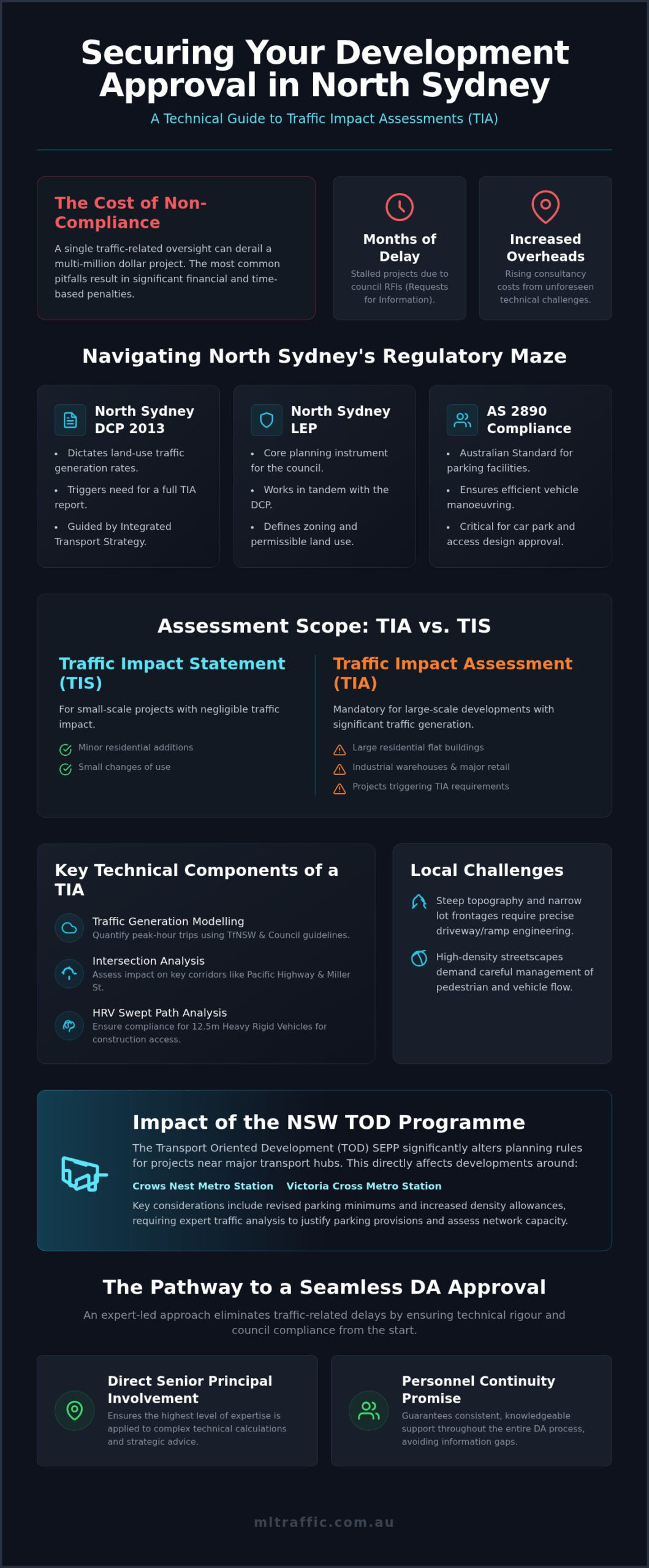
A Traffic Impact Assessment North Sydney Council is a mandatory component for most Development Applications (DAs) within the municipality. This document serves as the technical bridge between a developer’s vision and the regulatory requirements set out in the North Sydney Local Environmental Plan (LEP) and the North Sydney Development Control Plan (DCP) 2013. Council engineers use these assessments to evaluate how a new project will affect the local road network, particularly in high-congestion corridors like Miller Street and the Pacific Highway.
Non-compliance with these regulatory pillars carries significant risk. Inadequate reports frequently trigger a formal Request for Information (RFI), which can stall a project for weeks or months. Council prioritises pedestrian safety and active transport, meaning any proposal must demonstrate a clear commitment to ‘walkability’ and cyclist safety. If your assessment fails to address these priorities or lacks the necessary technical rigour, the likelihood of DA refusal increases substantially. To better understand this concept, watch this helpful video:
The North Sydney DCP Framework
The North Sydney DCP 2013 provides the specific land-use traffic generation rates that underpin every assessment. These rates vary significantly between residential, commercial, and mixed-use developments. Professional Traffic engineering principles must be applied to determine whether a project hits the ‘triggers’ for a full report, such as a net increase in vehicle trips or changes to on-street parking. Council’s decision-making is also guided by its Integrated Transport Strategy, which focuses on shifting transport modes away from private vehicles in the CBD and around major transport hubs.
Engineering Standards for Access and Parking
North Sydney’s unique topography and high-density streetscapes require precise engineering for vehicle access. Council has strict requirements for driveway widths and ramp gradients to ensure safe vehicle entry and exit without obstructing pedestrian flow. Generic reports often fail here because they don’t account for the steep terrain and narrow lot frontages typical of the area. Aligning your project with professional traffic engineering standards is essential for ensuring your driveway and car park designs are functional. Our senior principals handle these technical calculations directly, ensuring the precision required for complex vehicle manoeuvring and compliance with the 12.5m HRV limit for construction access.
Technical Components of a North Sydney Traffic Impact Assessment (TIA)
A technical Traffic Impact Assessment North Sydney Council requires rigorous data modelling to withstand engineering scrutiny. The report must quantify traffic generation by applying current Transport for NSW (TfNSW) guidelines alongside local Council specificities. For high-density developments, this involves estimating peak-hour trip generation for both residential and commercial components. Preparing a Traffic Impact Assessment North Sydney Council developers can rely on involves more than just counting cars; it requires a deep understanding of urban network constraints.
Traffic Impact Statement (TIS) vs. Full Assessment (TIA)
Council distinguishes between a Traffic Impact Statement (TIS) and a full Traffic Impact Assessment (TIA) based on the scale of the proposed works. A TIS is typically reserved for small-scale residential additions or minor changes of use where traffic increases are negligible. In contrast, a TIA is mandatory for large-scale residential flat buildings, industrial warehouses, or major retail developments. Submitting a TIS for a project that triggers TIA requirements leads to an immediate RFI and delays the planning process. If you’re unsure which report your project requires, our senior principals can provide a preliminary traffic engineering services review to determine the correct scope.
Intersection and Network Performance Analysis
North Sydney’s primary corridors, such as the Pacific Highway and Miller Street, often operate near capacity during peak periods. Council engineers require SIDRA modelling to assess how new traffic loads affect these intersections. The analysis must detail the Level of Service (LoS), average delay, and degree of saturation. A proposal that degrades an intersection’s LoS from ‘C’ to ‘D’ or worse will require specific mitigation strategies, such as physical road upgrades or demand management plans. Meticulous modelling ensures these strategies are both cost-effective and compliant with Council’s engineering standards.
The assessment must also evaluate public transport accessibility and ‘walkability’. Developments within the Crows Nest and Victoria Cross Metro catchments must align with the NSW Transport Oriented Development Program. This state-level policy influences how Council views parking minimums and pedestrian infrastructure. Finally, loading and service vehicle requirements are critical for high-density commercial sites. The report must demonstrate that service vehicles, including the 12.5m Heavy Rigid Vehicle (HRV), can safely enter and exit the site in a forward direction. Precise swept path analysis is the only way to prove this to Council’s satisfaction.
Car Parking Design and Compliance with AS 2890 in North Sydney
A Traffic Impact Assessment North Sydney Council must bridge the gap between network trip generation and the physical feasibility of the site. Council’s parking rates are not merely suggestions; they are strict ceilings or floors depending on the zone’s proximity to transport hubs. For developers, calculating the exact parking demand requires aligning the North Sydney DCP 2013 with the specific land-use categories of the project. In Category 1 areas, the annual parking space levy of A$3,120 for the 2027 tax year makes efficient car park design a financial necessity as well as a regulatory one.
Compliance with AS 2890.1 for off-street parking and AS 2890.2 for commercial vehicles is the baseline for any DA. Beyond basic stall dimensions, Council engineers scrutinise driveway ramp grades. North Sydney’s steep topography often makes achieving the required 1:20 transition zones difficult. Failure to provide a compliant vertical profile results in vehicles scraping or poor sight lines, both of which are common grounds for an RFI. Modern DAs also require the integration of mandatory bicycle parking and end-of-trip facilities, which must be factored into the initial floor plate design to avoid losing valuable car spaces later.
Vehicle Swept Path Analysis for Constrained Sites
Constrained urban sites in Crows Nest and the North Sydney CBD leave little room for error in vehicle manoeuvring. We use advanced AutoTURN software to perform precise vehicle swept path analysis. This demonstrates that waste collection vehicles and emergency services can enter and exit the site in a forward direction. Council typically restricts construction vehicle size to a 12.5m Heavy Rigid Vehicle (HRV), so your basement and loading dock must accommodate this specific turning circle. For a deeper look at these requirements, refer to our Swept Path Analysis guide.
Driveway and Access Design Compliance
Pedestrian safety is a priority for North Sydney Council, especially on high-traffic footpaths. Your Traffic Impact Assessment North Sydney Council must include a sight distance assessment that proves drivers can see pedestrians before crossing the property boundary. Managing driveway widths is equally critical. Council often limits width to minimise the break in the pedestrian corridor, which can conflict with the swept paths required for larger service vehicles. Ensuring your design adheres to AS 2890.1 standards while satisfying local access constraints is a technical balance that our senior principals manage directly on every project.
The Impact of the NSW TOD Programme on North Sydney Projects
The NSW Government’s Transport Oriented Development (TOD) program has fundamentally altered the planning landscape for North Sydney. The rezoning of the Crows Nest TOD precinct, finalised in late 2024, provides capacity for 5,900 new homes and 2,500 new jobs with building heights reaching up to 62 storeys. For developers, this shift necessitates a Traffic Impact Assessment North Sydney Council can approve within the context of state-mandated overrides that often conflict with traditional Development Control Plan (DCP) standards. Balancing these high-density mandates with local road capacity is now a primary challenge for DA approval in 2026.
Parking Rate Reductions in Metro Precincts
Proximity to the Crows Nest and Victoria Cross Metro stations allows for significant departures from standard parking minimums. Under the 2026 TOD framework, developers are encouraged to justify lower parking provisions by demonstrating high public transport accessibility. This shift requires a strategic Traffic Impact Assessment North Sydney Council engineers will accept, often supported by a comprehensive Green Travel Plan. By reducing on-site parking, developers can mitigate the A$3,120 per space parking levy while maximising Floor Space Ratios (FSRs) which can now reach up to 20:1 in specific accelerated precincts. To ensure your project leverages these new planning controls, you can explore our specialist parking demand assessment services.
Future-Proofing Your Development
The St Leonards and Crows Nest 2036 Plan influences how Council manages long-term traffic flow and local amenity. As density increases, the performance of the existing road network becomes more sensitive to minor changes in trip generation. Future-proofing a development involves preparing for these evolving traffic patterns while maintaining the ‘walkability’ scores Council demands. Assessments must now account for the mandated 3% minimum affordable housing in new residential developments, which can influence both parking demand and trip distribution. Meticulous planning ensures that today’s design remains resilient to the infrastructure renewals funded by the Special Rate Variation commencing in July 2026.
Managing the intersection of state-led rezoning and local engineering requirements requires senior-led expertise. Our personnel continuity promise ensures that the consultant who initiates your TOD strategy is the same expert performing the technical modelling. This accountability is vital when negotiating complex FSR and height increases with Council’s planning department. We focus on delivering results-oriented assessments that satisfy both the NSW TOD SEPP and North Sydney’s specific engineering standards.
Securing DA Approval: How ML Traffic Engineers Australia Streamlines the Process
Securing a DA approval in North Sydney requires more than technical data; it requires a strategic advocate who understands local engineering benchmarks and the specific preferences of Council’s assessment officers. ML Traffic Engineers Australia brings over 15 years of Australian consultancy experience to every project. We maintain proactive communication with North Sydney Council’s planning and traffic departments to identify potential roadblocks before they trigger a formal Request for Information (RFI). This results-oriented approach is designed to minimise delays and ensure your project remains on schedule.
Our personnel continuity promise is a core pillar of our service. Unlike larger firms where junior staff often handle the technical modelling, the senior principal who initiates your project is the same expert performing the work. This direct accountability ensures that the Traffic Impact Assessment North Sydney Council receives is accurate, authoritative, and defensible during Council negotiations. We have a proven track record of resolving complex traffic and parking objections, particularly for high-density developments in the CBD and TOD precincts.
From Scoping to Council Submission
The process begins with a comprehensive site assessment and rigorous data collection. We perform precise traffic counts and intersection analysis to establish a baseline for your project. Our reports are drafted to align strictly with North Sydney specific requirements, ensuring that every driveway width and vehicle swept path meets local DCP 2013 standards. If Council issues post-submission queries, our senior team responds efficiently, providing the technical justification needed to satisfy engineering requirements without compromising your development’s yield.
Why Developers Trust ML Traffic Engineers Australia
Our deep expertise in Traffic Impact Assessments allows us to resolve the most challenging vehicle manoeuvring issues. We use advanced AutoTURN software for precise swept path analysis, ensuring that even the most constrained sites in Crows Nest or St Leonards are functional and compliant with AS 2890. By providing direct access to senior leadership, we offer strategic DA advice that balances cost-effective engineering with rigid regulatory adherence. This dependable, meticulously led approach has established ML Traffic Engineers Australia as a trusted partner for developers navigating North Sydney’s complex 2026 landscape. Contact our team for a North Sydney project consultation to secure your DA’s traffic engineering components.
Secure Your DA Approval with Expert Traffic Engineering
Navigating the intersection of North Sydney’s rigorous DCP 2013 and the new TOD SEPP mandates requires technical precision and strategic advocacy. Achieving a seamless DA approval hinges on a meticulous Traffic Impact Assessment North Sydney Council engineers can trust; one that balances high-density requirements with local road capacity. Our firm brings over 15 years of Sydney planning experience to your project, ensuring every intersection analysis and parking demand calculation meets the highest regulatory standards.
We provide a personnel continuity promise where all reports are prepared exclusively by senior principals. This ensures your technical modelling, including expert AutoTURN swept path analysis, is defensible and compliant with AS 2890. By identifying potential traffic conflicts early, we help you avoid the delays associated with Council RFIs and post-submission queries. You can rely on our authoritative expertise to represent your interests during complex negotiations with Council’s engineering department.
Get a compliant Traffic Impact Assessment for your North Sydney DA today and move your project toward a successful determination. We look forward to helping you deliver a functional and compliant development in one of Sydney’s most dynamic precincts.
Frequently Asked Questions
When is a traffic report required by North Sydney Council for a Development Application?
A report’s mandatory if your proposal increases trip generation or alters vehicle access. Council typically requires a Traffic Impact Assessment North Sydney Council for projects involving new residential flat buildings, childcare centres, or significant commercial floor space. Even minor developments in high-traffic corridors like Miller Street may trigger a requirement for a Traffic Impact Statement to prove no adverse impact on local road performance or pedestrian safety exists.
What is the difference between a Traffic Impact Statement and a Traffic Impact Assessment?
A Traffic Impact Statement’s a concise document for small-scale projects with minimal network impact. A full assessment’s a detailed technical study required for larger developments. These reports include sophisticated SIDRA modelling of nearby intersections and a broader analysis of public transport and pedestrian infrastructure. Submitting the wrong report type often results in an immediate RFI and delays your DA determination by several weeks.
How does the NSW TOD programme affect parking requirements in North Sydney?
The NSW TOD programme introduces state-mandated overrides that often lower parking minimums for sites within 400 metres of Metro stations. In North Sydney, this applies specifically to precincts around Crows Nest and Victoria Cross. These controls aim to increase housing density and reduce private vehicle reliance. Developers must balance these state-level incentives with local engineering requirements to ensure site access remains functional for service vehicles and residents.
Does North Sydney Council require Swept Path Analysis for all residential developments?
Council requires swept path diagrams for most developments involving on-site parking or loading facilities. This analysis demonstrates that vehicles can safely enter and exit the site in a forward direction. For residential projects, you’ve got to show that waste collection vehicles and standard passenger cars can navigate the basement without conflict. We use advanced AutoTURN software to verify compliance with AS 2890.1 and AS 2890.2 standards for every assessment.
What are the standard parking rates for commercial developments in the North Sydney CBD?
Commercial parking rates are defined by the North Sydney DCP 2013 and vary according to the specific land-use zone. In the CBD, Council often enforces maximum parking limits rather than minimums to manage urban congestion. These rates are also influenced by the annual parking space levy, which is A$3,120 per space for the 2027 tax year. Accurate demand assessments are essential to ensure your car park design’s both compliant and cost-effective.
Can I reduce the number of parking spots if my site is near a Metro station?
You can justify reduced parking provision if your site falls within a designated high-accessibility precinct. Proximity to major transport hubs like the Crows Nest Metro station allows developers to leverage the TOD SEPP to lower parking counts. This strategy usually requires a Green Travel Plan within your Traffic Impact Assessment North Sydney Council. It’ll demonstrate how residents or employees will utilise public transport, cycling, and walking as primary transit modes.
How long does it take to prepare a compliant traffic report for North Sydney Council?
Preparing a compliant report generally takes between two and four weeks. This timeframe accounts for initial site inspections, traffic data collection, and technical modelling. Complex projects involving intersection analysis or large-scale swept path studies may require additional time for rigorous internal review by our senior principals. Engaging an expert early in the design phase ensures that traffic engineering constraints are integrated into the architectural plans before the formal DA submission.
What happens if North Sydney Council issues an RFI regarding my traffic assessment?
An RFI indicates that Council engineers require further clarification or technical evidence to support your proposal. This often involves providing additional swept path diagrams or re-modelling intersections based on different growth scenarios. Responding effectively requires a detailed technical rebuttal or design adjustments that satisfy Council’s concerns without significantly reducing your project’s yield. Our senior principals handle these negotiations directly to ensure a swift resolution and avoid DA refusal.

Disclaimer
The content on www.mltraffic.com.au, including all technical articles, guides, and resources, is provided for general informational and educational purposes only. It is not intended to constitute professional advice in traffic engineering, transportation planning, development approvals, or any other technical or legal field.
While ML Traffic Engineers makes every reasonable effort to ensure the accuracy, completeness, and timeliness of the information published, we do not provide any warranties or representations (express or implied) regarding its reliability, suitability, or availability for any particular purpose. Any reliance you place on the content is strictly at your own risk.
In no event shall ML Traffic Engineers, its directors, employees, authors, or affiliates be liable for any direct, indirect, incidental, special, consequential, or punitive damages (including, without limitation, loss of profits, data, or business opportunities) arising out of or in connection with the use of, or inability to use, any information provided on this website.
The articles and guides on this site are not a substitute for engaging a qualified, registered professional traffic engineer (such as an NPER or RPEQ engineer) to assess your specific project requirements. For tailored advice, compliance assessments, or traffic engineering services, please contact a competent professional.
This disclaimer may be updated from time to time without notice. By accessing or using this website, you agree to be bound by the most current version of this disclaimer.
