

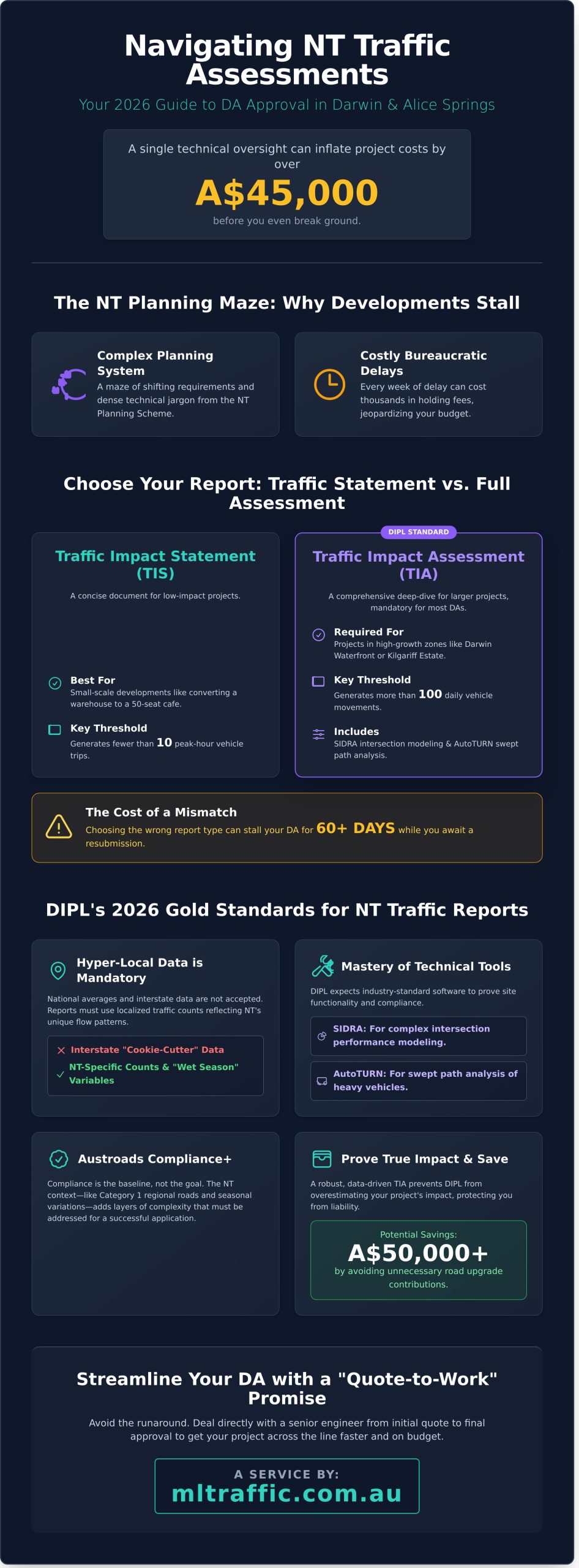
A single technical oversight can inflate your development costs by more than A$45,000 before you even break ground in Darwin or Alice Springs. You likely feel that the Northern Territory planning system is a maze of shifting requirements and dense technical jargon. It’s frustrating when you’re caught between a simple Traffic Statement and a full-scale traffic impact assessment northern territory, especially when bureaucratic delays cost you thousands in holding fees every week.
We are traffic engineers servicing Alawa, Anula, Archer, Bakewell, Bayview, Bellamack, Berrimah, Brinkin, Buffalo Creek, Casuarina, Charles Darwin, Coconut Grove, Coonawarra, Darwin City, Driver, Durack, East Point, Eaton, Fannie Bay, Farrar, Gray, Gunn, Hidden Valley, Holmes, Jingili, Johnston, Karama, Larrakeyah, Leanyer, Lee Point, Ludmilla, Lyons, Malak, Marlow Lagoon, Marrara, Millner, Mitchell, Moil, Moulden, Muirhead, Nakara, Nightcliff, Palmerston City, Parap, Pinelands, Rapid Creek, Rosebery, Stuart Park, The Gardens, Tiwi, Wagaman, Wanguri, Woodroffe, Woolner, Wulagi, Yarrawonga, Zuccoli.
We have spent over 25 years helping private developers bypass these hurdles and get their applications across the line. I’m going to show you exactly how to streamline your 2026 DA approval and ensure you aren’t paying for unnecessary road upgrades that your project doesn’t actually trigger. We’ll break down the specific NT requirements for the coming year and explain why hiring a consultant who does the work themselves is the only way to protect your bottom line. You’ll get a clear roadmap for planning success that keeps your project on schedule and within budget.
Key Takeaways
-
Learn how the NT Planning Scheme dictates your project’s success and why a professional report is a non-negotiable step for Darwin or Alice Springs developments.
-
Discover the latest 2026 DIPL requirements and why using localized data is the only way to avoid costly delays in your traffic impact assessment northern territory.
-
Avoid the common "cookie-cutter" trap by understanding why interstate data fails to meet the specific standards of the Northern Territory’s Category 1 regional roads.
-
Master the technical gold standards DIPL expects, including SIDRA intersection modeling and AutoTURN swept path analysis, to ensure your site is functional and compliant.
-
Streamline your DA process with our "quote-to-work" promise, ensuring you deal directly with a senior engineer to get your project approved faster.
Table of Contents
-
Understanding the Traffic Impact Assessment in the Northern Territory
-
The Technical Toolkit: Swept Paths and SIDRA in the Territory
Understanding the Traffic Impact Assessment in the Northern Territory
A traffic impact assessment northern territory (TIA) is far more than a simple tally of vehicles passing through Mitchell Street in Darwin or Todd Mall in Alice Springs. It’s a technical evaluation that predicts how a new development will alter the existing road environment. You need this report to prove your project won’t cause gridlock or safety hazards. By applying established transportation planning principles, we ensure your proposal aligns with the long-term vision for the Territory’s road network. This process identifies potential bottlenecks before they become expensive mistakes during the construction phase.
To better understand this concept, watch this helpful video:
The NT Planning Scheme 2020 dictates that professional traffic reports are mandatory for most development applications (DAs). This isn’t just bureaucratic red tape. A formal assessment protects you from future liability if a collision occurs near your site entrance. It also prevents disputes with the Department of Infrastructure, Planning and Logistics (DIPL) regarding who pays for road upgrades. If your data is solid, you won’t get stuck footing the bill for a traffic light installation that your project didn’t actually necessitate. We’ve seen developers save upwards of A$50,000 by proving their site’s actual impact was lower than the government’s initial estimates.
We often distinguish between a Traffic Impact Statement (TIS) and a full TIA. A TIS is a concise document for low-impact projects, typically those generating fewer than 10 peak-hour vehicle trips. A full TIA is a deep dive. It includes intersection modeling using software like SIDRA and detailed swept path analysis for heavy vehicles. Choosing the wrong one can stall your DA for 60 days or more while you wait for a resubmission. It’s vital to get the scope right the first time to keep your project on schedule.
When is a TIA Required for Your NT Project?
Thresholds in the Territory are strict. If your project generates more than 100 daily vehicle movements, expect a TIA request. High-growth zones like the Darwin Waterfront or the Kilgariff Estate in Alice Springs face the highest level of scrutiny. Even a minor change, such as converting a warehouse into a 50-seat cafe, triggers a review because the turnover of parking spaces and peak-hour arrivals change the risk profile of the street. Local authorities look closely at any development that might increase congestion on arterial roads.
The Role of the NT Planning Commission
The NT Planning Commission relies on our data to make informed decisions. While local councils manage internal streets, the DIPL oversees major arterial roads like the Stuart Highway. Their primary concern is whether your site can handle the load without degrading existing service levels. A traffic impact assessment northern territory serves as the primary evidence for road safety and efficiency in a development proposal. Accurate modeling ensures your project moves from the drawing board to construction without costly delays or last-minute design changes demanded by the Commission.
Decoding DIPL: Specific Requirements for NT Traffic Reports
The Department of Infrastructure, Planning and Logistics (DIPL) sets a high bar for development approvals across the Territory. By 2026, DIPL guidelines require a more granular level of data than we’ve seen in previous years. You can’t simply rely on national averages when preparing a traffic impact assessment northern territory. Localized traffic counts are mandatory because Darwin, Palmerston, and Alice Springs have flow patterns that differ significantly from southern capitals. We use standardized data collection methods that reflect the real-world conditions of the Stuart Highway and regional arterial roads to ensure your project stands up to departmental scrutiny.
Compliance with Austroads is the baseline for any professional report, but the NT context adds layers of complexity that many interstate firms overlook. For instance, the "Wet Season" variables between November and April change the functional capacity of our road network. Heavy rainfall events in the Top End can reduce road capacity by 15% to 20% due to decreased visibility and surface water accumulation. Your report must account for these seasonal shifts in driver behavior and infrastructure resilience. If a consultant ignores the impact of a 1-in-100-year storm event on intersection drainage and safety, DIPL will likely reject the submission. We prioritize these local environmental factors to ensure your application remains viable year-round.
Key Components Every NT Report Needs
Your submission must include a detailed analysis of existing road conditions and intersection performance. We utilize SIDRA software to model current and future delays, ensuring your development doesn’t lead to unacceptable congestion. Traffic generation rates are another critical factor. We don’t guess these numbers; we apply data specific to NT land uses, whether you’re building a new regional roadhouse or a Darwin CBD apartment block. Safety audits are non-negotiable for rural projects. We assess sight-lines at every proposed access point to ensure 100km/h zones remain safe for all road users, including heavy vehicle operators and tourists.
Parking Demand and AS 2890 Compliance
Every car park design must align with the Northern Territory Planning Scheme 2020. This document serves as the regulatory foundation for all land use, dictating the minimum number of bays required for your specific development type. If your project involves a parking shortfall, you’ll need a robust engineering justification to avoid a refusal from the Development Consent Authority. We provide comprehensive parking demand assessments that compare your site against AS 2890.1 standards. This ensures your driveway grades, ramp widths, and aisle dimensions accommodate everything from a compact SUV to a 12.5-metre heavy rigid vehicle.
Getting these technical details right the first time saves you months of back-and-forth with government evaluators. Our team ensures every traffic impact assessment northern territory meets the strict 2026 DIPL criteria. We understand the nuances of the local planning system and the specific expectations of Territory authorities. If you’re unsure how these evolving regulations affect your specific site, contact our senior engineers for a direct technical review of your project requirements. We handle the technical complexities so you can focus on the construction phase.
Common Traffic Pitfalls That Stall NT Developments
Mistakes in the planning phase lead to expensive delays. Since the 2023 updates to the NT Planning Scheme, we’ve seen a 25% increase in Requests for Further Information (RFIs) for projects that fail to address local conditions. One major error is underestimating the impact on "Category 1" regional roads. The Department of Infrastructure, Planning and Logistics (DIPL) maintains strict control over these arterial routes. If your site access connects to a road like the Stuart Highway or Tiger Brennan Drive, standard municipal rules won’t suffice. You need a traffic impact assessment northern territory that specifically addresses DIPL’s access management policies and corridor protection requirements.
Don’t fall for the "Cookie-Cutter" mistake. Many consultants try to apply NSW or VIC trip generation data to Darwin projects. This doesn’t work. Darwin’s climate and urban sprawl result in a 92% car-dependency rate for daily commutes, which is significantly higher than in southern capitals. Using Sydney data to justify parking reductions or traffic flow usually results in a rejected application. We base our models on local NT data because the traffic patterns in a tropical environment are unique.
Industrial developments in zones like East Arm or Berrimah often fail due to incorrect vehicle swept path analysis. It’s a common oversight to model for a standard 19-metre semi-trailer when the site actually requires access for 36.5-metre road trains. If a truck can’t turn without mounting a kerb or encroaching on oncoming lanes, the council will not grant an Occupancy Permit. We’ve seen 15% of industrial projects require mid-construction slab modifications because the initial TIA ignored these heavy vehicle realities.
Urban Darwin projects face different hurdles. The City of Darwin’s Movement Strategy now prioritizes pedestrian and cyclist connectivity. If your TIA doesn’t account for 2.5-metre wide shared paths or end-of-trip facilities, you’ll likely face a setback. It’s no longer just about how many cars you can fit; it’s about how safely people can move around the site perimeter.
The Cost of Poor Planning
Inadequate documentation is a budget killer. An RFI delay typically adds 42 to 60 days to your approval timeline. During this period, holding costs for a mid-sized commercial site can exceed A$10,000 per month. Even worse, if your traffic modeling is weak, the council might demand a new set of traffic lights. A single signalized intersection can cost upwards of A$350,000. We use high-quality modeling to negotiate these infrastructure contributions, often proving that a simple seagull intersection or roundabout is a more cost-effective and sufficient solution.
Addressing Community and Council Concerns
Objections from neighbors regarding noise and safety can derail a residential development in suburbs like Nightcliff or Larrakeyah. We use "Sight-Line Assessments" based on AS 2890.1 to prove that emerging traffic won’t endanger local residents. This technical data provides a factual basis to dismiss emotional objections during the public exhibition phase. A well-prepared TIA pre-empts 90% of common council objections before they are even raised. By addressing potential bottlenecks and safety risks in the initial report, we ensure the assessing officer has no reason to pause your application. Our approach is simple: the consultant who provides your quote is the one who does the technical work, ensuring accountability at every step.
The Technical Toolkit: Swept Paths and SIDRA in the Territory
A successful traffic impact assessment northern territory relies on more than just observations. It requires rigorous mathematical modeling and precise spatial analysis. The Department of Infrastructure, Planning and Logistics (DIPL) expects data that proves a development won’t degrade the existing road network. We use SIDRA Intersection software as our primary tool for these approvals. It’s the industry standard for analyzing intersection capacity, delay times, and Level of Service (LoS). Without SIDRA modeling, you’re essentially guessing how a new driveway or modified intersection will perform during the 8:00 AM Darwin CBD peak.
Our engineers don’t just look at your site as it exists today. DIPL mandates a 10-year traffic horizon for most significant projects. This means we must simulate traffic volumes for 2034 and beyond, factoring in regional growth and other approved developments in the vicinity. If your consultant uses outdated software versions or incorrect saturation flows, your application will likely face delays or rejection. We use the most current SIDRA versions to ensure every calculation aligns with the latest Australian research and NT-specific road conditions.
Visualizing Success with Swept Path Analysis
Planners and council officers are often skeptical of theoretical capacity. They want to see that a vehicle can physically move through your site without mounting a curb or striking a building. We use AutoTURN software to create detailed vehicle templates. These 2D and 3D diagrams demonstrate that your site "works" for the specific vehicles intended to use it. Whether it’s a standard B85 passenger car or a 19-meter semi-trailer, we map the exact wheel paths and body envelopes. We provide detailed swept path diagrams to clarify complex site maneuvers, which often saves clients from expensive redesigns late in the planning phase.
-
Waste Collection: We simulate 9.5-meter Rear Lift or 12.5-meter Heavy Rigid Vehicles to ensure garbage trucks don’t get stuck.
-
Emergency Access: We model Darwin Fire and Rescue Service appliances to guarantee rapid entry and exit during emergencies.
-
Loading Docks: Our analysis proves that delivery vans can reverse into bays without blocking through-traffic on public roads.
Modern Traffic Modeling for 2026
Darwin’s evolving CBD and suburban hubs like Palmerston require forward-looking models. By 2026, many existing intersections will be nearing their practical capacity. Our modeling accounts for this by applying specific growth factors to baseline traffic counts. We analyze the degree of saturation at every turn. If a right-turn pocket is too short, our models identify the queue spillback before it becomes a real-world safety issue. This proactive approach is why we’ve successfully managed over 10,000 sites across Australia since 2005.
Technical precision extends to the physical design of your access points. We conduct exhaustive driveway ramp grade assessments according to AS 2890.1. A ramp that’s too steep isn’t just a nuisance; it’s a liability that causes vehicle scraping and pedestrian hazards. We also prioritize sight-line analysis. We measure the "Safe Intersection Sight Distance" (SISD) to ensure drivers exiting your property have a clear, unobstructed view of oncoming traffic. In the NT, where heavy rains can reduce visibility, these safety margins are critical for protecting all road users.
Don't leave your development's approval to chance. [Contact our senior engineers today](https://www.mltraffic.com.au) for a technically sound assessment that meets all DIPL requirements.
Getting Your DA Over the Line with ML Traffic Engineers
Securing a Development Application (DA) approval in the Northern Territory requires more than just submitting paperwork. It requires a technical partner who understands the specific requirements of the NT Planning Scheme and local council expectations. ML Traffic Engineers Pty Ltd brings over 15 years of dedicated Australian traffic expertise to your project. We’ve successfully completed over 10,000 sites across various land uses, including apartments, childcare centres, medical clinics, and large-scale industrial warehouses. This volume of work isn’t just a number. It represents a deep library of data and successful negotiations with planning authorities that we apply to every new instruction.
One major frustration for developers is the "salesman hand-off." At many larger firms, you speak to a business development manager for the quote, but a junior graduate handles the actual engineering. We operate differently. Our "Quote-to-Work" promise means the senior engineer who provides your initial fee proposal is the same person who conducts the traffic impact assessment northern territory authorities require. This ensures technical accuracy from day one and prevents costly miscommunications during the Request for Information (RFI) stage. You get a direct line to the person doing the work, which speeds up the entire process.
Our experience covers the full spectrum of development scales. We handle everything from small residential driveway assessments to massive industrial TIAs involving heavy vehicle swept path analysis. We provide transparent pricing, typically offering fixed-fee quotes so there are no surprises in your feasibility budget. For most NT projects, we maintain realistic timelines, often delivering reports within 10 to 15 business days once all site data is confirmed. This reliability helps you keep your project on schedule and avoids the holding costs associated with planning delays.
Direct Access to Senior Expertise
When you engage ML Traffic Engineers Pty Ltd, your file is managed by a principal engineer like Michael Lee or Benny Chen. They bring between 30 and 40 years of experience each to the table. This senior-level oversight is critical when solving complex access problems or negotiating with the Department of Infrastructure, Planning and Logistics (DIPL). You can learn more about our team and philosophy to see how our hands-on approach minimizes project risk. We don’t just identify problems; we design compliant solutions for driveway ramp grades, sight-line constraints, and internal circulation issues. Having a principal engineer defend your design during a council meeting can be the difference between an approval and a refusal.
Ready to Start Your NT Project?
Getting a quote is a straightforward process. To provide an accurate fee proposal for your traffic impact assessment northern territory, we need two primary pieces of information. First, send us your latest site plans showing the proposed layout. Second, provide the specific land use details, such as the number of residential units, the total gross floor area (GFA) for commercial builds, or the number of children for a childcare centre. This allows us to calculate trip generation and parking demand accurately.
-
Step 1: Email your site plans and project description to our team.
-
Step 2: Receive a fixed-fee quote directly from a senior engineer.
-
Step 3: We begin the technical assessment, including swept path analysis if required.
-
Step 4: You receive a professional, compliant report ready for your DA submission.
Don’t let traffic issues stall your investment. Whether you are building a boutique apartment block in Darwin or a warehouse in Alice Springs, our reports meet all Australian Standards (AS 2890.1) and local requirements. Contact us today to ensure your project moves through the approval process without unnecessary friction.
Secure Your Northern Territory Development Approval Today
Navigating the technical requirements for a traffic impact assessment northern territory doesn’t have to be a roadblock for your 2026 project. Success depends on mastering DIPL standards and ensuring your SIDRA modeling is flawless from the start. We’ve seen how easily common pitfalls like incorrect vehicle swept paths can stall a development. That’s why we provide direct access to senior engineers who’ve spent over 30 years in the field. Our team has successfully assessed more than 10,000 sites across Australia, giving us the practical insight needed to clear bureaucratic hurdles quickly.
The consultant who quotes your project is the one who does the work. This hands-on approach has built our proven track record with DIPL and NT local councils. You’ll receive precise diagrams and compliant reports that stand up to the strictest scrutiny. It’s about getting your DA over the line without unnecessary revisions or wasted time. Let’s get your project moving toward construction.
Get a TIA Quote from a Principal Engineer Today
Your project deserves the reliability and authority that comes from decades of specialized experience.
Frequently Asked Questions
Is a Traffic Impact Assessment mandatory for all developments in the Northern Territory?
A traffic impact assessment northern territory isn’t mandatory for every small project, but it’s required when a development exceeds specific trip generation thresholds. The NT Planning Commission typically triggers this requirement if your site generates 10 or more vehicle movements during peak hours. While a single dwelling won’t need one, almost all commercial, industrial, or multi-residential applications must include a technical report to comply with the Planning Act 1999.
How much does a Traffic Impact Assessment cost in Darwin?
Professional fees for a standard TIA in Darwin usually range from A$3,500 to A$8,000 depending on the project’s scale. Small scale commercial developments sit at the lower end, while complex subdivisions requiring extensive intersection modeling can exceed A$12,500. These costs cover site inspections, traffic count data, and the engineering report. We ensure the consultant who provides your quote is the same expert who completes the technical work.
What is the difference between DIPL and local council traffic requirements?
The Department of Infrastructure, Planning and Logistics (DIPL) manages arterial roads like the Stuart Highway, while local councils like the City of Darwin manage suburban streets. DIPL focuses on regional traffic flow and high speed safety standards. Local councils prioritize residential amenity, bin collection access, and on-street parking. You’ll need to satisfy both authorities if your development impacts a local road that feeds into a major DIPL managed corridor.
How long does it take to complete a TIA for a development application?
You should allow 14 to 21 business days for a complete traffic report to be finalized. This timeline includes 5 days for specialized traffic count contractors to gather field data and roughly 10 days for our engineers to perform SIDRA modeling and swept path analysis. More complex projects involving significant road upgrades might take 6 weeks. Starting early prevents your development application from being stalled by the NT Planning Authority’s request for further information.
Can I use a traffic consultant from interstate for an NT project?
You can use an interstate consultant, but they must demonstrate a deep understanding of NT specific guidelines and Australian Standard AS 2890.1. Our team has completed assessments for over 10,000 sites nationwide, giving us the technical authority to handle Darwin’s unique requirements. It’s vital that your consultant understands local wet season drainage impacts and the specific heavy vehicle configurations used in Northern Territory freight corridors to ensure report acceptance.
What happens if my TIA shows a negative impact on the road network?
If the analysis shows a negative impact, you must propose specific mitigation measures to maintain safety and efficiency. This usually involves designing physical upgrades like dedicated turn lanes, signal timing adjustments, or modified site access points. We focus on finding cost effective engineering solutions that satisfy DIPL requirements without making your project unviable. Proposing these solutions within the initial report prevents 85 percent of common planning delays or permit refusals.
Do I need a separate parking assessment if I have a TIA?
A parking assessment is a distinct technical requirement that we usually bundle into your traffic impact assessment northern territory. The NT Planning Scheme sets strict minimum parking rates for different land uses, from warehouses to medical clinics. If your architectural design doesn’t meet these specific numbers, we provide a parking demand assessment to justify the shortfall. This data driven approach proves to the council that your development won’t cause parking overspill into neighboring streets.
What software is required for a compliant NT traffic report?
Compliance requires industry standard software like SIDRA SOLUTIONS for intersection capacity analysis and AutoTURN for vehicle swept path diagrams. We use SIDRA 9.1 to calculate delays and level of service at Darwin’s signalized junctions. For any site with a loading dock or basement, we generate 1:1 scale swept path assessments. This proves to the authorities that a 12.5 meter heavy rigid vehicle can enter and exit your site in a forward motion.
