

A single Request for Information (RFI) from Parramatta Council regarding your traffic report can stall a multi-million dollar development for months. Many developers find the Parramatta Development Control Plan (DCP) 2023 a source of significant friction, particularly when preparing a Traffic Impact Assessment Parramatta Council will find acceptable. You’re likely facing opaque requirements and technical jargon like peak hour distribution or swept path analysis that feel designed to trigger delays rather than facilitate progress.
Securing a compliant report requires more than just ticking boxes. It demands a professional engineering framework aligned with the latest 2026 standards and the City of Parramatta’s specific operational plans. This guide provides a direct path through the complexity, ensuring your parking and access designs meet AS 2890.1 and AS 2890.2 without compromise. We focus on providing the technical certainty needed to secure DA approval on the first submission.
We’ll examine the critical intersection between the Parramatta CBD planning strategy and your project’s traffic generation. Our senior principals break down the technical requirements for vehicle swept path analysis and detail how to structure your TIA report to eliminate RFI risks. This approach ensures your DA moves through the DTSU assessment process with minimal delays and costs.
Key Takeaways
- Identify whether your development requires a full Traffic Impact Assessment Parramatta Council submission or a minor Traffic Impact Statement based on specific 2026 GFA and unit count triggers.
- Master the technical requirements for SIDRA intersection modelling and vehicle swept path analysis mandated by the Parramatta Development Control Plan (DCP) 2023.
- Optimise your site’s car park design and access points to ensure full compliance with Australian Standards AS 2890.1 and AS 2890.2.
- Streamline the DA approval process by following a professional engineering framework that prioritises accurate data collection and direct senior principal oversight.
Understanding Parramatta Council’s Traffic Impact Assessment Requirements
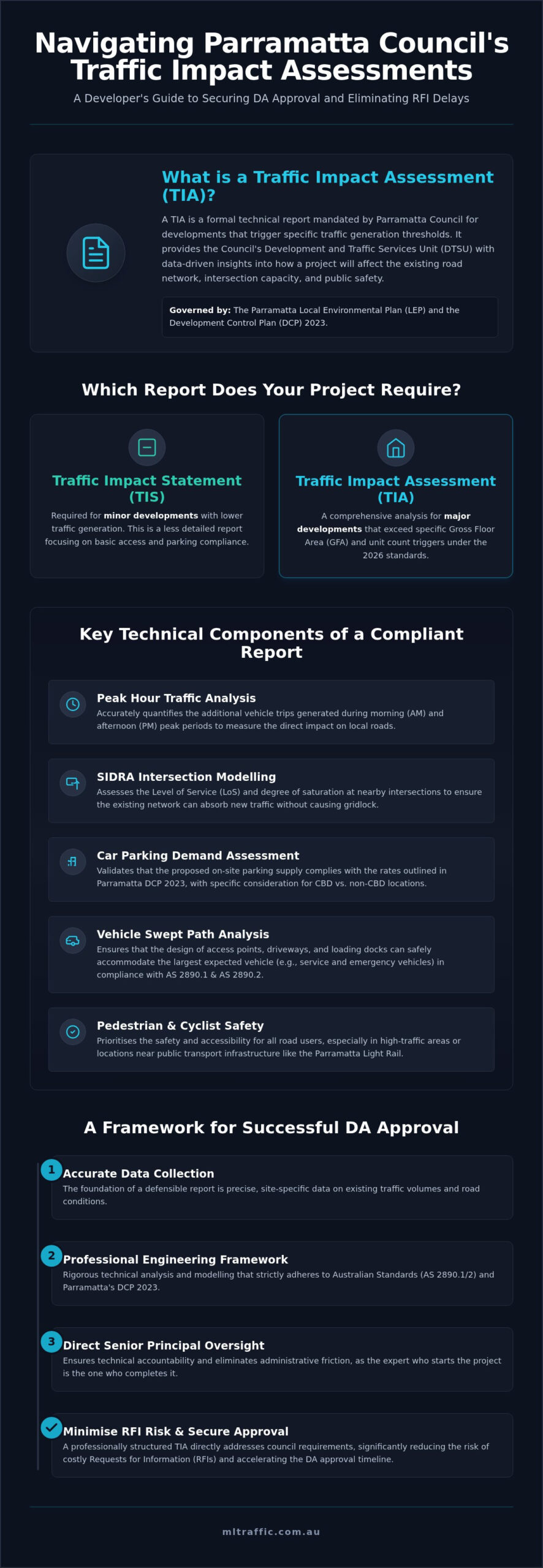
A Traffic Impact Assessment Parramatta Council is a formal technical report mandated for developments that trigger specific traffic generation thresholds within the Local Government Area. This document serves as a critical component of the broader Environmental Impact Assessment (EIA), providing planners with data-driven insights into how a project affects the existing road network. Unlike general civil reports, a TIA focuses exclusively on vehicle volumes, intersection capacity, and pedestrian safety. It’s a mandatory consideration for the council’s Development and Traffic Services Unit (DTSU) when evaluating the viability of a new project.
The Parramatta Local Environmental Plan (LEP) and the Development Control Plan (DCP) 2023 establish the statutory requirements for these assessments. These controls ensure that new developments contribute to the city’s growth without compromising the efficiency of the regional transport network. ML Traffic Engineers Australia operates under a “no-gatekeeper” model, providing developers with direct access to the senior principals performing the technical modelling. This approach eliminates the administrative friction often found in larger firms and ensures technical accountability from the outset.
To better understand this concept, watch this helpful video:
The Purpose of a TIA in the Parramatta LGA
Within the high-density environment of the Parramatta LGA, the primary objective of a traffic report is to maintain the Level of Service (LoS) at critical intersections. Assessments must quantify additional vehicle trips during peak morning and afternoon periods, particularly for sites near major conduits like Church Street or Victoria Road. Beyond vehicle flow, the report must validate that proposed on-site parking and loading facilities adhere to Australian Standards. This includes ensuring that pedestrian and cyclist safety is prioritised, especially in areas adjacent to the Parramatta Light Rail alignment. Failure to address these local nuances often results in immediate RFI delays.
Who Can Prepare Your Parramatta Traffic Report?
Parramatta Council mandates that traffic reports be prepared by qualified traffic engineers with a proven history of navigating NSW planning regulations. Generic or “off-the-shelf” reports typically fail to address the site-specific constraints required by the Council’s DTSU planners. ML Traffic Engineers Australia provides over 15 years of specialised consultancy experience, ensuring that every assessment is both compliant and defensible. Senior principal involvement is a non-negotiable standard for our firm, meaning the expert who initiates the project is the same one who completes the technical SIDRA modelling and swept path analysis. This personnel continuity is essential for complex urban developments where meticulous detail determines the speed of DA approval.
Key Technical Components of a Compliant Traffic Report
A Traffic Impact Assessment Parramatta Council for a 2026 DA submission must include rigorous data points to satisfy the Council’s Development and Traffic Services Unit (DTSU). This includes the accurate quantification of additional vehicle trips during morning and afternoon peak periods. For developments of significant scale or those located near sensitive infrastructure like the Parramatta Light Rail, SIDRA intersection modelling is essential. This software assesses the Level of Service (LoS) and degree of saturation at local intersections. It ensures the existing network can absorb the new traffic load without causing gridlock.
A Car Parking Demand Assessment is equally critical, especially when a project seeks to depart from the standard rates outlined in the Parramatta DCP 2023. Council planners differentiate strictly between CBD and non-CBD parking requirements. Developments within the CBD often face maximum parking caps to encourage public transport use. Suburban projects must meet minimum supply thresholds. Justifying these departures requires a fact-based analysis of local parking surveys and proximity to high-frequency transit. Compliance is non-negotiable.
Vehicle Access and Swept Path Analysis
Council planners prioritise safe and efficient site access. We utilise specialised AutoTURN software to conduct a Swept Path Analysis, which simulates the physical footprint of vehicles as they manoeuvre through the site. This is vital for B99 cars and heavy rigid vehicles (HRVs). Parramatta Council typically mandates that all vehicles, especially waste collection trucks, enter and exit the property in a forward direction. Our assessments also verify that sight distances at proposed driveways meet the safety standards defined in the DCP to protect pedestrians and cyclists.
Parking Design and AS 2890 Compliance
Every car park layout must adhere to AS 2890.1 for user-class parking and AS 2890.2 for commercial loading facilities. A Driveway Ramp Grade Assessment is necessary to ensure that ramp transitions do not cause vehicle scraping. This is a common point of failure in dense urban designs. We also calculate the specific requirements for disabled parking spaces and bicycle facilities as per the 2026 council budget and operational plan. If you are unsure about your site’s specific constraints, our senior principals can provide a preliminary review of your site layout to identify potential compliance issues early.
TIA vs. TIS: Determining Your Parramatta DA Requirements
Determining whether your project requires a full Traffic Impact Assessment Parramatta Council submission or a simplified Traffic Impact Statement (TIS) depends on the scale, land use, and location of the proposal. A TIS is generally acceptable for minor developments, such as small-scale dual occupancies or minor retail fit-outs, where traffic generation is negligible. In contrast, a TIA is a comprehensive technical report required for major developments that significantly alter vehicle flow or parking demand. Council planners use these reports to ensure the local road network remains functional as density increases.
Developers should use the following checklist to assess their reporting requirements:
- Does the development generate more than 50 vehicle trips during any peak hour?
- Is the site located within the Parramatta CBD or near the Parramatta Light Rail alignment?
- Does the proposal involve a high-turnover use such as a childcare centre, service station, or supermarket?
- Are you proposing a departure from the parking rates specified in the Parramatta DCP 2023?
- Is the development situated on or near a classified road managed by Transport for NSW (TfNSW)?
Parramatta CBD Planning Strategy Impacts
Developments within the Parramatta CBD face unique constraints compared to suburban sites in the LGA. The Parramatta City Centre Integrated Transport Plan prioritises a shift away from private vehicle reliance. Council often implements maximum parking rates in high-density zones to limit traffic congestion. For major commercial developments in the CBD, planners frequently mandate a Green Travel Plan. This document must outline strategies to encourage walking, cycling, and public transport use. Proximity to the Parramatta Light Rail also changes traffic generation calculations, as planners expect a higher percentage of mode shift towards rail services.
Triggers for Major Developments
A full Traffic Impact Assessment Parramatta Council report is non-negotiable for projects exceeding specific trip-per-hour thresholds. While the exact figure varies based on the road’s current Level of Service, 50 peak hour trips is the standard trigger for detailed modelling. Projects involving modifications to existing road infrastructure, such as new traffic signals or median breaks, also require a TIA. High-turnover land uses are under intense scrutiny. For example, a 110-child capacity childcare centre in Northmead recently required a minimum of 28 parking spaces based on an average parent stay of 6.8 minutes. Our senior principals ensure these calculations are grounded in empirical data rather than generic averages, reducing the risk of council refusal.
Navigating the Traffic Engineering Approval Process
The approval process for a Traffic Impact Assessment Parramatta Council requires a methodical engineering approach to withstand rigorous council scrutiny. Our framework consists of five distinct phases designed to eliminate technical errors and prevent delays. We follow a structured workflow that ensures every report is defensible during the formal assessment by the Development and Traffic Services Unit (DTSU):
- Step 1: Initial site assessment and review of Parramatta Council’s specific DCP requirements.
- Step 2: Data collection, including peak hour traffic counts and existing parking surveys.
- Step 3: Technical analysis using AutoTURN and SIDRA to model impacts.
- Step 4: Report compilation and internal peer review by senior principals.
- Step 5: Council submission and responding to post-lodgement RFIs.
Collaborating with Other Consultants
Effective traffic engineering requires seamless integration with the broader project team. We work closely with architects to optimise car park layouts and driveway ramp grades before the building footprint is finalised. This proactive collaboration prevents costly redesigns after the DA is lodged. Our technical findings are integrated into the Statement of Environmental Effects (SEE) to ensure consistency across all planning documentation. We also coordinate with town planners to verify that all Parramatta LEP clauses regarding transport, access, and sustainable travel are fully addressed.
Handling Council Objections and RFIs
The City of Parramatta Council frequently issues a Request for Information (RFI) when reports lack specific data or fail to address local site constraints like the Parramatta Light Rail alignment. Common triggers include inadequate swept path clearances for waste vehicles or non-compliant driveway sight distances. Having a senior engineer negotiate directly with council traffic planners is invaluable during this phase. For example, we recently resolved a complex “forward-in, forward-out” access objection by redesigning the internal circulation using AutoTURN simulations. This satisfied council safety requirements while maintaining the developer’s required parking yield. You can explore our full range of traffic engineering services to see how we handle these technical negotiations.
If your project has received a council objection or an RFI, you should contact our senior principals for a direct technical review of your current assessment.
Expert Traffic Consultancy for Parramatta and National Developments
ML Traffic Engineers Australia brings 15 years of expert consultancy experience to the 2026 development landscape. Securing a Traffic Impact Assessment Parramatta Council planners will approve requires more than just technical modelling; it demands a deep understanding of local infrastructure constraints. Our firm operates with a national perspective, ensuring every report adheres to the latest Australian Standards while respecting the unique transport objectives of the Parramatta LGA. We provide the technical certainty needed to navigate council scrutiny without the frustration of unnecessary gatekeepers. Technical excellence is non-negotiable.
Why ML Traffic Engineers Australia is the Preferred Choice
Our firm is the preferred choice for developers who require meticulous attention to detail in Traffic Engineering and car park design. We maintain a proven track record across residential, commercial, and industrial sectors, delivering results-oriented solutions that often reduce overall construction costs. The core of our service is the “direct access” model. Unlike larger, impersonal firms, we guarantee that a senior principal will perform all technical work, including the SIDRA modelling and swept path simulations. This personnel continuity promise ensures that the engineer who starts your project finishes it. This provides a level of accountability and technical depth that generalist firms cannot match.
Get Started with Your Parramatta Traffic Report
Requesting a formal fee proposal for your Parramatta project is a straightforward process. To provide an accurate quote and scope of work, our senior principals require a specific set of preliminary documents. Please have the following information ready for our review:
- The exact site address and lot description within the Parramatta LGA.
- A detailed summary of the proposed land use, including unit counts or GFA.
- Current architectural drafts, specifically basement layouts and site access plans.
- Any existing correspondence or RFIs from the Parramatta Council DTSU.
We will review these details to determine if your project triggers a full Traffic Impact Assessment Parramatta Council submission or a minor Traffic Impact Statement. Our team focuses on providing professional, reliable advice that secures your DA approval while minimising bureaucratic delays. You can contact our senior principals directly to discuss your site’s specific constraints and receive a comprehensive fee proposal tailored to your development goals.
Achieving Certainty in the Parramatta DA Process
Achieving a successful outcome in the Parramatta LGA requires more than just meeting minimum standards; it demands a strategic alignment with the city’s long-term transport vision. A high-quality report serves as a defensive asset, insulating your project from the logistical delays and financial costs associated with planning objections. By prioritising technical accuracy in the early stages, you create a clear pathway toward construction and eventual occupancy. This proactive approach ensures that your site’s vehicle access and parking yields remain compliant throughout the assessment lifecycle.
Every Traffic Impact Assessment Parramatta Council report we produce is engineered to satisfy the rigorous demands of the DTSU while protecting your project’s commercial viability. We focus on delivering precise data that stands up to the scrutiny of both local and state-level planning authorities. Secure your Parramatta DA approval with an expert Traffic Impact Assessment—Contact ML Traffic Engineers Australia today.
We look forward to providing the technical certainty your next development requires.
Frequently Asked Questions
How much does a Traffic Impact Assessment for Parramatta Council cost?
Fees for a Traffic Impact Assessment Parramatta Council are determined by the project’s technical complexity and the required scope of work. Factors influencing the fee include the necessity for intersection modelling, the number of vehicle swept path simulations, and whether new traffic surveys are required. Since every development site has unique constraints, we provide tailored fee proposals after reviewing your architectural drafts and council requirements to ensure an accurate scope.
When is a full TIA required instead of a basic Traffic Impact Statement?
A full TIA is mandatory for developments that exceed 50 peak hour vehicle trips or involve significant changes to the road network. Basic Traffic Impact Statements are typically sufficient for minor residential projects like dual occupancies. However, any development in the Parramatta CBD or near the light rail alignment often triggers stricter reporting requirements regardless of size. Our senior principals can review your project’s GFA and location to confirm the appropriate reporting level.
Does Parramatta Council require swept path analysis for small residential developments?
Yes, Parramatta Council frequently mandates swept path analysis for small residential projects to ensure safe vehicle movements. Planners specifically look for evidence that a B99 vehicle can enter and exit the property in a forward direction. If your site includes a basement or a narrow driveway, simulations using AutoTURN software are essential to prove compliance with AS 2890.1. This analysis prevents RFI delays related to non-compliant access designs.
What are the current parking rates for the Parramatta CBD?
Parking rates in the Parramatta CBD are governed by maximum caps rather than minimum requirements. The Parramatta DCP 2023 Part 6 outlines these specific rates to encourage the use of public transport and the Parramatta Light Rail. Rates vary based on land use, such as residential units versus commercial office space. Our car parking demand assessments help developers justify their parking provision while navigating these complex city centre density controls.
How long does it take to prepare a compliant traffic report?
Preparing a compliant Traffic Impact Assessment Parramatta Council report typically takes between two and four weeks. This timeframe accounts for site inspections, traffic data collection, and the technical modelling phase. Projects requiring SIDRA intersection analysis or extensive car parking surveys may take longer. We prioritise personnel continuity, ensuring the senior engineer who initiates the project performs the modelling work. This streamlined process helps minimise project delays and ensures a high-quality submission.
What happens if Parramatta Council objects to my proposed driveway access?
If council objects to your driveway access, you will likely receive a formal Request for Information (RFI). This situation requires a technical response that addresses safety concerns or non-compliance with AS 2890.1. We resolve these objections by performing a detailed driveway ramp grade assessment or modifying the access design using swept path analysis. Direct negotiation between our senior principals and council traffic planners often facilitates a workable solution that satisfies safety requirements.
Can I use a general civil engineer for my traffic report, or do I need a specialist?
While general civil engineers have broad infrastructure knowledge, Parramatta Council planners prefer reports authored by specialist traffic engineers. Specialists possess deep expertise in SIDRA modelling and the specific nuances of the Parramatta DCP. A specialist traffic consultant ensures your report is defensible and compliant with national regulatory standards. This focused expertise reduces the risk of council refusal and ensures that the expert performing the technical work understands the local traffic environment.
Do I need a separate Traffic Management Plan for the construction phase?
Yes, a Construction Traffic Management Plan (CTMP) is a separate requirement that focuses on the safety of the public and workers during the build. While a TIA assesses the long-term impact of the completed development, the CTMP details truck routes, pedestrian safety, and traffic control measures during construction. Parramatta Council often makes the approval of a CTMP a condition of development consent, particularly for sites near classified roads or light rail corridors.

Disclaimer
The content on www.mltraffic.com.au, including all technical articles, guides, and resources, is provided for general informational and educational purposes only. It is not intended to constitute professional advice in traffic engineering, transportation planning, development approvals, or any other technical or legal field.
While ML Traffic Engineers makes every reasonable effort to ensure the accuracy, completeness, and timeliness of the information published, we do not provide any warranties or representations (express or implied) regarding its reliability, suitability, or availability for any particular purpose. Any reliance you place on the content is strictly at your own risk.
In no event shall ML Traffic Engineers, its directors, employees, authors, or affiliates be liable for any direct, indirect, incidental, special, consequential, or punitive damages (including, without limitation, loss of profits, data, or business opportunities) arising out of or in connection with the use of, or inability to use, any information provided on this website.
The articles and guides on this site are not a substitute for engaging a qualified, registered professional traffic engineer (such as an NPER or RPEQ engineer) to assess your specific project requirements. For tailored advice, compliance assessments, or traffic engineering services, please contact a competent professional.
This disclaimer may be updated from time to time without notice. By accessing or using this website, you agree to be bound by the most current version of this disclaimer.
