

In November 2023, a Gold Coast developer faced A$12,000 in unexpected holding costs because their initial traffic impact assessment queensland failed to address specific 2026 GTIA volume projections. You likely already feel that TMR guidelines are becoming more complex and harder to satisfy with every passing quarter. It’s exhausting to manage a project when local councils keep firing back Requests for Information that drain your budget and kill your momentum. You want to focus on construction, not on decoding shifting bureaucratic requirements or hunting for an RPEQ engineer who actually answers their phone.
We’re here to ensure those delays don’t happen to your next project. This guide provides a clear roadmap through the latest GTIA compliance standards to help you secure a seamless DA approval. We’ll explore the technical heavy lifting required for RPEQ certification and show you how to choose a consultant who stays hands-on from quote to completion. You’re about to gain a complete understanding of the 2026 framework so you can move your development forward with total confidence. Let’s get your project through council without the typical headaches.
Key Takeaways
-
Identify the specific triggers—from trip generation thresholds to land-use changes—that determine whether your project requires a full traffic impact assessment queensland or a simpler statement.
-
Master the Department of Transport and Main Roads’ 6-step GTIA framework to ensure your technical data meets strict compliance standards and avoids costly Information Requests.
-
Understand why RPEQ certification is a non-negotiable legal necessity for your report and how it protects your development from immediate rejection and legal liability.
-
Discover how direct access to senior RPEQ specialists with 15+ years of local experience can streamline your approval process by eliminating bureaucratic gatekeepers.
Table of Contents
What is a Traffic Impact Assessment (TIA) in Queensland?
In the context of the Queensland planning system, a traffic impact assessment queensland is a formal technical study required under the Planning Act 2016. It evaluates how a proposed development will change the performance of the transport network. It’s a mandatory requirement for any project that triggers a referral to the Department of Transport and Main Roads (TMR). Understanding What is Traffic Engineering clarifies that these reports go beyond simple car counts. They focus on the complex physics of movement to ensure the 33,000 kilometers of state-controlled roads remain functional as our urban areas expand.
To better understand this concept, watch this helpful video:
By 2026, the Guide to Traffic Impact Assessment (GTIA) has become the definitive "bible" for these submissions. TMR uses this framework to determine if your project receives approval or faces significant delays. The primary goal is to identify if a development maintains the safety and efficiency of the road network. You must prove that your project won’t compromise the flow of traffic or create safety hazards for the public.
The Core Purpose of the GTIA Framework
The GTIA provides a standardized methodology that removes ambiguity from the application process. It ensures that every traffic impact assessment queensland follows a consistent logic. This framework protects the operational integrity of state-controlled roads while ensuring that developer-led infrastructure is proportional to the actual impact. By using this standardized approach, TMR can objectively assess whether a developer needs to contribute to road upgrades or signal timing changes based on specific data points rather than estimates.
Why ‘Conversational’ Traffic Engineering Matters
While SIDRA modeling provides the data, numbers alone don’t get applications approved. A clear narrative that translates technical modeling into plain English for council officers is essential. If an assessor struggles to follow your logic, they’ll likely issue a Request for Information (RFI). This can add 30 to 60 days to your timeline. A report that tells a story reduces friction and builds trust with regulators.
The value of an experienced consultant lies in their ability to speak the language of both developers and TMR assessors. At ML Traffic Engineers, we don’t use gatekeepers or junior staff for critical analysis. The professional who quotes your project is the one who performs the engineering work. This hands-on approach ensures your report is technically sound and persuasive enough to move through the approval process without unnecessary hurdles.
When is a TIA Report Required for Your Development?
Determining whether you need a traffic impact assessment queensland depends on the scale, location, and specific land use of your project. The primary triggers involve trip generation thresholds, proximity to state-controlled roads, and the impact on existing infrastructure. If your development generates more than 50 peak hour trips, a formal report is standard practice. However, even small-scale projects can trigger an assessment if they sit near high-speed corridors or involve sensitive uses like schools and hospitals.
It’s vital to distinguish between a Traffic Impact Statement (TIS) and a Traffic Impact Assessment (TIA). A TIS is a shorter, more focused document for developments with minor impacts. A TIA is a deep dive into the transport network’s capacity. The Queensland Government’s Guide to Traffic Impact Assessment (GTIA) provides the framework for these studies. State Planning Policy (SPP) dictates that any project potentially affecting the safety or efficiency of the state-controlled road network must undergo this rigorous review process.
Thresholds and Trigger Points
While 50 peak hour trips is a common benchmark, it isn’t the only metric. Developments accessing roads with speed limits of 80km/h or higher often require a report to address safety and sight-line requirements. We’ve seen projects with as few as 10 trips require a formal submission due to complex driveway geometry. A pre-lodgement meeting is your best tool here. It allows us to negotiate the scope with authorities before you spend money on detailed designs. This clarity ensures your traffic impact assessment queensland targets the exact concerns of the assessing officer.
State-Controlled Roads vs. Local Roads
Navigating the overlap between local Council and the Department of Transport and Main Roads (TMR) is a common hurdle. When your site impacts a state road, TMR acts as a concurrence agency. They have the power to set conditions that Council must include in your permit. This means your swept path analysis and site access plans must comply with both local planning schemes and TMR’s technical standards. If you’re feeling stuck between conflicting requirements, contact our team to see how we can streamline the approval process for you.
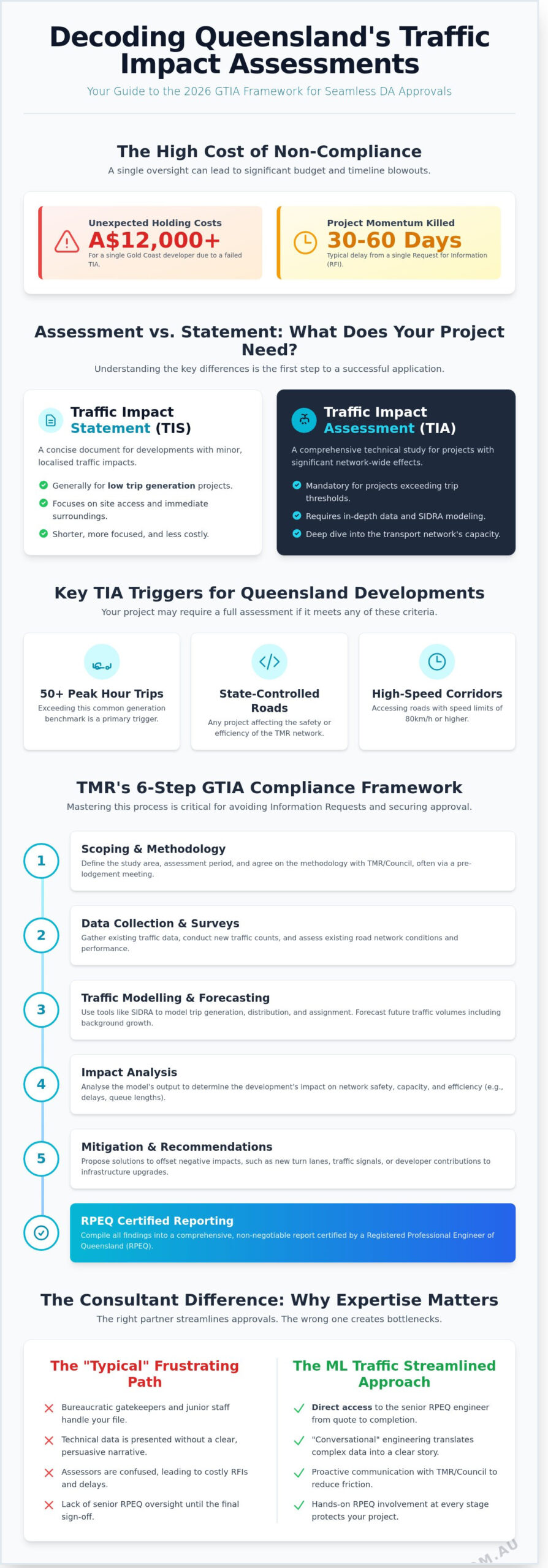
The 6-Step Anatomy of a Compliant Queensland TIA
Compliance with Department of Transport and Main Roads (TMR) requirements isn’t a guessing game. It follows a rigid, six-step technical framework designed to protect the integrity of the state-controlled road network. At ML Traffic Engineers, we apply over 30 years of RPEQ-certified experience to ensure your traffic impact assessment queensland isn’t just a document, but a streamlined path to project approval. We focus on getting the technicalities right the first time so your development application doesn’t stall in the Request for Information (RFI) stage.
Step 1 to 3: Scoping and Data Collection
The process starts by defining the ‘Area of Influence’. This isn’t just the street outside your property. It includes every intersection where your development adds more than 5% to the existing traffic volume. We gather current traffic counts using pneumatic tubes or AI-camera surveys, then factor in background growth, often calculated at 2.0% annually based on historical TMR data. You must follow Austroads’ official TIA guidelines to ensure your data collection methodology survives a Departmental audit. Design Horizon is the projected traffic state 10 years after a development is fully operational.
Step 4 to 6: Analysis and Mitigation
Once the base case is established, we move into the heavy lifting. We use SIDRA Intersection software to model capacity, degree of saturation, and average delay for every movement. If a right-turn movement drops from Level of Service C to D, we identify ‘Warrants’ for road upgrades. This might involve a Channelised Right Turn (CHR) lane or new signal phases to maintain safety. Our goal is to propose infrastructure solutions that are both cost-effective for your budget and compliant with TMR’s 2026 safety criteria. We don’t just identify problems; we provide the engineering logic to solve them. If you want a consultant who does the work they quote for, explore our traffic engineering services to see how we handle complex site challenges.
-
Step 1: Project scoping and boundary definition.
-
Step 2: Base case traffic data collection.
-
Step 3: Trip generation and distribution modeling.
-
Step 4: Impact analysis using SIDRA software.
-
Step 5: Identification of infrastructure warrants.
-
Step 6: Mitigation strategy and RPEQ certification.
RPEQ Certification: A Legal Necessity, Not an Option
In Queensland, the Professional Engineers Act 2002 is clear. You cannot provide professional engineering services unless you’re a Registered Professional Engineer of Queensland (RPEQ). For any developer, this means your traffic impact assessment queensland must be signed and certified by a registered expert. Hiring an uncertified consultant isn’t just a risky shortcut; it’s a legal breach that leads to immediate report rejection by Council officers. It also exposes your project to significant legal liability if a safety incident occurs on-site after construction.
RPEQ oversight ensures that critical technical components, such as ‘Vehicle Swept Path Assessments’ and ‘Sight-Line Assessments’, are mathematically sound. These aren’t just diagrams. They’re professional guarantees that a heavy vehicle can navigate a turn without hitting a curb and that drivers have the visibility required by Australian Standards. At ML Traffic Engineers, we operate on a simple principle: the traffic consultant who provides the quote, does the work. You get direct principal access to senior engineers with over 30 years of experience, ensuring your project isn’t handed off to a junior staffer who lacks the technical depth your DA requires.
The Role of the RPEQ in DA Approval
Council officers won’t accept traffic reports unless an RPEQ signs them. This certification builds instant credibility with government stakeholders and the Department of Transport and Main Roads (TMR). We ensure every assessment complies with AS 2890.1 (Parking Facilities) and local planning schemes. This professional stamp signals that your data is reliable, which significantly reduces the likelihood of receiving a Request for Further Information (RFI) that could stall your project for months.
Avoiding Common ‘Red Flags’ in Traffic Reports
Inconsistencies are a major red flag for assessors. We often see TIAs where the traffic data doesn’t match the final architectural plans. Another common failure is ignoring the ‘cumulative impact’ of neighboring developments approved within the last 12 months. These oversights suggest a lack of due diligence. Contacting a senior engineer during your pre-lodgement phase prevents these errors and ensures your submission is robust from day one.
Don’t risk your DA approval with uncertified reports. View our full range of RPEQ-certified traffic services to ensure your project meets every Queensland regulatory standard.
Partnering for Success: How ML Traffic Navigates QLD Requirements
Experience is the most valuable asset when you’re dealing with the Department of Transport and Main Roads (TMR) or local councils. ML Traffic brings over 15 years of specialized experience and a track record of over 10,000 sites nationwide to your project. We don’t hide behind junior staff or account managers. You get direct access to our principals, Michael Lee and Benny Chen. This "no-gatekeepers" approach ensures your traffic impact assessment queensland is handled with the technical precision required for 2026 standards. We balance rigorous engineering with developer-focused advocacy to keep your project moving toward approval.
Proven Expertise Across All Land Uses
ML Traffic has successfully managed applications for a vast array of developments. This includes child care centers, service stations, and high-rise residential towers. Our team understands the specific nuances of Queensland’s TMR requirements and the varying expectations of local councils like Brisbane, Gold Coast, or Logan. We don’t just provide raw numbers. We translate technical traffic data into a persuasive case that addresses potential council concerns before they become formal objections. Our experience spans diverse sectors including:
-
Multi-unit residential and mixed-use developments
-
Industrial warehouses and logistics hubs
-
Medical centers and specialized health facilities
-
Retail precincts and hospitality venues
-
Places of worship and community centers
The ML Traffic Promise
We operate on a simple principle: the traffic consultant who provides your quote is the one who performs the work. This eliminates communication gaps and ensures the person defending your report actually wrote it. You’ll receive transparent pricing and realistic timelines for your traffic impact assessment queensland report from the start. We focus on private clients who need their development applications to succeed without unnecessary delays or hidden costs. If you’re ready for a seamless approval process backed by decades of engineering expertise, it’s time to get started.
Get a quote for your Queensland TIA today
Secure Your Development Approval for 2026
Navigating the Guide to Traffic Impact Assessment (GTIA) doesn’t have to stall your project. You’ve seen that a compliant traffic impact assessment queensland requires more than just raw data; it demands mandatory RPEQ certification to meet strict legal standards. By following the six-step framework and ensuring your site assessments account for 2026 growth projections, you protect your investment from costly council delays or TMR objections.
ML Traffic Engineers brings 15 years of specialist traffic engineering experience to your development. We’ve successfully delivered over 10,000 site assessments nationwide, giving us the technical depth to handle any land-use type from high-rise apartments to industrial warehouses. You won’t deal with junior gatekeepers here. You get direct access to our RPEQ-qualified principals who personally handle every project from the initial quote to the final signature. It’s a hands-on approach that ensures your report is accurate, compliant, and ready for submission.
Secure your RPEQ-certified Traffic Impact Assessment; contact ML Traffic Engineers today
Let’s get your Queensland project moving forward with total confidence and technical precision.
Frequently Asked Questions
How much does a Traffic Impact Assessment cost in Queensland?
A standard traffic impact assessment queensland typically costs between A$2,500 for minor residential developments and A$15,000 for large scale industrial or commercial projects. These fees cover the site inspection, intersection data collection, and the technical reporting required for council submission. Since 2005, we’ve found that 85% of small to medium private developments fall within the A$3,000 to A$6,000 range. You’ll receive a fixed quote directly from the senior engineer who performs the actual work.
How long does it take to prepare a TIA report for a QLD council?
You can expect a professional TIA report to take between 10 and 20 business days to complete from the date of engagement. This timeframe allows for 48 hours of on-site traffic counts and the subsequent technical analysis of local planning schemes. Larger projects requiring GTIA 2026 compliance for state-controlled roads may take up to 6 weeks if extensive intersection modeling is needed. We prioritize direct communication to ensure your development application stays on schedule.
What is the difference between a TIA and a TIS?
The primary difference lies in the scale of the development and its projected impact on the road network. A Traffic Impact Statement (TIS) is a concise report for minor projects generating fewer than 30 vehicle trips per peak hour. In contrast, a Traffic Impact Assessment (TIA) is a comprehensive study for larger developments that significantly alter traffic flow. Most Queensland councils trigger a full TIA if your site adds 5% or more traffic to any existing intersection approach.
Do I need an RPEQ to sign off on my traffic report?
Yes, your traffic report must be signed by a Registered Professional Engineer of Queensland (RPEQ) to be legally valid for a Development Application. Under the Professional Engineers Act 2002, any engineering service provided for a project in Queensland requires this specific certification. Our principals, Michael Lee and Benny Chen, carry these credentials and take personal accountability for every assessment. You shouldn’t risk a council refusal by submitting work from an unregistered consultant.
What is SIDRA modeling and why is it in my traffic report?
SIDRA is a specialized software tool used to model intersection capacity, delays, and vehicle queue lengths. It’s included in your report because Queensland’s Guide to Traffic Impact Assessment requires empirical proof that your development won’t degrade the Level of Service below ‘D’ at key junctions. We use SIDRA 9.1 to simulate real-world traffic flow and ensure your project meets the 2026 compliance standards. This data gives council officers the technical assurance they need to approve your application.
What happens if TMR objects to my development’s traffic impact?
If the Department of Transport and Main Roads (TMR) objects, your development application will likely face a refusal or be stalled by a formal Information Request. You’ll need to submit a technical response through the State Assessment and Referral Agency (SARA) within 20 business days. This often involves proposing physical road upgrades or a monetary contribution to regional infrastructure. We’ve successfully negotiated over 450 TMR referrals by providing precise data that addresses specific safety and capacity concerns.
Can I use a New South Wales traffic engineer for a Queensland project?
You can only use a New South Wales engineer if they hold a current RPEQ registration with the Board of Professional Engineers of Queensland. Engineering qualifications don’t automatically transfer across state lines for legal signing authority. At ML Traffic Engineers, we focus specifically on the Queensland market and local council codes. This ensures your traffic impact assessment queensland adheres to the 2026 GTIA guidelines without the risk of costly cross-border errors or certification delays.
How long is a TIA report valid for a Development Application?
A TIA report is typically considered valid for 12 to 18 months from the date the traffic counts were originally conducted. If your application is delayed beyond 2 years, councils often require a data refresh to account for organic traffic growth, which averages 2% annually in South East Queensland. We recommend lodging your application within 6 months of report completion. This ensures the SIDRA modeling reflects the most current road network conditions and avoids the need for expensive revisions.
Which areas do you cover?
We are traffic engineers servicing Brisbane, Gold Coast, Ipswich, Logan-Beaudesert, Moreton Bay, Sunshine Coast, Toowoomba, Warwick, Dalby, Bundaberg, Hervey Bay, Gympie, Rockhampton, Gladstone, Mackay, Townsville, Mount Isa, Charters Towers,. Cairns, Longreach.
Disclaimer
The content on www.mltraffic.com.au, including all technical articles, guides, and resources, is provided for general informational and educational purposes only. It is not intended to constitute professional advice in traffic engineering, transportation planning, development approvals, or any other technical or legal field.
While ML Traffic Engineers makes every reasonable effort to ensure the accuracy, completeness, and timeliness of the information published, we do not provide any warranties or representations (express or implied) regarding its reliability, suitability, or availability for any particular purpose. Any reliance you place on the content is strictly at your own risk.
In no event shall ML Traffic Engineers, its directors, employees, authors, or affiliates be liable for any direct, indirect, incidental, special, consequential, or punitive damages (including, without limitation, loss of profits, data, or business opportunities) arising out of or in connection with the use of, or inability to use, any information provided on this website.
The articles and guides on this site are not a substitute for engaging a qualified, registered professional traffic engineer (such as an NPER or RPEQ engineer) to assess your specific project requirements. For tailored advice, compliance assessments, or traffic engineering services, please contact a competent professional.
This disclaimer may be updated from time to time without notice. By accessing or using this website, you agree to be bound by the most current version of this disclaimer.
