

A traffic impact assessment in South Australia is a strategic risk mitigation tool, not just another bureaucratic checkbox for PlanSA. You’ve likely experienced the frustration of development applications stalling due to technical non-compliance or confusion between local council and Department for Infrastructure and Transport (DIT) jurisdictions. With the release of the Planning and Design Code version 2026.14 and updated DIT Master Specifications, the margin for error in traffic reporting has narrowed significantly. It’s common to feel overwhelmed by the technicalities of AS 2890 compliance and shifting trip generation rates that vary across different land use categories.
This guide provides the technical clarity needed to master South Australian requirements, ensuring your development application meets every regulatory standard for a smooth approval. We leverage over 15 years of experience to help you navigate TIA thresholds and specialised SIDRA modelling standards. You’ll learn how to mitigate the risk of unexpected intersection upgrade costs and produce a compliant report that moves through council without delay. From car park design to vehicle swept path analysis, we’ll show you how to secure your project’s success through meticulous technical documentation and direct access to senior engineering expertise.
Key Takeaways
- Identify specific development triggers within the Planning and Design Code overlays to determine when a formal assessment is mandatory for your project.
- Ensure your traffic impact assessment south australia adheres to the latest DIT Master Specifications and Australian Standards to facilitate a streamlined council approval process.
- Master the core components of a compliant report, including accurate traffic generation modelling and distribution analysis based on verified 2026 guidelines.
- Mitigate project risks by identifying physical site constraints and potential intersection upgrade requirements early in the design phase.
- Understand how direct senior-level involvement and expert technical oversight reduce the likelihood of Request for Further Information (RFI) delays.
Understanding Traffic Impact Assessments within the South Australian Planning System
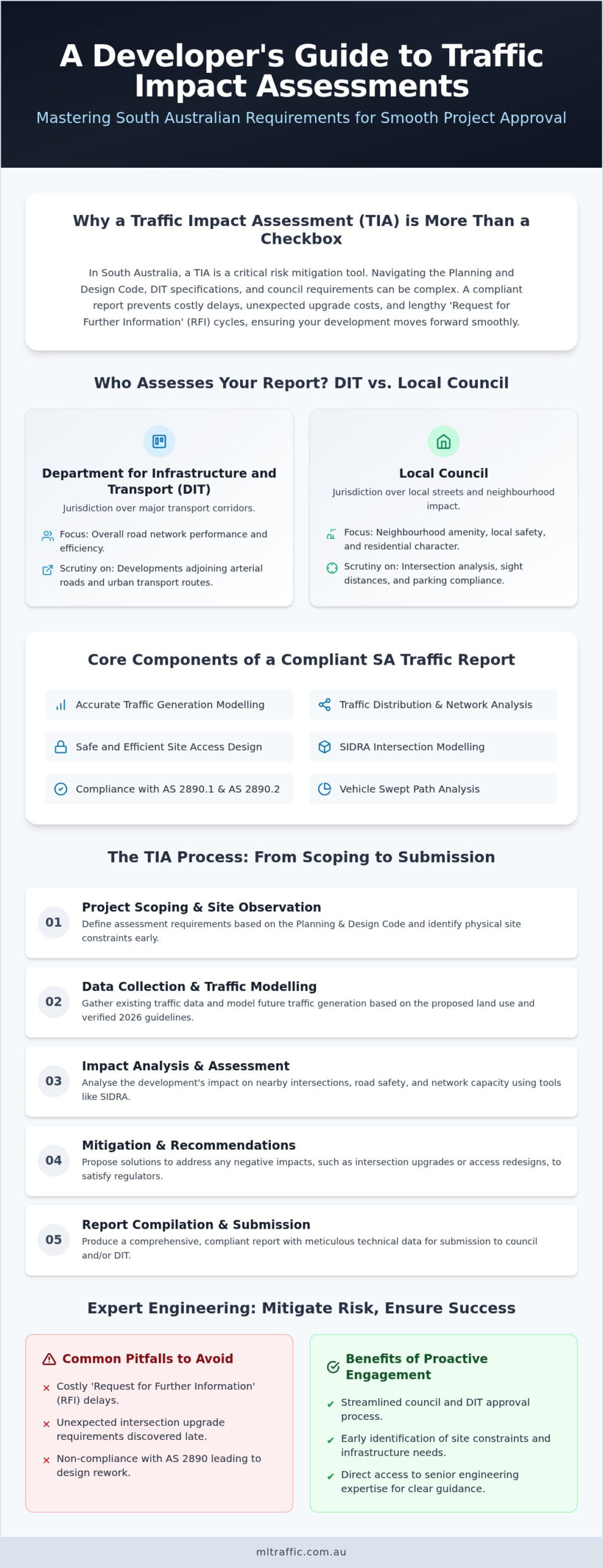
A traffic impact assessment south australia serves as a mandatory technical document for developments that meet specific triggers under the Planning and Design Code. Since the code’s implementation in March 2021, and with subsequent updates including version 2026.14, the assessment process has been centralised to ensure consistency across the state. This report is essential for Understanding Traffic Impact Assessments within the South Australian Planning System because it evaluates how a proposed land use will interact with the existing transport network.
The Department for Infrastructure and Transport (DIT) maintains jurisdiction over arterial roads and significant transport corridors. If your development adjoins an urban transport route, DIT will scrutinise the traffic impact assessment south australia to ensure road network performance isn’t compromised. Conversely, local councils focus on neighbourhood amenity, local street safety, and the preservation of residential character through intersection analysis and sight distance assessments.
To better understand the core principles of this analysis, watch this technical overview:
The Primary Objectives of an SA Traffic Report
A compliant report must address several high-level safety and efficiency goals. These objectives aren’t just suggestions; they’re the benchmarks used by assessing officers to approve or refuse a development application. Key objectives include:
- Ensuring safe and efficient vehicle access to and from the site for all users.
- Minimising the impact on existing road users and public transport networks to prevent congestion.
- Demonstrating strict compliance with Australian Standards for parking and manoeuvring, specifically AS 2890.1 and AS 2890.2.
Why Professional Traffic Engineering is Critical for Approval
Engaging a qualified consultant early in the process prevents the costly “request for further information” (RFI) cycle that often stalls South Australian projects. Professional engineering identifies physical site constraints and potential infrastructure contributions during the feasibility stage rather than after the design is finalised. This proactive approach allows developers to adjust site layouts for optimal Vehicle Swept Path Analysis and Car Park Design before submission.
At ML Traffic Engineers Australia, we ensure that the same expert who initiates your project performs the technical work, providing direct access to senior leadership without unnecessary bureaucracy. Our traffic impact assessment south australia services provide the meticulous technical data required to satisfy both DIT and local government requirements. A TIA functions as the technical bridge between development design and public road safety.
When is a TIA Required? Navigating the Planning and Design Code Thresholds
Determining the necessity of a traffic impact assessment south australia requires a detailed review of the Planning and Design Code overlays. While there is no single numerical threshold that applies to every site, specific triggers within the “Traffic Generating Development Overlay” and the “Urban Transport Routes Overlay” often dictate the level of assessment required. The complexity of these assessments exists on a hierarchy, ranging from simple traffic impact statements for minor developments to complex regional models for major infrastructure projects.
Site location significantly influences report requirements. A development located within 30 metres of a signalised intersection or one that proposes a new access point onto an arterial road will almost certainly require a formal referral to the Department for Infrastructure and Transport (DIT). In these instances, the report must adhere to the Core Components of a Compliant South Australian Traffic Report, which includes specific SIDRA modelling standards for intersection analysis. Common development types that trigger these requirements include:
- Child care centres and educational facilities.
- Medical clinics and allied health consulting rooms.
- Multi-deck apartments and high-density residential flat buildings.
- Service stations and fast-food outlets with drive-through components.
- Large-scale industrial warehouses and distribution centres.
Traffic Generation Thresholds Explained
Traffic engineers calculate peak hour vehicle movements based on the specific land-use category. An unofficial but widely accepted trigger for a comprehensive traffic impact assessment south australia is a development expected to generate over 100 additional vehicle trips during a single peak hour. For minor developments, a “10 vehicles per hour” rule of thumb often applies. If a project exceeds this minor threshold, the council may require a formal assessment to ensure the local street network maintains its functional capacity and safety standards.
The Impact of Land-Use Changes
A “change of use” application frequently necessitates a fresh parking demand assessment and traffic report. Converting a residential dwelling into a commercial office or consulting room changes the traffic profile and parking requirements of the site. Councils scrutinise these applications to prevent “overspill” parking on residential streets. You can learn more about our traffic engineering services to see how we manage these specific land-use transitions.
Meticulous technical documentation is the only way to satisfy the requirements of both local government and DIT. If you are unsure whether your project triggers a formal referral, contact our senior principals for a direct technical preliminary review of your site plans.
Core Components of a Compliant South Australian Traffic Report
A traffic impact assessment south australia must provide a rigorous technical analysis of the site’s interaction with the broader road network. The initial phase involves an existing conditions analysis, where we document current traffic volumes, existing road geometry, and any physical constraints that could impact development feasibility. This baseline data is essential for accurate modelling and ensures the report remains defensible during the council review process.
Traffic generation and distribution modelling determines exactly how many additional vehicle trips the project will create and where those vehicles will travel. We use verified trip generation rates, often sourcing data from the TfNSW Guide in the absence of a consolidated South Australian equivalent, to ensure the projections are accurate. This data allows us to predict the impact on local intersections and justify the proposed site access points through objective metrics.
Justifying deviations from the Planning and Design Code is a frequent requirement in urban developments. If your project cannot meet the strict parking ratios set out in the code, we perform a Car Parking Demand Assessment to justify a lower provision based on local empirical data or proximity to high-frequency public transport. Additionally, we evaluate Safe Intersection Sight Distance (SISD) to determine the safest driveway placement, ensuring compliance with Austroads guidelines and preventing future liability issues for the developer.
Vehicle Swept Path Analysis and Site Access
Demonstrating that service vehicles can enter and exit the site in a forward direction is a non-negotiable requirement for most South Australian councils. We utilise specialised software like AutoTURN to perform Vehicle Swept Path Analysis, ensuring that waste trucks and delivery vehicles can manoeuvre without encroaching on opposing traffic lanes. All designs must adhere to AS 2890.1 for private parking and AS 2890.2 for commercial facilities to ensure long-term operational safety.
Traffic Impact Statement vs. Full TIA
Not every project requires an exhaustive report. A Traffic Impact Statement is often sufficient for low-impact or “deemed-to-satisfy” developments where the traffic generation is negligible. However, a full traffic impact assessment south australia is mandatory when a project interfaces with major transport corridors or arterial roads managed by DIT. While a full TIA involves higher costs and longer preparation times due to detailed SIDRA modelling, it provides the robust evidence needed to mitigate project risks and secure planning approval for complex or high-density sites.
At ML Traffic Engineers Australia, our senior principals personally oversee the preparation of every report, ensuring the technical work is performed by the same expert who initiates the project. This personnel continuity promise ensures that your technical documentation remains consistent and that you have a direct line to the expert responsible for the analysis throughout the entire application lifecycle.
The TIA Process: From Site Observation to Council Submission
The process of securing a traffic impact assessment south australia begins with a rigorous scoping phase. This initial site inspection is critical to identify physical constraints such as existing street furniture, utility pits, and sightline obstructions that could impede driveway placement. Identifying these issues early prevents major redesigns during the later stages of the development application. We focus on practical site realities rather than just theoretical models to ensure the proposed access points are physically viable.
Empirical data collection forms the technical foundation of every report. We gather turning movement counts, pedestrian surveys, and crash history analysis to understand the current safety profile of the road network. We maintain active liaison with local council planning officers and DIT engineers throughout the design phase. This communication ensures the technical analysis aligns with specific network expectations before the final report is drafted, reducing the likelihood of fundamental objections later in the process.
Data Collection and Modelling Techniques
We utilise industry-standard SIDRA Intersection software to perform capacity and delay analysis. Turning movement counts at key access points are essential to capture real-world peak hour conditions. SIDRA modelling calculates intersection capacity and delay to predict the Level of Service (LoS) for 2026 traffic conditions, ensuring the proposed development does not degrade network performance below acceptable regulatory thresholds. This level of detail is necessary to satisfy the DIT Master Specification requirements for 2026 submissions.
Responding to Council and DIT Queries
The process often continues well after the initial report submission. Following public notification, projects frequently enter the “Response to Submissions” (RTS) phase. We represent your interests by negotiating necessary road upgrades or traffic calming measures with authorities. Meticulous technical data allows us to push back against unreasonable requests for infrastructure contributions that could impact project feasibility. If you require technical support for your submission, contact our senior engineers for advice directly.
Final report drafting and certification must be completed by a qualified traffic engineer to meet statutory requirements. At ML Traffic Engineers Australia, we guarantee that the same senior expert who initiates the scoping will perform the final technical work and certification. This personnel continuity promise ensures your project has a dedicated, accountable lead from the first site visit to the final council approval. Our direct-access approach removes the gatekeepers found in larger firms, allowing for faster response times and clearer technical communication during the assessment cycle.
Ensuring Planning Approval with Expert Traffic Engineering
Senior-level involvement is the primary driver for reducing project delays in the South Australian planning system. By integrating traffic design early in the feasibility phase, developers avoid the significant costs associated with late-stage architectural redesigns. ML Traffic Engineers has a 15-year track record of navigating South Australian approvals. We ensure every traffic impact assessment south australia meets the rigorous standards of both PlanSA and the Department for Infrastructure and Transport. Meticulous planning at the start of a project prevents the technical errors that lead to repeated council requests for further information.
Our approach focuses on technical compliance and project de-risking. We identify potential infrastructure contributions early, allowing for accurate project budgeting. This proactive engineering ensures that site access and internal circulation are optimised before the development application is submitted. It’s the most effective way to manage the complexities of the 2026 regulatory environment.
Strategic Car Park Design and Compliance
Optimising car park layouts is essential to maximise site yield while maintaining strict compliance with AS 2890.1. Our technical team ensures that every bay, aisle width, and ramp grade meets Australian Standards. For a detailed breakdown of these requirements, refer to our ultimate guide to compliant car park design. We also address the specific technical requirements of accessible parking under AS 2890.6 to ensure universal access and regulatory compliance. Meticulous design prevents the loss of valuable floor area while ensuring safe vehicle movements throughout the site.
The ML Traffic Advantage for Developers
The ML Traffic advantage is built on our personnel continuity promise. The senior principal who initiates your project performs the technical analysis and drafting. This ensures accountability and deep-seated expertise throughout the entire engagement. We provide direct access to leadership without the gatekeepers common in larger, more impersonal firms. Our experience covers an exhaustive list of project environments, including:
- High-density residential flat buildings and multi-deck apartments.
- Child care facilities and educational centres.
- Medical and allied health consulting rooms.
- Retail and commercial mixed-use developments.
- Industrial warehouses and large-scale distribution centres.
- Service stations and fast-food outlets with drive-through components.
We have a proven history of successfully navigating DIT referral requirements for developments on arterial roads. This ensures your traffic impact assessment south australia facilitates a smooth, predictable approval process. Our results-oriented methodology focuses on providing clear, defensible technical documentation that councils trust.
Securing Your Development Approval for 2026
Achieving a successful development outcome in South Australia requires a precise understanding of the current Planning and Design Code and the specific modelling standards set by the Department for Infrastructure and Transport. By identifying technical triggers and site constraints early, you prevent the costly redesigns and bureaucratic delays that often stall major projects. A high-quality traffic impact assessment south australia serves as your primary tool for mitigating risk and demonstrating long-term road safety compliance.
ML Traffic Engineers brings over 15 years of specialist traffic engineering experience to every project. We combine national expertise with deep South Australian regulatory knowledge to ensure your technical documentation is defensible and accurate. Our personnel continuity promise means you receive direct principal involvement in every report, providing a level of accountability that larger firms don’t offer. This hands-on approach ensures your project remains on track and compliant with all relevant Australian Standards.
We’re ready to help you navigate the complexities of the current planning system. Discuss your South Australian development with a senior traffic engineer today. We look forward to helping you deliver a successful project.
Frequently Asked Questions
What is the difference between a Traffic Impact Statement and a Traffic Impact Assessment in SA?
A Traffic Impact Statement is a concise technical letter used for minor developments with negligible impact on the road network. A full traffic impact assessment south australia is a comprehensive report required for high-traffic developments or those impacting arterial roads. TIAs include detailed SIDRA modelling, intersection capacity analysis, and extensive data collection that statements omit.
How much does a South Australian traffic impact assessment cost?
The cost of a traffic impact assessment south australia depends on the project’s technical complexity and the required scope of modelling. Factors influencing the total investment include the number of intersections requiring SIDRA analysis and whether the application triggers a formal DIT referral. We provide specific project quotes following a preliminary review of your site plans and land-use category.
When is a development referred to the Department for Infrastructure and Transport (DIT)?
Referrals to DIT occur when a development interfaces with the Urban Transport Routes Overlay or other strategic road overlays. This is mandatory if the site is within 30 metres of a signalised intersection or proposes a new access point onto an arterial road. DIT engineers scrutinise these applications to ensure new vehicle movements don’t degrade the performance of the state’s primary road network.
Can I use a general civil engineer for my traffic report?
Statutory requirements and council expectations generally demand a qualified traffic engineering specialist for these reports. While general civil engineers understand infrastructure, they often lack the specialised modelling expertise and specific knowledge of AS 2890 compliance required for approval. Specialist involvement reduces the risk of technical RFIs and ensures the report meets DIT modelling guidelines version 2.2.
Does every development in South Australia require a swept path analysis?
Not every development requires this analysis, but it’s mandatory for any site where service vehicles must enter and exit in a forward direction. This includes multi-deck apartments, child care centres, and commercial warehouses. It provides technical proof that waste trucks and delivery vehicles can manoeuvre safely within the site boundaries according to AS 2890.2 standards.
How long does it take to prepare a compliant traffic report for council?
Preparation timelines vary based on the complexity of the modelling and the need for fresh data collection. A standard traffic impact statement typically takes 10 to 15 business days to complete. More complex assessments requiring intersection counts, pedestrian surveys, and SIDRA modelling generally require three to four weeks to reach a submission-ready state for PlanSA.
What happens if my development does not meet the parking requirements of the Planning and Design Code?
You must provide a formal Car Parking Demand Assessment to justify any deviation from the Planning and Design Code ratios. This technical justification uses empirical data or proximity to high-frequency public transport to demonstrate that the proposed supply is sufficient for the specific land use. It allows developers to maximise site yield while ensuring parking doesn’t overspill into local residential streets.
How far back does traffic data need to be for a valid assessment?
Authorities generally require traffic data to be no older than 12 to 24 months to ensure it reflects current network conditions. Older data often fails to account for recent developments or infrastructure changes that have altered local traffic volumes. Using current counts ensures your modelling accurately reflects 2026 network conditions and provides a defensible Level of Service (LoS) analysis.

Disclaimer
The content on www.mltraffic.com.au, including all technical articles, guides, and resources, is provided for general informational and educational purposes only. It is not intended to constitute professional advice in traffic engineering, transportation planning, development approvals, or any other technical or legal field.
While ML Traffic Engineers makes every reasonable effort to ensure the accuracy, completeness, and timeliness of the information published, we do not provide any warranties or representations (express or implied) regarding its reliability, suitability, or availability for any particular purpose. Any reliance you place on the content is strictly at your own risk.
In no event shall ML Traffic Engineers, its directors, employees, authors, or affiliates be liable for any direct, indirect, incidental, special, consequential, or punitive damages (including, without limitation, loss of profits, data, or business opportunities) arising out of or in connection with the use of, or inability to use, any information provided on this website.
The articles and guides on this site are not a substitute for engaging a qualified, registered professional traffic engineer (such as an NPER or RPEQ engineer) to assess your specific project requirements. For tailored advice, compliance assessments, or traffic engineering services, please contact a competent professional.
This disclaimer may be updated from time to time without notice. By accessing or using this website, you agree to be bound by the most current version of this disclaimer.
