

A Traffic Impact Assessment is often viewed as a bureaucratic hurdle, but treating it as a strategic design tool is the only way to prevent costly site redesigns after your development application is lodged. Securing a professional traffic impact assessment sunshine coast developers can rely on requires more than just ticking boxes; it demands a deep technical understanding of the Sunshine Coast Planning Scheme 2014 and current Australian Standards.
You likely understand the frustration of seeing a project stalled by council requests for further information or being forced to relocate access points because of non-compliance with AS 2890.1:2021 parking standards. These delays are expensive and entirely avoidable. This guide provides a clear roadmap through the technical requirements and professional reporting necessary for successful council approval with minimal pushback. We will examine the specific triggers for a TIA, the necessity of accurate swept path analysis, and how direct access to the senior engineer performing the work ensures your submission is compliant from the outset.
Key Takeaways
- Identify the specific triggers within the Sunshine Coast Planning Scheme 2014 that necessitate a traffic impact assessment sunshine coast for your development application.
- Utilise Vehicle Swept Path Analysis and AutoTURN simulations to verify site accessibility and eliminate the risk of costly post-submission redesigns.
- Ensure strict compliance with AS 2890 standards for car park design, focusing on mandatory bay dimensions and aisle widths for light and commercial vehicles.
- Access senior engineering principals directly to ensure technical accountability and reduce the likelihood of council requests for further information.
Understanding the Necessity of a Traffic Impact Assessment (TIA)
A Traffic Impact Assessment (TIA) is a formal technical report that evaluates how a proposed development will affect the surrounding transport network. It is a critical component of transportation planning, ensuring that new infrastructure does not compromise road safety or network efficiency. For developers, a traffic impact assessment sunshine coast is often the difference between a swift approval and a protracted dispute with the Sunshine Coast Council. The report analyses current traffic conditions and predicts future demands to determine if the existing road capacity can accommodate the project.
To better understand this concept, watch this helpful video:
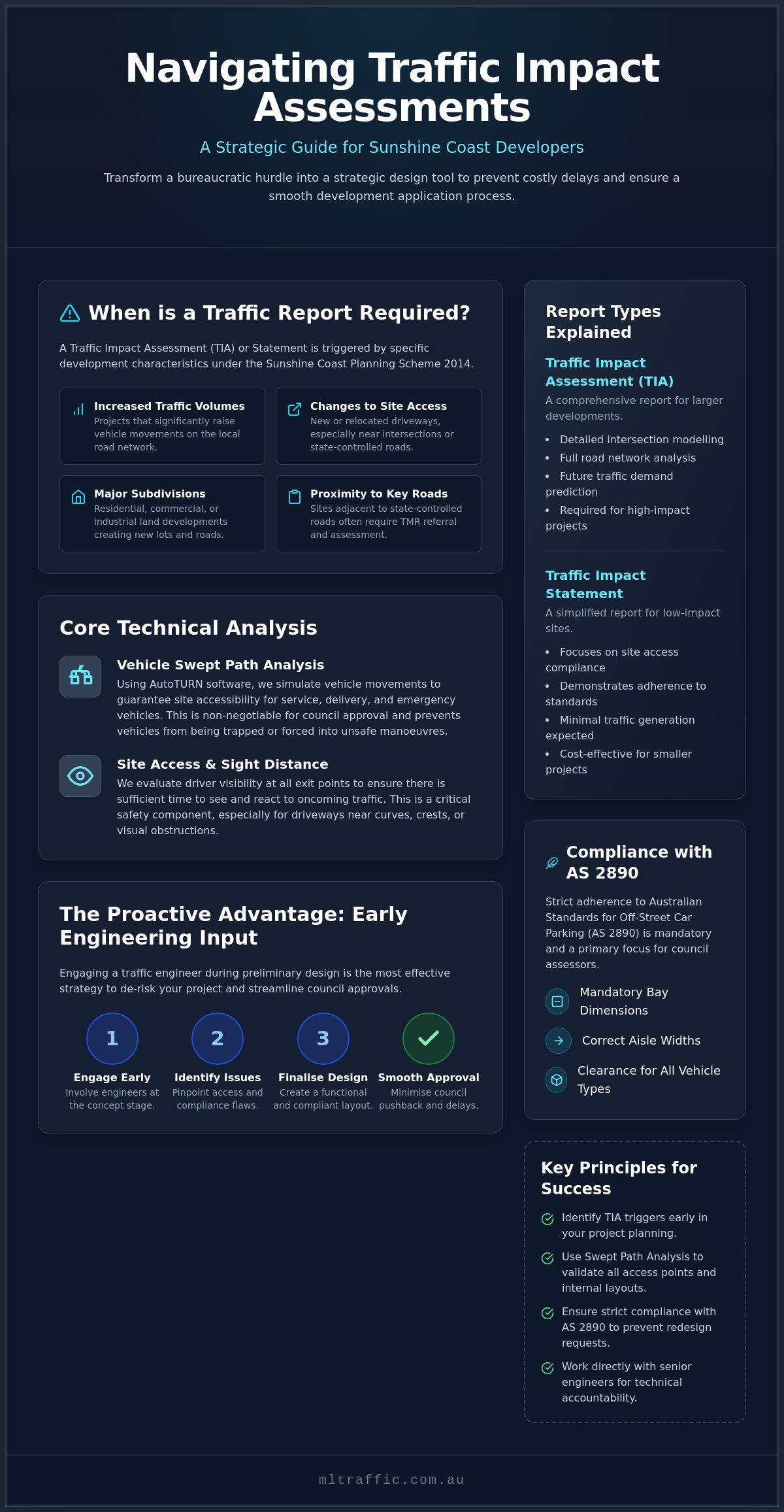
Council requirements distinguish between a comprehensive TIA and a simplified Traffic Impact Statement. While a TIA involves detailed intersection modelling and network analysis, a Statement is typically reserved for low-impact developments where traffic generation is minimal but access compliance must still be demonstrated. Identifying which report is necessary early in the planning phase prevents the high costs of redesigning access points after a development application (DA) is lodged. Triggers for these reports include increased traffic volumes, changes to site access, or potential safety concerns identified during the initial assessment.
When is a Traffic Report Required for Your DA?
Specific thresholds in the Sunshine Coast Planning Scheme 2014 dictate the level of reporting required. Residential subdivisions, large-scale commercial centres, and industrial precincts almost always trigger a formal review. The Statement of Environmental Effects often serves as the initial trigger, identifying where a development’s scale warrants expert engineering input. Proximity to state-controlled roads or major intersections adds another layer of complexity. These sites often require referral to the Department of Transport and Main Roads (TMR) for concurrence agency assessment. Expert reporting ensures your traffic impact assessment sunshine coast meets both local and state requirements.
The Strategic Value of Early Traffic Engineering Input
Engaging an engineer during the preliminary design phase is a results-oriented approach that identifies potential access issues before the design is finalised. Professional data collection, including peak hour counts and queue length surveys, provides the evidence needed to satisfy council queries before they become formal Information Requests (IRs). For a deeper dive into these requirements, consult our Traffic Impact Assessment Definitive Guide. Identifying sight distance issues or swept path constraints early ensures the site layout is functional and compliant from day one. This proactive strategy minimises council pushback and keeps project timelines on track.
Technical Analysis: Vehicle Swept Paths and Site Access
Vehicle Swept Path Analysis is a non-negotiable technical requirement for any modern development application. It provides a digital simulation of how specific vehicles move through a site’s proposed layout. When preparing a traffic impact assessment sunshine coast, our engineers use AutoTURN software to generate precise manoeuvring diagrams. These simulations verify that waste collection vehicles, heavy delivery trucks, and emergency services can navigate the site without physical conflict. Council assessors prioritise these diagrams to ensure service vehicles don’t become trapped or forced into dangerous reversing manoeuvres onto public roads.
Adherence to the Queensland Government’s Guide to Traffic Impact Assessment requires rigorous testing of all site access points. Sight distance assessments are a critical safety component of this process. We evaluate the visibility for drivers exiting the property to ensure they have sufficient time to react to oncoming traffic. This is especially vital for new driveways located near road crests, sharp curves, or dense vegetation. For projects with constrained footprints, a professional Vehicle Swept Path Analysis identifies these spatial issues before they lead to formal council refusals.
Proving Manoeuvrability with AutoTURN Diagrams
AutoTURN diagrams serve as visual proof that a design is functional. They demonstrate that the largest expected vehicle can enter and exit the site in a forward direction, which is a standard council requirement. We model complex site layouts using multi-point turn simulations to find the most efficient path for heavy vehicles. This level of detail prevents the need for expensive site modifications after the DA has been submitted. You can find more technical details in our Swept Path Analysis Guide.
Access Assessment and Driveway Ramp Grades
Evaluating the transition between the public road and private property is essential for vehicle safety. We perform driveway ramp grade assessments to ensure the vertical alignment doesn’t cause vehicle “grounding” or scraping. This is a common point of failure in designs with significant level changes. Our reports ensure that every driveway crossover meets local government specifications and remains accessible for all vehicle types, including low-clearance passenger cars. Proper assessment at this stage maintains the integrity of the design while meeting all regulatory safety benchmarks.
Compliance with Australian Standards for Car Park Design (AS 2890)
Adherence to Australian Standards is the technical foundation of any traffic impact assessment sunshine coast. Council assessors rely on AS 2890.1:2021 (Off-street car parking) and AS 2890.2 (Commercial vehicle facilities) as the mandatory benchmarks for site functionality. These standards dictate the physical geometry of the car park, ensuring that every space is accessible and safe for its intended user. For a benchmark of how these standards are applied in high-profile local projects, the Sunshine Coast City Hall Traffic Engineering Assessment demonstrates the rigorous level of detail required for successful council approval.
A compliant car park design must address several core technical elements simultaneously:
- Bay Dimensions: Precise width and length based on specific user classes.
- Aisle Widths: Sufficient space for two-way flow or specific manoeuvring requirements.
- Blind-Aisle Extensions: Mandatory 1-metre extensions to allow vehicles to turn around at the end of a dead-end aisle.
- Sight Distance: Ensuring drivers can see pedestrians and other vehicles at conflict points.
Our senior engineers take direct responsibility for certifying these layouts. We don’t just review plans; we actively design car park configurations that maximise yield while maintaining total compliance. This hands-on approach reduces the risk of council issuing an Information Request (IR) regarding non-compliant bay sizes or structural obstructions that could force a total redesign of the building’s basement or footprint.
Applying AS 2890.1 to Residential and Commercial Sites
The standard defines different “User Classes” which dictate bay widths. A Class 1a space for long-term residential parking is narrower than a Class 3 space intended for high-turnover retail use. We also pay close attention to the placement of columns and structural elements. These cannot intrude into the required “door opening envelopes” defined by the standard. For a comprehensive breakdown of these rules, read our guide on AS 2890.1 Explained.
Managing Parking Demand and Justifying Reductions
It’s common for constrained urban sites to fall short of the parking rates specified in the Sunshine Coast Planning Scheme 2014. In these cases, we perform a Car Parking Demand Assessment. By using empirical data from similar developments and site-specific surveys, we can often justify a reduction in the required number of spaces. We also highlight the inclusion of bicycle parking and end-of-trip facilities, as the council increasingly supports active transport under its Sustainable Transport Policy. This data-driven justification is essential for securing a traffic impact assessment sunshine coast that supports your project’s commercial viability.
The Traffic Reporting Process: From Analysis to Approval
The path to council approval follows a rigid technical workflow designed to eliminate ambiguity. It begins with a comprehensive site inspection and a review of architectural plans to identify immediate constraints. This initial phase ensures that the engineering response aligns with the developer’s vision while respecting the physical limitations of the road frontage. A structured approach is essential for a successful traffic impact assessment sunshine coast, as it provides the evidence-based foundation required by planning authorities.
Our process involves five distinct stages to ensure total technical accuracy:
- Step 1: Initial site inspection and review of proposed architectural plans to determine the scope of works.
- Step 2: Traffic data collection, including peak hour counts, queue length surveys, and intersection analysis.
- Step 3: Technical modelling of swept paths using AutoTURN and parking compliance checks against AS 2890.
- Step 4: Preparation of the formal Traffic Impact Statement or TIA report, depending on the project’s scale.
- Step 5: Direct liaison with council engineers post-submission to address any technical queries or requests for further information.
This sequence ensures that every potential hurdle is identified before the report reaches the assessor’s desk. By maintaining direct access to the senior engineer performing the work, clients receive a report that is technically sound and strategically prepared to withstand council scrutiny.
Data Collection and Intersection Analysis
Measuring existing traffic conditions creates the baseline for any traffic impact assessment sunshine coast. We conduct intersection analysis to determine current capacity and predict delays caused by the proposed development. For high-traffic impact projects, we utilise SIDRA modelling to simulate complex traffic flow. This modelling provides data on degrees of saturation and level of service, ensuring the local network remains functional after the development is completed. Accurate data collection prevents the council from questioning the validity of the report’s conclusions.
Finalising the Traffic Impact Statement
The final report organises technical findings into a concise, authoritative document for council planners. It addresses every requirement of the Sunshine Coast Planning Scheme 2014 and all relevant Australian Standards. We adopt a no-nonsense, professional resume approach in our report writing. This style focuses on facts, data, and compliance rather than unnecessary narrative. This clarity builds confidence with assessors and significantly reduces the likelihood of unnecessary Information Requests (IRs) that can stall project timelines. For expert assistance with your council submission, contact our senior engineering team today to discuss your project requirements.
Expert Traffic Engineering Consultancy for National Projects
ML Traffic Engineers Australia provides over 15 years of specialised consultancy experience in civil engineering and urban planning. We maintain a national reach, allowing us to navigate the specific regulatory requirements of local councils across Australia with precision. For developers seeking a traffic impact assessment sunshine coast, we offer a unique personnel continuity promise. The senior expert who initiates your project is the same professional who performs the technical analysis and signs off on the final report. This approach distinguishes us from larger, more impersonal firms where projects are often handed down to junior staff after the initial engagement.
Our firm is built on a foundation of reliability and deep-seated expertise. We understand that development timelines are sensitive and that council delays represent a significant financial risk. By ensuring senior principal involvement in every project, regardless of scale, we provide an authoritative technical voice that council assessors trust. This seasoned expertise is essential for navigating the complex bureaucratic requirements of the Sunshine Coast Planning Scheme 2014 and ensuring your project moves toward approval without unnecessary friction.
A Direct Line to Senior Engineering Principals
We eliminate bureaucratic gatekeepers by providing clients with direct access to our leadership team. This ensures technical accuracy and facilitates clear communication throughout the reporting process. Direct access speeds up the revision phase and ensures that council queries are addressed by the expert who understands the project’s technicalities inside and out. You can learn more about our professional traffic engineering services to see how this senior-led approach applies to your specific project needs. This hands-on, accountable philosophy is central to our consultancy model.
Reliable Results for Complex Land-Use Types
Our portfolio includes a vast range of diverse project environments, from childcare centres and medical facilities to large-scale industrial subdivisions and high-rise residential towers. We ensure every report is meticulously prepared to meet regulatory certification standards and Australian Standards. This attention to detail is vital for maintaining the professional status and reliability that council assessors expect from a traffic impact assessment sunshine coast. Whether your project is a small-scale development or a complex national infrastructure piece, our results-oriented methodology remains consistent. Contact ML Traffic Engineers Australia today for a project-specific fee proposal and secure senior-led expertise for your next application.
Secure Your Council Approval with Senior-Led Engineering
Successful development applications on the Sunshine Coast depend on the technical integrity of your traffic reporting. By addressing triggers early and ensuring total compliance with AS 2890 parking standards, you eliminate the risk of costly redesigns and council delays. A professional traffic impact assessment sunshine coast provides the necessary data to justify your site’s functionality to planning assessors. Meticulous preparation of swept path diagrams and parking demand justifications ensures your project meets all regulatory benchmarks from the outset.
ML Traffic Engineers Australia brings over 15 years of specialised experience to every project. We ensure senior principals perform all technical work; this provides you with direct accountability and expertise in AutoTURN swept path analysis. This hands-on methodology ensures your submission is prepared for immediate regulatory certification. Don’t leave your project’s success to chance with junior staff or impersonal firms. Get a professional Traffic Impact Assessment quote from ML Traffic Engineers Australia to secure reliable results for your development.
Frequently Asked Questions
What is the difference between a Traffic Impact Assessment and a Traffic Management Plan?
A Traffic Impact Assessment (TIA) is a strategic report used to support a development application by analysing the long-term effects of a project on the road network. In contrast, a Traffic Management Plan (TMP) is an operational document required for the construction phase or specific events to manage short-term vehicle and pedestrian movements. While a TIA focuses on permanent infrastructure and capacity, a TMP addresses temporary safety and flow.
How long does it typically take to prepare a Traffic Impact Statement?
Preparation of a Traffic Impact Statement generally takes between two and four weeks. This timeframe depends on the complexity of the site and the requirement for external traffic data collection, such as peak hour intersection counts. Projects requiring detailed SIDRA modelling or extensive swept path analysis may sit at the longer end of this range. Early engagement ensures that technical data is ready for your development application submission.
Why does council require a swept path analysis for my small development?
Council requires a swept path analysis for small developments to verify that essential service vehicles can enter and exit the site in a forward direction. Even for minor projects, assessors must see technical proof that waste collection trucks and emergency vehicles can manoeuvre safely without physical conflict. Providing these AutoTURN diagrams prevents council from issuing Information Requests regarding site functionality and safety.
Can I use a general civil engineer for my traffic report, or do I need a specialist?
While general civil engineers can perform basic reviews, specialist traffic engineers provide the advanced modelling and specific knowledge of AS 2890 required for complex development applications. Specialist consultancy ensures that your traffic impact assessment sunshine coast is prepared by experts who understand the nuances of intersection analysis and parking demand. Council assessors often have higher confidence in reports signed off by dedicated traffic engineering principals with specialised industry experience.
What happens if my proposed car park doesn’t meet AS 2890.1 dimensions?
If a proposed car park fails to meet AS 2890.1 dimensions, you must provide a technical justification or a Performance Solution to satisfy council. We perform a Car Parking Demand Assessment to prove that the proposed layout remains functional and safe despite the deviation. This process involves using empirical data from similar land uses to demonstrate that the reduced dimensions or parking rates won’t negatively impact the surrounding road network.
How much traffic does a development need to generate to trigger a full TIA?
The requirement for a full TIA is triggered by specific thresholds defined in the Sunshine Coast Planning Scheme 2014. Generally, developments generating more than 50 vehicle trips during any peak hour or those impacting state-controlled roads require comprehensive reporting. Smaller projects might only require a simplified traffic impact assessment sunshine coast. We review your architectural plans against these local government criteria to determine the exact level of assessment necessary for your application.
Does ML Traffic Engineers Australia provide Traffic Guidance Schemes (TGS) for construction?
Yes, ML Traffic Engineers Australia provides professionally drafted Traffic Guidance Schemes (TGS) for construction and roadwork activities. These schemes ensure that temporary traffic control measures comply with the Manual of Uniform Traffic Control Devices (MUTCD) and state safety standards. While our TIAs focus on development approval, our TGS services support the operational phase of your project, ensuring that contractors can manage vehicle and pedestrian flow safely during the build.
How do I get a quote for a traffic assessment on the Sunshine Coast?
To receive a project-specific fee proposal, you should provide a set of current architectural plans and the site address through our contact page. Our senior engineering principals review these documents to determine the required scope of work, including swept path analysis or intersection modelling. We provide direct access to the expert performing the work, ensuring that your quote reflects the precise technical requirements of your development application.

Disclaimer
The content on www.mltraffic.com.au, including all technical articles, guides, and resources, is provided for general informational and educational purposes only. It is not intended to constitute professional advice in traffic engineering, transportation planning, development approvals, or any other technical or legal field.While ML Traffic Engineers makes every reasonable effort to ensure the accuracy, completeness, and timeliness of the information published, we do not provide any warranties or representations (express or implied) regarding its reliability, suitability, or availability for any particular purpose. Any reliance you place on the content is strictly at your own risk.In no event shall ML Traffic Engineers, its directors, employees, authors, or affiliates be liable for any direct, indirect, incidental, special, consequential, or punitive damages (including, without limitation, loss of profits, data, or business opportunities) arising out of or in connection with the use of, or inability to use, any information provided on this website.The articles and guides on this site are not a substitute for engaging a qualified, registered professional traffic engineer (such as an NPER or RPEQ engineer) to assess your specific project requirements. For tailored advice, compliance assessments, or traffic engineering services, please contact a competent professional.This disclaimer may be updated from time to time without notice. By accessing or using this website, you agree to be bound by the most current version of this disclaimer.
