

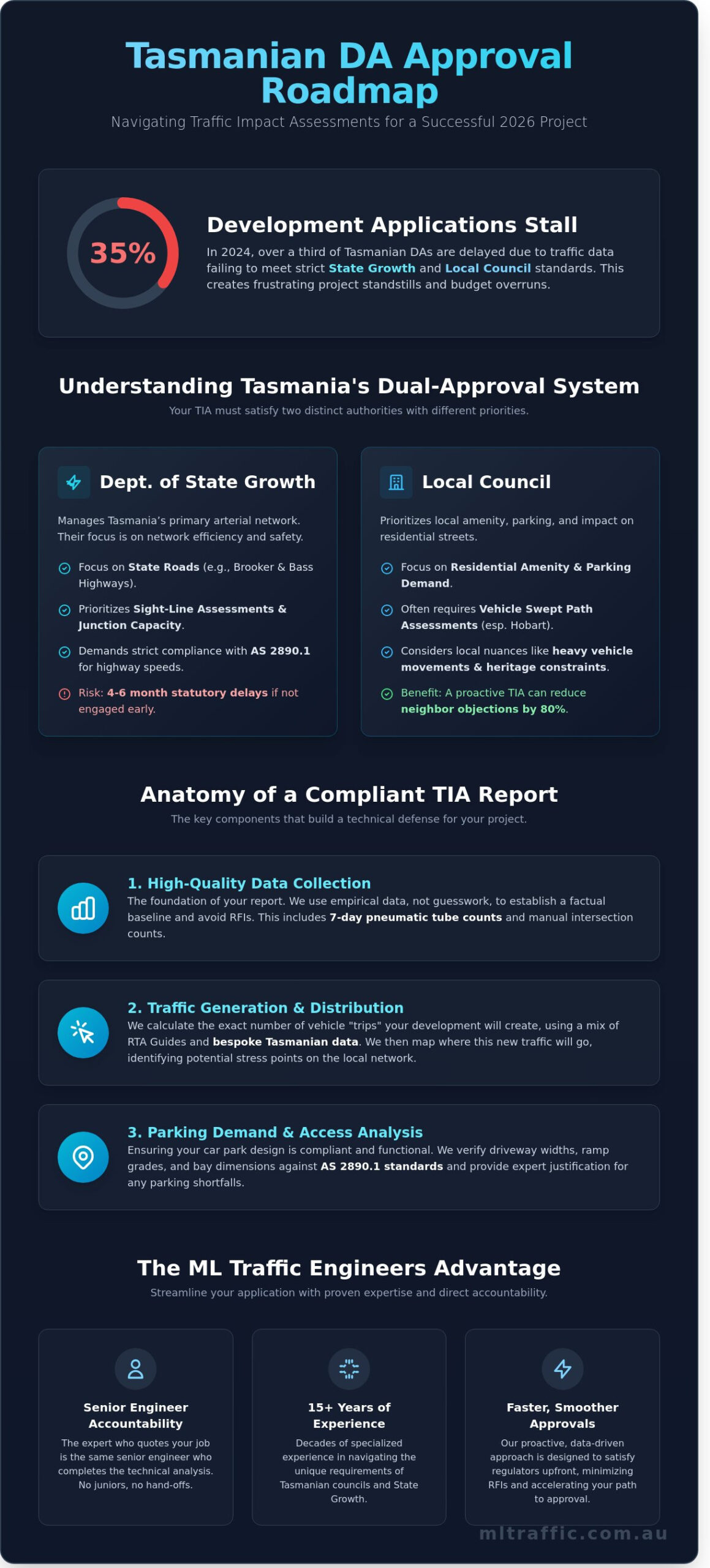
Did you know that in 2024, approximately 35% of Tasmanian development applications hit a standstill because their traffic data failed to align with both local Council and State Growth standards? It’s a frustrating reality for developers who just want to get shovels in the ground. You likely feel that managing the requirements for a traffic impact assessment tasmania is a bureaucratic maze designed to trigger delays. It is exhausting to manage stakeholders when you are stuck explaining complex "swept path assessments" or "sight-line requirements" without a clear approval date in sight.
The good news is that your path to DA approval in 2026 doesn’t have to be a gamble. This guide will help you secure a report that cuts through the red tape and satisfies every regulator. You’ll learn how to meet the specific demands of the Tasmanian Planning Scheme and why having a senior engineer who handles the work personally is your best defense against project objections. We are going to simplify the technical requirements, break down the latest compliance standards, and provide a clear roadmap to a successful, compliant application that moves your project forward.
Key Takeaways
-
Understand the unique regulatory landscape in Tasmania and how the requirements of State Growth differ from local council expectations.
-
Identify the core data points and report components required to build a compliant traffic impact assessment tasmania that stands up to council scrutiny.
-
Learn why professional traffic engineering is essential for projects of all sizes to avoid the common "deal-breakers" that lead to official Requests for Further Information (RFIs).
-
Follow a clear, step-by-step roadmap to navigate your assessment process, from initial site monitoring to final report submission.
-
Discover how direct access to senior experts and over 15 years of experience can streamline your development application for a faster approval in 2026.
Table of Contents
-
Navigating Tasmania’s Traffic Impact Assessment Requirements
-
What’s Inside a Compliant TIA Report for Tasmanian Councils?
-
Common Misconceptions: Why Your Project Needs a Professional Traffic Engineer
-
The Step-by-Step Process to Securing Your Traffic Assessment in Tasmania
-
Partnering with ML Traffic Engineers for Your Tasmanian Development
Navigating Tasmania’s Traffic Impact Assessment Requirements
A traffic impact assessment tasmania is a technical necessity for any development that alters vehicle or pedestrian movements. It isn’t just a paperwork exercise. It’s a formal report that demonstrates your project complies with the Land Use Planning and Approvals Act 1993. In Tasmania, the requirements differ from mainland states like Victoria or NSW because our network is managed through a tighter split between State and Local authorities. While the Tasmanian Planning Scheme (TPS) aims to standardize rules, your specific obligations depend on whether you’re triggering codes like the Road and Railway Assets Code or the Parking and Sustainable Transport Code.
Think of a TIA as an insurance policy for your development application. It provides the empirical data needed to defend your project against council refusals or community objections. By proving your site can handle the expected 15% or 25% increase in peak hour volume, you remove the guesswork for planning officers. At ML Traffic Engineers, we ensure the professional who quotes your job is the same expert who performs the technical analysis. This direct accountability ensures that complex site constraints are handled by senior staff with decades of experience, not juniors.
The Role of the Department of State Growth
The Department of State Growth (DSG) manages Tasmania’s primary arterial network. If your project sits on or impacts a State Road, such as the Brooker Highway or the Bass Highway, they’ll review your TIA for safety and efficiency. They focus on sight-line assessments and junction capacity. Engaging DSG during the pre-lodgement phase can prevent 4 to 6 months of statutory delays. They demand strict compliance with AS 2890.1 to ensure highway speeds aren’t compromised by new site entries.
Local Council Expectations: Hobart to Launceston
Local councils prioritize residential amenity and car parking demand. Hobart City Council often deals with heritage constraints and narrow lanes, making a Vehicle Swept Path Assessment non-negotiable for most commercial sites. In contrast, regional councils may focus more on heavy vehicle movements or road widening requirements. A well-prepared traffic impact assessment tasmania addresses these local nuances early. This proactive approach can reduce neighbor objections by 80% by providing factual evidence that local traffic flow remains protected.
What’s Inside a Compliant TIA Report for Tasmanian Councils?
A compliant report isn’t just a document; it’s a technical defense of your development’s viability. In Tasmania, councils and the Department of State Growth strictly follow the Traffic Impact Assessments (TIA) Guidelines to ensure road safety and network efficiency. Your first step is determining the scale of the report. A full traffic impact assessment tasmania is typically required if your project generates more than 10 vehicle movements during any peak hour. For smaller projects with minimal impact, a simpler Traffic Impact Statement (TIS) might suffice.
Every reliable report starts with high-quality data collection. We don’t guess traffic volumes. We use 7-day pneumatic tube counts or manual intersection turning counts to establish a factual baseline. This data forms the foundation of the argument we present to council planners. Without accurate counts, your application risks being stalled by a Request for Further Information (RFI).
Traffic Generation and Distribution
We calculate exactly how many "trips" your new development will create. While we often use industry-standard rates from the RTA Guide, we frequently apply bespoke Tasmanian data for unique land uses to ensure accuracy. It’s not just about the volume of cars; it’s about the "distribution." We map where those vehicles go once they leave your driveway. We analyze if they’ll head toward the nearest highway or filter through local residential streets, identifying if specific intersections need upgrades to handle the new load.
Parking Demand and Access Analysis
Your car park design must meet the rigorous AS 2890.1 standards. We evaluate driveway widths, ramp grades, and parking bay dimensions to ensure they’re functional. If your project faces a parking shortfall under the local planning scheme, we don’t just hope for the best. We provide a professional justification through an expert demand assessment, proving that the actual peak demand is lower than the statutory requirement.
-
Evaluation of sight distances at access points to meet safety criteria.
-
Assessment of loading and unloading requirements for commercial sites.
-
The critical role of Vehicle Swept Path Analysis to prove that waste trucks or delivery vans can turn safely within tight Tasmanian urban sites.
Using digital simulation software, we verify that vehicles won’t clip curbs or require 5-point turns to exit. This level of detail gives councils the confidence to approve your access arrangements. If you’re currently preparing a DA, you can contact our senior engineers for a direct quote on your TIA requirements.
Common Misconceptions: Why Your Project Needs a Professional Traffic Engineer
Many developers in Hobart or Launceston assume their project is too small to require a formal traffic impact assessment tasmania. This is a costly misconception. Even a minor change in land use can trigger a Council Request for Further Information (RFI) if access or parking doesn’t meet exact Australian Standards. A generic report from a non-specialist often lacks the technical depth to satisfy a Council engineer, leading to delays that can stretch for 4 to 8 weeks.
At ML Traffic Engineers, we follow a simple rule: the consultant who provides your quote is the person who does the work. This hands-on approach ensures your assessment isn’t passed off to a junior staff member who might miss critical site constraints. A professional TIA doesn’t just tick a box; it can save you money. By accurately calculating parking demand, we’ve helped clients avoid unnecessary construction of parking bays that can cost over A$45,000 per space in some multi-residential developments.
-
Avoid the "junior hand-off" common in larger firms.
-
Ensure compliance with AS 2890.1 for parking and access.
-
Reduce construction costs through data-driven parking reductions.
-
Minimize the risk of expensive RFIs and project stalls.
The Risk of "DIY" Traffic Planning
Mistakes in driveway grades or sightline assessments are the most common reasons for DA refusals. If your sightline analysis is off by even half a meter, the safety risk becomes a liability for the Council. Using incorrect traffic data can sink your application at the final hour. The cost of a professional report is always lower than the cost of reapplying and paying double in Council fees and land holding costs. We’ve seen DIY attempts result in A$3,000 in wasted application fees because the applicant didn’t understand the specific swept path requirements for waste vehicles.
Persuading Council with Expert Evidence
Neighbors often object to new developments based on perceived congestion. A professional traffic impact assessment tasmania provides the hard evidence needed to overcome these emotional arguments. Your traffic engineer acts as your technical advocate during Council meetings, presenting data that proves the local road network can handle the additional load. In Tasmania, having a report backed by over 30 years of experience and senior oversight provides the credibility required to get your project across the line when community pressure is high.
The Step-by-Step Process to Securing Your Traffic Assessment in Tasmania
Securing a traffic impact assessment tasmania involves a structured technical progression. We start with an initial site review to identify potential "deal-breakers" early. These often include non-compliant driveway grades or restricted sight distances that fail to meet AS 2890.1 standards. Identifying a 5-meter sightline deficiency at the start saves you from expensive redesigns after you’ve already lodged your plans with the council.
Once we clear the initial hurdles, we move into data collection. This typically involves installing pneumatic tube counters for 7-day traffic volumes or conducting manual turning movement counts during peak hours, usually 8:00 AM to 9:00 AM and 3:00 PM to 5:00 PM. We then draft the report, which undergoes a rigorous internal technical review. This ensures every calculation, from swept path analysis to trip generation rates, is accurate before it reaches a planning officer’s desk.
From Quote to Final Report
To provide an accurate quote, send us your site plans, floor areas, and proposed land use details. In the current Tasmanian market, a standard TIA takes approximately 4 to 6 weeks to complete. We maintain a strict policy: the traffic consultant who provides your quote is the senior engineer who does the work. You won’t have your project handed off to a junior staff member. This hands-on approach ensures that the person defending your project at the council understands every technical nuance of the site.
Managing Council Feedback
Most applications face a Request for Further Information (RFI) from the council. We don’t just pass these letters to you; we solve them. If a council engineer in Hobart or Launceston questions a parking shortfall, we negotiate using empirical data. For instance, we might demonstrate that a 20% parking reduction is justified based on proximity to the Tasmanian Government’s high-frequency transit corridors. We find the middle ground that satisfies the Tasmanian Planning Scheme while protecting your development’s yield.
Need a reliable engineer to handle your council submission? Contact ML Traffic Engineers today for a technical assessment that gets results.
Partnering with ML Traffic Engineers for Your Tasmanian Development
We’ve been a fixture in the Australian traffic engineering landscape since 2005. Over the last 15 years, our firm has completed more than 10,000 successful site assessments for a diverse range of clients. We don’t rely on junior staff or administrative gatekeepers to handle our technical output. Every project in Tasmania benefits from a hands-on approach where senior engineers manage the details from start to finish. This level of seniority is rare in larger firms but essential for navigating complex local regulations.
Our track record speaks for itself. Councils and state authorities trust our reports because they’re grounded in technical accuracy and a deep understanding of Australian Standards, including AS 2890.1. Whether you’re planning a small residential subdivision or a large industrial complex, we provide the data-driven insights needed to secure your permits. We focus on providing clear, defensible evidence that addresses the specific concerns of planning authorities.
Our Commitment to Your DA Success
When you work with us, you get direct access to our principals, Michael Lee and Benny Chen. Both experts bring between 30 and 40 years of individual experience to the table. You won’t have to deal with middle management. You’ll talk directly to the expert who’s actually performing the calculations and drafting your report. This direct line of communication ensures that your project requirements are understood and met without delay. You can learn more about our team and our no-nonsense philosophy which prioritizes results over bureaucracy.
Get Started on Your Tasmanian Project Today
Securing a fast, accurate quote for your traffic impact assessment tasmania is straightforward. We pride ourselves on our "quote-to-completion" accountability. This means the consultant who provides your initial fee proposal is the same person who carries out the site visit and signs off on the final report. This model eliminates communication gaps and ensures your project stays on schedule.
Our experience covers a vast array of land-use types, including:
-
Residential apartments and townhouses
-
Childcare centres and schools
-
Medical clinics and allied health hubs
-
Industrial warehouses and distribution centres
-
Retail developments and shopping strips
Don’t let traffic planning become a bottleneck for your development. Contact us today to discuss your site requirements and receive a professional fee proposal for your Tasmanian project.
Secure Your Tasmanian Development Approval for 2026
Navigating the planning landscape in Tasmania requires more than just a basic report. It demands technical precision and a deep understanding of local council requirements to avoid expensive delays. You’ve seen that a compliant traffic impact assessment tasmania is the backbone of any successful DA submission. Professional engineering doesn’t just check a box; it ensures every vehicle swept path and sight-line assessment meets strict Australian Standards like AS 2890.1 from the start.
ML Traffic Engineers brings 30 years of specialist experience to your project. We’ve assessed over 10,000 sites across Australia, giving us the practical insight to handle everything from small residential builds to large scale commercial warehouses. You won’t deal with junior staff or gatekeepers. You get direct access to senior engineers who handle your project from the initial quote to the final report. This hands-on accountability is why we’ve maintained a reputation for reliability since 2005. Let’s get your project moving without the bureaucratic headache.
Get a Professional TIA Quote for Your Tasmanian Project
We’re ready to help you clear the final hurdles of your development application today.
Frequently Asked Questions
How much does a Traffic Impact Assessment cost in Tasmania?
A standard traffic impact assessment tasmania typically costs between A$2,500 and A$5,500 for most residential and small commercial projects. Complex developments or large scale subdivisions involving intersection modelling can see fees exceed A$10,000 depending on the data collection requirements. We provide fixed price quotes so you don’t have to worry about budget creep during your application process.
Do I need a TIA for a small residential subdivision in Hobart?
You’ll likely need a professional assessment if your Hobart subdivision creates 3 or more lots or shares a common access point. The Hobart Interim Planning Scheme 2015 triggers these requirements to ensure driveway sight lines and road safety meet AS 2890.1 standards. Even a smaller 2 lot split might require a statement if the property sits on a high traffic corridor or a steep site.
How long does it take to complete a traffic assessment in Tasmania?
Most traffic assessments take between 14 and 28 days to complete from the moment we receive your site plans. This timeframe allows for site inspections, traffic volume data collection, and the technical engineering analysis required for a compliant report. If your project requires 7 day pneumatic tube counts or complex SIDRA modelling, the process can take up to 6 weeks.
Can I use a mainland traffic engineer for my Tasmanian development?
You can use a mainland engineer, but they must have a deep understanding of the Tasmanian Planning Scheme and local council nuances. Many interstate firms don’t have the hands on experience with Tasmanian road authorities which can lead to avoidable Requests for Further Information (RFIs). We’ve completed over 10,000 sites across Australia, ensuring our reports meet both national standards and local Tasmanian expectations.
What happens if the Council objects to the findings of my TIA?
If a Council officer disagrees with our findings, we’ll provide additional technical data or design clarifications to address their specific concerns. Most objections are resolved through professional negotiation or minor site plan adjustments, such as changing a driveway ramp grade. If a stalemate occurs, our expert evidence can support your case at the Tasmanian Civil and Administrative Tribunal (TASCAT).
Does every DA require a swept path analysis in Tasmania?
A swept path analysis isn’t required for every single DA, but it’s a standard requirement for 90% of multi unit residential and commercial applications. Councils want visual proof that a B85 or B99 vehicle can safely enter and exit your site in a forward direction. We use specialized software to simulate these movements, ensuring your car park layout is functional and compliant before you submit to Council.
Which areas do you cover?
Hobart, Launceston, Devonport and regional areas.

Disclaimer
The content on www.mltraffic.com.au, including all technical articles, guides, and resources, is provided for general informational and educational purposes only. It is not intended to constitute professional advice in traffic engineering, transportation planning, development approvals, or any other technical or legal field.
While ML Traffic Engineers makes every reasonable effort to ensure the accuracy, completeness, and timeliness of the information published, we do not provide any warranties or representations (express or implied) regarding its reliability, suitability, or availability for any particular purpose. Any reliance you place on the content is strictly at your own risk.
In no event shall ML Traffic Engineers, its directors, employees, authors, or affiliates be liable for any direct, indirect, incidental, special, consequential, or punitive damages (including, without limitation, loss of profits, data, or business opportunities) arising out of or in connection with the use of, or inability to use, any information provided on this website.
The articles and guides on this site are not a substitute for engaging a qualified, registered professional traffic engineer (such as an NPER or RPEQ engineer) to assess your specific project requirements. For tailored advice, compliance assessments, or traffic engineering services, please contact a competent professional.
This disclaimer may be updated from time to time without notice. By accessing or using this website, you agree to be bound by the most current version of this disclaimer.
