

A single non-compliant driveway grade can stall a multi-million dollar development for months. You likely understand that meeting the City of Newcastle’s planning requirements is often the most technical and frustrating phase of the development application process. Inadequate traffic reports are a leading cause of project delays, often resulting in expensive Requests for Information (RFIs) that push back your construction timelines. If your report fails to meet Australian Standards like AS 2890.1, the cost of redesigning access points after a Council review can be substantial.
This guide ensures your traffic impact assessment newcastle project is compliant from the first submission. We provide the technical clarity needed to navigate traffic engineering requirements and secure your development approval without the typical bureaucratic friction. You’ll gain a clear understanding of parking demand assessments and vehicle swept path requirements. We’ll also clarify the critical distinctions between a Traffic Impact Statement (TIS) and a full Traffic Impact Assessment (TIA) to ensure you don’t overspend on unnecessary documentation or under-deliver on essential data.
Key Takeaways
- Understand the mandatory role of a Traffic Impact Assessment (TIA) in the Development Application process and how it evaluates a site’s impact on the transport network.
- Identify the technical components required for a compliant traffic impact assessment newcastle councils expect, including trip generation modeling and road network performance analysis.
- Learn why Vehicle Swept Path Analysis is non-negotiable for simulating the movement of heavy vehicles, such as garbage trucks and emergency services, through your site.
- Navigate the submission process with a clear roadmap, from conducting initial traffic counts to consulting directly with Council engineers to confirm the required scope of work.
- Discover the strategic advantage of principal-led engineering and why senior oversight ensures technical compliance and increases the likelihood of DA approval.
What is a Traffic Impact Assessment (TIA) and Why is it Mandatory?
A Traffic Impact Assessment (TIA) is a formal technical study that evaluates the potential impact of a proposed development on the existing transport and road network. It is a critical component of the Development Application (DA) process. Council planning officers and State road authorities require these assessments to determine if the local infrastructure can accommodate the projected increase in vehicle movements. When conducting a traffic impact assessment newcastle, engineers must adhere to specific local government requirements and Transport for NSW (TfNSW) guidelines.
Legal necessity for a TIA stems from the need to manage urban growth without compromising public safety. It’s not a voluntary submission. Without a qualified traffic report, a DA is often considered incomplete and will face immediate delays or refusal. While smaller projects might only require a Traffic Impact Statement (TIS), larger developments demand the comprehensive data provided by a TIA. The assessment ensures that road safety and network efficiency are maintained for the entire community. It identifies whether existing intersections will fail or if new traffic signals and turning lanes are necessary to prevent congestion.
The Core Purpose of a Traffic Report
The primary objective is to identify the exact volume of traffic generation resulting from new land-use developments. This involves calculating expected trip rates during morning and afternoon peak periods. Our engineers use the Intersection Capacity Utilization method to model how these trips affect local junction performance. This rigorous analysis ensures full compliance with Australian Standards, including AS 2890.1 for parking facilities. A TIA is a tool for balancing development growth with infrastructure capacity.
When Does Your Project Require a Full TIA?
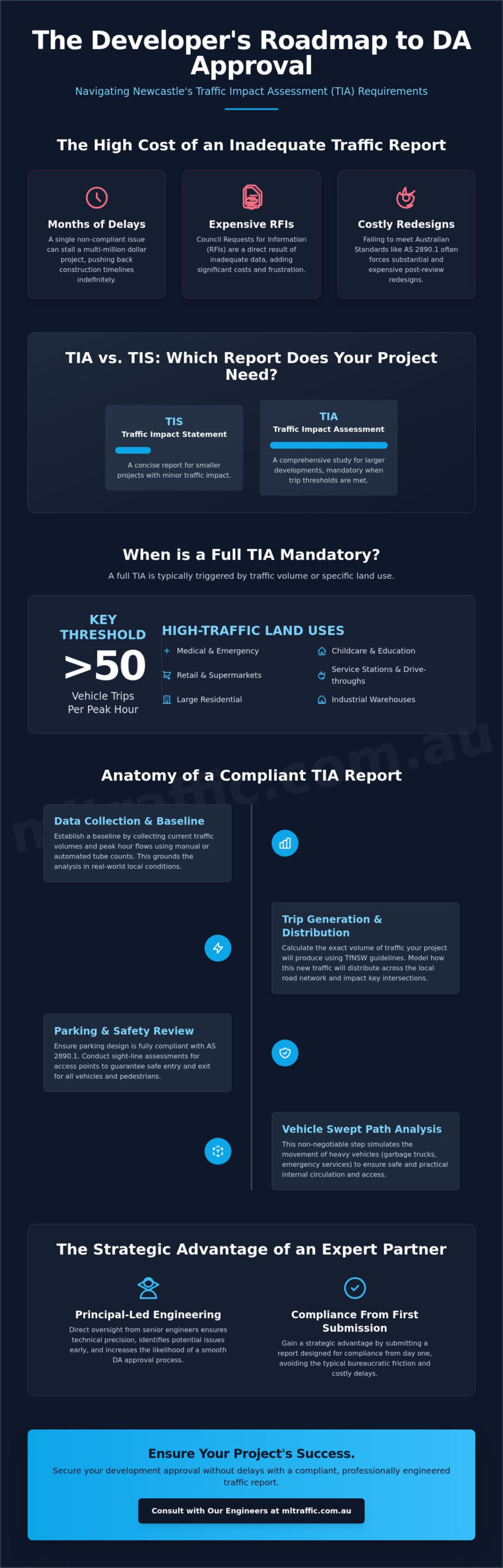
The transition from a simple statement to a full traffic impact assessment newcastle depends on specific trip generation thresholds. Most councils trigger a full TIA when a development is expected to generate over 50 vehicle trips per hour. However, certain “high-traffic” land uses require intensive reporting regardless of their square footage. These include:
- Childcare centres and educational facilities.
- Medical centres and emergency services.
- Retail shopping centres and supermarkets.
- Service stations and fast-food outlets with drive-through components.
- Large-scale residential flat buildings or industrial warehouses.
Identifying these requirements early prevents costly redesigns during the RFI (Request for Further Information) stage. You can learn when a traffic report is required for a DA by consulting with our senior engineers. We provide the technical clarity needed to satisfy Council requirements and move your project toward approval.
Technical Components: What Goes Into a Compliant TIA Report?
A professional report starts with an audit of the current road network performance. We collect data on traffic volumes, peak hour flows, and existing road geometry to establish a baseline. For a traffic impact assessment newcastle councils require data that reflects local conditions, including seasonal variations or impacts from nearby major transport hubs. This foundation ensures the subsequent modeling is grounded in reality rather than generic estimates.
Trip generation and distribution modeling form the core of the technical analysis. We use the Transport for NSW (TfNSW) Guide to Traffic Generating Developments to calculate the specific volume of traffic your project will produce. Once we determine the number of trips, we model the distribution. This identifies which specific intersections and local streets will bear the additional load. It’s a meticulous process that leaves no room for guesswork.
- Data Collection: Manual or tube counts to establish current traffic levels.
- Trip Generation: Calculation of peak hour vehicle movements based on land-use type.
- Safety Review: Sight-line assessments to ensure safe entry and exit for all road users.
- Internal Circulation: Swept path analysis for service vehicles and waste collection.
Parking and Access: The AS 2890.1 Standard
Parking design is governed by strict Australian Standards. We focus heavily on AS 2890.1 parking compliance to ensure every driveway, ramp grade, and parking bay is functional. An accurate parking demand assessment is vital. It prevents the over-supply of spaces, which wastes developable land, and avoids under-supply, which leads to council refusal due to overspill on public streets. We verify that the proposed supply aligns with both the Newcastle DCP and actual anticipated demand.
Intersection and Network Impact Analysis
Our engineers use SIDRA software to model intersection performance. We analyze the Level of Service (LoS) and average vehicle delays measured in seconds. It isn’t enough to look at your site in isolation. We must assess the cumulative impact of other approved but unbuilt developments in the vicinity. If the modeling shows a significant drop in network performance, the council may require developer contributions under Section 7.11 or physical road upgrades. We identify these triggers early to help you manage project costs.
Safe internal circulation is a non-negotiable requirement. We use specialized software to perform vehicle swept path assessments. This proves that delivery vans, garbage trucks, and emergency vehicles can navigate the site and exit in a forward direction. If you need assistance with these technical requirements, you can view our traffic engineering services to see how we support complex DA submissions.
The Critical Role of Vehicle Swept Path Analysis
Swept Path Analysis is the technical simulation of a vehicle’s wheel path and body envelope as it navigates a turn. It’s a non-negotiable component of any traffic impact assessment newcastle developers submit to Council. This process uses specialized software to prove that the proposed site layout can physically accommodate the vehicles intended to use it. Without these diagrams, a development application lacks the necessary proof of functional design.
Councils demand precise swept paths for several vehicle classes. These include 12.5-metre Heavy Rigid Vehicles (HRV) for waste collection, Medium Rigid Vehicles (MRV) for deliveries, and B99 cars for standard parking maneuvers. Emergency service vehicles must also have guaranteed access. We use AutoTURN software to generate these maneuvers. This industry-standard tool allows our engineers to overlay vehicle movements directly onto your architectural plans. These diagrams often dictate the final width of driveways and the geometric layout of loading docks. If a 12.5m garbage truck can’t clear a corner without mounting a kerb, the site plan must change.
Ensuring Safe Access and Egress
Safe movement depends on more than just fitting through a gap. We assess compliance with sight distance requirements at property boundaries according to AS 2890.1. Our analysis identifies ‘conflict points’ where heavy vehicle paths overlap with pedestrian walkways. Minimizing these interactions is a priority for Council safety officers. You can learn more about how swept path analysis secures Council approval to avoid design rework later in the process.
Common Swept Path Errors That Delay Projects
Project delays often stem from avoidable technical oversights in the initial application. We see three frequent errors in Newcastle submissions:
- Wrong Design Vehicle: Developers often fail to account for the largest ‘design vehicle’ expected on site. Using a small van simulation for a site that requires semi-trailer access leads to immediate rejection.
- Ignoring Clearances: Diagrams must include a minimum 300mm clearance for vehicle overhangs and mirrors. Simply showing the wheels clearing a wall isn’t enough.
- Inbound/Outbound Conflicts: Failing to show two vehicles passing at the driveway entrance.
A rejected swept path diagram is one of the most common reasons for an RFI from Council planners. Accuracy at this stage prevents the traffic impact assessment newcastle process from stalling. Our engineers ensure every turn is verified against current Australian Standards to keep your project moving forward.
Preparing for Council Submission: A Step-by-Step Process
Securing a development approval requires a systematic approach to traffic engineering. The process begins with an intensive site audit and data collection. We perform manual or pneumatic tube traffic counts and speed surveys to establish a baseline. This data isn’t generic; it reflects the specific road conditions and peak hour volumes of your site’s location. Accurate data is the foundation of any traffic impact assessment newcastle councils will accept.
Following data collection, we consult directly with Council engineers. This step confirms the required scope of work and ensures the technical report meets local expectations. Our internal process includes:
- Drafting the technical report based on current NSW Transport for NSW (TfNSW) guidelines.
- Performing internal quality assurance to verify compliance with AS 2890.1 (off-street parking) and AS 2890.2 (commercial vehicles).
- Finalizing the TIA for submission with the Statement of Environmental Effects (SEE).
- Providing ongoing support to address Council feedback and post-submission RFI responses.
The Importance of Early Engagement
Involving a traffic engineer during the concept design phase prevents costly errors. We identify “showstopper” access issues, such as inadequate sight lines or non-compliant driveway grades, before the design is finalized. Identifying these constraints early avoids expensive redesigns during the DA assessment phase. ML Traffic’s approach to early-stage consulting ensures that your architectural plans are functional and compliant from the start. This proactive strategy saves developers thousands in revision fees and months in planning delays.
Navigating Council RFIs (Request for Further Information)
Councils frequently issue an RFI to clarify technical details. Common questions involve parking demand vs. supply or the accuracy of vehicle swept path assessments. When a project faces a parking shortfall, we provide technical justifications based on empirical data and local precedents. Our engineers act as the primary mediator between the developer and Council. We translate complex engineering requirements into actionable solutions. This ensures your traffic impact assessment newcastle submission remains robust under scrutiny.
Our principals, Michael Lee and Benny Chen, handle these technical responses directly. The traffic consultant who provides your quote is the one who does the work, ensuring no technical detail is lost in communication during the RFI process.
Ensure your submission is technically sound from day one. Contact our senior engineers for a project-specific quote.
Choosing the Right Traffic Engineering Partner
Selecting a consultant for your traffic impact assessment newcastle requires more than just a price comparison. You need a partner with established DA credibility. ML Traffic Engineers has been trading since 2005. That’s nearly two decades of direct experience dealing with local councils and state authorities. This longevity matters because it builds a track record of reliability that Council officers recognize and trust. When a firm has been active for over 15 years, they understand the subtle shifts in local planning policies that newer firms might miss.
Senior oversight is non-negotiable for complex developments. Many large firms use senior staff to win the bid, then hand the technical work to junior graduates. We don’t operate that way. The traffic consultant who provides your quote is the one who actually does the work. This ensures accountability and technical precision from start to finish. You get direct access to principals Michael Lee and Benny Chen, who each bring between 30 and 40 years of experience to your project. This principal-led approach eliminates the communication gaps found in larger, bureaucratic firms.
Project deadlines for DA submissions are often tight. Delays in traffic reports can stall an entire development timeline. We focus on speed and reliability without compromising technical standards. Our reports adhere strictly to Australian Standards (AS 2890.1) and specific Council requirements to minimize RFI (Request for Further Information) cycles. Securing a traffic impact assessment newcastle from a seasoned expert ensures your project stays on track and avoids costly redesigns late in the planning phase.
Why ML Traffic Engineers Stands Out Nationally
We’ve completed assessments for over 10,000 sites across Australia. Our portfolio covers every conceivable land-use type, including:
- Apartments and mixed-use developments
- Child care centres and schools
- Medical clinics and hospitals
- Service stations and fast-food outlets
- Industrial warehouses and freight hubs
- Places of public worship and community centres
Our technical approach is no-nonsense and fact-based. We don’t rely on fluff or emotional appeals; we provide the data and technical justifications that Councils trust to make their decisions.
Get Started on Your Traffic Assessment
To receive a fast and accurate traffic engineering proposal, provide your architectural site plans and a brief project description. This allows us to determine the exact scope required, whether it involves Vehicle Swept Path Assessments, Sight-Line Assessments, or Car Parking Demand Assessments. A comprehensive quote ensures there are no hidden costs or technical surprises during the DA process. You can Contact ML Traffic Engineers for a project quote to begin your assessment today.
Secure Your Council Approval with Technical Precision
Navigating the complexities of a traffic impact assessment newcastle requires more than just filling out forms. It demands technical accuracy in vehicle swept path analysis and strict adherence to Australian Standard AS 2890.1. A compliant report doesn’t just check a box; it mitigates risk and prevents costly delays during the council submission process. ML Traffic Engineers brings over 15 years of dedicated industry experience to your project, having successfully assessed over 10,000 sites across Australia. You won’t deal with junior staff or gatekeepers because we believe in direct accountability.
Our unique approach ensures that the principal engineer who provides your quote is the same expert who performs the actual technical work. This hands-on involvement ensures your development application meets every regulatory requirement from the first submission. Whether you’re developing a small residential block or a large commercial warehouse, our data-driven reports provide the reliability councils demand. It’s time to move your project forward with confidence and professional engineering support. We look forward to helping you achieve a successful outcome for your Newcastle development.
Get a Compliant Traffic Impact Assessment Quote Today
Frequently Asked Questions
What is the difference between a Traffic Impact Assessment (TIA) and a Traffic Impact Statement (TIS)?
A Traffic Impact Statement (TIS) is a concise report for smaller developments with minimal traffic generation, while a Traffic Impact Assessment (TIA) is a comprehensive study for larger projects. Newcastle City Council typically requires a TIS for minor developments like small-scale retail. A TIA involves complex modeling for high-density residential or industrial sites that significantly alter local traffic flow.
How long does it take to prepare a professional traffic report for a DA?
Professional traffic reports for a Development Application (DA) generally take between 10 and 15 business days to complete. This timeframe includes site inspections, data collection, and technical writing. Complex projects requiring intersection modeling or extensive manual traffic counts may extend to 20 business days. We ensure the traffic consultant who provides the quote does the work to maintain this schedule.
Can a general civil engineer prepare my traffic impact assessment?
While a general civil engineer can technically sign off, Newcastle Council often requires a specialist traffic engineer with demonstrated experience in Australian Standard AS 2890.1. Specialist traffic consultants provide the technical depth needed for parking demand and swept path analysis. This expertise reduces the risk of Requests for Further Information (RFIs) during the DA assessment process.
What happens if my development doesn’t meet the required parking numbers?
If a development doesn’t meet the Newcastle Development Control Plan (DCP) parking rates, a Car Parking Demand Assessment is required to justify the shortfall. We use empirical data from the RTA Guide to Traffic Generating Developments to prove the proposed parking is sufficient. Councils often accept lower numbers if the site is within 400 metres of a high-frequency public transport hub.
How much does a Traffic Impact Assessment typically cost?
Traffic report costs vary based on project scale, but industry data indicates basic statements start from A$1,500, while complex assessments can exceed A$5,000. Factors influencing the final fee include the number of intersections requiring SIDRA modeling and the necessity for manual traffic counts. Every quote is site-specific to ensure compliance with current Australian Standards and local government regulations.
What is a swept path analysis and is it always required in a TIA?
A swept path analysis is a computer-simulated map showing a vehicle’s turning circle and is mandatory for any site with restricted access or heavy vehicle requirements. We use AutoTURN software to verify that waste collection vehicles or delivery trucks can enter and exit in a forward direction. This is a standard requirement for industrial developments and multi-deck car parks under AS 2890.2.
How long is a traffic impact assessment valid for Council submission?
Traffic impact assessments are generally considered valid for 12 months from the date of the traffic counts used in the report. If a DA is delayed beyond 12 months, Newcastle Council may require updated traffic data to account for recent background growth or new nearby developments. We recommend submitting reports within 6 months of completion to ensure data accuracy.
Do I need a traffic report for a simple change of use application?
Yes, a traffic report is often required for a change of use if the new land use generates more trips or has higher parking requirements. For example, converting a warehouse into a gym significantly increases peak hour traffic. A traffic impact assessment Newcastle council submission ensures the change won’t negatively affect local road safety or street parking availability for existing residents.

Disclaimer
The content on www.mltraffic.com.au, including all technical articles, guides, and resources, is provided for general informational and educational purposes only. It is not intended to constitute professional advice in traffic engineering, transportation planning, development approvals, or any other technical or legal field.
While ML Traffic Engineers makes every reasonable effort to ensure the accuracy, completeness, and timeliness of the information published, we do not provide any warranties or representations (express or implied) regarding its reliability, suitability, or availability for any particular purpose. Any reliance you place on the content is strictly at your own risk.
In no event shall ML Traffic Engineers, its directors, employees, authors, or affiliates be liable for any direct, indirect, incidental, special, consequential, or punitive damages (including, without limitation, loss of profits, data, or business opportunities) arising out of or in connection with the use of, or inability to use, any information provided on this website.
The articles and guides on this site are not a substitute for engaging a qualified, registered professional traffic engineer (such as an NPER or RPEQ engineer) to assess your specific project requirements. For tailored advice, compliance assessments, or traffic engineering services, please contact a competent professional.
This disclaimer may be updated from time to time without notice. By accessing or using this website, you agree to be bound by the most current version of this disclaimer.
