

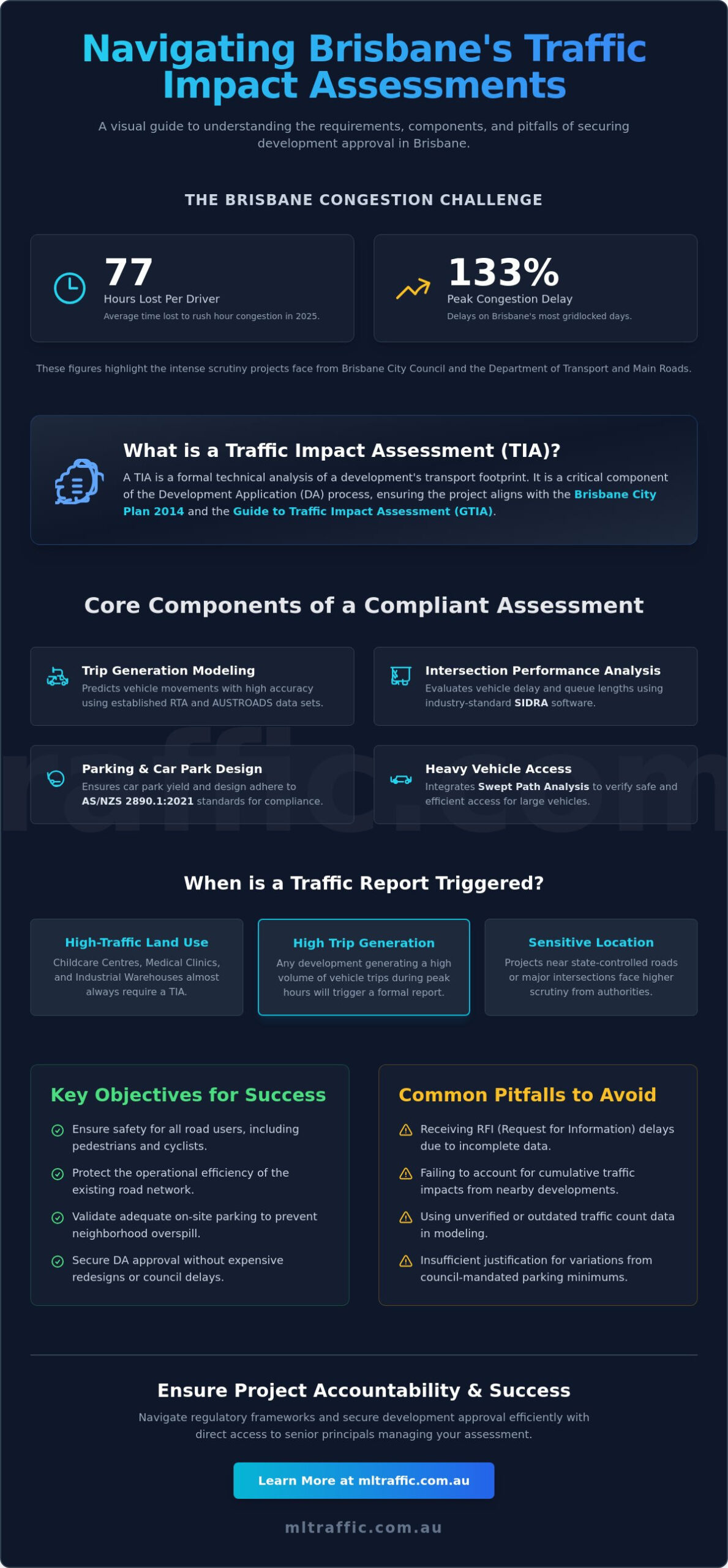
In 2025, Brisbane drivers lost an average of 77 hours to rush hour congestion, with peak delays reaching 133% on the city’s most gridlocked days. These metrics represent the intense scrutiny your project will face from both the Brisbane City Council and the Department of Transport and Main Roads. You recognize that a traffic impact assessment brisbane is a mandatory requirement, but the technical complexity of the Brisbane City Plan 2014 often creates bureaucratic delays and unexpected infrastructure costs.
We provide the professional expertise needed to navigate these regulatory frameworks and secure development approval efficiently. You’ll learn how to apply the July 2024 Guide to Traffic Impact Assessment (GTIA) and ensure your car park design adheres to the AS/NZS 2890.1:2021 standards. This guide details the technical requirements for vehicle swept path analysis and parking demand assessments, offering a clear path to a compliant, professional report that councils accept.
Key Takeaways
- Identify the specific technical requirements that make a traffic impact assessment brisbane mandatory for commercial, industrial, and multi-residential development applications.
- Utilize industry-standard SIDRA software and trip generation modeling to provide accurate intersection performance data for council review.
- Apply AS 2890.1 design standards to optimize car park yield while meeting or justifying variations to council-mandated parking minimums.
- Mitigate the risk of RFI delays by accounting for cumulative traffic impacts from neighboring developments and using verified, current traffic count data.
- Ensure project accountability through direct access to senior principals who manage the technical assessment from inception to final approval.
Understanding the Role of a Traffic Impact Assessment (TIA)
A Traffic Impact Assessment (TIA) is a formal technical analysis of a proposed development’s transport footprint. It provides a detailed evaluation of how a project will affect the surrounding road network and public transport systems. In the context of a traffic impact assessment brisbane, this document is a critical component of the Development Application (DA) process. It ensures the project aligns with the Brisbane City Plan 2014 and the Guide to Traffic Impact Assessment (GTIA) published by the Department of Transport and Main Roads. Traffic engineering principles underpin these assessments, allowing developers to mitigate potential congestion and safety risks before they become costly liabilities.
For a visual overview of the methodology and requirements of this technical study, watch this video:
A TIA is mandatory for most commercial, industrial, and multi-residential DAs because councils must verify that local infrastructure can handle the additional load. While a full TIA covers extensive modeling and intersection analysis, some smaller projects may only require a Traffic Impact Statement (TIS). This is a simplified version focusing on site-specific access and parking. Professional traffic engineering services provide the data needed to support the broader Statement of Environmental Effects by quantifying the physical impact of vehicle movements.
When is a Traffic Report Triggered?
Specific thresholds for trip generation usually dictate the level of reporting required for a site. If a development generates a high volume of peak-hour trips, authorities will mandate a formal report. High-traffic land uses such as childcare centers, medical clinics, and industrial warehouses almost always trigger this requirement. The site’s location also plays a significant role. A project near a state-controlled road or a major intersection will face higher scrutiny than one on a local street.
The Objectives of an Authoritative Assessment
The primary goal of a professional traffic impact assessment brisbane is to ensure the safety of all road users. This includes pedestrians and cyclists, not just motorists. A well-executed report protects the operational efficiency of the existing road network by preventing bottlenecks. It also validates that the proposed development provides adequate on-site parking, reducing the likelihood of overspill into neighboring streets. This technical validation is essential for securing DA approval without the risk of expensive redesigns or infrastructure levies.
Core Components of a Compliant Traffic Assessment
A compliant traffic assessment relies on rigorous data collection and standardized modeling protocols. Every traffic impact assessment brisbane must prove that a proposed development won’t degrade the existing level of service on the local road network. This process starts with precise trip generation and distribution modeling. Engineers utilize established data sets from RTA and AUSTROADS to predict vehicle movements with high accuracy. These figures are then integrated into intersection performance analysis using SIDRA software. SIDRA serves as the industry-standard tool for evaluating vehicle delay, queue lengths, and the overall degree of saturation at critical junctions.
The technical benchmarks for these studies are often guided by the Institute of Transportation Engineers Australia & New Zealand. Following these professional standards ensures that the report findings are defensible during the council’s internal review process. Beyond macro-level modeling, the assessment must address site-specific safety details. This includes a thorough sight distance assessment at all proposed driveway locations to ensure motorists can enter and exit the property safely.
Heavy vehicle access is a frequent point of contention in industrial and large-scale commercial applications. We integrate swept path analysis to simulate the movement of service vehicles. This analysis verifies that delivery trucks and waste collection units can maneuver within the site boundaries without striking curbs or encroaching on opposing traffic lanes.
Trip Generation and Traffic Modelling
Calculating peak hour vehicle movements for a traffic impact assessment brisbane requires a granular analysis of land-use categories. We determine exactly how many trips a site will generate during the morning and afternoon peaks based on its specific use, such as retail, residential, or industrial. This modeling also forecasts future traffic growth over a 10-year horizon to account for regional expansion. Using data-driven evidence allows us to counter council objections regarding traffic congestion. This factual approach is essential for developers who want to avoid unnecessary infrastructure contributions or road upgrade costs.
Vehicle Access and Maneuverability
The safety and efficiency of entry points are primary concerns for Brisbane City Council. The assessment determines if the site requires restricted "left-in, left-out" movements or if full-access intersections are viable. We also conduct a driveway ramp grade assessment to ensure the design meets Australian Standards. This prevents vehicle undercarriage damage and ensures smooth transitions from the site to the public road. If you require a detailed review of your site’s access potential, our traffic engineering services provide the technical clarity needed for approval.
Navigating Australian Standards for Parking and Design
Achieving planning approval requires more than managing external road impacts; it demands strict adherence to internal site design standards. For any traffic impact assessment brisbane, the primary technical benchmark is AS 2890.1. This standard governs off-street parking facilities, including bay dimensions, aisle widths, and headroom requirements. The 2021 update to this standard introduced revised design vehicle dimensions that engineers must incorporate into every new development. Compliance with these national standards ensures that the car park is functional for the intended user class while meeting the rigorous safety expectations of the Brisbane City Council.
Professional car park design also encompasses AS 2890.6 for disabled parking and specific provisions for loading zones. These elements are not just compliance hurdles. They are essential for the operational safety of the site. Certification of the design by a qualified engineer provides the council with the assurance that the layout is safe, accessible, and compliant with current Australian Standards. This technical validation reduces the risk of expensive redesigns during the construction phase.
Parking Demand vs. Council Requirements
Council-mandated parking minimums often conflict with site constraints or the commercial reality of a project. We bridge this gap by conducting a car parking demand assessment. This involves empirical parking surveys of similar land uses to prove that actual demand is lower than the statutory requirement. In high-density urban areas, we also integrate "Green Travel Plans." These strategies promote public transport and cycling, providing a technical justification for parking relaxations without compromising site functionality. This approach is particularly effective when site yield must be maximized within a limited footprint.
Designing for Compliance and Efficiency
Optimizing a car park layout is a technical exercise in maximizing site yield while maintaining compliance. We analyze aisle widths and bay angles to ensure efficient vehicle circulation throughout the facility. Every design undergoes vehicle swept path analysis for B99 vehicles and heavy service trucks to verify that turns are manageable without encroaching on opposing lanes. Pedestrian safety is another critical component of a traffic impact assessment brisbane. We design dedicated pathways and clear sightlines to minimize conflict points in high-traffic environments, ensuring the development is safe for all users.
Common Pitfalls in the Traffic Assessment Process
Many development applications stall because the technical reports lack depth or rely on flawed assumptions. A frequent oversight in a traffic impact assessment brisbane is the failure to account for cumulative traffic impacts. If your modeling ignores neighboring developments that are already approved or under construction, the council will likely reject your findings. Brisbane’s rapid growth means that intersection performance analysis must reflect the total future load, not just the isolated impact of a single site.
Data accuracy is another critical area where projects fail. Using outdated traffic count data is a significant risk. 2025 statistics show that Brisbane drivers lost an average of 77 hours to congestion, a metric that has shifted significantly since 2023. Reports relying on pre-2023 data don’t reflect current road realities. We see several other recurring technical errors:
- Applying incorrect trip generation rates that don’t match the specific land-use intensity.
- Conducting inadequate sight distance assessments that fail to meet safety standards for all road users.
- Ignoring the requirement for a Traffic Guidance Scheme (TGS) to manage vehicle movements during the construction phase.
- Submitting car park designs that don’t account for the increased dimensions of modern, larger vehicles.
Errors in these areas trigger immediate safety concerns from council officers. If you want to avoid these technical traps, contact our senior principals for an authoritative review of your project requirements.
Addressing Council RFI (Request for Further Information)
An RFI can add months to your approval timeline and thousands to your holding costs. A proactive TIA prevents these cycles by anticipating council questions and providing the data upfront. When a council officer raises a technical objection, your engineer must be able to negotiate using empirical evidence. We provide direct access to senior leadership for this purpose. If a project moves to the Planning and Environment Court, having a seasoned expert witness who can stand behind the technical modeling is essential for a successful appeal.
Integration with Other Engineering Disciplines
Traffic engineering shouldn’t happen in a vacuum. We coordinate closely with civil engineers to ensure that a driveway ramp grade assessment aligns with the site’s stormwater and finished floor levels. Solutions that solve a traffic problem must not create an acoustic conflict. For example, a required noise wall shouldn’t obstruct the sightlines identified in your sight distance assessment. The value of professional traffic engineering lies in this multi-disciplinary coordination, ensuring that every technical component supports the final DA approval.
ML Traffic Engineers: Seasoned Expertise for National Projects
ML Traffic Engineers provides the technical precision required for complex development applications. Our firm is led by senior principals with over 15 years of industry experience. We don’t utilize junior staff for critical technical work. Every traffic impact assessment brisbane we produce is managed directly by a qualified expert. This ensures that the technical modeling and council negotiations are handled with the highest level of professional accountability. Our clients benefit from direct access to leadership, ensuring a "no-gatekeepers" approach to project management.
A unique marker of our service is the personnel continuity promise. The expert who initiates your client relationship is the same professional performing the technical analysis and signing the final report. This distinguishes us from larger, more impersonal firms where projects are often passed down to less experienced personnel. It ensures that the specific nuances of your site’s access and parking requirements are understood from inception to final DA approval. This hands-on philosophy eliminates communication gaps and ensures that technical solutions remain consistent throughout the planning process.
Our National Capability and Technical Precision
Our project portfolio spans a diverse range of environments. We’ve delivered results across residential subdivisions, retail shopping centers, commercial offices, industrial warehouses, and healthcare facilities. This breadth of experience allows us to provide meticulous, results-oriented solutions for any land-use category. We utilize advanced software including SIDRA for intersection analysis and AutoTURN for vehicle swept path analysis. These tools allow us to provide fact-based reporting that Brisbane City Council and the Department of Transport and Main Roads trust. Our comprehensive services range from car park design to detailed traffic impact assessments.
We prioritize compliance and operational safety in every report. By adhering strictly to national regulatory standards like AS 2890.1, we minimize the risk of council RFIs. Our reporting is direct and information-dense, focusing on the technical metrics that drive approval. We understand the bureaucratic landscape of Brisbane’s planning schemes and provide the evidence needed to navigate it. Whether your project involves a childcare center, a service station, or a high-rise mixed-use development, our reporting provides a solid foundation for your planning application.
Streamline Your DA Approval Today
Securing a compliant traffic impact assessment brisbane is the first step toward a successful development. You can contact our senior engineers directly to discuss your site’s specific challenges. We provide clear, authoritative advice on driveway ramp grade assessments, sight distance requirements, and parking demand justifications. Our team understands the nuances of the Brisbane City Plan 2014 and the latest GTIA updates from July 2024. Benefit from the reliability of a seasoned expert who stays with your project from the initial fee proposal to the final council sign-off.
Contact ML Traffic Engineers for your Traffic Impact Assessment to ensure your next project proceeds without technical delays.
Secure Your Development Approval with Technical Precision
Achieving a successful development outcome in Brisbane requires a meticulous approach to transport planning. A compliant traffic impact assessment brisbane must integrate rigorous SIDRA modeling with precise swept path analysis to meet council expectations. Avoiding common pitfalls, such as using outdated traffic data or ignoring cumulative impacts, is essential to prevent costly RFI cycles. By aligning your site design with AS 2890.1 standards, you protect both the operational safety and the commercial yield of your project.
ML Traffic Engineers offers direct access to senior principals with over 15 years of industry experience. We provide nationwide service coverage and a personnel continuity promise that ensures the expert starting your project is the one who finishes it. This seasoned expertise is your most reliable tool for navigating complex bureaucratic requirements. Get a Quote from a Senior Traffic Engineer today to streamline your path to DA approval. We’re ready to help you move your project forward with confidence.
Frequently Asked Questions
How much does a Traffic Impact Assessment cost for a standard development?
The cost of a report depends entirely on the project’s scale and technical complexity. A simple change of use assessment requires fewer resources than a comprehensive study for a large mixed-use development. While we don’t provide fixed pricing without a site review, developers should account for mandatory council fees, such as the $572.00 fee for the review of Road and Traffic Signal Drawings for the 2025-26 financial year.
Is a Traffic Impact Assessment required for every Development Application?
No, a full TIA is not always mandatory. The requirement is triggered by specific trip generation thresholds or the land-use category. Smaller projects may only require a Traffic Impact Statement. However, any significant development in Brisbane typically requires a professional traffic engineering report to be considered a valid Development Application. High-traffic uses like childcare centers and industrial warehouses almost always trigger this requirement.
Can I use a general civil engineer for my traffic and parking report?
General civil engineers lack the specialized software and deep regulatory knowledge required for complex transport modeling. Councils prefer reports from specialist traffic engineers who use industry-standard tools like SIDRA and AutoTURN. A specialist provides the technical precision needed to navigate the Brisbane City Plan 2014 and the Guide to Traffic Impact Assessment (GTIA) without triggering unnecessary Requests for Further Information.
What happens if my development exceeds the council parking requirements?
Providing more parking than the council-mandated minimum is generally permitted but can reduce your overall site yield. If your design cannot meet the minimum requirements, you must provide a car parking demand assessment. This technical study uses empirical data to justify a parking relaxation. It proves that the actual demand will be lower than the statutory requirement, protecting your project from rejection.
How long does it take to prepare a compliant Traffic Impact Assessment?
A typical traffic impact assessment brisbane takes between 2 to 4 weeks to complete. This duration allows for the collection of current traffic count data, SIDRA intersection modeling, and a thorough review by a senior principal. Complex projects involving state-controlled roads may require additional time for coordination with the Department of Transport and Main Roads (TMR) to ensure all regulatory benchmarks are met.
What is the difference between AS 2890.1 and AS 2890.2?
AS 2890.1 is the Australian Standard for off-street car parking, focusing on light vehicles and residential or commercial bays. AS 2890.2 governs off-street commercial vehicle facilities, including loading docks and service areas for heavy trucks. A compliant traffic impact assessment brisbane must often address both standards to ensure that service vehicles and private cars can coexist safely on the site without operational conflicts.
Can a TIA help in negotiating a reduction in infrastructure contributions?
Yes, an authoritative TIA provides the technical evidence required to challenge excessive infrastructure levies. By accurately modeling the project’s actual impact on the local road network, engineers can demonstrate that certain upgrades are not warranted. This data-driven approach allows developers to negotiate more favorable terms with council officers based on the development’s true transport footprint rather than generalized estimates.
Do I need a new TIA if I change the land-use type of my development?
Yes, changing the land use significantly alters the trip generation rates and parking demands of a property. A medical clinic generates different traffic patterns than a warehouse of the same size. A revised assessment ensures the new use remains compliant with the Brisbane City Plan 2014. It also confirms that the local intersection capacity can handle the specific peak-hour movements associated with the new land-use category.
What suburbs do you cover within Brisbane Metropolitan Area?
We are traffic engineers servicing Brisbane, Brisbane City, Fortitude Valley, New Farm, Teneriffe, Kangaroo Point, East Brisbane, South Brisbane, West End, Highgate Hill, Dutton Park, Woolloongabba, Ascot, Clayfield, Albion, Bowen Hills, Newstead, Bulimba, Hawthorne, Morningside, Balmoral, Indooroopilly, Taringa, Toowong, Auchenflower, Milton, Paddington, Red Hill, Bardon, Ashgrove, The Gap, Enoggera, Mitchelton, Aspley, Chermside, Kedron, Stafford, Everton Park, Gordon Park, Wilston, Grange, Alderley, Kelvin Grove, Herston, Lutwyche, Windsor, Nundah, Wavell Heights, Chermside West, Zillmere, Carseldine, Bald Hills, Bracken Ridge, Brighton, Sandgate, Shorncliffe, Deagon, Taigum, Fitzgibbon, Boondall, Virginia, Banyo, Nudgee, Northgate, Hamilton, Hendra, Eagle Farm, Murarrie, Cannon Hill, Seven Hills, Norman Park, Coorparoo, Camp Hill, Carina, Carindale, Mount Gravatt, Upper Mount Gravatt, Mansfield, MacGregor, Robertson, Sunnybank, Sunnybank Hills, Acacia Ridge, Inala, Oxley, Corinda, Graceville, Sherwood, Yeronga, Annerley, Moorooka, Tarragindi, Holland Park, Holland Park West, Coopers Plains, Greenslopes, Fairfield, Yeerongpilly, Stones Corner, Wynnum, Wynnum West, Manly, Manly West, Tingalpa, Hemmant, Lota, Wakerley, Rochedale, Eight Mile Plains, Runcorn, Calamvale, Parkinson, Algester, Doolandella, Forest Lake, Richlands, Darra, Wacol, Archerfield, Rocklea, Salisbury, Nathan, Mount Gravatt East, Wishart, Karawatha, Stretton, Kuraby, Belmont, Chandler, Gumdale, Lytton, Port of Brisbane, Kenmore, Jindalee, Mount Ommaney, Sinnamon Park, Fig Tree Pocket, Chapel Hill, St Lucia, Petrie Terrace, Spring Hill, Wooloowin, Newmarket, Gaythorne, Keperra, Ferny Grove, Upper Kedron, Bridgeman Downs, McDowall, Stafford Heights, Geebung, Pinkenba, Brisbane Airport, Nudgee Beach, Kalinga, Albion (duplicate avoided), Anstead, Bellbowrie, Brookfield, Chelmer, Chuwar, England Creek, Enoggera Reservoir, Jamboree Heights, Karana Downs, Kenmore Hills, Kholo, Lake Manchester, Middle Park, Moggill, Mount Coot-tha, Mount Crosby, Pinjarra Hills, Pullenvale, Riverhills, Seventeen Mile Rocks, Upper Brookfield, Westlake, Banks Creek, Burbank, Drewvale, Durack, Ellen Grove, Heathwood, Larapinta, Mackenzie, Pallara, Sumner, Tennyson, Willawong, Carina Heights, Ransome, Cannon Hill (duplicate avoided), Carindale, Manly, Moreton Island, Bulwer, Cowan Cowan, Kooringal.
Can you help with developments outside of Brisbane, like the Gold Coast or Sunshine Coast?
Yes. While we have deep expertise in Brisbane, our senior engineers have extensive experience securing DA approvals with councils across Queensland, including the Gold Coast, Sunshine Coast, Moreton Bay, Logan, and Ipswich.

Disclaimer
The content on www.mltraffic.com.au, including all technical articles, guides, and resources, is provided for general informational and educational purposes only. It is not intended to constitute professional advice in traffic engineering, transportation planning, development approvals, or any other technical or legal field.
While ML Traffic Engineers makes every reasonable effort to ensure the accuracy, completeness, and timeliness of the information published, we do not provide any warranties or representations (express or implied) regarding its reliability, suitability, or availability for any particular purpose. Any reliance you place on the content is strictly at your own risk.
In no event shall ML Traffic Engineers, its directors, employees, authors, or affiliates be liable for any direct, indirect, incidental, special, consequential, or punitive damages (including, without limitation, loss of profits, data, or business opportunities) arising out of or in connection with the use of, or inability to use, any information provided on this website.
The articles and guides on this site are not a substitute for engaging a qualified, registered professional traffic engineer (such as an NPER or RPEQ engineer) to assess your specific project requirements. For tailored advice, compliance assessments, or traffic engineering services, please contact a competent professional.
This disclaimer may be updated from time to time without notice. By accessing or using this website, you agree to be bound by the most current version of this disclaimer.
