

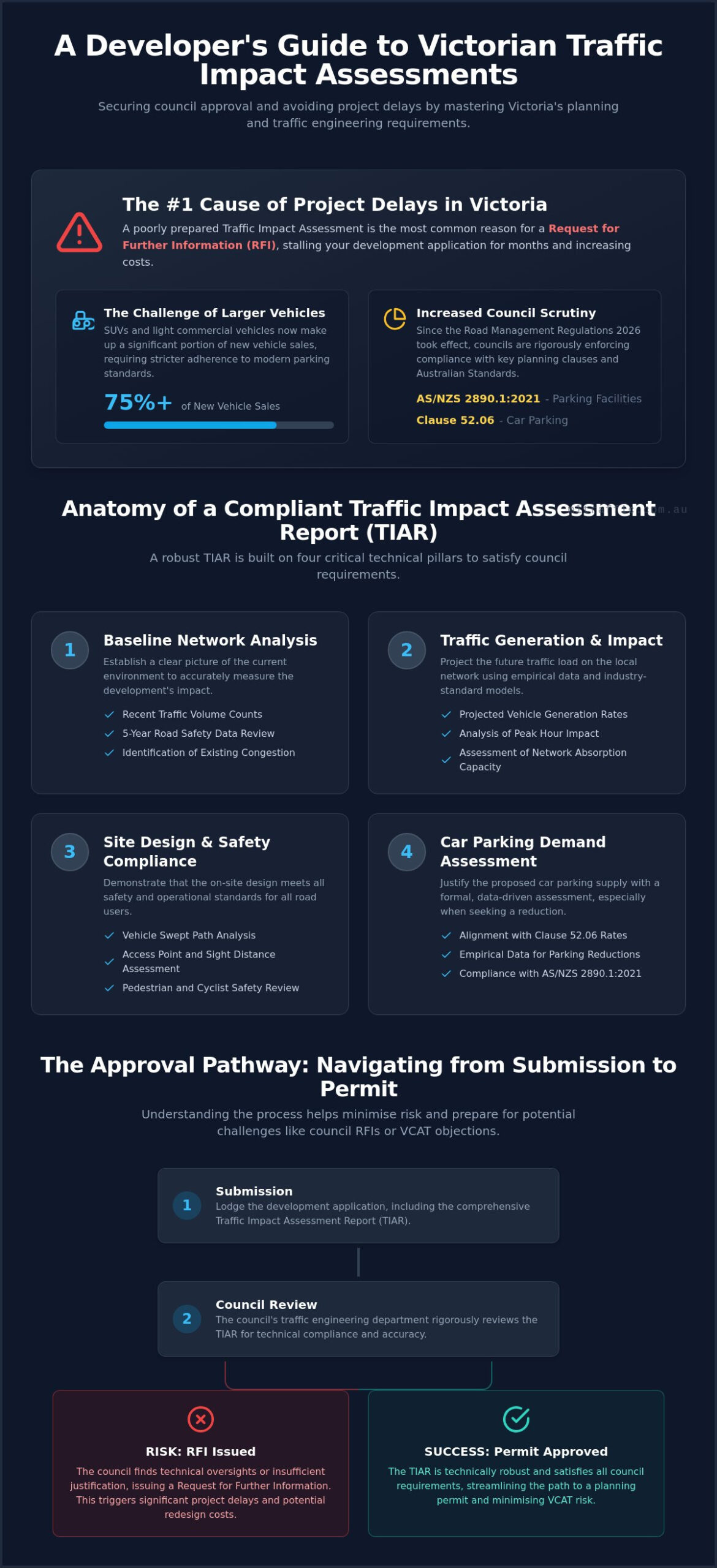
A poorly prepared traffic impact assessment victoria is the most common cause of project delays. Since the Road Management Regulations 2026 took effect on 13 June, councils have increased their scrutiny of every development application. A minor technical oversight in your car parking design or access plan can trigger a Request for Further Information (RFI) that stalls your progress for months. You cannot afford to treat traffic planning as an afterthought when SUVs and light commercial vehicles now account for over 75% of new car sales, forcing stricter adherence to AS/NZS 2890.1:2021 standards.
We recognise that the Victorian Planning Scheme is a complex and often contradictory framework. This guide provides the technical roadmap you need to secure council approval and avoid the risk of VCAT objections. You’ll learn how to align your project with Clause 52.06 requirements and the new infrastructure contribution rates for the 2026-27 financial year. We will cover the critical role of vehicle swept path analysis, the necessity of accurate car parking demand assessments, and the strategies required to defend your design against common council objections.
Key Takeaways
- Streamline your planning permit application by understanding the specific technical requirements for a traffic impact assessment victoria.
- Identify the essential data points required for a compliant TIAR, from baseline road safety data to projected vehicle generation rates.
- Master the application of AS/NZS 2890.1:2021 and Clause 52.06 to justify car parking reductions through formal demand assessments.
- Minimise development risk by effectively managing Council Requests for Further Information (RFIs) and preparing for expert VCAT representation.
- Leverage over 15 years of Victorian consultancy experience and a “no-gatekeepers” approach for direct access to senior engineering principals.
Understanding Traffic Impact Assessment (TIA) in the Victorian Planning System
A Traffic Impact Assessment (TIA) is a formal technical report required by Victorian planning authorities to evaluate how a proposed development affects the existing transport network. In the context of a traffic impact assessment victoria, the report serves as evidence that the project’s traffic generation will not compromise road safety or operational efficiency. Local councils and the Department of Transport and Planning utilise these documents to make informed decisions during the planning permit application process.
Professional assessments rely on established traffic engineering principles to model vehicle movements and parking demand. While larger developments require a comprehensive Traffic Impact Assessment Report (TIAR), smaller projects with minimal expected impact might only necessitate a simpler Traffic Impact Statement (TIS). The distinction depends on the scale of the development and the specific requirements of the local planning scheme.
To better understand when these assessments are required, watch this brief overview:
When is a TIA Mandatory in Victoria?
The requirement for a traffic assessment is typically triggered when a development exceeds specific thresholds defined in the Victorian Planning Scheme. This includes large-scale residential subdivisions, significant commercial retail spaces, or intensive industrial facilities. Land-use changes, such as converting a warehouse into a gymnasium or a licensed venue, often necessitate a new traffic impact assessment victoria due to the shift in peak-hour traffic patterns and parking requirements.
Clause 52.06 of the Victoria Planning Provisions is a primary driver for these reports. This clause dictates the statutory car parking requirements for new developments. If a developer seeks a reduction in the standard parking rates, a professional engineering report must justify the shortfall using empirical data and parking demand analysis. Councils frequently issue a Request for Further Information (RFI) if these justifications aren’t technically robust from the outset.
The Objective of Traffic Engineering Reports
The core objective of these reports is to ensure the safety and functionality of the road network for all users. This involves several technical validations:
- Confirming safe vehicle access and egress points to prevent collisions.
- Analysing sight distances at intersections to meet Australian Standards.
- Validating that existing infrastructure can absorb the projected traffic volume without causing excessive congestion.
- Assessing pedestrian and cyclist safety within the site’s immediate vicinity.
The TIAR serves as a technical instrument that balances the developer’s commercial objectives with the council’s mandate to maintain community safety and road network integrity.
Essential Components of a Victorian Traffic Impact Assessment Report (TIAR)
A TIAR must be a robust technical document that survives rigorous council review. It begins with a detailed analysis of the existing road network. This involves collecting recent traffic volume counts and reviewing road safety data, typically spanning the previous five years. Identifying existing congestion points or safety blackspots is essential to establish a baseline for the development’s impact. Without this foundation, the council cannot accurately gauge the incremental pressure your project will place on local infrastructure.
The core of the report focuses on how the proposed site will function once operational. Every traffic impact assessment victoria must include several critical technical pillars:
- Projected traffic generation based on empirical evidence and industry-standard databases.
- Assessment of vehicle access points to ensure they meet sight distance requirements under Australian Standards.
- Evaluation of internal site circulation for both passenger and commercial vehicles.
- Integration of Swept Path Analysis to verify that the largest expected vehicles can manoeuvre safely.
- Proposed mitigation strategies, such as intersection upgrades or modified signal timings, to address identified capacity constraints.
Traffic Generation and Distribution Modelling
Engineers calculate peak hour impacts by applying trip generation rates specific to the land-use category. For instance, a residential development has different peak characteristics than a medical centre or a retail hub. Once we determine the volume of trips, we model the traffic distribution. This involves mapping exactly how vehicles will enter and exit the site and which adjacent intersections they will use. Accurate modelling helps pre-empt council concerns regarding local noise and traffic bottlenecks before they lead to an RFI.
Swept Path Analysis and Access Design
Access design must comply with AS 2890.1:2021 for cars and AS 2890.2 for commercial vehicles. We utilise AutoTURN software to generate precise vehicle movement diagrams. These diagrams prove that waste collection trucks and delivery vans can navigate the site without striking kerbs or blocking aisles. For a deeper look at the technical requirements of these diagrams, refer to our Swept Path Analysis: A Complete Guide for Australian Developments.
Ensuring these designs are correct from the start reduces the likelihood of costly layout revisions during the construction phase. If you require a compliant Traffic Impact Assessment (TIA) Report, our senior principals provide the technical oversight necessary to secure a favourable outcome.
Car Parking Demand and Compliance with AS 2890
Car parking is often the most contentious aspect of a planning application. In Victoria, developers must align their designs with Clause 52.06 of the planning scheme. While the scheme sets standard rates, a traffic impact assessment victoria provides the technical justification for a reduction when those rates aren’t feasible or necessary. This is particularly relevant following the December 2025 updates to Clause 52.06, which linked parking requirements more closely to public transport accessibility levels.
A formal Car Parking Demand Assessment uses empirical data to prove that a development won’t overflow into surrounding streets. This is essential for projects in high-density areas where street capacity is already limited. By providing a traffic impact assessment victoria that includes a robust demand analysis, you demonstrate that the site can function without burdening the local community. We use local parking surveys and comparative site data to build a case that councils can approve with confidence.
Technical precision in the physical layout is equally vital. We provide detailed design input for driveway ramp grades and aisle widths to ensure the car park is functional and safe. A ramp that is too steep or an aisle that is too narrow will result in an immediate council rejection. Our assessments ensure every bay and access point complies with the latest Australian Standards for off-street parking and commercial vehicle facilities.
Navigating AS 2890.1 and AS 2890.2
Residential developments follow Part 1 of the standard, while commercial and industrial sites must adhere to the more stringent Part 2 requirements for larger vehicles. Part 1 focuses on off-street car parking for typical passenger vehicles; Part 2 handles the complexities of service and delivery vehicles. Expert design avoids “tight spots” that lead to vehicle damage and council rejection. For a technical breakdown of these requirements, see our guide on AS 2890.1 Explained: The Ultimate Guide to Compliant Car Park Design.
Parking Management Plans (PMP)
Councils frequently mandate a formal PMP for developments involving car stackers, tandem parking, or shared residential and visitor spaces. These plans outline the specific rules for how users will access and occupy the facilities. A well-structured PMP can resolve “unreasonable impact” objections from local authorities by providing a clear, enforceable framework for how shared and allocated spaces are managed. This ensures the car park remains functional over the long term without creating operational headaches for the owners’ corporation.
The Approval Process: From Council RFI to VCAT Representation
The lifecycle of a Victorian development application involves rigorous technical scrutiny. Once you submit your plans, the council reviews the traffic impact assessment victoria to determine if the proposal meets local transport objectives. If gaps are identified, the council issues a Request for Further Information (RFI). This stage is critical. Technical precision here prevents months of delays, especially given the updated conditions for “deemed consent” under the Road Management Regulations 2026. We address these requests by providing the specific data or design modifications required to satisfy planning officers.
Securing support often requires direct negotiation with road authorities. This is particularly true for developments affecting arterial roads or requiring new intersection infrastructure. We represent your interests in these discussions to ensure that any conditions of approval are fair, technically feasible, and commercially viable. Our goal is to move your project through the approval pipeline without unnecessary bureaucratic friction.
Responding to Council Objections
Councils often raise objections regarding traffic congestion, safety at access points, or perceived parking shortfalls. We counter these claims using empirical evidence and site-specific surveys. Engaging a qualified Traffic Engineer early in the process allows us to pre-empt these issues. We refine the TIA report to address community concerns raised during the public notice period. This proactive approach reduces the likelihood of the application being pushed to a tribunal hearing due to unresolved technical disputes.
VCAT Expert Evidence and Hearings
If a council refuses a permit or a third party objects, the case may proceed to the Victorian Civil and Administrative Tribunal (VCAT). At this stage, the traffic engineer transitions into the role of an expert witness. VCAT has strict requirements for expert evidence reports, governed by specific Practice Notes. Our reports are prepared with the level of detail necessary to withstand cross-examination. Senior principal involvement ensures that your case is presented with the authority and depth of experience that tribunal members expect. We provide clear, evidence-based testimony that focuses on the technical merits of the traffic impact assessment victoria.
If your project is facing council objections or requires expert representation, contact our senior principals today for a technical review of your application.
Why Choose ML Traffic Engineers Australia for Your Victorian Project?
ML Traffic Engineers Australia brings over 15 years of specialised experience in traffic engineering and transport planning to every project. We understand the high stakes involved in a traffic impact assessment victoria and the financial cost of development delays. Our firm operates on a foundation of reliability and deep-seated expertise, providing developers with the technical certainty required for planning success. We have delivered successful outcomes for a vast range of developments, including residential subdivisions, commercial retail centres, industrial warehouses, medical clinics, child care centres, and mixed-use high-rise buildings.
Unlike larger, more impersonal firms, we offer a “No-Gatekeepers” approach. Every client has direct access to our senior principals. This ensures that your project benefits from high-level strategic oversight at every stage. We provide a personnel continuity promise; the expert who initiates your project and performs the initial site assessment is the same professional who completes the technical work and defends it if necessary. This hands-on accountability distinguishes our consultancy and ensures that no technical detail is lost in transition between junior staff.
Our comprehensive suite of services includes:
- Traffic Impact Assessment (TIA) Report
- Vehicle Swept Path Analysis
- Car Parking Demand Assessment
- Driveway Ramp Grade Assessment
- Intersection Analysis and Sight Distance Assessment
- Car Park Design and Waste Management Plans
Meticulous Technical Standards
We maintain rigorous adherence to all Victorian regulatory standards and Australian Standards, specifically AS 2890.1:2021 and AS 2890.6. Our team utilises sophisticated modelling software and AutoTURN analysis to produce precise vehicle movement diagrams that satisfy council engineers and road authorities. ML Traffic Engineers Australia is committed to providing results-oriented consultancy that avoids unnecessary bureaucracy and focuses entirely on project delivery and compliance.
Strategic Advocacy for Developers
A traffic impact assessment victoria must be more than a checkbox exercise; it must be a strategic advocacy tool. Our reports are engineered to withstand rigorous peer review and intense council scrutiny. We leverage our extensive experience to negotiate directly with road authorities, ensuring that infrastructure requirements remain reasonable and site access is optimised for your specific land use. Our proven track record in VCAT expert witness representation provides our clients with a significant advantage when applications are contested or move to a tribunal hearing. Contact our Senior Principals today to discuss your site requirements and secure a compliant pathway to planning approval.
Secure Your Planning Permit with Expert Traffic Engineering
A compliant development requires more than just meeting standard parking rates. Success depends on aligning your design with the latest Victorian Planning Scheme updates and Australian Standards. A robust traffic impact assessment victoria acts as your primary defence against council RFIs and protracted VCAT appeals. By addressing vehicle manoeuvrability and parking demand early, you de-risk your project and maintain your construction timeline.
ML Traffic Engineers Australia provides the technical certainty your development needs. With over 15 years of specialist experience, we ensure your project is handled with meticulous attention to detail. You’ll benefit from direct principal-to-client communication and comprehensive VCAT expert witness services if your application is contested. We focus on results-oriented consultancy that removes bureaucratic obstacles from your path. Discuss your Victorian development with a Senior Traffic Engineer today to ensure your site is engineered for approval. We are ready to assist you in achieving a successful planning outcome.
Frequently Asked Questions
What is the purpose of a Traffic Impact Assessment in Victoria?
A Traffic Impact Assessment evaluates how a proposed development will affect the safety and efficiency of the surrounding road network. It ensures that the project complies with the Victorian Planning Scheme and identifies any necessary infrastructure upgrades. This document is essential for demonstrating that the site can handle projected vehicle volumes without compromising existing traffic flow or pedestrian safety.
Can I prepare my own traffic report for a Victorian planning permit?
Councils require reports prepared by qualified traffic engineers with the technical expertise to perform complex modelling. Self-prepared reports lack the professional certification and software analysis, such as AutoTURN or SIDRA, necessary for planning approval. Professional assessments provide the technical weight required to withstand scrutiny from council transport departments and road authorities.
How much does a Traffic Impact Assessment cost for a standard development?
The investment required for a traffic impact assessment victoria depends on the development’s scale, the land-use category, and the specific requirements of the local road authority. Complex sites requiring intersection modelling or extensive traffic counts involve a different scope than smaller residential projects. We recommend contacting our senior principals directly to discuss your specific site requirements and receive a tailored fee proposal.
What happens if the Council issues an RFI regarding my traffic report?
An RFI indicates that the council requires additional technical clarification or data before they can make a decision on your permit. Your traffic engineer must respond with precise data or design amendments to address the council’s specific concerns. Failing to provide a robust technical response to an RFI can lead to significant project delays or an outright permit refusal.
How long does it take to complete a full TIAR for a Victorian site?
Completing a full TIAR generally takes between two to four weeks depending on the complexity of the project and the need for fresh traffic count data. Projects requiring multi-day surveys or complex intersection analysis may take longer to ensure all modelling is accurate and compliant. Early engagement allows for the coordination of these technical requirements without stalling the broader planning application.
Is a Swept Path Analysis always required in a Victorian TIA?
Swept Path Analysis is almost always mandatory for any development involving commercial vehicle access, waste collection, or multi-level car parking. It provides the visual proof that the largest expected vehicles can navigate the site safely without striking infrastructure or blocking aisles. This analysis is a critical component of ensuring your driveway ramp grades and internal circulation are functional.
What is the role of a traffic engineer at a VCAT hearing?
At a VCAT hearing, the traffic engineer acts as an independent expert witness to provide the Tribunal with unbiased technical evidence. They prepare an expert evidence report and must be available for cross-examination by the Tribunal and other parties. The engineer’s role is to assist the Tribunal in understanding the technical merits of the traffic impact assessment victoria and its alignment with planning policy.
Can a TIA help justify a reduction in the required number of car parks?
A professionally prepared TIA is the primary tool used to justify a reduction in the statutory car parking requirements under Clause 52.06. By conducting a Car Parking Demand Assessment, engineers can provide empirical evidence that the actual parking needs of a development are lower than the standard rates. This justification often relies on comparative site data, local parking surveys, and proximity to public transport networks.

Disclaimer
The content on www.mltraffic.com.au, including all technical articles, guides, and resources, is provided for general informational and educational purposes only. It is not intended to constitute professional advice in traffic engineering, transportation planning, development approvals, or any other technical or legal field. While ML Traffic Engineers makes every reasonable effort to ensure the accuracy, completeness, and timeliness of the information published, we do not provide any warranties or representations (express or implied) regarding its reliability, suitability, or availability for any particular purpose. Any reliance you place on the content is strictly at your own risk. In no event shall ML Traffic Engineers, its directors, employees, authors, or affiliates be liable for any direct, indirect, incidental, special, consequential, or punitive damages (including, without limitation, loss of profits, data, or business opportunities) arising out of or in connection with the use of, or inability to use, any information provided on this website. The articles and guides on this site are not a substitute for engaging a qualified, registered professional traffic engineer (such as an NPER or RPEQ engineer) to assess your specific project requirements. For tailored advice, compliance assessments, or traffic engineering services, please contact a competent professional. This disclaimer may be updated from time to time without notice. By accessing or using this website, you agree to be bound by the most current version of this disclaimer.
