

A single missing swept path analysis can stall a multi-million dollar Perth project for six months or more. You’ve likely felt the frustration of receiving vague council feedback or realized that the line between a Traffic Impact Statement and a full Assessment is thinner than it looks. It’s exhausting to watch your 2026 project timeline slip because of a technicality you didn’t see coming. We understand that you need certainty, not more bureaucracy, to get your shovels in the ground.
This guide provides the exact roadmap you need to navigate a traffic impact assessment western australia. You’ll learn how to align your submission with the latest WAPC guidelines and ensure full compliance with AS 2890.1. We are going to break down the specific triggers for different assessment levels and show you how to secure a ‘no-objections’ response from the authorities. By the end of this article, you’ll have the clarity required to move from a pending application to a formal approval.
Key Takeaways
- Learn how to navigate evolving WAPC guidelines and secure your development approval by understanding why 2026 is a pivotal year for WA infrastructure.
- Discover the technical components-from SIDRA modeling to trip distribution-that turn a standard traffic report into a powerful tool for council negotiation.
- See how using AutoTURN for Swept Path Analysis can "magically" resolve council concerns regarding waste collection and delivery vehicle access.
- Find out why involving an expert early to conduct your traffic impact assessment western australia is the most effective way to prevent costly design revisions.
- Unlock the strategic advantage of working directly with senior engineers to streamline your pre-lodgement meetings and keep your project on schedule.
Understanding Traffic Impact Assessment in Western Australia
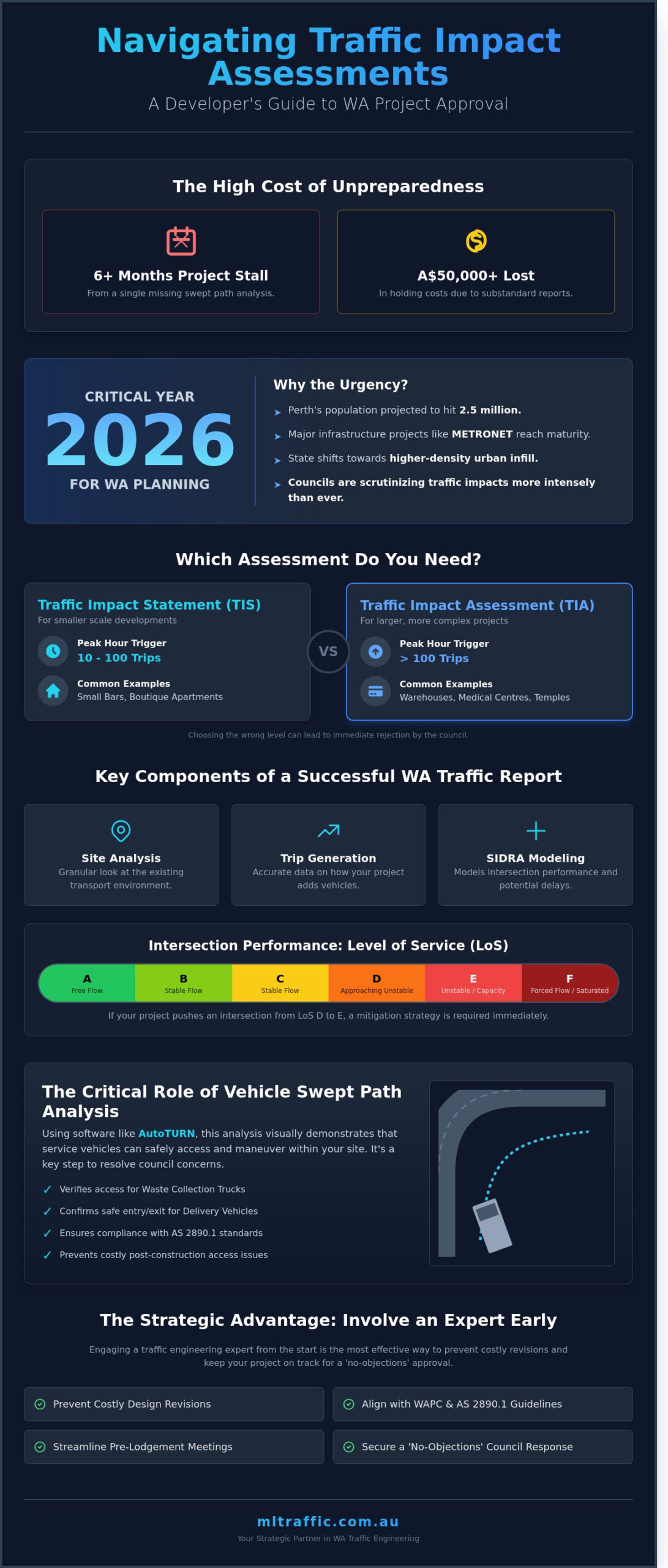
A traffic impact assessment western australia is a technical report that evaluates how your proposed development interacts with the existing road network. It isn’t just a box-ticking exercise for the local council. It’s a vital part of a broader Impact assessment strategy that ensures safety and efficiency for all road users. With Perth’s population projected to reach 2.5 million by 2026, the Western Australian Planning Commission (WAPC) has tightened its oversight to manage the resulting congestion and infrastructure demand.
To better understand the core principles of these reports, watch this helpful video:
The WAPC sets the benchmarks that every local government in WA follows. If your report doesn’t meet these standards, you’ll likely face costly delays or community objections that can stall a project for 6 months or more. A professional TIA identifies potential bottlenecks before they become expensive problems. We’ve seen developers lose A$50,000 in holding costs because they submitted a substandard report that didn’t address specific council concerns. Our team has completed assessments for over 10,000 sites, ensuring that every technical detail, from vehicle swept paths to sight-line assessments, meets the WAPC criteria.
2026 is a critical year for WA planning. Major infrastructure projects like Metronet are reaching maturity, and the state is shifting toward higher-density urban infill. This means your traffic impact assessment western australia must be more precise than ever. Councils are scrutinizing how new residents or customers will move in and out of sites, especially in established suburbs where road capacity is already stretched. A well-prepared report prevents these technicalities from becoming roadblocks to your approval.
TIA vs. TIS: Which One Do You Actually Need?
The scale of your project dictates the reporting level required by the authorities. A Traffic Impact Statement (TIS) is the standard for smaller developments, such as a small bar or a boutique apartment block, that generate between 10 and 100 vehicle trips during peak hours. Once you cross the 100-trip threshold, the WAPC requires a full Traffic Impact Assessment (TIA). This involves complex modeling of intersection capacity and regional road impacts. Whether you’re building warehouses, temples, or medical centres, choosing the wrong level can lead to immediate rejection by the council, costing you weeks of progress.
The Impact of the WAPC Transport Impact Assessment Guidelines
The WAPC uses five volumes of guidelines to maintain consistency across Western Australia. For most commercial developers, Volume 4, focusing on Individual Developments, and Volume 5, providing Technical Guidance, are the most relevant. These documents provide the framework for everything from parking demand to driveway ramp grades. By adhering to these guidelines, you ensure that your project is evaluated fairly by any of the 139 local governments in WA. This consistency is what allows us to secure approvals efficiently, as we speak the same technical language as the reviewing engineers. Using industry-standard acronyms like TGS, TCP, and RPEQ isn’t just jargon; it’s a requirement for compliance with AS 2890.1 standards.
Key Components of a Successful WA Traffic Report
A successful traffic impact assessment western australia doesn’t just tick boxes; it provides a bulletproof technical narrative for your development. We start with a granular site description, looking at the existing transport environment in your specific WA suburb, whether that’s the high-density corridors of Stirling or the expanding residential zones in Wanneroo. This baseline sets the stage for accurate trip generation data. We use SIDRA intersection software to model how your project adds vehicles to the network during peak hours. Level of Service (LoS) is the primary metric for intersection performance in WA, ranking delays on a scale from LoS A, representing free-flowing conditions, to LoS F, indicating total saturation.
If your project pushes a nearby "black spot" intersection from a LoS D to an E, you need a mitigation strategy immediately. Our reports integrate your project with the wider transport ecosystem, including public transport links, pedestrian paths, and cycling networks. Councils in 2024 are increasingly focused on "active transport," so demonstrating that your site is accessible to more than just cars is vital for approval. We analyze the 85th percentile speed of passing traffic to ensure that any new movements don’t compromise the safety of existing road users.
Parking Demand and Compliance with AS 2890.1
Calculating "real-world" parking demand is where most developers find their biggest wins. Council schemes often demand a set number of bays based on rigid tables, but these don’t always reflect how people actually behave. We use empirical data from 2023 and 2024 developments to justify a parking shortfall to a WA council. If you’re 10 bays short, we can often prove that proximity to high-frequency bus routes or the Perth train network reduces the need for on-site parking. This evidence-based approach can save you between A$30,000 and A$50,000 per bay in construction costs or cash-in-lieu payments. We also ensure every bay and aisle meets the latest AS 2890.1 standards to prevent last-minute design rejections.
Access and Safety: The WAPC Perspective
The Western Australian Planning Commission (WAPC) prioritizes safety above all else. Driveway locations aren’t arbitrary; they must be evaluated for maximum safety and minimum disruption to the streetscape. Sight-line assessments are the number one reason for access rejection in WA. We verify these using the Guide to Traffic Management Part 12 to ensure your entry points meet national safety benchmarks. If your project sits on a Primary Regional Road, we coordinate with Main Roads WA to ensure your access points don’t compromise the strategic road network. Getting this right early prevents the need for expensive "left-in, left-out" only restrictions later. If you’re unsure about your site’s specific constraints, speaking with an experienced traffic consultant early can prevent costly redesigns.
A comprehensive traffic impact assessment western australia must also address the "swept path" of the largest vehicle expected on site. Whether it’s a 12.5-meter heavy rigid vehicle for deliveries or a standard waste truck, we use specialized software to prove these vehicles can enter and exit in a forward gear. This technical proof is often the final piece of the puzzle that gives council officers the confidence to recommend your project for approval.
The Critical Role of Vehicle Swept Path Analysis
Vehicle Swept Path Analysis is often the deciding factor in whether a local council approves your development. While it might look like colorful lines on a site plan, it serves as the technical proof that your design actually works in the real world. At ML Traffic Engineers, we use AutoTURN software to simulate the precise movements of vehicles. This process removes the guesswork. To a council planning officer, these diagrams feel like "magic" because they provide visual certainty that a 12.5m heavy rigid vehicle won’t take out a structural column or mount a pedestrian curb.
We see the most friction in Western Australian developments at basement ramps and loading docks. These are the "tight spots" where centimeters matter. If your traffic impact assessment western australia doesn’t include these simulations, you’re essentially asking the council to take a gamble on your design. We don’t believe in gambles. We provide the data. If a swept path "fails" during our design phase, it’s actually a blessing. It’s far cheaper to move a wall on a CAD drawing than it is to jackhammer a concrete pillar after the building is finished. We identify these spatial conflicts early to ensure your project remains compliant and functional.
Designing for Heavy Vehicles in WA
Commercial and industrial sites in WA must accommodate specific vehicle classes to remain operational. We focus on the requirements for 8.8m Medium Rigid Vehicles (MRVs) and 12.5m Heavy Rigid Vehicles (HRVs) as dictated by the project’s scale. For multi-unit residential sites, waste management access is a frequent sticking point. We ensure your site layout allows a heavy waste truck to enter and exit in a forward gear, which is a non-negotiable safety standard for most Perth metropolitan councils. Our team designs these facilities to meet AS 2890.2 standards, ensuring that delivery and service vehicles can operate without disrupting local traffic flow.
Driveway Ramp Grades and Ground Clearance
Nothing kills a project’s reputation faster than a basement ramp that scrapes the undercarriage of every car that enters. We perform detailed ramp grade assessments to avoid the "scrape" entirely. This involves testing the vertical clearance for B85 and B99 vehicles, which represent the 85th and 99th percentile of cars on Australian roads. We follow the strict geometry requirements of AS 2890.1 to prevent bottoming out or topping out at the crest of a ramp. Because we’ve worked on over 10,000 sites, we know exactly where the pitfalls lie. Our engineers certify car park designs to give you peace of mind that every vehicle, from a low-clearance sedan to a large SUV, can transition between floor levels safely.
Our approach is direct and technical. We don’t just hand over a report; we provide a functional blueprint for your site’s accessibility. A traffic impact assessment western australia is only as good as the engineering logic behind it. By using industry-standard software and our decades of experience, we ensure your project meets every regulatory hurdle. We’ve been trading since 2005, and our philosophy remains the same: the consultant who provides your quote is the expert who does the work. This hands-on involvement ensures that technical details like swept paths and ramp grades are never overlooked by junior staff.
Navigating the DA Process with Your Traffic Consultant
Involving a traffic engineer during your initial concept stage isn’t just a recommendation; it’s a financial safeguard. We’ve seen Perth developers save between A$20,000 and A$50,000 in redesign fees by identifying access constraints before the first architectural drawings are finalized. When you secure a traffic impact assessment western australia at the start, you’re buying certainty. It’s much easier to move a driveway on a digital screen than it is to negotiate a crossover location with a council officer after your plans are already lodged.
The pre-lodgement meeting is where your strategy is truly set. We present your traffic data to council officers to address potential roadblocks early. This proactive approach allows us to frame the narrative around peak hour management and site accessibility. If officers from the City of Stirling or City of Perth raise concerns about congestion or safety, we use real-time data to provide solutions on the spot. This transparency builds trust and often fast-tracks the formal review process.
Expect to receive a Request for Further Information (RFI) during the assessment. It’s a standard part of the bureaucracy. When this happens, we respond with technical authority using SIDRA intersection modeling and swept path analysis. We don’t guess; we provide empirical evidence that satisfies the council’s engineering requirements. Once the assessment is complete, your TIA becomes a formal condition of your development approval. This means the layout we’ve verified is exactly what you’re legally permitted to build, ensuring no surprises during the construction phase.
Collaborating with Local WA Councils
Each council has its own specific set of requirements. The City of Perth focuses heavily on pedestrian permeability and public transport integration for CBD projects. In contrast, the City of Stirling often scrutinizes residential amenity and the potential for "rat-running" through suburban side streets. If your project triggers community consultation, traffic is usually the primary complaint from neighbors. We use hard data to de-escalate these issues, speaking the technical language that council planners and local councillors respect to keep your project moving forward.
Avoiding Common Pitfalls in Traffic Applications
Mistakes in your application can lead to months of delays. First, don’t use outdated traffic count data from 2023 or earlier. Post-pandemic traffic patterns in the Perth metro area changed by up to 12% in specific corridors; using old numbers leads to an immediate RFI. Second, you can’t ignore the cumulative impact of neighboring developments. If a 50-unit complex was approved next door last month, your assessment must include their projected trips in your modeling. Finally, don’t wait until the DA is lodged to think about parking. Checking if a B99 vehicle can safely turn around in your basement is a day-one requirement, not an afterthought.
Don’t let traffic hurdles stall your project. Contact our senior engineers to secure your development approval today.
Why ML Traffic Engineers is Your Strategic WA Partner
Choosing a traffic consultant shouldn’t feel like navigating a complex maze. At ML Traffic Engineers Pty Ltd, we’ve intentionally stripped away the layers of management that often slow down development approvals. We operate on a "No Gatekeepers" model. This means when you pick up the phone, you aren’t shuffled off to a junior graduate or a project coordinator. You speak directly to the senior engineers who actually sign off on your reports.
Since 2005, we’ve successfully completed work on over 10,000 sites across Australia. This isn’t just a hollow statistic. It represents a massive database of scenarios we’ve already solved. Whether your project involves apartments, bars, childcare centres, medical suites, temples, or warehouses, we’ve likely handled a similar site before. This depth of experience is vital when you’re seeking a traffic impact assessment western australia, as local councils and Main Roads WA have specific, non-negotiable standards that must be met to avoid costly redesigns.
One of our core promises is simple: the traffic consultant who provides your quote is the person who does the work. In many larger firms, a principal might win the contract only to hand the data entry and analysis to a junior staff member who lacks the context of your specific project. That doesn’t happen here. You get senior expertise from the first phone call to the final submission. We’re a conversational and persuasive partner who fights for your project’s success because we understand that your ROI depends on a timely approval.
Our Hands-On Philosophy
Our principals, Michael Lee and Benny Chen, possess between 30 and 40 years of individual experience. They don’t just oversee the firm; they stay involved in every single TIA. This level of involvement ensures that every report is technically sound and strategically positioned for approval. You can see our about page to see our expert team in action. We value results over bureaucratic fluff because we know your holding costs increase every day your project is stuck in the planning phase. Accountability is built into our DNA.
Ready to Secure Your Approval?
Securing a traffic impact assessment western australia doesn’t need to be a bottleneck for your development. To provide a rapid quote, we typically need a few key items: your current site plan, a description of the proposed land use, and any specific feedback you’ve already received from the council or Main Roads. We’ve streamlined our internal processes to ensure you get an authoritative Traffic Impact Statement or TIA without unnecessary delays. Our team is ready to help you clear the final hurdle of your application. Contact ML Traffic Engineers Pty Ltd today to discuss your project requirements and get a professional assessment that moves your project forward.
Secure Your 2026 Development Approval Today
Success in the WA property market requires more than just a good design. It demands technical precision that meets rigorous Department of Transport and local council standards. Your project’s timeline depends on an accurate traffic impact assessment western australia that addresses everything from car parking demand to complex vehicle swept path analysis. Don’t let your DA stall because of avoidable technical errors or poor communication with planning authorities.
At ML Traffic Engineers, we’ve spent 15+ years refining our process and have successfully assessed over 10,000 sites across Australia. We don’t hide behind junior staff or account managers. When you call us, you get direct access to our Principal Engineers. It’s a simple philosophy: the traffic consultant who provides your quote is the one who actually does the work. This hands-on approach ensures your report is compliant, professional, and ready for 2026 regulatory shifts. We’re ready to help you clear the final hurdles of your application.
Get a Quote from the Engineers Who Actually Do the Work
Let’s get your development moving forward with confidence.
Frequently Asked Questions
What is the difference between a Traffic Impact Statement and an Assessment in WA?
A Traffic Impact Statement (TIS) is a simplified report for developments with moderate impact, typically generating between 10 and 100 vehicle trips during peak hours. If your project exceeds 100 peak hour trips, the Western Australian Planning Commission requires a full Traffic Impact Assessment (TIA). The TIA is a more technical document involving detailed intersection modeling and broader network analysis. We’ll help you identify which category your project fits to ensure you don’t overspend on unnecessary data.
How much does a Traffic Impact Assessment cost for a standard DA in Perth?
A professional report for a standard Development Application in Perth usually costs between A$2,200 and A$5,500. This price depends on the land use, such as a 15 unit apartment complex or a new 600 square meter warehouse. Our pricing stays competitive because the traffic consultant who provides your quote is the same expert who performs the work. You won’t pay for the heavy administrative overheads found at larger, multi-disciplinary firms.
When should I hire a traffic engineer for my development project?
You should hire a traffic engineer during the preliminary design phase before you finalize your site layout. Engaging us early allows for the optimization of driveway locations and parking configurations to meet AS 2890.1 standards. This proactive step prevents the frustration of costly architectural redesigns if the council identifies access safety issues later. We’ve supported over 10,000 sites since 2005, and early involvement is the most reliable way to keep your project on track.
Does a traffic report guarantee that my development will be approved?
No report can legally guarantee a result, but a professional traffic impact assessment western australia makes a successful outcome much more likely. Our reports provide the engineering evidence and technical justifications that local government planners need to recommend approval. We focus on demonstrating total compliance with state policies and local planning schemes. This data-driven approach moves your application past subjective objections and focuses on objective engineering facts.
What are the most common reasons WA councils reject traffic assessments?
WA councils often reject assessments due to outdated traffic data or non-compliance with specific Australian Standards. Approximately 40% of rejected reports fail because they don’t adequately address sightline requirements at property exits. Another common pitfall is using generic trip generation rates that don’t reflect the specific Western Australian context. We ensure every report uses current, site-specific data and meets the strict technical standards of local authorities like the City of Wanneroo or City of Melville.
Can ML Traffic Engineers help with parking shortfalls and council negotiations?
Yes, we specialize in resolving parking shortfalls through detailed Car Parking Demand Assessments. We negotiate directly with council officers by presenting empirical evidence from similar developments like medical centres, cafes, or childcare hubs. Our principals, Michael Lee and Benny Chen, bring over 30 years of experience to every negotiation. We provide the technical leverage needed to secure a parking variation, ensuring your project remains viable without sacrificing valuable floor space.
What data do I need to provide for a Swept Path Analysis?
You need to provide a scaled site plan in CAD or PDF format that shows all proposed driveways, structural columns, and parking bays. It’s also vital to specify the design vehicle your council requires, such as an 8.8 meter refuse truck or a B99 passenger car. Our team uses specialized software to simulate these vehicle movements, proving that cars and service vehicles can maneuver safely. This analysis is a mandatory requirement for almost every commercial DA in WA.
How long does it take to prepare a full TIA report for a WAPC submission?
Preparing a comprehensive TIA report for a WAPC submission typically takes 10 to 15 business days. This timeframe covers site observations, data collection, and any necessary SIDRA intersection modeling. If your project is complex and requires new 24 hour traffic counts, the process might take up to 20 days. We work efficiently to ensure your documentation is ready for the statutory advertising periods often required for significant Western Australian developments.
Which suburbs do you service?
We operate in Alexander Heights, Alfred Cove, Alkimos, Anketell, Applecross, Ardross, Armadale, Ascot, Ashby, Ashendon, Ashfield, Attadale, Atwell, Aubin Grove, Aveley, Balcatta, Baldivis, Balga, Ballajura, Banksia Grove, Bassendean, Bateman, Bayswater, Beaconsfield, Beckenham, Bedford, Beechboro, Beeliar, Beldon, Bellevue, Belmont, Bentley, Bertram, Bibra Lake, Bicton, Booragoon, Brentwood, Brigadoon, Brookdale, Bull Creek, Bullsbrook, Burns Beach, Burswood, Butler, Byford, Canning Vale, Cannington, Carine, Carlisle, Carramar, Casuarina, Caversham, Champion Lakes, Chidlow, Churchlands, City Beach, Claremont, Clarkson, Cloverdale, Cockburn Central, Connolly, Coogee, Coolbellup, Coolbinia, Cottesloe, Craigie, Crawley, Currambine, Dalkeith, Darch, Doubleview, East Perth, Edgewater, Ellenbrook, Floreat, Fremantle, Girrawheen, Greenwood, Guildford, Hamilton Hill, Heathridge, Hillarys, Inglewood, Joondalup, Kallaroo, Kingsley, Leeming, Mandurah, Maylands, Melville, Midland, Mindarie, Morley, Mosman Park, Mount Hawthorn, Mount Lawley, Mullaloo, Nedlands, North Perth, Northbridge, Ocean Reef, Osborne Park, Padbury, Perth, Piara Waters, Rockingham, Scarborough, South Perth, Subiaco, Swanbourne, Thornlie, Tuart Hill, Victoria Park, Wangara, Wanneroo, Warwick, Wembley, West Perth, Willetton, Woodvale, Yokine.

Disclaimer
The content on www.mltraffic.com.au, including all technical articles, guides, and resources, is provided for general informational and educational purposes only. It is not intended to constitute professional advice in traffic engineering, transportation planning, development approvals, or any other technical or legal field.
While ML Traffic Engineers makes every reasonable effort to ensure the accuracy, completeness, and timeliness of the information published, we do not provide any warranties or representations (express or implied) regarding its reliability, suitability, or availability for any particular purpose. Any reliance you place on the content is strictly at your own risk.
In no event shall ML Traffic Engineers, its directors, employees, authors, or affiliates be liable for any direct, indirect, incidental, special, consequential, or punitive damages (including, without limitation, loss of profits, data, or business opportunities) arising out of or in connection with the use of, or inability to use, any information provided on this website.
The articles and guides on this site are not a substitute for engaging a qualified, registered professional traffic engineer (such as an NPER or RPEQ engineer) to assess your specific project requirements. For tailored advice, compliance assessments, or traffic engineering services, please contact a competent professional.
This disclaimer may be updated from time to time without notice. By accessing or using this website, you agree to be bound by the most current version of this disclaimer.
