
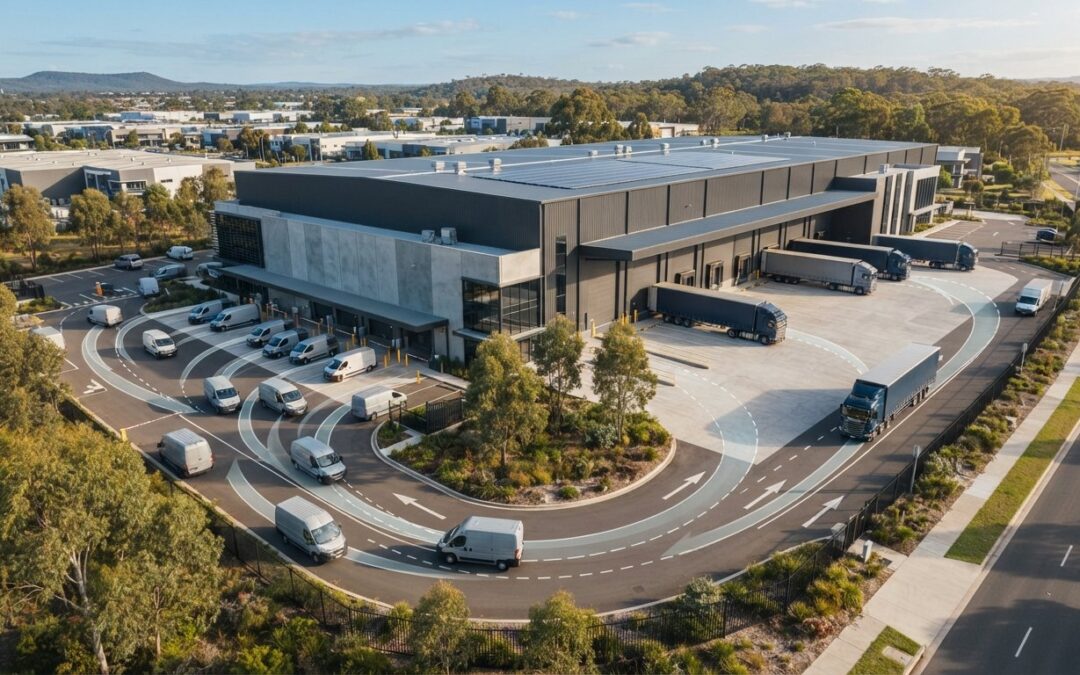
Why are councils rejecting industrial Development Applications at record rates despite a national vacancy rate sitting at a tight 3.2%? The answer lies in the evolving traffic impact of online retail on industrial property, which has transformed warehouses from static storage sheds into high-velocity transport nodes. You’ve likely noticed that traditional traffic modelling no longer accounts for the hundreds of light commercial vehicles (LCVs) now swarming sites alongside heavy articulated trucks. This mismatch causes chronic congestion at access points and leads to costly Requests for Information (RFIs) from planning authorities who demand higher technical precision.
Getting your project over the line in 2026 requires more than a basic assessment. It demands a technical deep dive into modern logistics requirements and strict adherence to the latest TfNSW TS 00085 and AS 2890.2:2018 standards. This analysis explores how e-commerce is reshaping industrial traffic requirements and provides the exact technical strategies developers must implement to secure planning approvals. We’ll examine the necessity of segregated loading docks, the impact of high-frequency parcel dispatch, and how to future-proof your assets for 2026 market demands through compliant TIA reports and precise swept path analysis.
Key Takeaways
- Identify why 2026 industrial developments require higher trip generation benchmarks compared to traditional warehousing models.
- Optimise site layouts to manage the traffic impact of online retail on industrial property by separating high-frequency light commercial vehicles from heavy haulage.
- Ensure strict AS 2890 compliance for loading docks and courier bays to prevent structural damage and site access congestion.
- Prepare a robust Traffic Impact Assessment (TIA) report that uses parcel volume metrics rather than just floor area to satisfy council requirements.
- Secure planning approvals by utilising senior-level technical expertise and a “personnel continuity promise” throughout the DA process.
The Evolution of Industrial Property: From Storage to High-Frequency Hubs
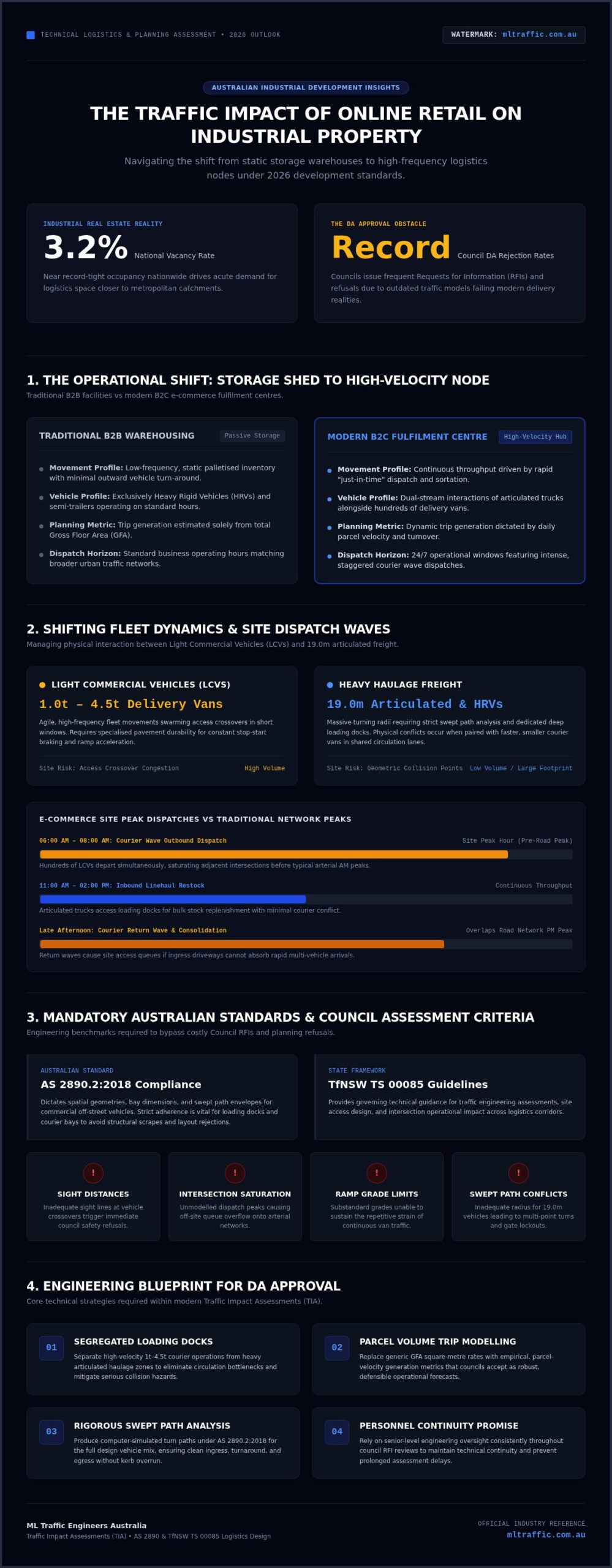
The decentralisation of industrial activity across Australia has redefined site requirements. Traditional B2B warehouses served as passive storage points with minimal outward movements. In contrast, modern B2C fulfilment centres act as high-frequency transport nodes. This shift increases the traffic impact of online retail on industrial property, as sites now require continuous throughput to meet “just-in-time” delivery expectations. Older traffic benchmarks often fail to capture this intensity, leading to significant capacity issues on local road networks.
By 2026, industrial assets are being positioned closer to residential catchments to facilitate rapid dispatch. This proximity places a greater burden on urban infrastructure, requiring precise modelling of trip generation rates that reflect high-velocity sorting rather than static pallet storage. Developers must account for these dual-stream movements early in the planning phase to avoid costly infrastructure contributions or planning delays.
To better understand how e-commerce is transforming industrial real estate requirements, watch this technical overview:
The Rise of the Last-Mile Delivery Centre
Urban last-mile hubs differ from regional distribution centres by prioritising speed and turnover over long-term storage. These facilities manage complex last-mile delivery logistics, which involve rapid turn-around times and often 24/7 operational windows. Traditional industrial trip rates are now frequently inadequate for Council DAs because they don’t account for the wave dispatches typical of parcel delivery. ML Traffic Engineers Australia focuses on providing empirical evidence to justify these higher generation rates, ensuring that the site remains functional without overflowing onto public streets.
Traffic Engineering as a Critical Factor in Site Selection
Success in the current market depends on identifying traffic constraints before a land purchase is finalised. Assessing road hierarchy and potential access points is vital for sites expecting high-frequency movements. Professional Traffic Engineering identifies “red flag” issues like restricted sight distances or intersection saturation early in the feasibility stage. ML Traffic Engineers Australia provides the technical oversight needed to assess these risks, ensuring that the traffic impact of online retail on industrial property doesn’t compromise the site’s ultimate development potential.
Shifting Vehicle Mix: Managing LCVs and Articulated Vehicles
The composition of traffic at industrial sites has changed fundamentally. Traditional warehouses prioritised heavy rigid vehicles (HRVs) and semi-trailers. Modern e-commerce fulfilment centres now see a massive surge in Light Commercial Vehicles (LCVs), such as 1-tonne to 4.5-tonne delivery vans. This shift significantly alters the traffic impact of online retail on industrial property, as the high volume of smaller vehicles creates different congestion patterns than a few large trucks.
Mixed-vehicle environments introduce specific safety risks. LCVs are faster and more agile than 19.0m articulated vehicles; this often leads to site bottlenecks where these different classes interact. Additionally, the peak hour for e-commerce sites rarely aligns with standard road network peaks. Courier dispatch often occurs between 6:00 AM and 8:00 AM, while return waves hit in the late afternoon. This requires a nuanced analysis of intersection capacity for both site peaks and network peaks to satisfy planning authorities.
High-frequency use by smaller vehicles also impacts infrastructure durability. Driveway ramp grades and pavement specifications must accommodate the constant “stop-start” movements of hundreds of vans. If you’re unsure about your site’s capacity, consulting an expert for a Traffic Impact Assessment can prevent operational bottlenecks and ensure your layout is fit for purpose.
Swept Path Analysis for Diverse Fleets
Managing a fleet that includes 26.0m B-doubles alongside agile courier vans requires precision. We use AutoTURN software to perform a detailed Swept Path Analysis, ensuring all vehicles can enter and exit in a forward direction without conflict. Compliance with the AS 2890.2 commercial vehicle facilities standard is mandatory for council approval. This modelling must demonstrate that the largest design vehicle and the most frequent LCVs can coexist safely in shared loading aprons.
Loading Dock Optimisation for E-commerce
Efficient site design now requires “van-ready” facilities. Traditional loading docks are often too high for LCVs, leading to slow manual loading or the need for specialised ramps. Optimised docks incorporate flexible heights or dedicated rapid-load zones for vans. Operational failure often occurs when developers model only the largest vehicle, neglecting the high-frequency requirements of the courier fleet. This oversight results in queueing on public roads, a primary reason for DA rejection. Precise vehicle modelling ensures that every bay is utilised effectively without causing site-wide delays.
Site Design Challenges and AS 2890 Compliance for Online Retail
Site safety depends on the physical separation of pedestrian staff movements from high-speed delivery traffic. Modern logistics hubs frequently operate on a 24/7 basis. This means staff shift changes often overlap with peak delivery dispatch windows, necessitating robust safety protocols; international consultancies like DL Safety provide specialised support for managing these industrial risks. Driveway grades and sight distances must be meticulously calculated to ensure high-frequency egress does not conflict with passing traffic. We assess Safe Intersection Sight Distance (SISD) to ensure all vehicles can exit the site without compromising road safety. Technical precision in these early stages prevents costly redesigns during the construction phase.
Staff densities in e-commerce fulfilment centres are significantly higher than traditional warehouses. This creates a discrepancy between statutory council parking rates and actual operational requirements. We conduct a Car Parking Demand Assessment to justify variations to these standards. Using technical methodologies like the FHWA freight and land use travel demand evaluation allows for realistic modelling of trip generation. Developers must also provide courier “waiting zones” to prevent delivery vans from idling on public verges or blocking heavy vehicle access lanes. This proactive approach ensures the site remains functional during peak seasonal periods.
Compliance with AS 2890.2 for Loading Areas
Modern delivery fleets require specific geometric clearances that older industrial assets lack. Minimum clearance heights of 4.5 metres are standard for rigid vehicles; however, specialist high-cube vans may require up to 4.8 metres. Driveway ramp grades must be compliant for both low-clearance passenger cars and heavy rigid trucks to avoid scraping or bottoming out. Reviewing AS 2890.1 explained helps designers avoid common pitfalls in off-street parking layouts. A compliant loading area must feature unobstructed reversing aprons that match the swept path of the largest design vehicle. This ensures the traffic impact of online retail on industrial property is managed entirely within the site boundaries without overflowing onto the local road network.
Modern Traffic Impact Assessments (TIA) for Logistics Developments
Modern TIA reports for e-commerce require a significant departure from traditional methodology. Standard storage facilities generate low vehicle volumes; however, fulfilment hubs operate based on parcel throughput rather than just floor space. A comprehensive report must address the high-frequency turning movements of delivery vans and the potential noise impacts on nearby residential zones. This level of technical detail is essential to manage the traffic impact of online retail on industrial property and secure planning approval from councils that are increasingly wary of under-calculated traffic volumes. We focus on providing data that reflects the reality of 2026 logistics operations.
Intersection analysis is a core component of these assessments. We use micro-simulation software like SIDRA to model the impact of rapid-fire egress on the local network. This analysis must distinguish between the site peak hour, which often occurs during early morning courier dispatch, and the adjacent road network peak. Demonstrating that the local infrastructure can handle these overlapping windows is the only way to prevent costly Requests for Information (RFIs) or outright DA rejections. Addressing community concerns regarding traffic volume and operational noise within the TIA ensures a smoother pathway through the public exhibition phase.
Data-Driven Trip Generation Modelling
Councils often reject DAs that rely solely on outdated guides. These legacy benchmarks frequently underestimate the vehicle movements associated with modern fulfilment centres. We utilise empirical data from active e-commerce sites and the latest TfNSW TS 00085 v1.1 guidelines to provide an accurate forecast. This modelling must account for significant seasonal peaks, such as Black Friday and Christmas, where vehicle dispatches can surge. Providing this robust engineering evidence justifies the proposed traffic volumes to planning authorities and ensures the site is future-proofed for maximum operational capacity.
Mitigating External Traffic Impacts
High-frequency egress requires specific mitigation strategies to maintain road safety. This often involves designing intersection upgrades or proposing signal timing adjustments to manage increased demand. A detailed Traffic Management Plan (TMP) is a critical component of these operational approvals. It outlines how traffic will be managed to ensure the “last mile” of the delivery chain does not create congestion on primary arterial roads. Addressing these external factors proactively demonstrates that the traffic impact of online retail on industrial property has been fully mitigated within the technical submission. If your development requires a compliant submission, you can secure a professional Traffic Impact Assessment (TIA) Report through our senior engineering team to ensure your project meets all regulatory standards.
Securing DA Approval with Expert Traffic Engineering
Planning industrial developments in 2026 requires more than a standard engineering report. As councils and transport authorities tighten their scrutiny, the technical evidence supporting the traffic impact of online retail on industrial property must be beyond reproach. ML Traffic Engineers Australia provides this high-level technical precision by bridging the gap between engineering standards and planning law. Senior-level involvement ensures that site layouts are not only compliant but also optimised for the intense throughput of modern e-commerce.
A core differentiator of our service is the personnel continuity promise. At ML Traffic Engineers Australia, the senior principal who initiates your relationship is the same expert who performs the technical work. This eliminates the communication gaps found in larger, impersonal firms where junior staff often handle complex modelling. This direct line of accountability ensures that the engineering logic presented in your TIA remains consistent from the initial feasibility study through to final council representation.
Developers preparing an industrial submission in 2026 should verify this technical checklist:
- Empirical data sets that reflect actual parcel turnover rather than generic floor-space benchmarks.
- Full adherence to AS 2890.2:2018 for all off-street commercial vehicle facilities and loading docks.
- Animated swept path analysis verifying forward-in, forward-out movements for the largest designated design vehicle.
- SIDRA modelling that validates intersection performance for both site dispatch peaks and network peaks.
- Physical segregation between high-speed LCV zones and heavy vehicle manoeuvring areas.
Navigating Council Objections
Councils often issue RFIs or refuse applications due to underestimated vehicle volumes or inadequate dock designs. These objections usually arise when a submission fails to account for the specific vehicle mix required for rapid fulfilment. A professional Traffic Impact Assessment addresses these concerns by providing evidence-based solutions for congestion and safety. Early and proactive engagement with transport authorities allows ML Traffic Engineers Australia to mitigate potential “red flags” before they stall the planning process.
The ML Traffic Advantage for Industrial Projects
With over 15 years of experience in Australian transport planning, our firm focuses on delivering technical results through direct access to leadership. There are no gatekeepers; you receive direct input from the experts responsible for your project’s success. This streamlined model allows for rapid response times and meticulous attention to detail. If you are preparing a submission for an e-commerce hub or last-mile facility, discuss your industrial traffic requirements with the senior engineering team at ML Traffic Engineers Australia to secure a compliant and results-oriented outcome.
Future-Proofing Industrial Assets for 2026 Logistics Demands
The transition from traditional warehousing to high-velocity fulfilment centres is permanent. To secure planning approval in this competitive environment, developers must move beyond outdated trip generation benchmarks and adopt data-driven modelling based on parcel volume and LCV frequency. Successful DAs in 2026 will be those that strictly adhere to AS 2890.2:2018 standards and provide animated swept path analysis for diverse fleets. Managing the traffic impact of online retail on industrial property requires a technical approach that prioritises site safety, segregated vehicle movements, and intersection capacity.
ML Traffic Engineers offers 15+ years of experience in transport planning and specialised expertise in AS 2890 compliance. We provide direct access to senior principals for all technical work, ensuring your TIA report is robust and results-oriented. Our personnel continuity promise means the expert who initiates your project is the one who performs the engineering work. Get a professional Traffic Impact Assessment for your industrial DA to ensure your project meets all regulatory requirements and operational demands. Meticulous technical preparation today will protect your long-term asset value and streamline the approval process.
Frequently Asked Questions
How does e-commerce change the trip generation rates for industrial property?
E-commerce increases trip generation rates by shifting focus from bulk storage to high-frequency parcel turnover. Traditional rates based on Gross Floor Area (GFA) are often inadequate for modern fulfilment centres. We utilise empirical data and the latest TfNSW TS 00085 v1.1 guidelines to provide accurate forecasts. This ensures the traffic impact of online retail on industrial property is fully accounted for during the peak morning and afternoon dispatch windows.
Is a standard Traffic Impact Assessment sufficient for a last-mile delivery hub?
A generic Traffic Impact Assessment is rarely sufficient for a last-mile delivery hub due to unique vehicle profiles. These sites generate significantly higher Light Commercial Vehicle (LCV) movements than traditional warehouses. A modern TIA must include micro-simulation modelling, such as SIDRA, to assess intersection capacity during both site-specific peaks and road network peaks. This technical depth is necessary to prevent council rejections based on underestimated traffic volumes or inadequate local network analysis.
What are the specific AS 2890 requirements for e-commerce delivery vans?
Compliance with AS 2890.2:2018 is the mandatory standard for off-street commercial vehicle facilities. For delivery vans, designers must ensure minimum vertical clearances of 3.5 metres for Small Rigid Vehicles (SRVs) and up to 4.5 metres for larger rigid vans. Aisle widths and loading bay lengths must also accommodate high-frequency turnover. We provide detailed design certification to ensure that courier “waiting zones” and loading aprons meet these strict geometric requirements.
How do I model swept paths for a mix of B-doubles and LCVs?
Modelling diverse fleets requires digital swept path analysis using specialised software like AutoTURN. We simulate the movements of the largest design vehicles, such as 26.0m B-doubles, alongside agile courier vans to identify potential site bottlenecks. This analysis ensures that all vehicles can enter and exit the property in a forward direction with standard safety clearances. Precise modelling prevents structural dock damage and ensures that mixed-vehicle interactions do not compromise operational efficiency.
Does my industrial development need a formal Traffic Management Plan?
A formal Traffic Management Plan (TMP) is essential for managing the operational complexities of high-frequency logistics. It outlines how vehicle movements are segregated on-site to ensure pedestrian safety and efficient loading. For projects in New South Wales, a Traffic Guidance Scheme (TGS) may also be required for construction-related road disruptions. These plans demonstrate to planning authorities that the development will not lead to congestion or safety hazards on adjacent public roads.
What is the impact of 24/7 e-commerce operations on local traffic modelling?
Continuous 24/7 operations require modelling that accounts for overlapping traffic peaks across different time windows. While traditional industrial sites peak during standard business hours, e-commerce hubs often dispatch courier waves between 6:00 AM and 8:00 AM. Traffic modelling must validate intersection performance for these early windows while also addressing the traffic impact of online retail on industrial property during the afternoon return peak. This multi-window analysis is vital for council amenity and noise assessments.
How can I justify a reduction in car parking for a high-automation logistics site?
Justifying a parking reduction requires a technical Car Parking Demand Assessment. High-automation sites often have lower staff densities than traditional facilities, but e-commerce hubs can also experience high-density shifts. We analyse the specific operational requirements and shift profiles to provide robust engineering evidence. This data-driven approach allows developers to justify variations to statutory council parking rates while ensuring sufficient space remains for courier staging and heavy vehicle manoeuvring.
Why are Councils becoming stricter on industrial traffic access points?
Councils are stricter because modern industrial sites operate as high-frequency transport nodes rather than simple storage facilities. Increased LCV volumes place greater pressure on local intersections and road safety. Authorities now demand “forward-in, forward-out” access to prevent dangerous reversing manoeuvres onto public streets. We conduct detailed Intersection Analysis and Sight Distance Assessments to prove that proposed access points can handle the cumulative network impact without compromising the safety of local road users.

Disclaimer
The content on www.mltraffic.com.au, including all technical articles, guides, and resources, is provided for general informational and educational purposes only. It is not intended to constitute professional advice in traffic engineering, transportation planning, development approvals, or any other technical or legal field.
While ML Traffic Engineers makes every reasonable effort to ensure the accuracy, completeness, and timeliness of the information published, we do not provide any warranties or representations (express or implied) regarding its reliability, suitability, or availability for any particular purpose. Any reliance you place on the content is strictly at your own risk.
In no event shall ML Traffic Engineers, its directors, employees, authors, or affiliates be liable for any direct, indirect, incidental, special, consequential, or punitive damages (including, without limitation, loss of profits, data, or business opportunities) arising out of or in connection with the use of, or inability to use, any information provided on this website.
The articles and guides on this site are not a substitute for engaging a qualified, registered professional traffic engineer (such as an NPER or RPEQ engineer) to assess your specific project requirements. For tailored advice, compliance assessments, or traffic engineering services, please contact a competent professional.
This disclaimer may be updated from time to time without notice. By accessing or using this website, you agree to be bound by the most current version of this disclaimer.
