
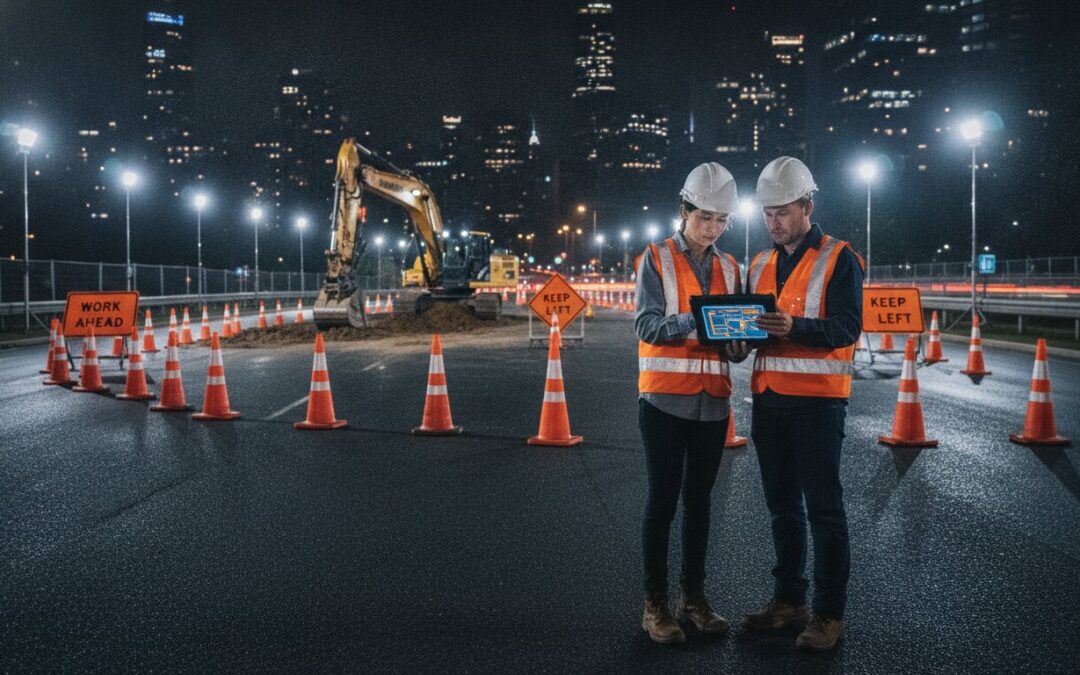
Night-time traffic management is a specialised engineering discipline, not just a daytime plan with extra floodlights. When visibility drops and fatigue risks rise, a standard approach won’t satisfy the 35 per cent increase in site inspections seen across Australia this year. Effective traffic management for night construction works requires meticulous technical planning to navigate the 7th Edition of the TfNSW TCAWS Technical Manual and the latest 2026 Austroads updates. Failure to account for these specific variables often results in costly project delays or immediate stop-work orders from regulatory authorities.
You likely understand the pressure of meeting strict council approval windows while managing noise complaints and heavy machinery logistics in restricted corridors. It’s a high-stakes environment where compliance is the only path to project continuity. This guide provides the engineering framework you need to master these regulatory requirements and maintain a zero-incident safety record. We will examine the technicalities of compliant Traffic Guidance Schemes (TGS), the necessity of Swept Path Analysis for night-time operations, and the critical role of senior leadership oversight in ensuring every plan meets Australian Standards.
Key Takeaways
- Understand why traffic management for night construction works requires a specialised engineering approach to balance reduced road volumes with heightened operational risks.
- Identify the mandatory requirements for high-visibility retroreflective devices and signage as dictated by Australian Standard AS 1742.3.
- Learn the technical parameters for engineering lighting plans that achieve minimum lux levels for site safety without compromising the vision of oncoming motorists.
- Apply Vehicle Swept Path Analysis to ensure heavy machinery can safely navigate restricted night-time corridors without impacting existing infrastructure.
- Ensure all Traffic Guidance Schemes (TGS) are developed by senior principals to provide the technical accountability required for swift regulatory approval.
The Strategic Role of Traffic Management for Night Construction Works
Night construction is the preferred choice for major infrastructure upgrades across Australia. These projects often involve high-traffic corridors where daytime closures would cause systemic failure of the transport network. Professional traffic management for night construction works allows engineers to execute complex site movements while the city sleeps. This strategic timing facilitates the delivery of essential services with minimal disruption to the millions of daily commuters who rely on the national transport network.
A traffic engineer’s primary responsibility is to balance the benefit of reduced vehicle volumes against the heightened operational risks unique to the dark. While there are fewer cars, the severity of incidents at night is often higher. Expert planning ensures that Road traffic control principles are applied to manage speed differentials and site access points effectively. By identifying night-specific hazards during the design phase, engineers can implement controls that prevent accidents before the first bollard is placed on the road.
Benefits of Night-Time Construction Schedules
Reducing impact on peak-hour traffic is the most significant driver for night-time schedules. It prevents the cascading delays that occur when arterial roads are constricted during the morning or afternoon peaks. Public transport schedules remain unaffected, ensuring bus and light rail networks operate without interruption. Additionally, night shifts provide a safer window for workers due to lower vehicle density. This period is also critical for moving heavy machinery or oversize loads. Our senior principals often use Vehicle Swept Path Analysis to verify that these large assets can navigate tight urban corridors safely during the shift without damaging existing infrastructure.
The Unique Challenges of the Night Environment
The night environment introduces physiological and environmental hurdles that are not present during daylight hours. Drivers experience reduced peripheral vision and depth perception. This makes spotting temporary signage or workers significantly more difficult. There is also a documented increase in fatigued or impaired motorists during late-night and early-morning hours. Beyond safety, engineers must manage strict noise and environmental constraints. Local councils often mandate specific noise-dampening measures and limited operational windows to protect residential amenity. Professional planning identifies these constraints early to avoid project stoppages or heavy fines for non-compliance.
Effective traffic management for night construction works is not a simple extension of daytime protocols. It is a specialised engineering task. It requires a deep understanding of how lighting, fatigue, and visibility intersect with regulatory requirements to keep both workers and the public safe.
Regulatory Compliance and Australian Standards for Night TTM
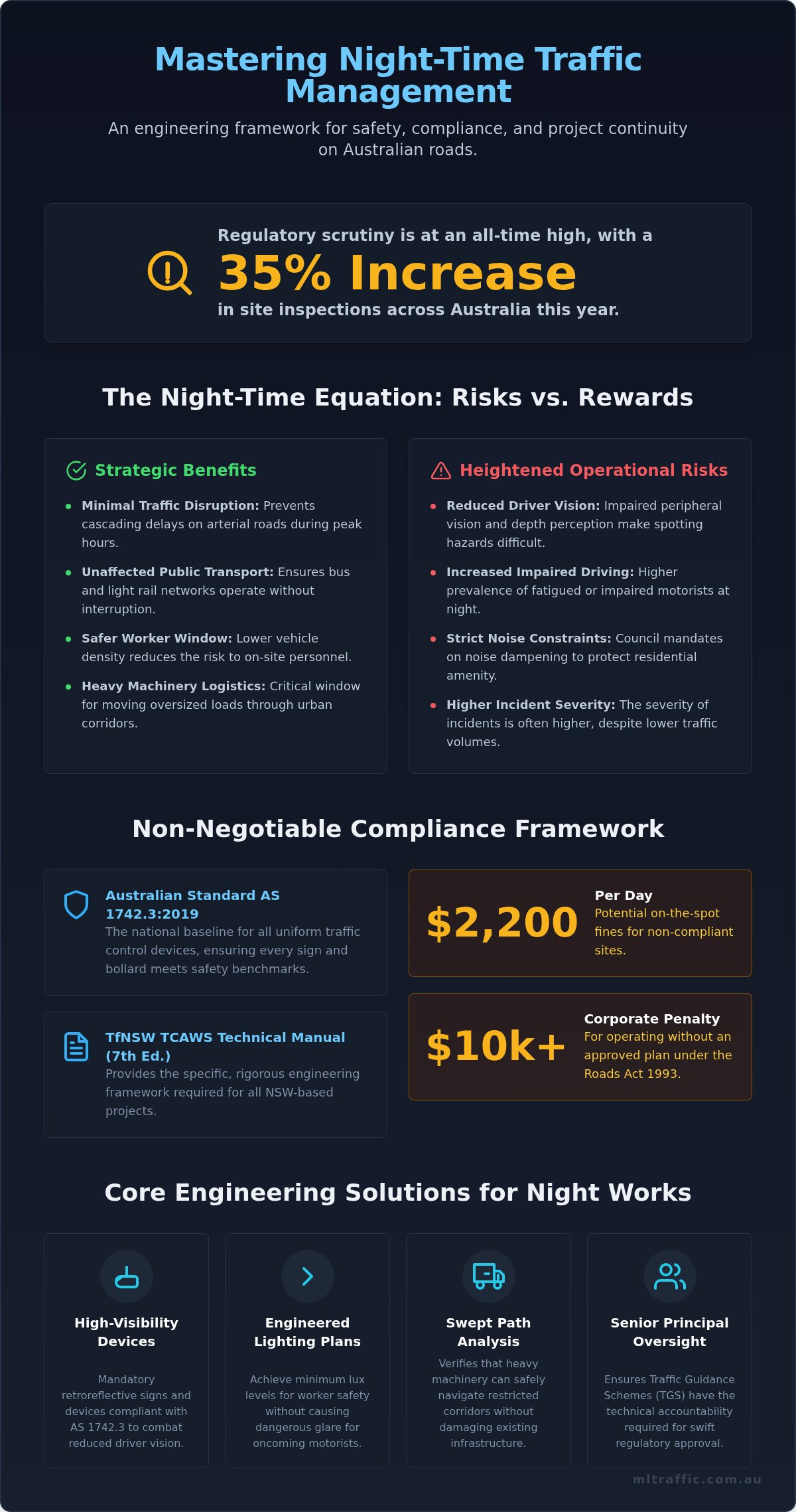
Adherence to Australian Standard AS 1742.3:2019 is the non-negotiable baseline for any project involving traffic management for night construction works. This standard dictates the manual of uniform traffic control devices, ensuring that every sign, bollard, and arrow board meets national safety benchmarks. Compliance is under heavy scrutiny in 2026. Transport for NSW and local councils have increased site inspections by 35 per cent compared to previous years. On-the-spot fines for non-compliant sites can reach $2,200 per day, while corporations operating without an approved plan face penalties exceeding $10,000 under the Roads Act 1993. Legal obligations also extend to the National Heavy Vehicle Regulator (NHVR) standards, which govern how heavy machinery enters and exits work zones during low-light shifts.
Every state maintains specific variations in Temporary Traffic Management (TTM) accreditation. For instance, the TfNSW Traffic Control at Work Sites (TCAWS) Technical Manual was updated to its 7th Edition in January 2026. This manual provides the specific framework for NSW projects, overriding generic advice with rigorous technical requirements. Engineers must integrate these Safe Work Australia guidelines into their planning to manage the overlapping risks of public safety and worker protection.
Signage and Delineation Standards
Visibility is the primary engineering challenge after sunset. All night-time signage must utilise Class 1 retroreflective material to ensure it is legible under vehicle headlights. Standard signage used during the day is often insufficient for night-time use. Engineers must also adjust the spacing of cones and bollards. Low-light conditions require tighter delineation to prevent motorists from wandering into work zones. Illuminated arrow boards and Variable Message Signs (VMS) are mandatory for high-speed environments or complex diversions. These devices provide clear, early warnings to drivers, reducing the likelihood of sudden braking or erratic manoeuvres near the site boundary.
Documentation Required for Compliance
There is a critical distinction between a Traffic Management Plan (TMP) and a Traffic Guidance Scheme (TGS). A TMP is a strategic document outlining the broader project impact, while a TGS is the technical diagram showing the exact placement of every device. For complex night diversions, authorities often require a Road Safety Audit to verify the design’s integrity. Professional planning ensures these documents are structured for rapid approval, avoiding the project delays that stem from council rejections. Engaging Professional Traffic Engineering Services early in the design phase allows you to identify potential regulatory hurdles before they impact your construction timeline. Our senior principals ensure that every TGS we produce is compliant with both national standards and local council permits.
Technical Requirements for Lighting and Visibility
Engineering a precise lighting plan is a core requirement for effective traffic management for night construction works. It involves more than simply deploying high-output lamps. Engineers must calculate specific lux levels to ensure the site is visible without creating hazardous conditions for road users. Work zones generally require a minimum of 50 lux for basic tasks. Pedestrian thoroughfares and complex intersection zones often demand 100 lux to maintain safety standards. Strategic placement of lighting towers is essential to eliminate deep shadows. These shadows can hide trip hazards or obscure workers from machinery operators, leading to site incidents.
Illumination must be consistent across the entire work area. Uneven lighting causes the human eye to struggle with constant adjustment, increasing worker fatigue. Our senior principals oversee the design of these plans to ensure that every light source serves a technical purpose. This meticulous approach prevents the “black hole” effect where drivers transition from a brightly lit work zone into total darkness, which significantly impairs their reaction times.
Managing Glare and Light Spill
Compliance with AS 4282, the Australian Standard for the control of the obtrusive effects of outdoor lighting, is mandatory for all night shifts. Lighting must be directional. It should illuminate the work area while protecting residential amenity from light spill. Glare is a significant operational risk. It can temporarily blind heavy vehicle drivers or onsite traffic controllers, creating a secondary hazard. Professional planning uses shielding and specific tilt angles to mitigate these effects. This ensures that light is contained within the site boundaries and does not interfere with the vision of oncoming motorists or nearby residents.
Swept Path Analysis for Night-Time Site Access
Lighting equipment and generators often occupy significant physical space within restricted night-time corridors. If placement is not carefully engineered, these towers become dangerous obstructions. Using a Swept Path Analysis Guide allows engineers to verify that heavy machinery can manoeuvre safely around site equipment. This is particularly important when lanes are narrowed or temporary barriers are installed.
This analysis is also critical for maintaining emergency vehicle access. Night work zones are frequently constricted by machinery and lighting assets. We must ensure that ambulances or fire trucks can pass through the site without delay. Every Traffic Guidance Scheme (TGS) we produce accounts for these physical constraints. We prioritise the movement of oversized assets and emergency services through the work zone to maintain safety and network integrity.
Risk Mitigation: Addressing Fatigue, Speed, and Community Impact
Risk mitigation in night works is a multi-layered engineering challenge. While previous sections focused on visibility and compliance, the human element, specifically fatigue and speed, requires equal technical attention. A rigorous fatigue management plan must be integrated into the site’s operational framework. This involves more than just managing worker rosters. It requires ensuring that the Traffic Guidance Scheme (TGS) is intuitive. Complex lane shifts that demand high cognitive load are dangerous for tired motorists and site personnel alike. Professional traffic management for night construction works prioritises simplicity in design to account for the reduced reaction times of road users during the early morning hours.
A static plan is rarely sufficient for the duration of a project. On-site supervisors must monitor traffic behaviour in real-time and adjust the TGS if motorists appear confused or are ignoring controls. This responsive approach ensures the site remains safe as traffic conditions fluctuate throughout the shift. Our senior principals provide the technical oversight necessary to ensure these adjustments remain compliant with national standards.
Speed Control and Traffic Calming
High speeds are a major hazard in night-time work zones. Standard signage is often ignored by motorists on empty roads after midnight. Engineers must implement physical traffic calming measures to enforce compliance and protect the work zone. These include:
- Deploying temporary speed humps for low-speed transitions in residential or urban areas.
- Utilising shadow vehicles with truck-mounted attenuators (TMAs) to provide a physical barrier in high-speed corridors.
- Setting up Variable Message Signs (VMS) that trigger speed warnings based on approaching vehicle radar.
Speed transitions must be clearly visible from a significant distance. Abrupt speed drops lead to rear-end collisions in low-light conditions. Engineers calculate the required taper lengths and buffer zones to ensure vehicles can decelerate safely before reaching the active work area.
Managing Residential and Environmental Impacts
Noise and vibration are the primary causes of community complaints and subsequent council interventions. Strategic scheduling is the most effective mitigation tool. High-impact activities, such as saw cutting or hydraulic hammering, should be scheduled for early evening windows before the 10:00 pm noise threshold typically enforced by local authorities. To maintain project momentum while respecting residential amenity, we recommend:
- Installing acoustic barriers around stationary machinery or noisy work zones.
- Mandating the use of non-tonal “white noise” reversing alarms on all heavy machinery.
- Establishing direct communication protocols to notify residents of upcoming shifts at least seven days in advance.
Proactive engagement prevents work stoppages. If residents feel informed and see that noise mitigation is a priority, they are less likely to escalate complaints to the council or the EPA. If you require a technically robust plan that balances safety with community requirements, contact our senior engineering team to develop your next TGS.
Securing Council and Authority Approval for Night-Time TMPs
Securing regulatory approval for night-time operations is an exercise in technical justification. Councils and state road authorities are often sceptical of night shifts due to the potential for noise complaints and community disruption. To gain rapid approval, your Traffic Management Plan (TMP) must provide quantitative evidence that daytime works are not a viable alternative. This involves demonstrating that daytime lane closures would exceed the saturation capacity of the road network or cause unacceptable delays to public transport services. An engineering-led approach ensures that these justifications are backed by traffic data and site-specific analysis.
A common point of friction in development applications is the confusion between a strategic TMP and a technical Traffic Guidance Scheme (TGS). The TMP is the overarching document that outlines the project’s impact and broad mitigation strategies. In contrast, the TGS is the specific site map used by crews to set up the work zone. For traffic management for night construction works, councils frequently demand that the TGS includes precise details on lighting tower placement and noise-dampening equipment. Coordinating these documents with state road authorities and public transport providers early in the planning phase is essential for maintaining your construction timeline.
The Role of the Traffic Engineer in Approvals
Authorities require technical evidence before issuing a Road Occupancy Licence (ROL) or a Section 138 permit. A qualified traffic engineer provides the necessary calculations for sight distances and speed transitions that satisfy these regulatory bodies. Ensuring your TGS is signed off by a suitably qualified professional is a non-negotiable requirement for complex urban projects. At ML Traffic Engineers, our senior principals perform the technical work for every night-work TGS to ensure accuracy and accountability. You can learn more About ML Traffic Engineers and our 15 years of experience in navigating the bureaucratic requirements of local and state authorities.
Next Steps for Your Construction Project
The first step in any successful night-work application is a preliminary site assessment. This includes conducting traffic counts to establish baseline volumes and identifying potential environmental constraints. Engaging experts during the pre-construction phase allows you to address council concerns before they lead to project delays. Meticulous planning at this stage prevents the $10,000 penalties associated with unauthorised road occupancy or non-compliant site setups. If you require a technically sound and rapidly approvable plan, contact ML Traffic Engineers for a compliant TGS today to discuss your project requirements.
Advancing Your Night-Time Construction Strategy
Successful traffic management for night construction works is a technical discipline that requires more than just standard daytime protocols. It demands a sophisticated understanding of visibility engineering, fatigue mitigation, and the latest 2026 regulatory updates. By prioritising high-visibility retroreflective signage and conducting meticulous Swept Path Analysis for heavy machinery, you ensure your site remains safe and compliant throughout the shift. It’s the only way to avoid the increased regulatory scrutiny and heavy fines currently being enforced across the country.
ML Traffic Engineers brings over 15 years of specialised consultancy experience to every project. We ensure that our senior principals perform the technical work for every night-shift Traffic Guidance Scheme, providing the accountability needed for rapid council approval. Our plans maintain full compliance with AS 1742.3 and national standards, protecting your project from costly delays. If you’re ready to secure your site’s safety and regulatory standing, Request a Professional Traffic Management Plan for Your Night Works. We’re prepared to help you deliver a zero-incident project on schedule.
Frequently Asked Questions
Is a Traffic Management Plan mandatory for all night construction works in Australia?
A Traffic Management Plan (TMP) is a legal requirement for any construction activity that impacts the road network, particularly for night-time operations. State legislation, such as the Roads Act 1993 in NSW, mandates that an approved plan must be in place before a Road Occupancy Licence (ROL) is issued. Operating without these approvals risks on-the-spot fines of $2,200 or corporate penalties exceeding $10,000. It serves as the primary risk assessment for authorities.
What is the difference between a Traffic Guidance Scheme (TGS) and a Traffic Control Plan (TCP)?
A Traffic Guidance Scheme (TGS) is the current technical term used in the Austroads Guide to Temporary Traffic Management (AGTTM). It refers to the specific diagram showing the placement of all traffic control devices. A Traffic Control Plan (TCP) is an older term still used colloquially in some jurisdictions. While they serve the same purpose, modern regulatory submissions require a TGS that adheres to the latest AS 1742.3:2019 standards.
How do Australian Standards regulate lighting for night-time roadworks?
Lighting for night-time roadworks is regulated by AS 4282 and AS 1742.3. These standards mandate that work zones achieve specific illumination levels, typically 50 to 100 lux, depending on the task complexity. Lighting must be directional to prevent glare for oncoming motorists and protect residential amenity from light spill. Engineering-led planning ensures lighting towers are positioned to eliminate shadows without obstructing vehicle swept paths in restricted night-time corridors.
What are the specific signage requirements for night works compared to day works?
Signage for night works must utilise Class 1 retroreflective material to ensure maximum visibility under vehicle headlights. Standard daytime signage is often insufficient for low-light conditions. Additionally, effective traffic management for night construction works frequently requires the use of illuminated arrow boards and Variable Message Signs (VMS). These devices provide early warning to drivers, which is critical given the reduced peripheral vision and depth perception experienced by motorists after sunset.
How can I minimise noise complaints during night-time construction?
Minimising noise complaints requires a combination of strategic scheduling and physical mitigation. High-impact works should be prioritised for early evening windows before 10:00 pm. Implementing non-tonal white noise reversing alarms and acoustic barriers can significantly reduce the decibel impact on nearby residents. Proactive community notification, delivered at least seven days in advance, is also a standard requirement for most local council approvals to maintain project continuity and avoid stop-work orders.
Does my project need a Road Safety Audit for night-time traffic diversions?
A Road Safety Audit is often required for complex night-time diversions or high-speed arterial road closures. Authorities mandate these audits to independently verify that the proposed traffic management design is safe for all road users. While a standard TGS may suffice for simple residential works, complex infrastructure projects involve higher risk profiles that necessitate a formal audit process. This ensures the design meets the rigorous safety benchmarks set by state road authorities.
How long does it typically take to get a night-time Traffic Management Plan approved?
Approval timelines vary depending on the local council and the complexity of the road occupancy. Most authorities require at least 10 to 15 business days to review a night-time Traffic Management Plan. Complex applications involving state-managed roads or public transport corridors may take 20 days or longer. Engaging a traffic engineer early in the pre-construction phase is the most effective way to avoid project start-date delays caused by regulatory or bureaucratic backlog.
What qualifications must a person have to design a night-work TGS?
A night-work TGS must be designed by a person holding the appropriate state-recognised accreditation, such as the Prepare Work Zone Traffic Management Plan qualification. For complex or high-risk traffic management for night construction works, councils often require a degree-qualified traffic engineer. We ensure every scheme is developed by senior principals with over 15 years of experience. This provides the technical accountability and professional sign-off required for high-stakes urban infrastructure projects.

Disclaimer
The content on www.mltraffic.com.au, including all technical articles, guides, and resources, is provided for general informational and educational purposes only. It is not intended to constitute professional advice in traffic engineering, transportation planning, development approvals, or any other technical or legal field.
While ML Traffic Engineers makes every reasonable effort to ensure the accuracy, completeness, and timeliness of the information published, we do not provide any warranties or representations (express or implied) regarding its reliability, suitability, or availability for any particular purpose. Any reliance you place on the content is strictly at your own risk.
In no event shall ML Traffic Engineers, its directors, employees, authors, or affiliates be liable for any direct, indirect, incidental, special, consequential, or punitive damages (including, without limitation, loss of profits, data, or business opportunities) arising out of or in connection with the use of, or inability to use, any information provided on this website.
The articles and guides on this site are not a substitute for engaging a qualified, registered professional traffic engineer (such as an NPER or RPEQ engineer) to assess your specific project requirements. For tailored advice, compliance assessments, or traffic engineering services, please contact a competent professional.
This disclaimer may be updated from time to time without notice. By accessing or using this website, you agree to be bound by the most current version of this disclaimer.
