

The success of a modular project is decided at the site gate, not on the factory floor. With the Australian modular construction market projected to reach USD 17.1 billion by 2034, the pressure on local infrastructure is reaching a critical point. Effective traffic management for prefabricated construction now requires a shift from reactive planning to predictive engineering. You’re likely aware that a single logistical bottleneck with an oversized load can stall a project and lead to immediate site access failure. It’s a common pain point for developers facing strict council requirements for Traffic Management Plans and the technical limitations of specialized trailers.
We agree that the complexity of modern modular builds demands a higher standard of technical precision. This guide provides the expert traffic engineering strategies you need to manage oversized loads and maintain site access. You’ll learn how to achieve seamless delivery of prefab units and fast-tracked DA approvals through compliant assessments. We’ll preview the essential roles of Vehicle Swept Path Analysis, Sight Distance Assessments, and intersection modeling in ensuring your heavy vehicles reach their destination without incident or delay.
Key Takeaways
- Identify why Oversize Overmass (OSOM) vehicle movements and Just-in-Time delivery schedules necessitate specialized traffic management for prefabricated construction.
- Master the use of Vehicle Swept Path Analysis to model oversized module movements and verify site access feasibility before delivery.
- Contrast the logistical requirements of traditional construction with the high-impact, low-frequency traffic patterns unique to modular projects.
- Learn how to structure a compliant Traffic Guidance Scheme (TGS) and Intersection Analysis to meet strict council requirements and secure permits.
- Explore how senior-led traffic engineering and Sight Distance Assessments can fast-track DA approvals for complex prefabricated developments.
Table of Contents
-
Why Prefabricated Construction Requires Specialized Traffic Management
-
Technical Requirements: Swept Path Analysis for Modular Deliveries
-
Comparing Traditional Construction vs. Prefab Traffic Logistics
-
Developing a Compliant Traffic Management Plan (TMP) for Prefab Sites
-
Expert Traffic Engineering: Streamlining Modular Project Approvals
Why Prefabricated Construction Requires Specialized Traffic Management
Traditional construction sites operate on a "drip-feed" logistical model. Small to medium vehicles deliver materials like timber, bricks, and concrete over many months. In contrast, modular construction utilizes a concentrated delivery schedule. This shift in methodology requires traffic management for prefabricated construction that accounts for Oversize Overmass (OSOM) vehicle movements. These loads often exceed standard lane widths and weight limits, requiring specific route assessments and site access protocols to avoid infrastructure damage or total gridlock.
The stakes for developers are high. Failure to coordinate these heavy vehicle movements often results in significant council fines, immediate site shutdowns, or project delays that cascade through the supply chain. Because prefab units are often finished internally before transport, any vibration or sudden braking caused by poor road surface selection can damage the product. Precision in planning is the only way to mitigate these risks.
To better understand the critical necessity of managing these complex movements, watch this helpful video:
The Logistical Intensity of Modular Delivery
Modular projects typically follow a "delivery-to-install" workflow. This means the prefab unit arrives on a specialized trailer and is lifted directly from the vehicle onto the foundation. It’s a Just-in-Time (JIT) model that creates high-intensity traffic windows. If a vehicle misses its arrival window by even fifteen minutes, it can cause local road congestion and leave expensive crane crews standing idle. Developers must utilize extendable flatbeds or low loaders that have significantly larger turning circles than standard articulated vehicles. Managing these specialized trailers requires a detailed Traffic Management Plan that identifies holding zones and precise transit paths.
Regulatory Expectations for Prefab Projects
Councils and road authorities view modular builds as high-impact events. They require more rigorous documentation than standard residential or commercial developments. A compliant traffic management for prefabricated construction strategy must align with national Traffic Engineering standards. This includes coordinating with the National Heavy Vehicle Regulator (NHVR) for OSOM permits and escort requirements. Authorities expect to see evidence that the developer has considered the impact on local residents, public transport routes, and existing infrastructure. Providing a comprehensive Traffic Guidance Scheme (TGS) during the DA process is essential for securing approval without repeated requests for information (RFIs).
Technical Requirements: Swept Path Analysis for Modular Deliveries
Swept path analysis isn’t just a compliance step. It’s the technical cornerstone that dictates site feasibility for modular projects. While traditional construction sites might manage with standard delivery trucks, traffic management for prefabricated construction requires modeling the exact geometry of specialized transport vehicles. We use industry-standard software like AutoTURN to simulate vehicle movements against site-specific CAD drawings. This process identifies physical pinch points such as narrow intersections, low-hanging utility lines, or tight site entries before the first unit leaves the factory. Ensuring compliance with AS 2890.2 is essential for commercial vehicle access and regulatory approval.
Relying on generic vehicle templates is a high-risk strategy. Every modular project uses different trailer configurations, often involving extendable flatbeds or low loaders with rear-steering capabilities. We model these specific vehicles to ensure they can navigate the surrounding road network without mounting curbs or striking street furniture. This technical rigor is what distinguishes a successful delivery from a logistical failure that results in council fines and damaged assets.
Visualising Vehicle Manoeuvres
A detailed Swept Path Analysis prevents costly site damage and structural failures during delivery. It’s particularly critical when transporting and storing prefabricated concrete elements, where the weight and length of the load significantly alter the vehicle’s turning arc. Our engineers focus on several key technical variables:
-
Modeling extendable flatbeds and specialized low loader configurations.
-
Assessing vertical clearance for over-height modules against bridges and overhead cables.
-
Evaluating driveway ramp grades to prevent grounding of specialized trailers.
-
Simulating reverse-in maneuvers for sites with limited internal turnaround space.
Mitigating Access Risks
Tight urban environments present the greatest challenge for modular logistics. We conduct a Sight Distance Assessment at every entry and egress point to ensure heavy vehicle drivers have sufficient visibility of oncoming traffic. In 2026, swept path analysis for OSOM vehicles is defined as the digital simulation of the dynamic footprint of a heavy vehicle to ensure total clearance from all infrastructure and physical obstructions. If your project involves complex maneuvers on constrained roads, our senior engineers can provide a Vehicle Swept Path Analysis to confirm access feasibility before you commit to a delivery schedule.
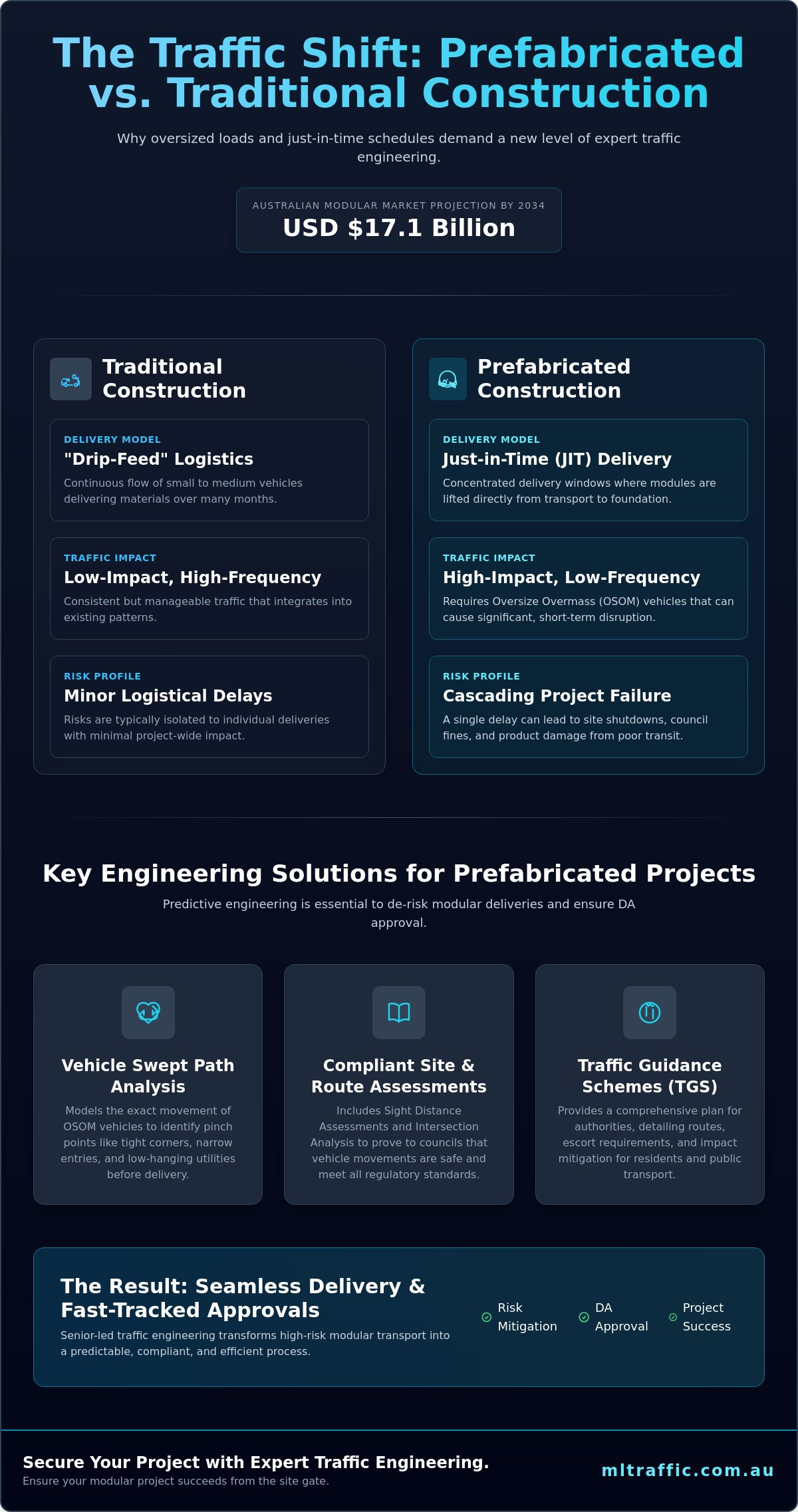
Comparing Traditional Construction vs. Prefab Traffic Logistics
Traditional construction logistics operate as a long-term marathon. Developers manage a consistent flow of light vehicles, trade utes, and concrete trucks over months or years. This creates a predictable but persistent demand on local road networks and on-street parking. Conversely, traffic management for prefabricated construction functions as a series of high-intensity sprints. The total number of vehicle movements over the project lifecycle is significantly lower, but the impact of each movement is exponentially higher. Managing a 30-meter extendable trailer requires a fundamentally different level of technical oversight than managing a standard delivery van.
The shift to modular methods changes the primary logistical challenge from volume to intensity. While traditional sites struggle with daily congestion from hundreds of contractors, modular sites must manage the extreme physical footprint of OSOM vehicles. This requires a transition from on-site material storage to off-site staging areas. Vehicles must be held in secondary locations and called to the site only when the crane is ready for an immediate lift. This "just-in-time" approach minimizes the duration of local disruption but requires flawless execution to avoid blocking arterial roads.
Volume vs. Impact: A Strategic Breakdown
A strategic analysis of traffic movements reveals that prefab projects reduce long-term community friction. Because much of the work occurs in a factory, the daily worker vehicle count drops by up to 80% compared to traditional builds. This reduces the need for extensive Car Parking Demand Assessments for staff. However, the short-term intensity of modular deliveries creates a different set of risks. Pedestrian management becomes a critical safety concern during crane operations. Regulatory bodies like WorkSafe Victoria classify high-risk construction work involving precast concrete as a priority area, particularly when mobile cranes operate from a public road. Developers must prove that pedestrian exclusion zones are physically secure and clearly delineated in the Traffic Guidance Scheme (TGS).
Resource Allocation for Traffic Control
Allocating resources for modular logistics focuses on short-term, high-impact interventions. Traditional builds may require semi-permanent lane closures or long-term parking permits that frustrate local councils. Prefabricated projects often utilize full road closures for 24 to 48 hours to facilitate rapid installation. While the upfront cost of these closures is higher, the total expenditure on traffic control is often lower due to the reduced project timeline. Understanding The Role of a Traffic Engineer is vital here. An experienced engineer can negotiate these temporary closures with councils by demonstrating that the total duration of public inconvenience is shorter than traditional methods. This data-driven approach turns a logistical hurdle into a selling point for planning approvals.
Developing a Compliant Traffic Management Plan (TMP) for Prefab Sites
A compliant Traffic Management Plan (TMP) is the primary regulatory document that bridges the gap between factory production and site installation. Generic plans are insufficient for modular builds. Precision is mandatory. The document must account for the exact dimensions of prefab modules and the specific trailers used for transport. We integrate detailed Traffic Guidance Schemes (TGS) that specify crane outrigger positions and hoist locations to ensure that heavy lifting does not compromise road safety or structural integrity. Every TMP we develop also prioritizes 24/7 access routes for emergency services. This ensures that even during peak installation windows, the site remains accessible to police, fire, and ambulance services.
Coordination with local councils is a critical path activity. Developers must secure temporary road occupancy permits well in advance of the delivery date. This process involves demonstrating that the proposed traffic management for prefabricated construction minimizes public risk while facilitating the movement of Oversize Overmass (OSOM) loads. We provide the technical documentation required to satisfy council engineers, focusing on the intersection of site-specific logistics and public infrastructure protection.
Essential Components of a Prefab TMP
A robust TMP for modular projects includes several specialized layers. Pilot vehicle coordination is a primary requirement for most OSOM movements in Australia. For example, in New South Wales as of June 2025, any load wider than 3.5 meters or longer than 26 meters requires at least one pilot vehicle for daytime travel. The plan must also define staging zones where vehicles can wait without obstructing traffic. Pedestrian exclusion zones are equally vital. These zones must be physically secured during heavy lifts to prevent unauthorized access to the "drop zone" under the crane. Finally, a formal communication strategy is required to notify local residents and businesses of scheduled OSOM movements and potential road closures.
Navigating National and Local Regulations
Developers often struggle with the overlapping jurisdictions of the National Heavy Vehicle Regulator (NHVR) and local councils. The NHVR manages the vehicle access permit, which currently carries a $91 application fee for Performance-Based Standards (PBS) vehicles. However, the NHVR permit does not grant permission to occupy a council road or manage local traffic. That authority remains with the local council through the TMP approval process. Compliance with AS 1742.3:2019 is the baseline requirement for all traffic control devices used on-site. To ensure your project meets these rigorous standards, we recommend commissioning a professional Traffic Guidance Scheme (TGS) that integrates both NHVR requirements and local council expectations. Adhering to this dual-layered regulatory framework is the only way to avoid project stoppages and legal liability.
Expert Traffic Engineering: Streamlining Modular Project Approvals
Securing council approval for modular developments requires proving the feasibility of high-impact vehicle movements within existing urban constraints. ML Traffic Engineers Australia facilitates planning approvals by providing data-driven evidence that satisfies both local councils and road authorities. Our senior engineers bridge the gap between architectural design and logistical reality. Site plans must account for the physical requirements of specialized transport trailers from the outset. Professional traffic management for prefabricated construction is now a prerequisite for avoiding project gridlock as competition for road space increases across Australia.
Our approach centers on technical accuracy and regulatory compliance. We provide detailed reports that meet the rigorous standards of Australian councils. Senior-level involvement in every project ensures that complex issues, such as intersection capacity and sight distance, are addressed with the precision required for fast-tracked approvals. This meticulous oversight ensures that technical reports are comprehensive from the first submission. It significantly reduces the risk of a council Request for Information (RFI) that can delay a project for weeks.
The ML Traffic Engineers Australia Advantage for Developers
Technical expertise is only one part of the approval process. Accountability and experience are equally critical. Our firm brings over 15 years of specialized experience in conducting Traffic Impact Assessments for diverse project environments. We operate with a personnel continuity promise. The senior expert who initiates your project is the same professional who performs the technical work and defends the report to the council. This "no-gatekeepers" philosophy ensures direct access to leadership and a higher level of accountability for your project’s success.
-
Direct principal involvement in every modular site assessment.
-
Elimination of junior-level errors through senior-led modeling.
-
Consistent adherence to AS 1742.3 and individual state supplements.
-
Proven track record in navigating NHVR and council jurisdictional overlaps.
Next Steps for Your Modular Project
Engagement with a traffic engineer should occur early in the feasibility stage. Waiting until the DA submission to consider vehicle access often leads to costly design changes. By requesting a preliminary swept path or access assessment, developers can confirm that their site can physically accommodate the intended modules. This proactive engineering approach identifies constraints before they become liabilities. To secure your delivery timeline and ensure compliant site access, Contact ML Traffic Engineers Australia for a project-specific consultation. We provide the technical certainty required to move your modular project from the factory to the site without logistical failure.
Securing Your Modular Delivery Timeline
Mastering traffic management for prefabricated construction requires moving beyond basic logistical planning into rigorous technical engineering. The success of a modular build depends on the precision of Vehicle Swept Path Analysis and the ability to navigate the overlapping jurisdictions of the NHVR and local councils. By identifying physical pinch points and structural constraints before the first unit is dispatched, developers eliminate the risk of site access failure and costly council fines. Technical documentation must be accurate, compliant, and ready for senior-level scrutiny.
ML Traffic Engineers Australia provides the technical certainty needed for high-stakes modular projects. With over 15 years of traffic engineering experience and a specialized focus on AutoTURN swept path modelling, we ensure your site is accessible and compliant. Our senior principals handle every technical report personally, providing the personnel continuity and direct accountability your project deserves. Speak directly with a Senior Traffic Engineer about your prefab project to streamline your next approval and ensure a seamless delivery process. Proper planning ensures your innovative construction methods are supported by reliable logistical reality.
Frequently Asked Questions
What is the difference between a Traffic Management Plan (TMP) and a Traffic Guidance Scheme (TGS)?
A Traffic Management Plan (TMP) is a comprehensive strategic document that outlines the overall approach to managing traffic risks and impacts for a project. A Traffic Guidance Scheme (TGS), formerly known as a Traffic Control Plan, is a technical diagram that shows the exact placement of signs, bollards, and controllers. For modular builds, the TGS is a critical component of the TMP that illustrates specific crane outrigger positions and pedestrian exclusion zones.
Do I need a swept path analysis for all prefabricated construction projects?
You must perform a swept path analysis for any project involving Oversize Overmass (OSOM) vehicles or specialized modular trailers. Because these units often exceed standard vehicle dimensions, councils require digital proof that the load can navigate every intersection and site entry. Failing to provide this analysis during the planning phase often leads to immediate rejection of your construction traffic submissions.
How does the National Heavy Vehicle Regulator (NHVR) affect my construction traffic planning?
The NHVR manages the access permits for heavy vehicles over 4.5 tonnes across most Australian states. While the NHVR approves the vehicle’s right to travel on a specific route, it doesn’t grant permission to occupy or manage traffic on local council roads. Effective traffic management for prefabricated construction requires the seamless integration of NHVR route permits with local council road occupancy approvals.
What are the most common traffic-related reasons for council to reject a modular development application?
Councils frequently reject applications due to inadequate swept path modeling or the lack of a designated staging area for waiting vehicles. If a plan doesn’t demonstrate how it’ll prevent OSOM vehicles from idling on narrow residential streets, it’ll fail the approval process. Other common reasons include insufficient pedestrian safety protocols and failing to account for the impact on local public transport routes.
Can a traffic engineer help reduce the required number of on-site parking spaces for a prefab build?
A traffic engineer can prepare a Car Parking Demand Assessment to justify a reduction in statutory parking requirements. Since prefabricated construction involves fewer on-site trades and a significantly shorter project duration, we can prove that the actual parking demand is lower than traditional builds. This data-driven evidence allows developers to maximize site area while remaining compliant with council expectations.
What specialized vehicles are typically used for transporting modular buildings in Australia?
Modular transport typically utilizes extendable flatbeds, low loaders, and trailers with independent rear-axle steering. These vehicles are designed to handle the unique geometry and weight of prefabricated units. Our engineers model these specific vehicle configurations in AutoTURN to ensure they can physically clear street furniture, utility poles, and tight urban corners without causing infrastructure damage.
How far in advance should I engage a traffic consultant for a prefabricated project?
You should engage a traffic consultant during the initial feasibility stage, ideally three to six months before the planned delivery. Early engagement allows for a preliminary swept path assessment to inform the architectural design and site entry locations. This proactive approach prevents costly redesigns that occur when logistical constraints are only identified during the final DA submission.
Is a Traffic Impact Assessment (TIA) required for temporary modular structures?
A Traffic Impact Assessment (TIA) is often mandatory for temporary modular structures if they alter existing site access or generate significant new vehicle movements. Councils require these reports to ensure that temporary installations, such as site offices or classrooms, don’t obstruct sight distances or interfere with intersection capacity. We conduct Sight Distance Assessments to verify that these structures maintain safe visibility for all road users.
Which areas do you cover?
We are traffic engineers servicing Melbourne, Sydney, Brisbane, Gold Coast, Hobart, Perth, Adelaide, Darwin, Canberra and surrounding areas.

Disclaimer
The content on www.mltraffic.com.au, including all technical articles, guides, and resources, is provided for general informational and educational purposes only. It is not intended to constitute professional advice in traffic engineering, transportation planning, development approvals, or any other technical or legal field.
While ML Traffic Engineers makes every reasonable effort to ensure the accuracy, completeness, and timeliness of the information published, we do not provide any warranties or representations (express or implied) regarding its reliability, suitability, or availability for any particular purpose. Any reliance you place on the content is strictly at your own risk.
In no event shall ML Traffic Engineers, its directors, employees, authors, or affiliates be liable for any direct, indirect, incidental, special, consequential, or punitive damages (including, without limitation, loss of profits, data, or business opportunities) arising out of or in connection with the use of, or inability to use, any information provided on this website.
The articles and guides on this site are not a substitute for engaging a qualified, registered professional traffic engineer (such as an NPER or RPEQ engineer) to assess your specific project requirements. For tailored advice, compliance assessments, or traffic engineering services, please contact a competent professional.
This disclaimer may be updated from time to time without notice. By accessing or using this website, you agree to be bound by the most current version of this disclaimer.
