

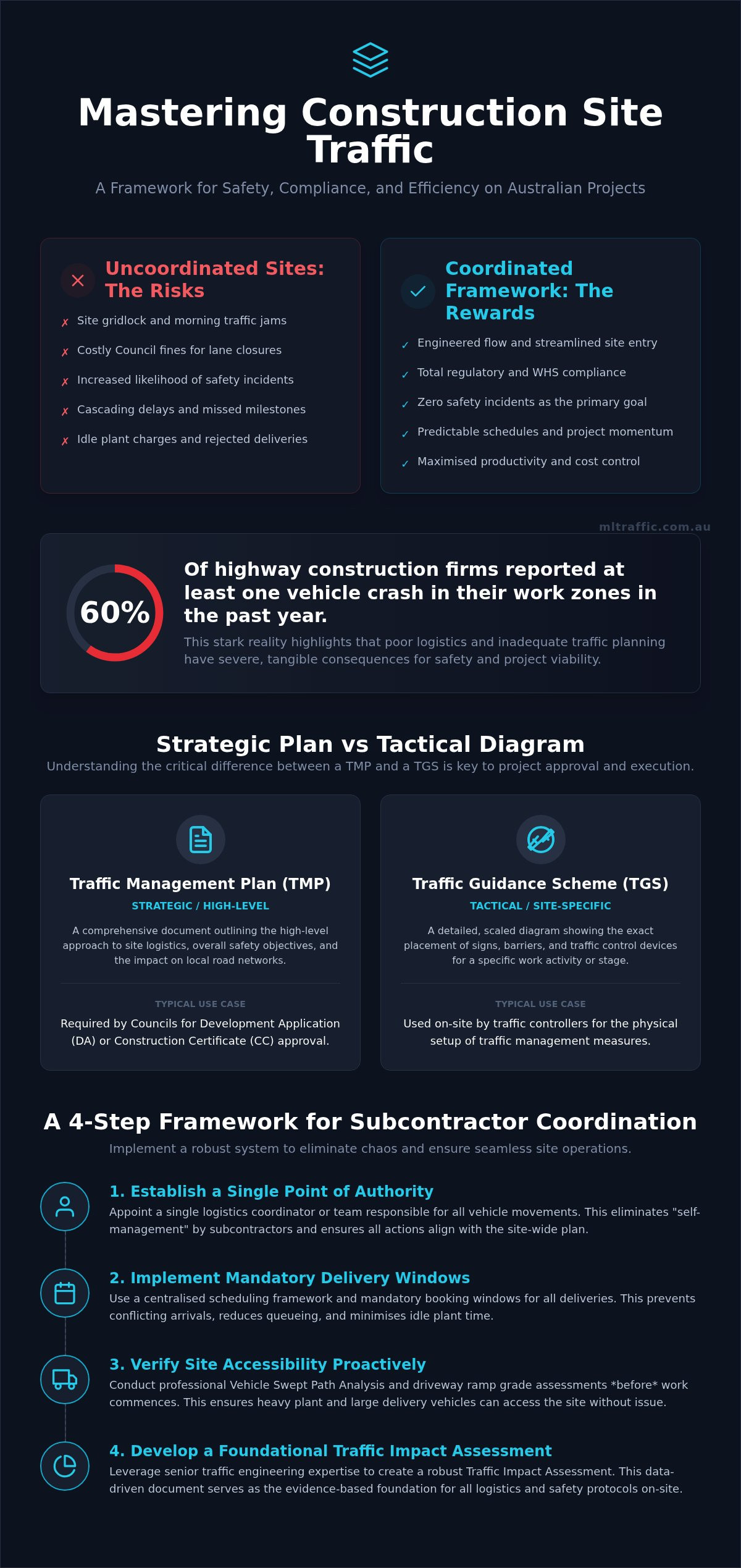
If your site entry looks like a morning traffic jam on a major arterial road, your logistics plan has already failed. Managing a dozen different subcontractors all trying to hit the same gate at 7:00 AM is a recipe for chaos, Council fines, and safety incidents. You likely agree that coordination is the most volatile element of any major project. Meeting the standard construction traffic management plan requirements isn’t just about ticking a box for the local authorities. It’s about engineering a flow that prevents unauthorised lane closures and site gridlock before the first truck arrives. Research indicates that 60% of highway construction firms reported at least one vehicle crash in their work zones in the past year, proving that poor logistics have real consequences.
We’ll show you how to master these complexities with a robust coordination framework that ensures zero safety incidents and total regulatory compliance. This guide provides a professional roadmap for site logistics, covering everything from vehicle swept path analysis to streamlined entry protocols that keep your project moving without the threat of unexpected work stoppages or expensive compliance breaches. You’ll learn how to align your site operations with Australian Standards while maintaining the momentum your schedule demands.
Key Takeaways
- Coordinate multiple subcontractors through a single point of authority to eliminate site gridlock and avoid costly Council fines for unauthorised lane closures.
- Identify the specific construction traffic management plan requirements that distinguish a strategic, high-level TMP from a tactical, site-specific Traffic Guidance Scheme (TGS).
- Verify site accessibility for heavy plant and large delivery vehicles by utilising professional Vehicle Swept Path Analysis and driveway ramp grade assessments.
- Establish mandatory delivery booking windows and a centralised scheduling framework to prevent conflicting subcontractor arrivals and reduce idle plant time.
- Leverage senior traffic engineering expertise to develop a robust Traffic Impact Assessment that serves as the foundation for all site logistics and safety protocols.
The Challenge of Multi-Subcontractor Traffic Coordination
Managing a single supply chain is straightforward. Managing twenty simultaneous subcontractor movements is an engineering feat. On large-scale projects, the risk of a safety incident doesn’t simply increase with each new contractor; it multiplies. This occurs because every subcontractor operates on their own schedule, often with conflicting priorities. Meeting the specific construction traffic management plan requirements for a multi-user site is a technical task that requires senior oversight. Without a central authority, site entry points become bottlenecks, leading to unauthorised lane closures and heavy Council penalties.
Australian Work Health and Safety (WHS) laws place the burden of coordination squarely on the Principal Contractor. You have a non-delegable duty to ensure that all persons on-site, including visitors and the public, are protected from traffic-related hazards. Failure to establish clear construction traffic management plan requirements can lead to more than just fines. It can result in project-halting safety incidents. While standards vary, many professional frameworks draw foundational principles from the Manual on Uniform Traffic Control Devices (MUTCD) to ensure consistency in signage and signalisation across complex environments.
Common Risks on Uncoordinated Sites
Uncoordinated sites suffer from “self-management” syndrome. This happens when subcontractors make their own decisions about where to park or when to unload based on their immediate needs rather than site-wide logic. The results are predictable and dangerous. High-frequency interactions between heavy plant and pedestrians increase the likelihood of a strike. Drivers often park on footpaths or block cycle lanes when site access is denied, leading to immediate Council infringements. Additionally, reversing vehicles without dedicated spotters or poorly positioned signage creates blind spots that subcontractors haven’t been briefed on during induction.
The Financial Impact of Traffic Delays
The cost of a traffic bottleneck isn’t just a delayed truck; it’s the systemic failure of the day’s programme. Concrete deliveries are particularly sensitive. If a mixer is held in a queue due to poor site access, the product may exceed its placement window, leading to rejected loads and wasted labour. Steel deliveries and crane lifts operate on tight windows. A 30-minute delay at the gate can cascade into thousands of dollars in idle plant charges and missed milestones. Professional traffic engineering services help mitigate these risks by establishing a data-driven flow that respects project timelines and insurance requirements. Meticulous planning ensures that every vehicle movement is accounted for before the first subcontractor arrives on-site.
Core Construction Traffic Management Plan Requirements
A compliant plan serves as the operational backbone of a construction site. It’s not a static document but a framework that must evolve with each stage of the build. Meeting construction traffic management plan requirements necessitates a deep understanding of how different subcontractors interact within limited spatial constraints. Every document must include detailed provisions for emergency vehicle access, clear sight distances at all egress points, and lighting for night-time operations where applicable. These elements ensure that your site remains safe for both workers and the public throughout the project lifecycle.
TMP vs TGS: Knowing Which You Need
Distinguishing between strategic and tactical documents is vital for project continuity. A strategic Traffic Management Plan (TMP) outlines the high-level approach to site logistics, including the impact on local road networks and overall safety objectives. In contrast, a Traffic Guidance Scheme (TGS) is a tactical diagram showing the exact placement of traffic control devices for specific work stages. Councils often require a certified TMP during the Development Application (DA) or Construction Certificate (CC) phase to assess the broader impact on the community. Professional Traffic Engineering ensures these documents are technically sound and capable of withstanding rigorous Council scrutiny.
Statutory Compliance and Australian Standards
Technical compliance extends beyond general safety. AS 2890 provides the national standard for off-street parking and loading facilities, which is critical when managing heavy plant and delivery vehicles. If your site requires any use of the public road reserve, you must secure a Road Occupancy Licence (ROL). These licences are contingent on your plan’s ability to maintain pedestrian protection and disability access. You must ensure that all temporary footpaths are level, unobstructed, and clearly marked for all members of the public.
Generic templates frequently fail the audit process because they lack site-specific data. A compliant plan must account for the actual swept path of the largest vehicle expected on-site. AS 1742.3, the Manual of uniform traffic control devices, requires that all traffic control devices be maintained in good condition and positioned to provide adequate warning to road users. Adhering to these construction traffic management plan requirements prevents unauthorised lane closures and the resulting Council fines. If you need assistance navigating these technical standards, you can consult with our senior principals to ensure your documentation is audit-ready and compliant with all national regulations.
Analysing Site Access and Vehicle Movements
Technical verification is the only way to ensure a site can handle the physical dimensions of modern construction logistics. You cannot rely on visual estimates when coordinating the arrival of articulated vehicles or heavy plant. A core component of meeting construction traffic management plan requirements is providing documented proof that the largest anticipated vehicles can enter, manoeuvre, and exit the site safely. This requires a geometric assessment of all access points and internal roadways to prevent vehicles from mounting kerbs or striking site infrastructure.
Using Swept Path Analysis to Prevent Bottlenecks
Simulating vehicle movements before a project commences identifies potential gridlock points that are often invisible on a standard 2D site plan. We utilise AutoTURN software to conduct a professional Swept Path Analysis for every critical delivery type, from concrete agitators to 19-metre semi-trailers. This modelling allows for the precise design of loading zones and turning circles, ensuring that steel or pre-cast concrete deliveries don’t result in a site-wide standstill. These simulations are also vital for effective Car Park Design and temporary loading bay placement, ensuring that subcontractor vehicles don’t obstruct primary thoroughfares or emergency access routes.
Managing Heavy Vehicle Egress
Safe egress is just as critical as site entry. You must ensure that all site exits provide adequate sight distances for drivers to merge into live traffic without creating a hazard. A formal Sight Distance Assessment verifies that the “gap” available to a departing heavy vehicle meets Australian Standards. This is particularly important on high-speed roads or near intersections where traffic flow is dense. Adhering to these construction traffic management plan requirements protects your project from liability and reduces the risk of vehicle-to-vehicle collisions.
Vertical geometry is another frequently overlooked factor. We perform a Driveway Ramp Grade Assessment to ensure that heavy plant and low-clearance trailers don’t scrape or become hung up on steep transitions. Site access must also be “all-weather” to prevent heavy vehicles from tracking mud onto public roads, which is a common trigger for Council environmental fines. When managing oversized loads, such as piling rigs or large excavators, you must coordinate with local authorities well in advance. Professional engineering oversight ensures that these movements are integrated into the daily schedule without disrupting the broader subcontractor coordination framework. This level of precision is fundamental for large-scale projects handled by McMahons Civil and Contracting PTY LTD, where civil and infrastructure works must align perfectly with site logistics.
Establishing a robust coordination framework is a technical necessity for any Principal Contractor. You cannot manage a high-volume site through informal agreements or verbal cues. A professional framework centralises authority and ensures that all construction traffic management plan requirements are met through rigorous scheduling and site-wide communication. This structure eliminates the “first-in, best-dressed” delivery model that frequently leads to unauthorised road occupancy and Council infringements. Effective management requires a hierarchy where a designated site traffic supervisor oversees all movements, ensuring that no subcontractor operates in isolation.
Step 1: The Centralised Delivery Schedule
A centralised schedule is the primary tool for preventing site gridlock. You must move away from ad-hoc arrivals by implementing mandatory delivery booking windows for all trades. High-impact deliveries, such as concrete pours or structural steel, should be allocated specific gate times that do not conflict with other major movements. Digital scheduling tools allow you to synchronise subcontractor arrivals in real-time, providing a clear visual of the day’s expected traffic volume. To support these digital systems on sites with weak signals, professional RF solutions from telcoantennas.com.au can provide the necessary mobile coverage for uninterrupted coordination. This data-driven approach allows the site team to identify potential bottlenecks before they manifest as physical delays on the road network.
Compliance begins with clear communication. Every subcontractor must be briefed on the site-specific Traffic Guidance Scheme (TGS) during their initial induction. It is a non-negotiable requirement that every trade supervisor signs off on the TGS, acknowledging their understanding of site entry points, internal speed limits, and designated loading zones. Visual aids are essential for a diverse workforce. You should install large-scale site maps at every entry point that clearly illustrate vehicle flow and pedestrian exclusion zones. This ensures that even infrequent visitors to the site understand the movement protocols without the need for constant supervision.
Step 3: Real-Time Traffic Adjustment
Construction environments are dynamic, and delays are often unavoidable. Your framework must include a protocol for handling late arrivals without disrupting the entire site programme. When a delivery is delayed, the site manager must have the authority to re-prioritise gate access or redirect vehicles to an off-site holding area if one is available. Reporting near-misses and traffic disputes between subcontractors is vital for iterative improvement. If a specific movement consistently creates a hazard, the plan must be adjusted to mitigate the risk. If you require a professional framework that meets all construction traffic management plan requirements, explore our traffic engineering services to ensure your site remains compliant and efficient.
Professional Engineering: The Key to Seamless Coordination
A high-performance construction site requires more than just a gatekeeper and a clipboard. It requires a technical foundation built on rigorous engineering principles. A certified Traffic Impact Assessment (TIA) serves as this foundation. It provides the data necessary to justify your site’s operational flow to local authorities and road managers. By quantifying the expected vehicle movements and their impact on the surrounding network, the TIA ensures that your subsequent construction traffic management plan requirements are grounded in reality rather than guesswork. Meticulous documentation reduces project risk by anticipating conflicts before they cause a work stoppage.
Continuity in professional oversight is vital for maintaining site safety. When the engineer who designs the plan is also responsible for its technical execution, you eliminate the risk of misinterpretation. This hands-on approach ensures that the coordination framework described in previous sections remains effective as the project scales. Meticulous technical documentation serves as your primary defence against liability, providing a clear record of compliance with all relevant Australian Standards and Council mandates.
The Value of Senior Technical Oversight
Complex developments with multiple subcontractors cannot afford the “junior engineer” trap. Senior expertise is essential when navigating the intersection of AS 2890 compliance and the daily realities of a busy site. ML Traffic Engineers Australia provides direct access to senior principals who bring over 15 years of industry experience to every project. This seniority ensures that your traffic solutions are customised for unique site constraints, such as limited frontage or steep driveway ramp grades. Professional plans developed by seasoned experts speed up Council and Road Authority approvals because they address potential friction points proactively. You receive a level of accountability that larger, more impersonal firms often fail to provide.
Next Steps for Your Development
Engaging a traffic consultant early in the project lifecycle is the most effective way to prevent future bottlenecks. Ideally, this engagement should occur during the design phase to ensure that site access points are optimised for heavy vehicle swept paths. Before your project commences, you should prepare for a comprehensive traffic audit by verifying all construction traffic management plan requirements against the latest Australian Standards. This includes checking sight distances, pedestrian protection measures, and loading zone capacities. Our personnel continuity promise means the same expert who initiates your project at ML Traffic Engineers Australia will be the one performing the technical work, ensuring consistency from initial design through to final approval. Contact ML Traffic Engineers Australia for a tailored quote and a professional assessment of your site’s logistics needs.
Securing Your Site with Professional Logistics
Mastering multi-subcontractor coordination transforms a chaotic site into a streamlined operation. You’ve seen how centralised scheduling and technical verification through Swept Path Analysis eliminate the risks of idle plant and unauthorised road occupancy. Meeting all construction traffic management plan requirements is a technical task that demands senior engineering oversight to ensure safety and regulatory compliance. We provide national consultancy services for all development types, backed by over 15 years of industry experience and direct principal involvement in every report produced.
Don’t let logistics bottlenecks stall your project milestones or lead to expensive Council infringements. Our “no-gatekeepers” approach gives you immediate access to experts who ensure the same senior professional who starts your project performs the technical work. Get a professional Traffic Management Plan for your next project to secure your site entry and maintain total compliance. Proactive planning is the most effective way to ensure a safe, efficient, and profitable build environment.
Frequently Asked Questions
Do I need a separate Traffic Management Plan for every subcontractor?
You don’t need a separate plan for every subcontractor. Instead, the Principal Contractor must establish a single, comprehensive document that dictates all site movements. This centralised approach ensures that every trade, from excavation to fit-out, operates under the same safety protocols. Having multiple conflicting plans would create chaos at site entry points. Every subcontractor must be inducted into this primary plan to ensure they understand their specific access windows and loading zones.
What is the difference between a TMP and a TGS in Australian construction?
A Traffic Management Plan (TMP) is a strategic document used for high-level planning and Council approvals. It outlines how the project will impact the broader road network. A Traffic Guidance Scheme (TGS), previously known as a TCP, is a tactical diagram showing the precise location of signs and cones. While the TMP sets the construction traffic management plan requirements, the TGS provides the on-ground instructions for traffic controllers to manage daily vehicle movements safely.
Who is legally responsible if a subcontractor causes a traffic incident?
Legal responsibility typically rests with the Principal Contractor under Australian Work Health and Safety laws. You have a non-delegable duty to provide a safe workplace, which includes managing traffic hazards created by subcontractors. While the subcontractor has a duty to follow the site rules, the Principal Contractor must ensure those rules are robust and enforced. Failure to oversee subcontractor movements can lead to shared liability and significant penalties if an incident occurs on or near the site.
Can I create my own construction traffic plan or do I need an engineer?
You can technically draft a basic plan for minor, low-impact works, but most Councils require a certified professional for complex projects. Meeting technical construction traffic management plan requirements often involves specialised software and engineering knowledge. Using a qualified traffic engineer ensures that your plan complies with AS 1742.3 and AS 2890. This professional oversight reduces the risk of Council rejection and ensures that your site logistics are actually functional for heavy vehicle movements.
How often should a Construction Traffic Management Plan be updated?
Your plan should be updated whenever there is a significant change in the construction stage or site layout. This includes transitions from excavation to structural works, as vehicle types and frequencies will change. You must also review the plan if a near-miss occurs or if a new traffic hazard is identified during daily briefings. A static plan quickly becomes obsolete on a dynamic site. Regular audits ensure that your traffic controls remain effective and compliant.
What are the penalties for non-compliance with a Council-approved TMP?
Penalties for non-compliance are severe and can include immediate work stoppages or the cancellation of your Road Occupancy Licence (ROL). Councils can issue heavy fines, with serious construction violations often resulting in penalties exceeding $15,000. Beyond financial costs, repeated breaches can damage your professional reputation and make future permit approvals more difficult. In serious cases involving safety incidents, penalties for willful violations can reach significantly higher amounts under national WHS legislation.
Do I need a Traffic Guidance Scheme for minor works on the nature strip?
You generally need a TGS if your works impact the safety of pedestrians or road users, even on the nature strip. Any activity that requires workers to be near a live traffic lane or that obstructs a public footpath falls under Australian Standards for traffic control. A TGS ensures that you have provided adequate warning and a safe bypass for the public. Failing to implement proper controls for minor works is a common cause of Council infringements.
How does Swept Path Analysis help with subcontractor coordination?
Swept Path Analysis provides a technical simulation of how the largest subcontractor vehicles will manoeuvre through your site. By modelling these movements, you can identify “tight spots” and design loading zones that don’t block primary access routes. This prevents subcontractors from getting stuck or being forced to reverse onto public roads. It’s a vital tool for proving to Councils that your site can handle the logistics of multiple trades without creating external traffic congestion.

Disclaimer
The content on www.mltraffic.com.au, including all technical articles, guides, and resources, is provided for general informational and educational purposes only. It is not intended to constitute professional advice in traffic engineering, transportation planning, development approvals, or any other technical or legal field.
While ML Traffic Engineers makes every reasonable effort to ensure the accuracy, completeness, and timeliness of the information published, we do not provide any warranties or representations (express or implied) regarding its reliability, suitability, or availability for any particular purpose. Any reliance you place on the content is strictly at your own risk.
In no event shall ML Traffic Engineers, its directors, employees, authors, or affiliates be liable for any direct, indirect, incidental, special, consequential, or punitive damages (including, without limitation, loss of profits, data, or business opportunities) arising out of or in connection with the use of, or inability to use, any information provided on this website.
The articles and guides on this site are not a substitute for engaging a qualified, registered professional traffic engineer (such as an NPER or RPEQ engineer) to assess your specific project requirements. For tailored advice, compliance assessments, or traffic engineering services, please contact a competent professional.
This disclaimer may be updated from time to time without notice. By accessing or using this website, you agree to be bound by the most current version of this disclaimer.
