

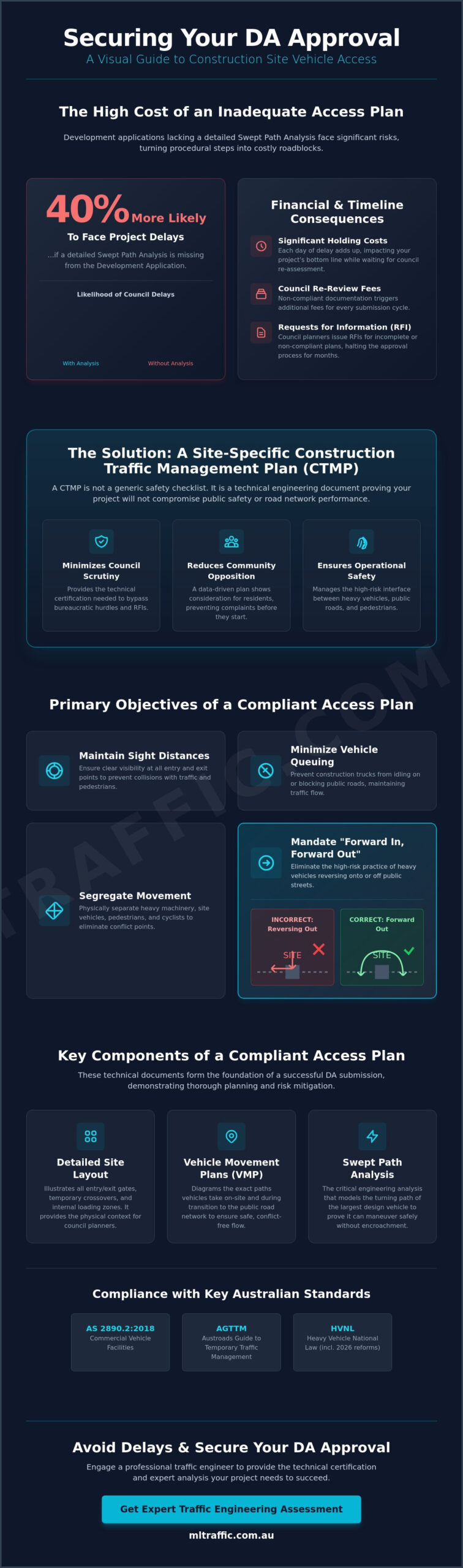
Did you know that development applications for multi-residential or commercial properties across Australia are 40% more likely to face delays if they lack a detailed Swept Path Analysis? Securing council approval is a primary bottleneck in any project timeline. Non-compliant documentation does more than stall progress; it triggers re-review fees and significant holding costs. Achieving a successful vehicle access design for construction site DA approval requires a meticulous approach that prioritizes technical accuracy over generic safety checklists.
This article will show you how to design and implement a traffic management plan that secures council approval and ensures operational safety. You’ll learn the specific requirements for AS 2890.2:2018 compliance, the mandatory “forward in, forward out” maneuvering standards, and how to prepare for the 2026 Heavy Vehicle National Law reforms. We detail the engineering documentation needed to facilitate efficient heavy vehicle movement and eliminate safety risks at your site entry points.
Key Takeaways
- Identify why site access is the highest-risk element of your construction traffic strategy and the necessity of a site-specific Construction Traffic Management Plan (CTMP).
- Master the technical requirements of vehicle access design for construction site DA approval, including integrated site layouts and internal Vehicle Movement Plans (VMP).
- Ensure full compliance with Australian Standard AS 2890.2 for commercial vehicle facilities and the Austroads Guide to Temporary Traffic Management (AGTTM).
- Learn to define the correct design vehicle for each construction phase by conducting a comprehensive road network audit and site analysis.
- Understand the role of technical certification and professional swept path analysis in minimizing council scrutiny and preventing project holding costs.
The Critical Role of a Traffic Management Plan for Construction Site Access
A site-specific Construction Traffic Management Plan (CTMP) is a technical engineering document designed to manage the interaction between construction activity and the public road network. It’s far more than a safety checklist. While a generic TMP might address internal site safety, a dedicated access assessment focuses specifically on the interface where heavy vehicles enter and exit the property. For developers, a robust vehicle access design for construction site DA approval is the only way to prove to local authorities that the project won’t compromise public safety or network performance.
Site access is the highest-risk element of any construction traffic strategy. It involves large, slow-moving vehicles crossing pedestrian footpaths and merging into live traffic lanes. Without precise engineering, these movements create conflict points that lead to accidents and significant community opposition. Poor planning doesn’t just risk safety; it results in project delays and potential legal liability under Australian road authority frameworks. To better understand this concept, watch this helpful video:
Developers must adhere to strict legal obligations. In Australia, this includes alignment with the Heavy Vehicle National Law (HVNL) and state-specific guidelines from bodies like Transport for NSW or Victoria’s Department of Transport. These regulations demand that site access adheres to established Road traffic control principles to maintain the integrity of the local road network. Failing to provide a technical assessment often leads to councils issuing a Request for Further Information (RFI). This can stall a project for months and increase holding costs. Professional traffic engineering provides the necessary technical certification to bypass these bureaucratic hurdles.
Why Council Approval Hinges on Access Design
Council planners evaluate development applications through the lens of the Statement of Environmental Effects (SEE). They require documented proof that your construction phase won’t cause gridlock or endanger residents. Engaging a professional for a Traffic Impact Assessment ensures these technicalities are addressed early. By using data-driven assessments, you can mitigate community complaints before they start. A well-designed access plan demonstrates that you’ve considered every turn, merge, and stop, satisfying the stringent conditions typically attached to a DA.
Primary Objectives of an Access-Focused TMP
The primary goal is to create a predictable and controlled environment. Key objectives include:
- Ensuring the physical segregation of heavy machinery from pedestrians and cyclists.
- Maintaining mandatory sight distances at all entry and exit points to prevent collisions.
- Minimizing the footprint of construction vehicle queuing to prevent trucks from idling on public roads.
- Implementing “Forward In, Forward Out” protocols to eliminate the high-risk practice of reversing onto public streets.
Key Components of a Compliant Construction Site Access Plan
A compliant access plan consists of several technical layers that work together to secure regulatory approval. At its core is a detailed site layout. This document must clearly illustrate all proposed entry and exit gates, temporary crossovers, and internal loading zones. It’s the primary reference for council planners to assess the physical footprint of your construction operations. Without a high-fidelity layout, your vehicle access design for construction site DA approval will lack the necessary context for a favorable review.
Vehicle Movement Plans (VMPs) are equally vital. These diagrams detail the specific paths vehicles take within the site and their transition to the external road network. A VMP ensures that heavy vehicles don’t conflict with site offices or storage areas. It also dictates how traffic enters the public stream safely. For complex projects, a Traffic Guidance Scheme (TGS) is often required to manage temporary road occupancy. This scheme outlines the placement of traffic control devices when construction vehicles must disrupt normal traffic flow. Adhering to Australian standards for traffic management is mandatory to ensure these schemes meet legal safety thresholds.
The Necessity of Vehicle Swept Path Analysis
Engineering precision is non-negotiable. We use specialized software like AutoTURN to simulate heavy vehicle maneuvers. This analysis is critical for identifying pinch points where a 12.5-meter Heavy Rigid Vehicle (HRV) might clip a curb. According to AS 2890.2:2018, a standard HRV requires a 12.5-meter turning radius and 4.5-meter vertical clearance. For a deeper dive, see our guide on Swept Path Analysis: A Complete Guide for Australian Developments. Identifying these issues early prevents property damage. If your project involves tight urban constraints, professional Vehicle Swept Path Analysis is the most reliable way to prove maneuverability.
Signage and Delineation Requirements
Clear communication reduces on-site incidents. Your plan must include standardized warning signs for construction vehicle turning movements. Temporary line marking and physical barriers are essential for segregating access lanes from public thoroughfares. You must ensure all signage remains visible during dawn and dusk operations. Pedestrian management strategies are also a priority. You need to account for the safe diversion of foot traffic around the site perimeter, particularly where construction gates intersect with public footpaths. Meticulous delineation ensures that both drivers and pedestrians understand their designated paths, reducing the likelihood of a high-consequence event.
Navigating Australian Standards and Regulatory Requirements
Compliance is the barrier between a theoretical design and a legally executable project. Achieving a compliant vehicle access design for construction site DA approval requires a deep understanding of the Australian Standards framework. While the National Construction Code (NCC) 2022 provides the overarching building code, traffic-specific requirements are dictated by AS 2890.2:2018. This standard governs off-street commercial vehicle facilities and is the benchmark for all heavy vehicle access points. Local councils also mandate adherence to the Austroads Guide to Temporary Traffic Management (AGTTM). This guide provides the technical basis for managing traffic during the construction phase, ensuring that temporary site access points don’t compromise the safety of the existing road network.
Local government authorities typically provide specific Construction Management Plan (CMP) templates. These documents require you to detail how your project will align with local Development Control Plans (DCPs). Beyond council requirements, you must satisfy the Work Health and Safety (WHS) Act. This legislation necessitates a documented approach to traffic control to protect workers and the public. For developers in northern regions, following the Queensland government traffic management guidelines is a critical step in demonstrating WHS compliance. Engineering documentation for vehicle access design for construction site DA approval must demonstrate that these multi-layered regulatory demands have been met with technical precision.
AS 2890.2: The Benchmark for Heavy Vehicle Access
AS 2890.2:2018 sets rigid parameters for heavy vehicle facilities. For a standard 12.5-meter Heavy Rigid Vehicle (HRV), the design must accommodate a 12.5-meter turning radius. Minimum vertical clearance is strictly set at 4.5 meters for all areas where these vehicles operate. Driveway widths must allow for seamless entry without encroaching on opposing traffic lanes. Gradient limits are equally critical; site ramps must be designed to prevent vehicles from bottoming out or losing traction. Meticulous adherence to these dimensions is the only way to avoid a non-compliance notice during the DA review process.
Permit Requirements for Road Occupancy
If your site access requires vehicles to stand on public roads or if you need to modify existing traffic lanes, you must obtain a Road Occupancy Licence (ROL). This is common for urban sites with limited internal space. A traffic engineer plays a vital role here, certifying that the access design meets the safety standards required for such permits. Coordination with state road authorities, such as Transport for NSW or Victoria’s Department of Transport, is mandatory for any site with access to arterial roads. These authorities require technical proof that your construction traffic won’t degrade the performance of high-volume corridors.
Step-by-Step: Developing an Effective Construction Site Access Plan
Moving from a theoretical site plan to an approved access strategy requires a systematic, engineering-led process. You can’t rely on assumptions; every centimeter of road space must be accounted for through empirical data. A successful vehicle access design for construction site DA approval depends on five technical steps that bridge the gap between architectural intent and the physical reality of the Australian road network.
- Step 1: Conduct a site and road network audit. Map all physical constraints on and around the site.
- Step 2: Define the design vehicle. Match the vehicle dimensions to the most intensive construction phase, such as excavation or structural assembly.
- Step 3: Perform swept path analysis. Use simulation software to verify that the design vehicle can execute all maneuvers without crossing centerlines or hitting curbs.
- Step 4: Draft TGS and VMP documentation. Create the visual schemes for temporary road occupancy and internal site flow.
- Step 5: Engineering certification. Have a qualified traffic engineer sign off on the technical accuracy of the plan to satisfy council requirements.
Step 1: The Site Audit and Constraint Mapping
A desktop study isn’t enough for a high-risk access plan. You need a physical audit to identify existing infrastructure that could impede heavy vehicle movement. This includes power poles, street trees, drainage pits, and telecommunications cabinets. We measure existing road widths and calculate available sight lines to ensure they meet the minimum requirements for the local speed environment. If your project team lacks the equipment or expertise for a technical field survey, you can consult the ML Traffic Services Page for professional audit support. Identifying these constraints early prevents the need for costly design revisions later in the DA process.
Finalizing the Documentation for Submission
Your documentation must be scalable. Construction projects are dynamic; the access requirements for the excavation phase will differ significantly from the building fit-out. You must ensure the TMP accounts for these shifts. It’s also essential to integrate your waste management plan with site access points. Council planners look for a cohesive strategy where waste collection vehicles don’t conflict with general construction traffic. Choosing the wrong design vehicle is a common cause for DA rejection. If you design for a Small Rigid Vehicle (SRV) but the excavation phase requires a 12.5-meter Heavy Rigid Vehicle (HRV), the plan is fundamentally flawed.
For a comprehensive breakdown of these documentation requirements, reference the Traffic Management Plan (TMP): The Definitive Guide for Australian Projects. If you need immediate technical assistance for your submission, contact our senior engineering team to ensure your access design meets all regulatory benchmarks.
Securing DA Approval with Expert Traffic Engineering
DIY traffic plans often fail council scrutiny because they lack the empirical rigor of a certified engineering assessment. A hand-drawn sketch or a template-based document cannot account for the complex physics of heavy vehicle movement in constrained urban environments. Councils require technical documentation backed by professional indemnity insurance. This provides the legal and safety assurance that the proposed vehicle access design for construction site DA approval is functional. Without this professional sign-off, developers frequently face repeated Requests for Further Information (RFIs) and mounting holding costs.
Specialized software like AutoTURN provides the high-fidelity evidence that local government planners demand. These simulations offer a frame-by-frame analysis of how a vehicle interacts with the road geometry. It’s the difference between an assumption and a proven maneuver. When a plan includes professional swept path diagrams, it demonstrates a commitment to public safety and infrastructure protection. This level of technical detail is essential for projects involving Heavy Rigid Vehicles (HRVs) or articulated plant where margins for error are minimal.
One of the most significant advantages of professional consultancy is personnel continuity. In many large firms, a senior principal might sign a contract while a junior staffer performs the technical work. We reject this model. The expert who initiates your project and understands your site constraints is the one who performs the analysis and drafts the report. This “no-gatekeepers” approach ensures that technical nuances aren’t lost in communication, resulting in a more robust and defensible submission to council.
Avoiding Common Pitfalls in Access Planning
Underestimating the turning circle of heavy construction plant is a frequent error that leads to rejections. Excavators and mobile cranes often have different tail-swing and pivot characteristics than standard delivery trucks. You must also account for pedestrian desire lines near site gates. People don’t always follow designated diversions; your access points must be designed to manage this risk. Additionally, ignoring the impact of queuing vehicles on public bus routes will trigger immediate objections from state road authorities. A single truck idling in a bus lane can disrupt an entire transport corridor, leading to heavy fines or site shutdowns.
Partnering with ML Traffic Engineers Australia
ML Traffic Engineers Australia brings over 15 years of national experience in civil engineering and urban planning to your project. We specialize in navigating the bureaucratic requirements of local councils and state road authorities across Australia. Our focus is entirely on providing meticulous, results-oriented assessments that secure approvals and ensure operational safety. You’ll have direct access to senior leadership throughout the project lifecycle. We don’t just provide reports; we provide technical certainty. Reach out to our team to discuss your site access requirements and ensure your next development application meets every regulatory benchmark.
Securing Your Construction Site Access Approval
Professional traffic engineering transforms a high-risk site interface into a compliant, council-ready asset. You’ve seen how engineering precision, specifically through AS 2890.2:2018 compliance and AutoTURN simulations, eliminates the ambiguity that leads to DA delays. A successful vehicle access design for construction site DA approval requires more than just safety signs. It demands technical alignment with the Heavy Vehicle National Law and local development control plans. By prioritizing technical certification and meticulous site audits, you protect your project from the 40% higher risk of delay associated with non-compliant documentation.
ML Traffic Engineers provides national coverage for all development types, backed by over 15 years of specialist traffic engineering experience. We ensure direct senior principal involvement on every report. This accountability maintains personnel continuity from the initial audit to the final submission. Our reports are technically defensible and designed to withstand council scrutiny. Get a professional Traffic Management Plan for your site-Contact ML Traffic Engineers today. Your project is ready for a streamlined approval process.
Frequently Asked Questions
What is the difference between a TMP and a CTMP?
A CTMP specifically manages traffic impacts during the construction phase of a project, while a TMP is a broader term often used for operational or event traffic. The CTMP is a mandatory requirement for most development applications to address heavy vehicle movements and site-specific hazards. It functions as a technical sub-set of the overarching project management documentation designed to satisfy council conditions.
Do I need a swept path analysis for every construction site?
Most commercial, industrial, and multi-residential projects require a swept path analysis to verify that the largest design vehicle can safely navigate the site. Local councils increasingly mandate these diagrams for any site with tight constraints or heavy vehicle access. This analysis is a core component of a vehicle access design for construction site DA approval to prevent property damage and ensure public safety.
Who is responsible for implementing the traffic management plan on-site?
The principal contractor or developer holds the legal responsibility for implementing and maintaining the traffic management plan on-site. While a traffic engineer designs the technical document, the on-site team must ensure all physical controls, such as signage and barriers, remain compliant with the approved plan. Failure to adhere to the document can result in Work Health and Safety breaches and site shutdowns.
How often should a construction traffic management plan be reviewed?
You should review your construction traffic management plan at the commencement of each new project phase or whenever site conditions change significantly. Regular audits ensure that the plan remains effective as excavation moves to structural work and eventually fit-out. If a new design vehicle is introduced, the plan must be updated to reflect the new swept path requirements and access constraints.
What qualifications are required to prepare a traffic management plan in Australia?
A qualified traffic engineer with specialized training in temporary traffic management must prepare these plans. In most Australian states, this requires specific certifications, such as the Traffic Management Designer qualification in NSW or similar accredited training. Councils typically reject plans that lack the signature of an accredited professional with professional indemnity insurance and technical expertise.
Can I use a generic traffic management plan for a small construction site?
Generic plans rarely satisfy council requirements because they fail to address site-specific constraints like power poles, existing driveways, or local bus routes. Even small sites require a tailored approach to manage the unique risks of their specific location. A custom vehicle access design for construction site DA approval provides the technical evidence needed to prove that your project won’t negatively impact the surrounding road network.
What happens if my site access plan does not comply with AS 2890.2?
Non-compliance with AS 2890.2:2018 typically results in a formal Request for Further Information or an outright rejection of your development application. This standard is the legal benchmark for commercial vehicle facilities in Australia. Failing to meet minimum driveway widths or vertical clearances will trigger a re-review fee and lead to significant project delays and holding costs.
How long does it typically take to get a TMP approved by council?
Approval timelines vary by local government area but generally range from four to eight weeks when submitted as part of a DA. Providing technically accurate documentation, including professional swept path analysis, can reduce this timeframe by minimizing the risk of further information requests. Delays often occur when councils identify inaccuracies in vehicle maneuvering or sight distance assessments.

Disclaimer
The content on www.mltraffic.com.au, including all technical articles, guides, and resources, is provided for general informational and educational purposes only. It is not intended to constitute professional advice in traffic engineering, transportation planning, development approvals, or any other technical or legal field.
While ML Traffic Engineers makes every reasonable effort to ensure the accuracy, completeness, and timeliness of the information published, we do not provide any warranties or representations (express or implied) regarding its reliability, suitability, or availability for any particular purpose. Any reliance you place on the content is strictly at your own risk.
In no event shall ML Traffic Engineers, its directors, employees, authors, or affiliates be liable for any direct, indirect, incidental, special, consequential, or punitive damages (including, without limitation, loss of profits, data, or business opportunities) arising out of or in connection with the use of, or inability to use, any information provided on this website.
The articles and guides on this site are not a substitute for engaging a qualified, registered professional traffic engineer (such as an NPER or RPEQ engineer) to assess your specific project requirements. For tailored advice, compliance assessments, or traffic engineering services, please contact a competent professional.
This disclaimer may be updated from time to time without notice. By accessing or using this website, you agree to be bound by the most current version of this disclaimer.
