

A single Request for Information (RFI) from a local council can stall a multi-million dollar development for weeks, eroding your project’s profit margins faster than any onsite equipment failure. You know that obtaining a traffic management plan for council approval is rarely a straightforward administrative task. It’s a complex technical hurdle where confusion between the Austroads Guide to Temporary Traffic Management (AGTTM) and various local regulatory supplements, including recent updates, often results in rejected applications and increased liability.
This guide, brought to you by ML Traffic Engineers Australia, provides the authoritative framework you need to navigate these regulatory hurdles, protect your project timelines, and ensure full compliance with AS 1742.3 and AS 2890.1. We break down the essential technical requirements for Traffic Guidance Schemes, the necessity of specific jurisdictional accreditations, and the strategic data points required to achieve a zero-incident safety record on your site. By mastering these technical requirements, you move from bureaucratic uncertainty to rapid permit acquisition and site safety.
REQUIREMENTS:
Key Takeaways
- Define the role of a Traffic Management Plan within the Australian planning framework to facilitate seamless Development Application (DA) approvals.
- Identify the technical requirements for a compliant Traffic Guidance Scheme (TGS), focusing on accurate site geometry and AS 1742.3 signage standards.
- Implement the Hierarchy of Control to eliminate traffic hazards and maintain a zero-incident safety record in accordance with national benchmarks.
- Streamline the administrative process for a traffic management plan for council approval by correctly identifying road ownership and permit requirements.
- Mitigate project liability and operational delays through engineered assessments that optimize site-specific traffic flow and infrastructure design.
Understanding the Traffic Management Plan for Council Approval
A traffic management plan for council approval serves as a technical blueprint for maintaining the safety and efficiency of the road network during development. Within the Australian planning framework, this document is a mandatory requirement for any activity that disrupts the normal flow of traffic or occupies the road reserve. It’s a critical component of the Development Application (DA) process. Councils use the TMP to assess whether a project can proceed without causing unacceptable congestion or safety risks to the community.
To better understand this concept, watch this helpful video:
Developers must identify specific triggers that necessitate a formal traffic report. These triggers typically include the construction of new site access points, significant increases in heavy vehicle volumes, or any work requiring a Road Occupancy Permit (ROP). Beyond local council requirements, developers carry strict legal obligations under national Work Health and Safety (WHS) laws. These regulations mandate that all foreseeable risks associated with traffic movement must be identified and controlled. Failure to provide a compliant plan can lead to immediate work stoppages and significant legal liability if an incident occurs.
The Purpose of Temporary Traffic Management
The primary objective of temporary traffic management is the systematic application of the principles of road traffic control to protect all road users. This involves more than just placing signs. It requires a detailed analysis of how construction activities will impact the existing road network. Effective plans prioritise the safety of pedestrians, cyclists, and other vulnerable road users who are often most at risk near construction zones. Additionally, the plan must ensure that local businesses maintain access and that emergency services can navigate the area without delay.
TMP vs. TCP: Defining the Scope of Your Submission
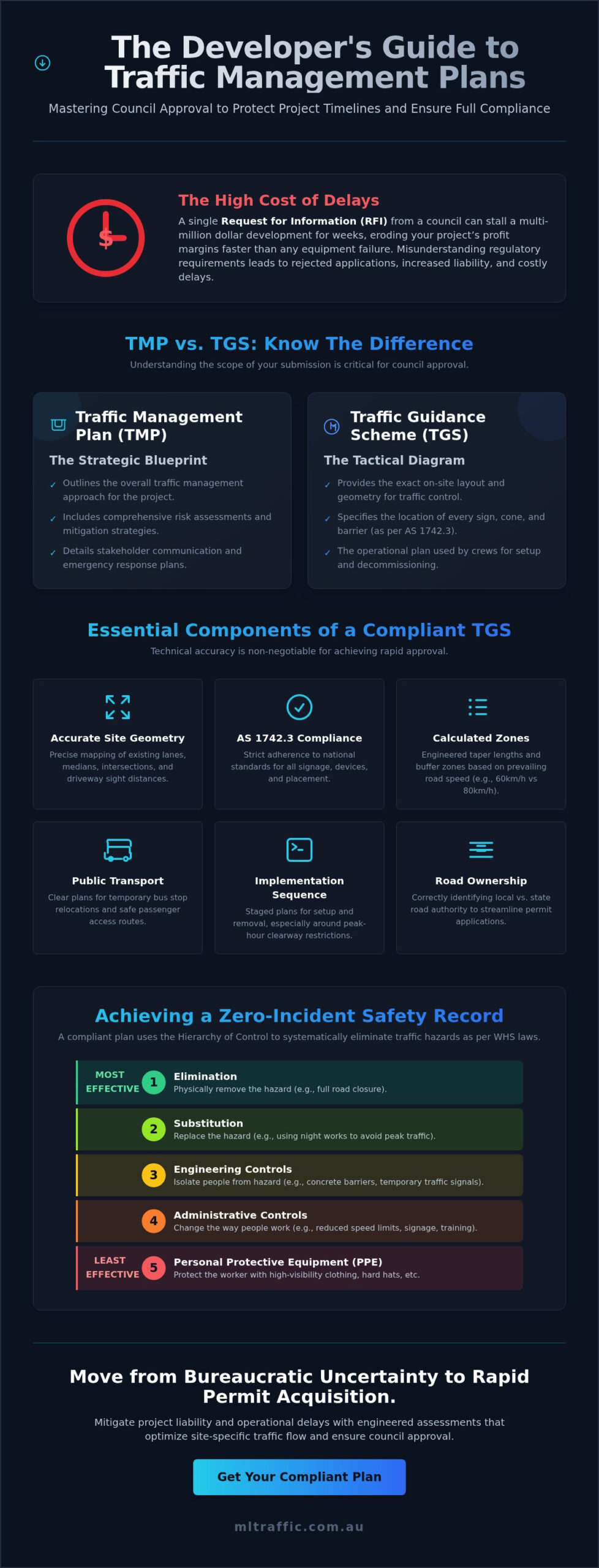
There’s often confusion regarding the technical distinctions between a high-level Traffic Management Plan and a specific Traffic Control Plan (TCP). A TMP is a strategic document. It outlines the overall traffic management approach, including risk assessments and stakeholder communication strategies. In contrast, a Traffic Guidance Scheme (TGS), formerly known as a TCP, is a tactical diagram. It provides site workers with the exact location of every sign, cone, and bollard required for a specific work stage. For complex urban developments, councils frequently require a hybrid submission that includes both the strategic TMP and detailed TGS diagrams to ensure every operational detail is addressed before work begins.
Essential Components of a Compliant Traffic Guidance Scheme
A compliant Traffic Guidance Scheme (TGS) serves as the tactical execution layer for your broader traffic management plan for council approval. While the strategic plan provides the framework, the TGS provides the specific geometry required for onsite safety. This includes precise mapping of existing lanes, medians, and intersections. Technical accuracy is non-negotiable. Councils frequently reject plans that fail to account for site-specific constraints such as driveway sight distances or existing traffic signals.
Engineering a TGS requires calculating taper lengths and buffer zones based on the prevailing road speed. A 60km/h zone necessitates different longitudinal buffers than an 80km/h arterial road to allow for safe vehicle deceleration. You must also account for public transport infrastructure. If your worksite necessitates a bus stop relocation, the plan must detail the temporary location and passenger access routes. Managing the implementation and decommissioning sequence is equally vital. Plans must specify how crews will transition the site before and after peak-hour clearway restrictions to avoid urban gridlock.
For projects requiring high-level technical precision, engaging an expert to develop a Traffic Guidance Scheme ensures your submission meets all regulatory benchmarks on the first attempt.
Signage and Delineation Standards
Adherence to AS 1742.3:2019 is the baseline for all signage and delineation. Every TGS must include mandatory advanced warning signs and clear termination requirements to inform motorists when they’ve cleared the work zone. Selecting the correct delineation device is a matter of risk assessment. While cones are suitable for short-term daytime works, physical barriers or water-filled bollards provide necessary protection for long-term excavations. All devices must meet reflective material standards to maintain visibility during night-time operations or low-visibility weather conditions.
Pedestrian and Cyclist Safety Provisions
Protecting active transport users is a primary focus for council assessors. Plans must demonstrate compliance with AS 1428 to maintain path continuity for people with disabilities. This includes the provision of temporary ramps with appropriate grades and non-slip surfaces. Safe crossing points must be clearly marked and separated from heavy machinery. Minimum separation distances must be maintained between active footpaths and work areas to prevent debris or equipment from endangering the public. Failure to provide these specific safety details often triggers a Request for Information (RFI), delaying project commencement.
Managing Site Risk and Safety Under AS 1742.3
AS 1742.3:2019 represents the national benchmark for traffic control at roadworks across all Australian jurisdictions. Adherence to this standard isn’t optional. It provides the mandatory technical requirements for protective measures in high-risk environments. Effective safety management begins with the Hierarchy of Control. Developers must first attempt to eliminate traffic hazards, perhaps through full road closures, before moving to lower-level controls like signage or manual traffic management. Substitution and engineering controls, such as using physical barriers instead of cones, provide higher levels of protection for both workers and the public.
A traffic management plan for council approval is only as robust as the site-specific risk assessment underpinning it. This assessment must precede the drafting of any technical diagrams. It identifies specific hazards such as limited sight lines at intersections or high-speed approach zones. Managing these complex manoeuvres requires engineered solutions that account for vehicle braking distances and reaction times. In high-speed environments, the distance required for advanced warning signs increases significantly to allow for safe motorist adjustment.
The Role of Professional Traffic Controllers
Traffic controllers serve as a critical safety layer when automated systems are impractical. Their positioning is determined by strict visibility requirements to ensure motorists have ample time to react to stop-slow bats. In congested urban areas, multi-point control requires dedicated radio communication protocols to synchronise traffic flow effectively. Controllers must also be trained in managing aggressive driver behaviour, which is an increasing risk factor in modern roadworks. The safety plan must specify worker egress routes, providing safe zones where personnel can retreat if a vehicle breaches the work area boundary.
Utilising Swept Path Analysis for Work Zones
Technical validation of vehicle movements is a core component of risk mitigation. Engineers use Swept Path Analysis to confirm that heavy vehicles, such as construction trucks or emergency services, can navigate temporary diversions without incident. This digital simulation prevents vehicle hang-ups on temporary curbs and ensures that tight turns remain within the road’s structural capacity. Accuracy here is vital to avoid site gridlock. Additionally, all construction vehicle access points must meet AS 2890.1 standards for off-street facility design. This ensures that the transition from the public road to the private site doesn’t create secondary traffic hazards or cause damage to public infrastructure.
Navigating the Council Approval and Permit Process
Securing a traffic management plan for council approval requires a precise understanding of jurisdictional boundaries. Road ownership dictates the entire application pathway. Local council roads are managed under municipal guidelines, while state road authorities, such as Transport for NSW or the Victorian Department of Transport and Planning, govern arterial networks. A successful Road Occupancy Permit (ROP) application must include a comprehensive document pack. This typically includes the certified TMP, detailed TGS diagrams, and evidence of public liability insurance, often required at a minimum value of A$20 million.
Lead times vary significantly across Australia. Brisbane City Council generally processes TGS approvals within 10 to 15 business days. In contrast, the City of Melville requires submissions at least four weeks before the proposed start date. Multi-stage projects demand even tighter scheduling to ensure permits align with construction milestones. Coordination with external stakeholders is equally critical. You must notify emergency services and utility providers to ensure your work zone doesn’t impede critical infrastructure access or response times.
Common Reasons for Application Rejection
Councils frequently reject submissions that fail to account for local peak-hour traffic volumes or existing clearway restrictions. If your plan proposes lane closures during morning or afternoon peaks on high-volume roads, expect an immediate Request for Information (RFI). Inadequate sight distances for advanced warning signage is another common technical failure. Assessors check your proposed sign placement against actual road geometry. Using outdated road data or non-standard symbols that deviate from AS 1742.3 will also lead to unnecessary delays.
Strategic Stakeholder Communication
Proactive notification is a regulatory requirement, not a courtesy. You must provide written notice to affected residents and businesses, detailing the duration and nature of the disruption. When technical queries arise from council engineers, having access to professional traffic engineering expertise is vital. Certified plans demonstrate a level of technical rigor that builds trust with assessors, often fast-tracking the DA process. This professional oversight reduces the likelihood of multiple RFI rounds that can stall your project.
To secure your project timeline and ensure your submission meets all technical benchmarks, contact our senior engineering team today for a compliant traffic management assessment.
The Strategic Value of Professional Traffic Engineering
Professional traffic engineering transforms a mandatory document into a strategic risk-management asset. A traffic management plan for council approval is a legal shield. It provides essential liability protection for developers and contractors. If a safety incident occurs onsite or on the adjacent road network, a certified and engineered plan serves as your primary evidence of due diligence. This insurance value is indispensable for managing high-value projects where public safety is a factor. Beyond safety, professional engineering drives operational efficiency. By optimising vehicle movements and reducing bottlenecks, you protect your project timelines from the compounding costs of site gridlock.
Our expertise ensures compliance across all land-use categories, from high-density residential towers to complex industrial subdivisions. We apply over 15 years of national consultancy experience to every project. This longevity allows us to anticipate council objections before they result in costly RFIs. We understand the nuances of diverse Australian regulatory environments and ensure your project meets the strict requirements of national standards from the initial submission. This proactive approach minimises the risk of work stoppages and regulatory fines.
Expertise Beyond the Basic Diagram
Complex site challenges require more than a standard template. Senior principal involvement is a core component of our service delivery. We don’t delegate technical work to junior staff. Our personnel continuity promise ensures that the expert who initiates your project is the one performing the technical analysis and signing off on the final report. This accountability is vital for high-stakes developments. For larger projects, we integrate Traffic Impact Assessment expertise to address long-term infrastructure requirements and community impacts during the DA phase.
Partnering with ML Traffic Engineers Australia
We operate with a direct-access, no-gatekeeper communication model. You speak directly with the senior engineers responsible for your project. This transparency eliminates bureaucratic friction and ensures rapid response times. We provide comprehensive national coverage for all Australian development projects, regardless of scale or location. Whether you require a Vehicle Swept Path Analysis or a detailed Car Park Design, our team delivers results-oriented solutions. Contact our senior engineers today to secure a compliant traffic management plan for council approval and protect your development’s ROI.
Secure Your Project Timeline with Technical Precision
Achieving a successful traffic management plan for council approval requires a meticulous synthesis of national standards and local regulatory requirements. By prioritising strict compliance with AS 1742.3 and AS 2890.1, developers eliminate the technical errors that lead to costly project delays and legal liability. A robust submission isn’t just a set of diagrams; it’s a strategic asset that protects your workers, the public, and your project’s bottom line.
With over 15 years of national traffic engineering experience, our team provides the authoritative oversight needed for rapid permit acquisition. You receive direct access to senior principal engineers who manage your project from the initial assessment through to final council sign-off. This high-level accountability ensures your site remains safe and fully compliant with all Australian civil and urban planning benchmarks. Technical rigour at the planning stage prevents operational friction during construction.
Speak directly with a senior engineer about your council traffic requirements to ensure your next development moves forward without administrative delay. We look forward to securing your site’s operational success.
Frequently Asked Questions
What is the difference between a Traffic Management Plan and a Traffic Control Plan?
A Traffic Management Plan (TMP) is a strategic document outlining the broader approach to safety and risk management. It addresses stakeholder communication, risk assessments, and emergency procedures. A Traffic Control Plan, now formally called a Traffic Guidance Scheme (TGS), is a tactical diagram. It specifies the exact placement of signs, cones, and bollards. Councils often require both documents to ensure comprehensive site oversight.
How long does it typically take to get a traffic management plan approved by council?
Approval timelines vary significantly between jurisdictions. Brisbane City Council typically processes a traffic management plan for council approval within 10 to 15 business days. Other authorities, such as the City of Melville, require submissions at least four weeks before work commences. Developers should factor in these lead times to avoid project delays caused by administrative friction and RFI cycles.
Who is legally qualified to design a traffic control plan for roadworks in Australia?
Only individuals with specific state-mandated accreditations are qualified to prepare these documents. In New South Wales, you must hold a “Prepare Work Zone Traffic Management Plan” qualification. Western Australia requires “Advanced Worksite Traffic Management (AWTM)” accreditation from Main Roads. Using uncertified designers often results in immediate application rejection and increased project liability during the construction phase.
Do I need a traffic management plan for minor works on a nature strip?
Yes, a plan is required if the works impact public assets, pedestrian footpaths, or vehicle sightlines. Even if the road remains open, councils must ensure that nature strip excavations don’t endanger the public or obstruct service access. Failure to secure a permit for minor works can result in substantial fines and the potential suspension of your construction insurance coverage.
What are the primary Australian Standards governing traffic control for construction?
The foundational standard is AS 1742.3:2019, which details traffic control devices for works on roads. Developers must also adhere to AS 2890.1 for off-street car parking and driveway design. These national standards are often supplemented by state-specific guides, such as the Austroads Guide to Temporary Traffic Management (AGTTM) and local department supplements released as recently as February 2026.
Can I use a generic traffic control template for my council permit application?
No, councils require site-specific plans that reflect the actual geometry and traffic volumes of the location. Generic templates fail to account for unique constraints like nearby intersections, bus stops, or specific clearway restrictions. A tailored traffic management plan for council approval is necessary to demonstrate that you’ve identified and mitigated all site-specific risks to protect the public.
How often should a traffic management plan be reviewed during a long-term project?
Plans must be reviewed whenever construction stages change or site conditions evolve. If a safety incident occurs, an immediate review is mandatory to update risk controls. For stable, long-term sites, industry best practice suggests a formal review every six months to ensure compliance with any updated regulatory supplements or changes in local traffic patterns and speed limits.
What are the consequences of operating roadworks without an approved traffic plan?
Operating without approval leads to immediate work stoppages and significant financial penalties. Regulatory authorities can issue infringement notices exceeding A$10,000 for serious safety breaches. Beyond fines, you face immense legal exposure if an accident occurs. Unapproved works often void public liability insurance policies, leaving the developer personally accountable for all damages, litigation costs, and potential criminal negligence charges.

Article by
Michael Lee
Practising traffic engineer with over 35 years experience.
Disclaimer
The content on www.mltraffic.com.au, including all technical articles, guides, and resources, is provided for general informational and educational purposes only. It is not intended to constitute professional advice in traffic engineering, transportation planning, development approvals, or any other technical or legal field.
While ML Traffic Engineers makes every reasonable effort to ensure the accuracy, completeness, and timeliness of the information published, we do not provide any warranties or representations (express or implied) regarding its reliability, suitability, or availability for any particular purpose. Any reliance you place on the content is strictly at your own risk.
In no event shall ML Traffic Engineers, its directors, employees, authors, or affiliates be liable for any direct, indirect, incidental, special, consequential, or punitive damages (including, without limitation, loss of profits, data, or business opportunities) arising out of or in connection with the use of, or inability to use, any information provided on this website.
The articles and guides on this site are not a substitute for engaging a qualified, registered professional traffic engineer (such as an NPER or RPEQ engineer) to assess your specific project requirements. For tailored advice, compliance assessments, or traffic engineering services, please contact a competent professional.
This disclaimer may be updated from time to time without notice. By accessing or using this website, you agree to be bound by the most current version of this disclaimer.
