
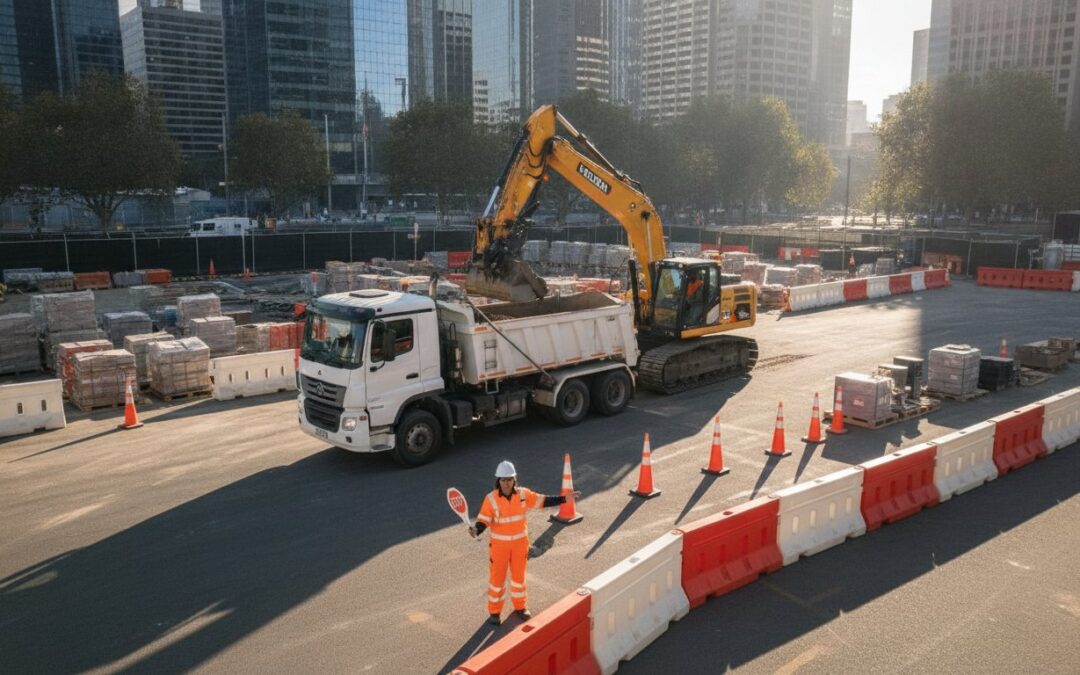
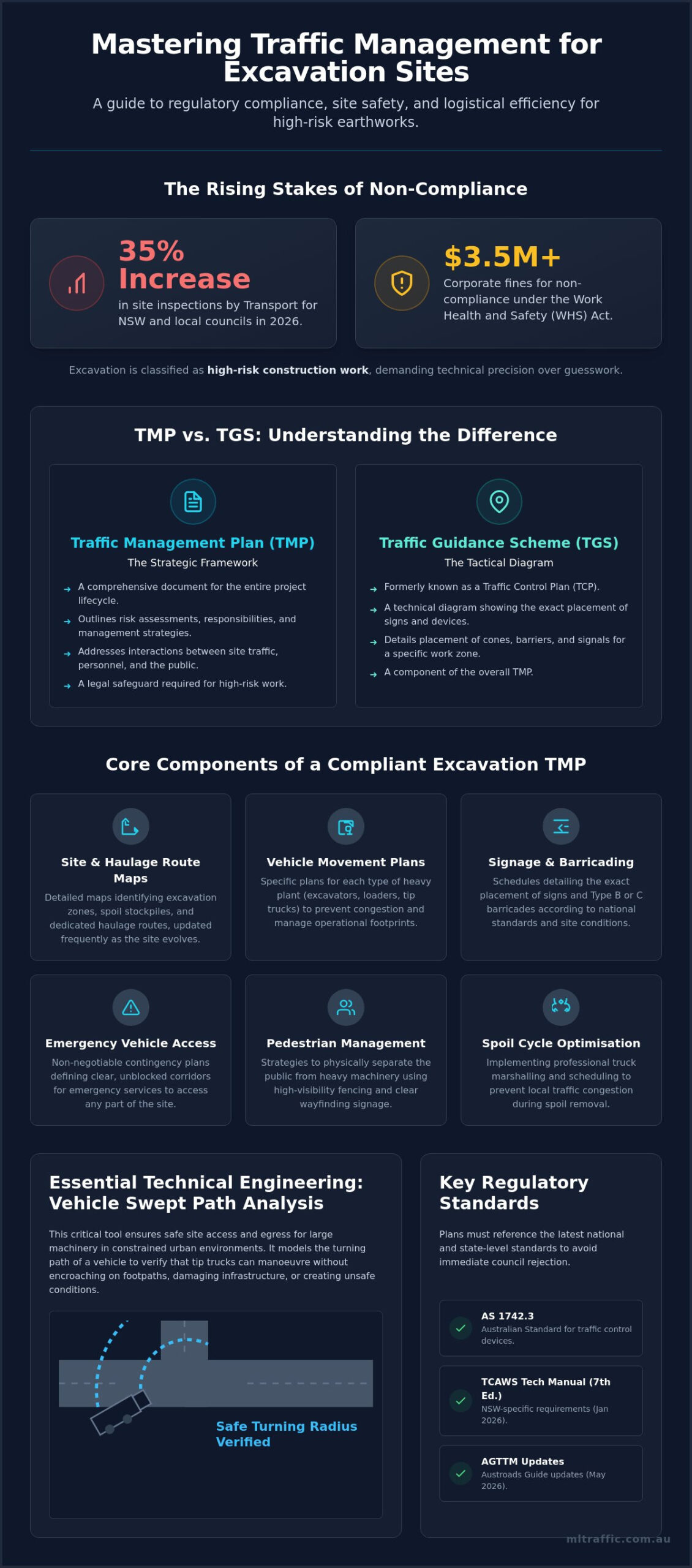
Did you know that Transport for NSW and local councils increased site inspections by 35 per cent in 2026? With corporate fines for non-compliance now exceeding $3.5 million under the WHS Act, a generic traffic management plan for excavation work is a significant financial liability. You’re likely aware that poorly designed plans lead to immediate council rejections and dangerous logistical bottlenecks during the critical spoil removal phase.
It’s clear that managing heavy plant movements and pedestrian safety requires technical precision rather than guesswork. This expert engineering guide ensures you master the complexities of traffic safety and regulatory compliance for high-risk sites. We’ll examine the 2026 Austroads updates, the role of vehicle swept path analysis, and the exact steps required to achieve zero safety incidents while maintaining efficient truck turnaround times.
Key Takeaways
- Differentiate between strategic Traffic Management Plans and tactical Traffic Guidance Schemes to ensure full compliance with updated 2026 regulatory standards.
- Optimise the spoil removal cycle by implementing professional truck marshalling strategies that prevent local traffic congestion and logistical bottlenecks.
- Master the core requirements of a traffic management plan for excavation work, including site-specific maps and dedicated movement plans for heavy plant and tip trucks.
- Reduce the risk of council rejection by aligning your Traffic Impact Assessment (TIA) with specific excavation site requirements and local government conditions.
- Utilise technical tools like Vehicle Swept Path Analysis to ensure safe site access and egress for large machinery in constrained urban environments.
What is a Traffic Management Plan for Excavation Work?
A traffic management plan for excavation work is a comprehensive strategic document that outlines how a project will manage the interaction between construction traffic, site personnel, and the public. Unlike general construction plans, an excavation-specific TMP must account for the high-frequency movement of heavy machinery and the constant removal of spoil. This document is not merely a procedural requirement; it’s a legal safeguard that addresses the unique logistical pressures of earthworks.
It’s vital to distinguish between a Traffic Management Plan (TMP) and a Traffic Guidance Scheme (TGS). A TMP provides the strategic framework for the entire project lifecycle, including risk assessments and responsibilities. A TGS, formerly known as a Traffic Control Plan (TCP), is a technical diagram showing the specific placement of signs, cones, and barriers for a work zone. Under the Work Health and Safety (WHS) Act 2011, excavation is classified as high-risk construction work. This classification is due to the presence of mobile plant and the inherent dangers of working near deep trenches or unstable ground.
To better understand how these plans are implemented on a live site, watch this detailed overview:
Professional traffic engineers are essential for certifying a traffic management plan for excavation work to ensure site access and egress points are technically viable. They apply the principles of road traffic control to ensure that heavy tip trucks don’t create bottlenecks on local roads. Their role involves conducting rigorous assessments of sight distances and driveway grades. Without this engineering oversight, projects often face logistical failures that delay the entire construction timeline.
The Purpose of Traffic Planning in Earthworks
The primary objective of traffic planning during earthworks is the absolute separation of heavy plant from vulnerable road users. Excavators, loaders, and haulage trucks have significant blind spots that pose a lethal risk to pedestrians and cyclists. A compliant plan establishes physical barriers, dedicated haulage routes, and clear signage to mitigate these risks. We focus on protecting the public from hazards while ensuring that high-volume spoil removal doesn’t paralyse the surrounding road network.
Regulatory Framework and AS 1742.3 Compliance
All plans must adhere to the Australian Standard AS 1742.3 for traffic control devices. However, state-specific requirements often vary significantly across Australia. For instance, projects in New South Wales must now comply with the 7th Edition of the TCAWS Technical Manual released in January 2026. Simultaneously, the May 2026 Austroads Guide to Temporary Traffic Management (AGTTM) updates have introduced stricter requirements for worksite safety. Failing to reference these current standards leads to immediate council rejection and potential legal liability. Engaging an accredited consultancy ensures your plan meets these evolving national and state-level benchmarks.
Core Components of a Compliant Excavation TMP
A compliant traffic management plan for excavation work must integrate several technical layers to satisfy council requirements and WHS obligations. It begins with a detailed site map. This document identifies active excavation zones, spoil stockpiles, and dedicated haulage routes. Site maps require frequent updates. This ensures they reflect the shifting topography of an earthworks site as digging progresses.
Vehicle movement plans must be specific to the plant in use. Excavators and loaders have different operational footprints compared to articulated tip trucks. A generic plan often fails to account for these differences, leading to site congestion and increased risk. Effective plans also include signage and barricading schedules that dictate the exact placement of Type B or Type C barricades according to national standards.
Emergency vehicle access is a non-negotiable component. Contingency planning must detail how emergency services can reach a worker in a deep excavation while heavy machinery is operational. This involves maintaining clear access corridors that are never blocked by waiting trucks or spoil piles. You must also account for pedestrian management strategies. High-visibility fencing and clear wayfinding signage are necessary to prevent unauthorised site entry by members of the public.
Site Access and Egress Design
Designing entry and exit points is an engineering challenge. You must prevent heavy vehicles from queuing on public roads, which often leads to council fines and community complaints. Implementing Swept Path Analysis allows us to simulate vehicle manoeuvres. This ensures that the largest expected vehicles can navigate the site safely without encroaching on pedestrian paths or oncoming traffic.
Driveway ramp grades require precise calculation. A loaded tip truck faces significant stability risks on steep or uneven inclines. Ensuring these grades are compliant is essential for both safety and operational efficiency. If you are unsure of your site’s technical requirements, engaging a professional for a Driveway Ramp Grade Assessment is a prudent step to ensure compliance with Australian Standards.
Separating People and Plant
The physical separation of personnel and machinery is the most effective way to prevent site fatalities. Establish robust barriers. Concrete barriers or heavy-duty water-filled plastic barriers are the gold standard for protecting workers from active excavation pits and haulage routes.
Designating “no-go” zones ensures that personnel remain outside the swing radius of excavators. In high-density urban sites where space is limited, physical barriers might not be enough. In these scenarios, the use of accredited traffic controllers and spotters is mandatory at all high-risk interfaces. These professionals act as the final line of defence between people and plant, managing the flow of machinery with precision.
Managing the Spoil Cycle: Truck Movements and Logistics
Managing the “spoil cycle” represents the most significant logistical challenge in any earthworks project. High-frequency truck movements are necessary to keep the excavation face clear and the project on schedule. A robust traffic management plan for excavation work must quantify these movements to assess their impact on local road capacity accurately. If a site generates high volumes of truck-and-dog movements per hour, the local intersection must be able to absorb this volume without reaching a level of service failure.
A truck marshalling plan is a critical component for preventing local street congestion. This involves designating an off-site holding area or a dedicated on-site queueing lane where drivers wait for their turn to load. It prevents heavy vehicles from idling in residential streets or blocking arterial traffic flow. Scheduling is equally important. Movements should be restricted during morning and afternoon peak hours. Prohibiting heavy vehicle activity during school zone hours is often a mandatory council condition for project approval.
Heavy Vehicle Manoeuvring and Turning Paths
Engineers use specialized software to verify that the proposed site layout accommodates the specific turning circles of heavy machinery. Truck-and-dog combinations require significantly more space than standard rigid trucks. A traffic management plan for excavation work that ignores these technical dimensions leads to site damage or vehicles becoming stuck in tight urban corners. We also verify sight distances at the exit point. Drivers require a clear line of sight to oncoming traffic to merge safely from a standstill while carrying heavy loads.
Load Security and Road Surface Integrity
Environmental compliance is a core part of site logistics. Managing dust and debris tracking onto public roads is a major concern for local councils and residents. We implement rumble grids or high-pressure wash-down bays at all site exits to remove mud from tyres before vehicles enter the public road network. Load security is also paramount. Dedicated tarping areas must be established where drivers can safely secure their loads to prevent falling spoil and debris.
Constant heavy vehicle movements can rapidly degrade local road surfaces. Monitoring road wear and tear is a proactive measure to manage liability. If the road surface shows signs of failure, the traffic plan may need adjustment to redistribute loads or change haulage routes. This technical oversight ensures the project remains compliant with both environmental regulations and local government asset protection requirements. If you require technical verification of your site’s access capabilities, a Vehicle Swept Path Analysis provides the necessary engineering proof for council submission.
Navigating Council Approvals and Compliance
The path to a council-approved traffic management plan for excavation work begins with a robust Traffic Impact Assessment (TIA). While the TIA identifies the broader effects of the development on the local network, the TMP provides the specific operational response for the earthworks phase. Councils scrutinise these documents to ensure that the proposed high-volume truck movements won’t compromise local safety or road efficiency. The TIA establishes the “why” of the traffic impact, while the TMP details the “how” of the mitigation.
Common reasons for council rejection include the use of generic templates that ignore site-specific constraints. Rejections also stem from failing to provide technical proof of vehicle clearance or neglecting to account for peak-hour restrictions. For major projects affecting arterial roads, you must also secure approval from the state’s Traffic Management Centre (TMC). This adds a layer of regulatory oversight that requires detailed intersection analysis and precise timing for any proposed lane closures or temporary road occupancy.
A complete Development Application (DA) submission for excavation works typically requires a suite of technical documents. You must include the TIA Report, the site-specific TMP, and detailed Traffic Guidance Schemes (TGS) for each distinct stage of the work. If your project requires expert assistance to navigate these regulatory hurdles and avoid costly delays, you can contact our senior traffic engineers for a compliant and professional submission.
Stakeholder Consultation and Notifications
Significant traffic changes require proactive community engagement. You must organise formal notifications for neighbouring properties and businesses that may be affected by truck noise, dust, or temporary access restrictions. Liaising with local councils and state road authorities early in the design phase prevents late-stage objections. Effective consultation ensures that stakeholders understand the duration of the impact and the measures you’ve implemented to maintain local amenity.
Monitoring and Updating the Plan
A traffic management plan for excavation work is not a static document. It is a “living document” that must evolve as the excavation depth and site layout change. As the dig progresses, access ramps may shift and loading zones might move. Regular site audits are essential for maintaining ongoing compliance and identifying new risks that weren’t apparent during the initial planning phase. Establish clear procedures for reporting and investigating near-misses. These investigations allow you to refine the TMP and prevent future accidents, ensuring the site remains safe until the earthworks are complete.
Expert Traffic Engineering for National Excavation Projects
Professional consultancy is a non-negotiable requirement for high-stakes earthworks. The technical demands of managing high-frequency haulage movements exceed the capabilities of general traffic control providers. Engaging a specialist firm ensures that your traffic management plan for excavation work is grounded in rigorous engineering principles. This level of technical oversight is necessary to mitigate the legal and financial risks associated with site accidents or council-imposed work stoppages.
With over 15 years of specialist traffic engineering experience, our team understands the nuances of the Australian regulatory landscape. We ensure every project adheres to AS 2890.1 for off-street parking and site access, alongside the current 2026 national standards. This technical rigour prevents the common errors that lead to plan rejection. ML Traffic Engineers Australia maintains a results-oriented approach that prioritises logistical efficiency and site safety.
A key distinction of our consultancy is direct access to senior leadership. We don’t use gatekeepers. Every client works directly with a senior principal who remains accountable for the project from inception to approval. This personnel continuity promise ensures that the expert who understands your site’s specific challenges is the one performing the technical work. It’s a meticulous, hands-on philosophy that distinguishes ML Traffic Engineers Australia from larger, more impersonal firms.
Tailored Solutions for Complex Sites
Constrained urban excavation sites present unique challenges that generic plans cannot address. We specialise in designing bespoke solutions for tight footprints where traditional truck-and-dog combinations may struggle. This often requires integrating a Waste Management Plan with broader traffic logistics to manage the precise timing of spoil removal. Our comprehensive services cover the entire lifecycle of your project, from the initial Traffic Impact Assessment to the final Traffic Guidance Scheme.
Contact ML Traffic Engineers Australia
Securing a council-approved traffic management plan for excavation work doesn’t have to be a bureaucratic hurdle. Our senior engineers specialise in streamlining the approval process through the provision of data-driven, compliant reports. We provide the technical evidence councils require to greenlight your project without delay. If you require professional engineering oversight for your next earthworks project, request a consultation through our contact page today.
Securing Your Site with Professional Traffic Engineering
Managing an excavation site requires more than just basic safety signage; it demands a rigorous engineering approach to heavy vehicle logistics and public protection. A technically sound traffic management plan for excavation work ensures that high-frequency spoil removal doesn’t lead to council-enforced shutdowns or dangerous street congestion. By implementing the 2026 regulatory standards discussed in this guide, you protect your project from the significant financial liabilities and safety risks associated with non-compliance.
ML Traffic Engineers Australia provides the seasoned expertise required to navigate these complex regulatory requirements. We offer over 15 years of specialist experience and ensure that every client has direct access to senior principals for every project. This accountability has resulted in a proven track record of council approvals for major earthworks projects nationwide. Get a compliant Traffic Management Plan from the experts at ML Traffic Engineers Australia to keep your project moving forward safely. Professional planning is the most effective tool for ensuring your excavation phase is completed on time and without incident.
Frequently Asked Questions
Is a traffic management plan legally required for all excavation work?
Yes, a traffic management plan for excavation work is legally required under the Work Health and Safety (WHS) Act 2011 for any project involving high-risk construction work. This includes any activity where mobile plant is used in areas that could impact the safety of workers or the public. Failing to maintain a compliant plan can result in corporate fines exceeding $3.5 million as of 2026.
What is the difference between a TMP and a Traffic Guidance Scheme (TGS)?
A Traffic Management Plan (TMP) is a strategic document that outlines the overall traffic management objectives and risk assessments for the project. In contrast, a Traffic Guidance Scheme (TGS) is a technical diagram that illustrates the specific placement of signs and barriers for a particular work zone. Both documents are usually required for a complete council submission.
How much does a traffic management plan for excavation typically cost?
Industry data from 2026 suggests that basic traffic plans in major Australian cities like Sydney and Brisbane start at approximately $300 to $600. For complex excavation projects requiring technical assessments, costs can range between $2,000 and $5,500 depending on the project’s scale and the local council’s specific technical requirements. These figures represent industry averages for design and preparation.
Does my excavation traffic plan need to be signed off by a qualified engineer?
Yes, most local councils and state road authorities require that a traffic management plan for excavation work be prepared or signed off by a qualified traffic engineer. This is particularly true for sites located on arterial roads or those requiring complex vehicle swept path analysis. Professional certification ensures the plan is technically viable and compliant with national safety standards.
How long does it take for a council to approve an excavation traffic plan?
Council approval timelines typically range from 10 to 20 business days, though this varies significantly between local government areas. Major projects requiring approval from state authorities like Transport for NSW or the Traffic Management Centre may face longer lead times. Proactive submission of a technically sound plan is the most effective way to avoid project delays.
What are the most common traffic hazards on an excavation site?
The most common hazards include the accidental interaction between heavy plant and pedestrians, vehicle blind spots during reversing, and the tracking of spoil onto public roads. Unstable site access ramps also pose a significant risk to loaded tip trucks. Addressing these specific variables within your plan is essential for maintaining a safe worksite and satisfying WHS obligations.
Can I use the same traffic plan for the entire construction phase?
No, a plan designed for the excavation phase is rarely suitable for the entire construction lifecycle. The logistical requirements for spoil removal differ vastly from those of the structural or fit-out stages. Your traffic management strategy must evolve to reflect the changing risks and vehicle types associated with each distinct phase of the build.
What Australian Standards govern traffic management for excavation?
Traffic management is primarily governed by the Australian Standard AS 1742.3 (Manual of uniform traffic control devices). Additionally, the Austroads Guide to Temporary Traffic Management (AGTTM) and state-specific manuals, such as the 7th Edition of the TCAWS Technical Manual in NSW, provide the regulatory framework for compliant site planning and execution.

Disclaimer
The content on www.mltraffic.com.au, including all technical articles, guides, and resources, is provided for general informational and educational purposes only. It is not intended to constitute professional advice in traffic engineering, transportation planning, development approvals, or any other technical or legal field. While ML Traffic Engineers makes every reasonable effort to ensure the accuracy, completeness, and timeliness of the information published, we do not provide any warranties or representations (express or implied) regarding its reliability, suitability, or availability for any particular purpose. Any reliance you place on the content is strictly at your own risk. In no event shall ML Traffic Engineers, its directors, employees, authors, or affiliates be liable for any direct, indirect, incidental, special, consequential, or punitive damages (including, without limitation, loss of profits, data, or business opportunities) arising out of or in connection with the use of, or inability to use, any information provided on this website. The articles and guides on this site are not a substitute for engaging a qualified, registered professional traffic engineer (such as an NPER or RPEQ engineer) to assess your specific project requirements. For tailored advice, compliance assessments, or traffic engineering services, please contact a competent professional. This disclaimer may be updated from time to time without notice. By accessing or using this website, you agree to be bound by the most current version of this disclaimer.
