
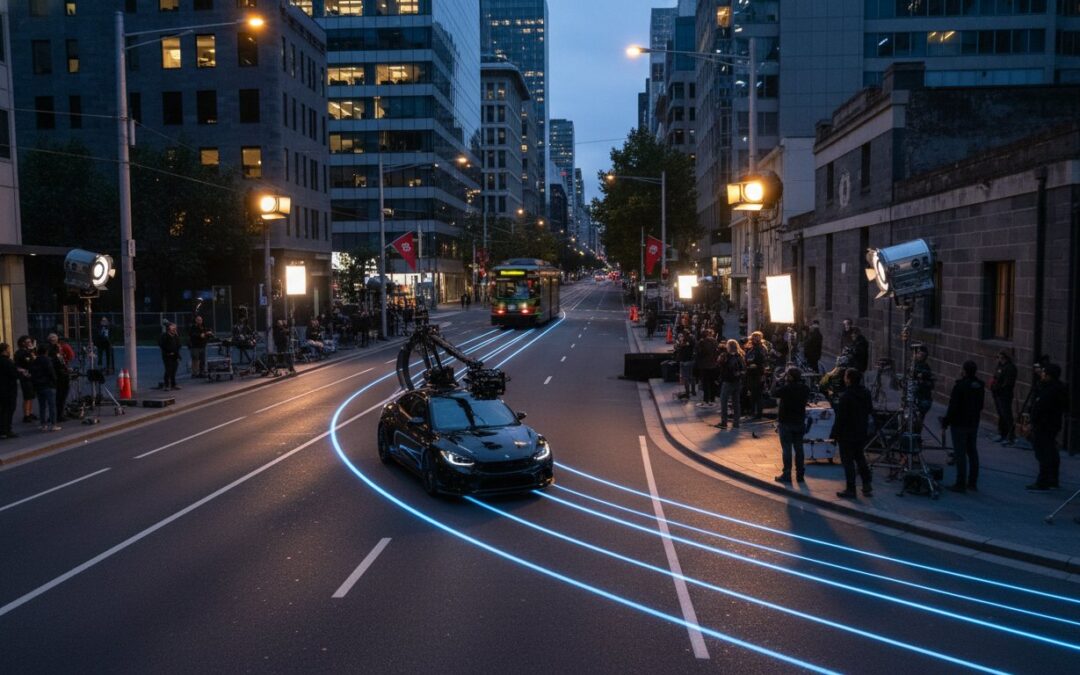
A filming permit is often treated as a creative formality, but a council-approved traffic management plan for filming is a rigorous engineering document where one error in swept path analysis can halt a multi-million dollar production. You already know that bureaucratic permit hurdles and the safety risks of specialist tracking vehicles are the primary bottlenecks in pre-production. Missing a 10-day submission deadline for Los Angeles County or failing to account for the $178 per hour cost of San Diego police supervisors leads to expensive delays that your budget simply can’t afford.
This guide provides the technical roadmap to secure compliant traffic management plans that ensure public safety and rapid regulatory approval. You’ll learn how to align your production with the MUTCD 11th Edition Revision 1 standards adopted on March 5, 2026. We detail the engineering assessments required to maintain site safety for cast and crew while ensuring minimal disruption to public traffic flow. Our focus is on providing the technical precision needed to move from application to approval without the friction of non-compliant documentation.
Key Takeaways
- Understand the legal necessity of a professional traffic management plan for filming to maintain public safety and production liability insurance.
- Discover how Vehicle Swept Path Analysis using AutoTURN software ensures specialist filming vehicles like low-loaders can navigate tight urban environments safely.
- Identify the essential components of a compliant Traffic Guidance Scheme (TGS), including precise signage placement and pedestrian mitigation for high-profile shoots.
- Streamline the approval workflow by identifying key stakeholders and coordinating draft submissions with councils and road authorities during pre-production.
- Benefit from direct principal involvement and experience across 10,000+ sites to ensure technical compliance with all relevant Australian Standards.
Table of Contents
-
Understanding Traffic Management Plans for Filming and Media Production
-
Essential Components of a Compliant Filming Traffic Guidance Scheme (TGS)
-
Technical Analysis: Swept Paths and Specialist Filming Vehicles
-
The Approval Workflow: Coordinating with Councils and Road Authorities
-
Professional Traffic Engineering Solutions for the Screen Industry
Understanding Traffic Management Plans for Filming and Media Production
A traffic management plan for filming is a technical engineering document. Road authorities require it to manage risk on public roads. It isn’t a mere formality for a permit. It is the legal basis for your production liability insurance. Without a certified plan, a production company faces significant exposure if an incident occurs. Our role as traffic engineers is to balance your creative vision with the rigid safety requirements of the road authority. We ensure that your tracking vehicle shots or street scenes don’t compromise the safety of the public or your crew.
We distinguish between Intermittent Traffic Control (ITC) and full road closures. ITC involves holding traffic for short bursts, typically three to five minutes. This is usually sufficient for simple dialogue scenes. Full road closures are mandatory for high speed stunts or large scale set dressings. We apply Road traffic control principles to ensure these disruptions don’t result in gridlock or unsafe vehicle speeds near the cast and crew. This technical oversight is essential for securing council approval and maintaining site safety during complex shoots.
To better understand the core requirements of a safe plan, watch this video:
TMP vs. TGS: Knowing the Difference
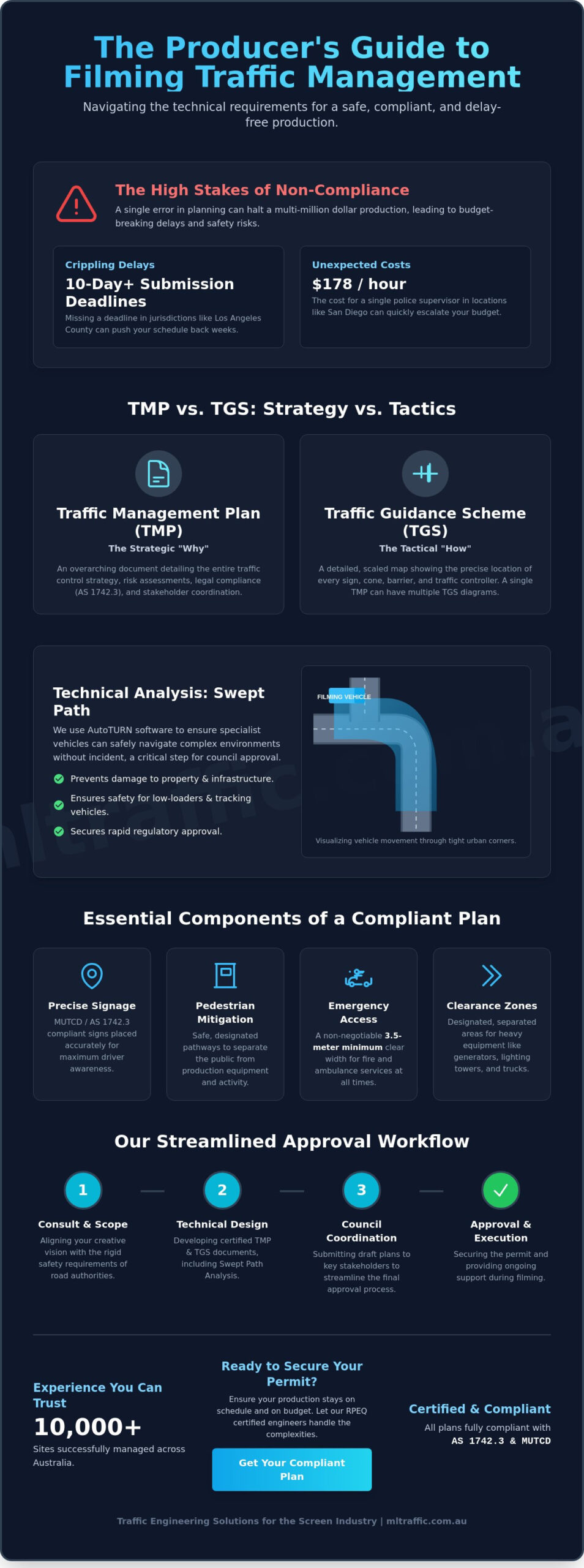
The Traffic Management Plan (TMP) is the overarching strategic document. It explains the "why" and "how" of the traffic control strategy, including risk assessments and stakeholder coordination. Conversely, the Traffic Guidance Scheme (TGS) is the tactical map. It shows the exact location of every cone, sign, and traffic controller. A single traffic management plan for filming often requires multiple TGS diagrams. You might need one layout for the actual shoot and another for the "base camp" where trucks and catering are parked. This ensures all aspects of the production remain compliant with local regulations.
Australian Standards and Regulatory Compliance
All plans must comply with AS 1742.3, the Manual of Uniform Traffic Control Devices. This national standard ensures that a stop sign or a lane closure looks and functions the same way across different states and councils. Consistency is vital for driver recognition and safety. Councils and road authorities typically require these plans to be developed by experienced consultants. Using a registered engineer, such as an RPEQ in Queensland, provides the level of certification required for high risk filming activities. You can view our full range of traffic engineering services to see how we handle these complex compliance requirements. We draw on our experience across over 10,000 sites to ensure every plan meets these rigid safety benchmarks without causing unnecessary delays to your production schedule.
Essential Components of a Compliant Filming Traffic Guidance Scheme (TGS)
A compliant Traffic Guidance Scheme (TGS) serves as the technical blueprint for on-site operations. While the broad traffic management plan for filming outlines the strategy, the TGS details the tactical execution. This includes the precise placement for every traffic controller, water barrier, and bollard. Road authorities expect these maps to be scaled and accurate. They must account for existing infrastructure like bus stops, fire hydrants, and pedestrian crossings. We ensure every device is positioned to maximize safety while minimizing the footprint on the road reserve.
Emergency vehicle access is a non-negotiable component of any TGS. Even during active filming, a minimum 3.5-meter clear width must be maintained for fire and ambulance services. We also designate specific clearance zones for heavy equipment. Lighting towers, 100kVA generators, and catering trucks often occupy the road reserve. These items require physical separation from live traffic lanes using barriers or specific buffer distances defined in the MUTCD standards. Failure to provide these clearances often results in immediate permit revocation by the council.
Signage and Delineation for Film Sets
Standard warning signs aren’t always enough for high-profile productions. We often specify Variable Message Signs (VMS) to provide real-time updates for road closures. These must be placed at least 300 meters in advance of the work zone on high-speed roads to allow for safe driver reaction times. For night filming, all signage must meet Class 1 reflectivity standards. We also include auxiliary lighting plans to ensure traffic controllers remain visible to motorists without interfering with the cinematographer’s specific lighting requirements.
Pedestrian and Crowd Management
Rubbernecking poses a significant safety risk during high-profile shoots. Our plans incorporate visual screening or specific safe zones for public onlookers. This prevents site incursions that could lead to accidents or production delays. We also manage crew movement between the base camp and the hot set. If the crew must cross an active road, we implement controlled crossing points. All plans must maintain disability access according to AS 1428. This ensures that temporary cables or equipment don’t create barriers for those with limited mobility. For productions requiring this level of technical detail, you can contact our senior engineers to discuss your specific site requirements.
Technical Analysis: Swept Paths and Specialist Filming Vehicles
A professional traffic management plan for filming must go beyond static signage. It requires a rigorous engineering assessment of the specific vehicles used on set. Specialist filming rigs, such as low-loaders, A-frames, and camera pursuit vehicles, don’t behave like standard passenger cars. Their extended wheelbases and unique weight distributions create distinct turning envelopes. We use AutoTURN software to simulate these movements within the existing road geometry. This technical simulation identifies potential conflict points before the first truck arrives on location.
Safety buffers are another critical engineering requirement. When a pursuit vehicle operates a camera boom, the vehicle’s footprint becomes dynamic. We calculate the lateral clearance needed for the boom’s full range of motion. This ensures that the filming activity doesn’t encroach on live traffic lanes or endanger crew members standing in the "hot set." These calculations are based on the vehicle’s speed and the boom’s extension length. This provides a data-driven safety zone that road authorities can trust.
Vehicle Swept Path Assessment for Low-Loaders
Oversized filming rigs require precise intersection analysis. A Swept Path Analysis allows us to verify that a 12-meter low-loader can navigate tight urban corners without striking curbs or heritage buildings. We analyze the vehicle’s "cut-in" at the rear and "tail swing" at the front. This is particularly important when production requires vehicles to navigate temporary traffic diversions. Our analysis ensures that your production fleet won’t cause property damage or become wedged in narrow CBD corridors. Such incidents lead to immediate permit suspension.
Driveway and Ramp Grade Compliance
Specialist tracking cars often feature extremely low ground clearance, sometimes less than 100mm. We conduct a detailed Driveway Ramp Grade Assessment to ensure these vehicles don’t bottom out on steep transitions or speed humps. By verifying site access points against AS 2890.1 standards, we protect both the road infrastructure and your expensive camera equipment. We also check that heavy production trucks won’t scrape their undercarriages on driveway "breakover" points. This level of technical scrutiny is what separates a council-approved plan from a rejected application. If you have concerns about site access, you can view our full list of traffic engineering services to see how we assist with these specific technical challenges.
The Approval Workflow: Coordinating with Councils and Road Authorities
Securing a traffic management plan for filming requires a structured approval workflow. The process begins with a site assessment to identify all relevant stakeholders. This includes local police, council traffic departments, and public transport operators. We evaluate the impact of the production on existing road users and infrastructure. This initial phase is critical for identifying potential technical objections before they delay the project. Our engineers assess the site’s capacity to handle production vehicles while maintaining the safety standards established in earlier sections of this guide.
We then develop the draft Traffic Management Plan for preliminary review. This document serves as the basis for the Memorandum of Agreement (MoA) with the road authority. The MoA outlines the responsibilities of the production company and the specific conditions of road usage. Once we receive feedback, we finalize the TGS to reflect site-specific permit conditions. This ensures the tactical execution on the day matches the council’s safety expectations and regulatory requirements.
Lead Times and Critical Path Planning
Production schedules in 2026 must account for increased council scrutiny and longer review periods. Lead times vary significantly based on the project’s scope. A minor impact application involving simple intermittent traffic control might require 3 to 5 business days for processing. However, major impact projects involving full road closures often require 10 to 15 business days for engineering review. Following the adoption of the MUTCD 11th Edition Revision 1 on March 5, 2026, authorities now demand higher levels of technical documentation. High-quality engineering plans reduce the likelihood of RFI cycles that stall production.
Stakeholder Engagement and Notifications
Notification is a mandatory legal requirement for most filming permits. In major jurisdictions, residents and businesses within a 150-meter radius must receive notice at least 24 to 48 hours before filming begins. We coordinate with emergency services to ensure 24/7 route viability is maintained throughout the shoot. Our senior engineers often represent the production at council meetings to resolve technical disputes regarding lane widths or detour routes. This professional representation ensures that creative requirements don’t clash with public safety mandates. For expert assistance with your next production, contact our senior traffic consultants to start the approval process.
Professional Traffic Engineering Solutions for the Screen Industry
ML Traffic Engineers provides specialized Traffic Engineering services tailored for the unique demands of the screen industry. Every traffic management plan for filming we produce is overseen by our senior principals, Michael Lee and Benny Chen. We’ve traded since 2005 and have completed assessments for over 10,000 sites across Australia. This extensive experience ensures we understand the technicalities of all land-use types, from narrow inner-city lanes to expansive industrial warehouses used for base camps. Our "quote to completion" promise means the engineer who provides your initial quote is the same expert who performs the technical analysis and signs off on the documentation.
A professionally engineered plan significantly reduces production risk. Road authorities and insurers require rigorous documentation to mitigate the liability associated with filming on public roads. By delivering a plan that exceeds the standards of the MUTCD 11th Edition and local council mandates, we help you avoid the high costs of production delays. Our technical reports provide the assurance that your site is safe for cast, crew, and the traveling public. This reliability is why major productions trust us to handle their most complex traffic engineering requirements.
Why Senior Expertise Matters for Filming
Filming often involves non-standard road usage that requires advanced engineering judgment. For example, stunt sequences or high-speed tracking shots require precise Sight-Line Assessments to ensure drivers and crew have adequate reaction times. We also ensure AS 2890.1 compliance when designing production base camps and temporary parking layouts. This prevents bottlenecks and ensures heavy production vehicles can enter and exit sites without scraping or bottoming out. Our senior staff are available to provide rapid responses to script changes, ensuring your traffic flow remains compliant even as the creative vision evolves.
Get Started with Your Filming TMP
Securing a traffic management plan for filming starts with a direct consultation. You’ll speak directly with Michael Lee or Benny Chen to discuss your production’s specific needs. To provide a rapid and accurate traffic engineering quote, we require your filming dates, specific road locations, and details regarding any specialist vehicles like low-loaders or camera pursuit cars. We’ve spent between 30 and 40 years each in this field, ensuring we can navigate bureaucratic hurdles with efficiency. Contact ML Traffic Engineers to secure your filming road permits and ensure your production stays on schedule and fully compliant.
Secure Your Production Schedule with Engineering Precision
Securing a council-approved traffic management plan for filming requires more than just a basic map; it demands technical precision and deep regulatory expertise. We’ve established that compliance with AS 1742.3 and the March 5, 2026, MUTCD standards is non-negotiable for maintaining site safety and insurance validity. Utilizing rigorous Vehicle Swept Path Analysis ensures your specialist production rigs can navigate tight urban corners without property damage or permit violations. These engineering benchmarks provide the foundation for a safe environment for both your crew and the traveling public.
ML Traffic Engineers brings over 15 years of specialized experience and a track record across 10,000+ sites to your production. You receive direct access to senior principals Michael Lee and Benny Chen, ensuring that the consultant who quotes your project is the one performing the technical work. This accountability eliminates bureaucratic friction and accelerates the approval workflow with road authorities. Don’t let non-compliant documentation stall your creative vision. It’s time to move your project from the planning phase to the hot set with confidence.
Secure your filming permits with an expert Traffic Management Plan from ML Traffic Engineers. We look forward to helping you achieve a safe and successful shoot.
Frequently Asked Questions
How far in advance do I need a traffic management plan for filming?
You should submit your traffic management plan for filming at least 10 to 15 business days in advance for major impact projects. While some jurisdictions like Albuquerque require 72 hours, Los Angeles County mandates 10 business days for activities that interfere with traffic. Starting early allows for necessary RFI cycles from council engineers to ensure your permit is approved before the shoot begins.
Do I need a traffic engineer for filming on private property?
You need a traffic engineer if your production vehicles affect public road safety or site access points. Even on private property, production base camps must meet AS 2890.1 standards for driveway and parking design. We conduct Driveway Ramp Grade Assessments to ensure specialist camera cars with low ground clearance don’t bottom out while entering the property.
What is the difference between a Traffic Control Plan and a Traffic Management Plan?
A Traffic Management Plan (TMP) is a strategic document outlining the overall safety and risk management approach for the production. A Traffic Control Plan, technically referred to as a Traffic Guidance Scheme (TGS), is a tactical map showing the specific placement of signs and barriers. Most filming permits require both documents to satisfy road authority compliance and insurance requirements.
Do I need police presence if I have a professional traffic management plan?
Police presence is often mandatory for filming on arterial or collector roads, regardless of your engineering plan. Local film offices or police departments make this determination based on traffic volume and safety risks. In San Diego, police officers cost $178 per hour with a four hour minimum. Miami-Dade County rates for 2026 start at $74 per hour for deputies.
Can a traffic management plan allow for rolling blocks during tracking shots?
A professional traffic management plan for filming can include provisions for rolling blocks, technically known as Intermittent Traffic Control (ITC). These blocks typically last between 3 and 5 minutes to allow for specific tracking shots. We calculate the safety buffers and sight distances required to ensure these movements don’t endanger the public or the production crew.
How much does a professional traffic management plan for filming cost?
The cost of developing a plan depends on the complexity of the road environment and the specific engineering assessments required. External costs include the MUTCD 11th Edition manual, priced at $120 for non-members, and permit fees like Chicago’s $250 per day per location. We provide custom quotes based on the specific technical requirements and number of TGS diagrams your production needs.
What happens if the production schedule changes after the TMP is approved?
Any change to the production schedule requires an immediate amendment to the approved plan. Road authorities issue permits for specific dates and times; operating outside these windows invalidates your legal compliance. We provide rapid response updates to ensure your revised schedule remains legal and covered by your production liability insurance.
Does a filming TMP cover the parking of production vehicles and trailers?
Yes, a comprehensive TMP includes a specific TGS for the parking of all production vehicles and trailers at the unit base. This ensures that catering trucks, generators, and honey wagons don’t obstruct sight lines or emergency vehicle access. We analyze the parking demand to ensure all equipment fits within the designated road reserve or base camp area safely.
Which areas do you cover?
We are traffic engineers servicing Melbourne, Sydney, Brisbane, Gold Coast, Hobart, Perth, Adelaide, Darwin, Canberra and surrounding areas.

Disclaimer
The content on www.mltraffic.com.au, including all technical articles, guides, and resources, is provided for general informational and educational purposes only. It is not intended to constitute professional advice in traffic engineering, transportation planning, development approvals, or any other technical or legal field.
While ML Traffic Engineers makes every reasonable effort to ensure the accuracy, completeness, and timeliness of the information published, we do not provide any warranties or representations (express or implied) regarding its reliability, suitability, or availability for any particular purpose. Any reliance you place on the content is strictly at your own risk.
In no event shall ML Traffic Engineers, its directors, employees, authors, or affiliates be liable for any direct, indirect, incidental, special, consequential, or punitive damages (including, without limitation, loss of profits, data, or business opportunities) arising out of or in connection with the use of, or inability to use, any information provided on this website.
The articles and guides on this site are not a substitute for engaging a qualified, registered professional traffic engineer (such as an NPER or RPEQ engineer) to assess your specific project requirements. For tailored advice, compliance assessments, or traffic engineering services, please contact a competent professional.
This disclaimer may be updated from time to time without notice. By accessing or using this website, you agree to be bound by the most current version of this disclaimer.
