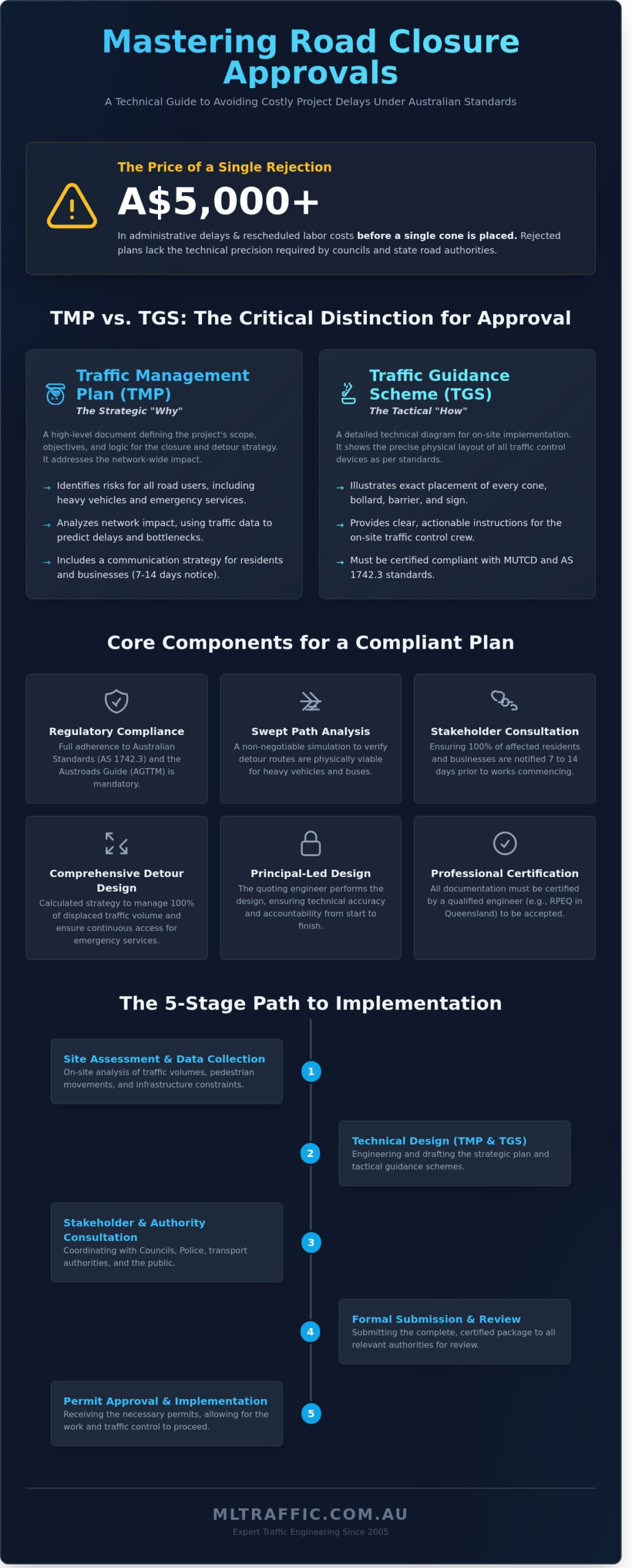

A single rejected traffic management plan for road closure can inflate project costs by over A$5,000 in administrative delays and rescheduled labor before a single cone is even placed on the asphalt. You understand that navigating the bureaucracy of local councils and state road authorities is a meticulous process where a single missing swept path assessment or incorrect sight-line calculation leads to an immediate rejection. It’s a high-stakes requirement where technical precision is the only way to avoid project stagnation and budget blowouts.
This guide provides the technical roadmap you need to master Australian Standards AS 1742.3 and relevant state-specific codes. We’ll help you secure faster approvals from authorities and eliminate the common confusion between a basic Traffic Guidance Scheme (TGS) and a comprehensive Traffic Management Plan (TMP). You’ll learn the mandatory components of detour design and the specific documentation required to maintain your project schedule. We’ve compiled these insights to ensure your road closure is compliant, efficient, and approved on the first submission.
Key Takeaways
-
Understand the legal requirements for a professional traffic management plan for road closure, ensuring full compliance with Australian Standards (AS 1742.3) and AGTTM guidelines.
-
Learn the critical technical distinction between the strategic Traffic Management Plan (TMP) and the tactical Traffic Guidance Scheme (TGS) to ensure your documentation meets authority expectations.
-
Discover why Swept Path Analysis is a non-negotiable component of detour design when diverting heavy vehicles and buses through complex urban environments.
-
Navigate the multi-stage approval process by coordinating with Councils, Police, and transport authorities through expert-led site assessments and stakeholder consultation.
-
Identify how a principal-led engineering approach reduces project liability and ensures technical accuracy by having the quoting engineer perform the actual design work.
Table of Contents
What is a Traffic Management Plan for Road Closure?
A traffic management plan for road closure is a detailed technical document. It defines the specific protocols for diverting vehicles and pedestrians when a road section is obstructed. This is not a simple sketch. It is a calculated Road traffic control strategy designed to mitigate the risks associated with total network disruption. While a standard lane closure allows traffic to pass the work site, a road closure forces 100% of the volume onto detour routes. This necessitates a professional traffic engineer’s certification to ensure the surrounding infrastructure can handle the displaced load.
To better understand this concept, watch this helpful video:
Compliance with Australian Standards AS 1742.3 and the Austroads Guide to Temporary Traffic Management (AGTTM) is mandatory. These regulations provide the technical framework for safety and implementation. A traffic management plan for road closure must address the high-risk profile of redirecting heavy vehicles and public transport. Professional engineers use vehicle swept path assessments to verify that detours are physically viable. Without this technical verification, councils and state road authorities will not grant the necessary permits for the work to proceed.
The Objectives of a Road Closure Plan
The primary goal is the safety of all road users and site personnel. We focus on three core objectives to ensure a successful application. First, we protect workers by creating a physical barrier between the site and moving traffic. Second, we minimise the impact on the local transport network. This includes maintaining the schedule of bus routes and heavy vehicle corridors. Third, we ensure emergency services and residents have continuous access. If a plan fails to account for a single driveway or fire hydrant, it’s non-compliant.
Regulatory Framework: AS 1742.3 and AGTTM
The AGTTM Part 8 sets the national standard for training and implementation. It emphasizes a hierarchy of controls. Total road closure is often the safest option because it completely separates workers from live traffic. However, the traffic management plan for road closure must prove this is the most effective solution. Standardised plans usually fail for complex closures. Each site requires a bespoke assessment of traffic volumes, pedestrian movements, and local business needs. Our engineers have been providing these technical assessments since 2005, ensuring every plan meets the rigorous requirements of AS 1742.3.
TMP vs. TGS: Understanding the Technical Documentation
Distinguishing between a Traffic Management Plan (TMP) and a Traffic Guidance Scheme (TGS) is critical for project approval. A traffic management plan for road closure serves as the strategic framework. It details the project’s scope, safety objectives, and the logic behind chosen detours. Conversely, the TGS is a tactical diagram. It illustrates the precise placement of every cone, bollard, and sign on the road surface. Most Australian councils won’t even look at an application that lacks this dual-layered approach.
Authorities in Australia, such as Transport for NSW or Queensland’s Department of Transport and Main Roads, require high-level accountability. For projects in Queensland, an RPEQ (Registered Professional Engineer of Queensland) must certify these documents. This ensures the design complies with the Manual of Uniform Traffic Control Devices (MUTCD) and AS 1742.3. Having a senior engineer sign off on the traffic management plan for road closure reduces the risk of liability and speeds up the permit process with state road bodies.
Components of a Professional TMP
A professional TMP identifies risks for all road users, including heavy vehicles and emergency services. It evaluates how a closure at one point creates a bottleneck at the next intersection. This network impact analysis often utilizes data from recent traffic counts to predict delays. Effective plans also include a communication strategy. This ensures that 100% of affected residents and local businesses receive notification at least 7 to 14 days before works commence. While Australian standards are the primary focus, engineers often reference the Caltrans Transportation Management Plan Guidelines to implement advanced detour design and incident management strategies that exceed local minimums.
What Makes an Effective TGS for Closures?
The TGS must be exact. It includes detailed signage schedules with placement coordinates based on specific speed zones. For a 60km/h zone, the "road work ahead" sign must be placed exactly 80 to 120 metres from the start of the taper. The diagram clearly defines the work zone, the termination zone, and the lateral shift. Provisions for non-motorised users are mandatory. This means mapping 1.5-metre wide paths for pedestrians and safe bypasses for cyclists to ensure they aren’t forced into live traffic lanes.
Our team at ML Traffic Engineers has managed over 10,000 sites, ensuring every TGS meets strict regulatory standards. You can view our full range of traffic engineering services to see how we handle complex road closures and council approvals. We focus on providing direct access to the engineers who actually do the work, ensuring your project stays on schedule.
Detour Design and Swept Path Analysis for Closures
Diverting traffic from an arterial road to a residential side street involves more than just swapping signs. A robust traffic management plan for road closure must account for the "detour dilemma." This occurs when local streets, typically designed for 1,000 to 3,000 vehicles per day, are forced to absorb 15,000 or more diverted movements. Engineers must identify pinch points where narrow 3.2m lanes or high-density street parking will lead to immediate gridlock. Failure to assess these constraints results in safety incidents and community complaints within the first 60 minutes of implementation.
The Role of Swept Path Analysis
Swept path analysis is a computer-simulated verification of a vehicle’s turning radius and clearance. Our team uses AutoTURN software to model how specific vehicles navigate the proposed detour route. We test the turning movements of 12.5m Heavy Rigid Vehicles (HRV) and 19m Articulated Vehicles to ensure they don’t mount kerbs or strike street furniture. This technical assessment ensures compliance with AS 2890.2 for heavy vehicle access on temporary routes. Without this data, a traffic management plan for road closure risks total failure at the first tight intersection. While we follow local council guidelines, we also reference MUTCD standards for road closures to maintain international best practices for temporary traffic control zones.
Managing Public Transport and Service Vehicles
Detours must accommodate more than just private cars. We coordinate directly with local bus authorities to re-route services and establish temporary bus stops at least 48 hours before the closure begins. This ensures commuters aren’t left stranded and bus drivers don’t attempt to navigate impassable side streets. Waste collection is another critical factor. A standard garbage truck requires a 9.5m turning circle; if a detour blocks their usual path, we must provide a turnaround area or alternative access point. For complex projects, our swept path analysis services provide the necessary proof to authorities that delivery vehicles can still reach local businesses. We’ve seen projects delayed by 14 days because the initial plan didn’t account for a single 10.5m service vehicle’s requirements.
-
Volume Assessment: Comparing peak hour flows against the spare capacity of the detour route.
-
Pinch Point Identification: Mapping areas where street trees, power poles, or narrow bridges restrict heavy vehicle movement.
-
Parking Restrictions: Implementing temporary "No Standing" zones on detour corners to facilitate wide turns.
-
Signage Clarity: Placing advance warning signs at least 200m before the final turn-off point to prevent last-minute lane changes.
Effective detour design isn’t about finding the shortest path. It’s about finding the most capable path. By identifying potential bottlenecks during the design phase, we prevent the 20% increase in travel time that often accompanies poorly planned diversions.
The Approval Process: From Application to Implementation
The approval of a traffic management plan for road closure follows a rigid sequence to ensure public safety and network efficiency. It’s not a simple administrative task; it’s a technical requirement that demands precision. At ML Traffic Engineers, we’ve managed these approvals across more than 10,000 sites since 2005, ensuring every plan meets Australian Standards like AS 1742.3 and relevant state supplements.
-
Step 1: Initial site assessment and stakeholder consultation. We conduct a physical inspection of the site to identify constraints like bus zones, clearways, and property access. We consult with local Councils, Police, and state transport authorities early to identify potential deal-breakers.
-
Step 2: Preparation of the TMP and TGS. A qualified traffic management plan for road closure designer creates the Traffic Management Plan (TMP) and Traffic Guidance Scheme (TGS). These documents detail the exact placement of signs, barriers, and personnel.
-
Step 3: Submission of the Road Occupancy Licence (ROL). We lodge the ROL or equivalent permit application with the relevant authority. This is the formal request to occupy the road space.
-
Step 4: Review and revision phase. Authorities review the submission against network demands. We address feedback regarding traffic volume, pedestrian safety, or conflicting nearby works.
-
Step 5: Final approval and implementation. Once approved, we coordinate public notifications, such as letterbox drops or Variable Message Signs (VMS), before the physical implementation of the plan on-site.
Common Reasons for Application Rejection
Inadequate detour planning is a primary cause for rejection. If the diverted traffic exceeds the capacity of the alternate route, the application will fail. Authorities also reject plans that ignore "blackout" periods, typically between 6:00 AM to 9:00 AM and 3:00 PM to 6:00 PM on major arterials. Administrative errors, such as missing signatures from accredited traffic designers or outdated insurance certificates, cause 15% of initial delays. Every plan must be signed by a designer with the appropriate state-recognised qualifications.
Timelines and Lead Times for Approvals
Typical processing times for local council permits range from 10 to 15 business days. State road authority ROLs often require 20 business days for a comprehensive review. Early engagement with a traffic engineer is critical to prevent project delays that can cost developers thousands in idle labour. For emergency road closures, such as burst water mains, the process is compressed, but it still requires a post-event lodgement of a formal TGS to ensure ongoing site safety. Our principals have between 30 and 40 years of experience, ensuring we navigate these timelines with technical accuracy.
Contact ML Traffic Engineers today to discuss your road closure permit requirements with a senior consultant.
Why Expert Traffic Engineering is Critical for Closures
ML Traffic Engineers operates on a principal-led model. The traffic consultant who provides your quote is the same senior engineer who completes the technical work. This ensures direct accountability and eliminates communication gaps. Since 2005, we’ve successfully managed over 10,000 sites across Australia. This volume of work provides the foresight required to anticipate council objections before they’re raised. A professional traffic management plan for road closure shouldn’t be viewed as a bureaucratic hurdle. It’s a strategic tool for project efficiency. Meticulous planning prevents costly work stoppages. It ensures site safety from day one. Our experience covers a vast range of developments including apartments, bars, temples, warehouses, and shopping centres.
We understand the technicalities of road authorities. Our team knows how to navigate the specific requirements of local councils and state road agencies. We provide the following technical assessments to ensure project success:
-
Vehicle Swept Path Assessment using latest industry software.
-
Sight-Line Assessment for safe entry and exit points.
-
Driveway ramp grade calculations and compliance checks.
-
Car Parking Demand Assessment for high-density areas.
-
Traffic Impact Statements (TIS) for development applications.
Reducing Liability and Ensuring Compliance
Non-compliant traffic management carries severe legal risks. If an accident occurs on a site with an inadequate plan, the developer and contractor face significant liability. Professional certification protects your project. We ensure every document complies with Australian Standards, specifically AS 1742.3 and AS 2890.1. ML Traffic delivers results-oriented documentation. Our technical precision ensures that the traffic management plan for road closure is approved without unnecessary delays. This meticulous approach reduces the likelihood of insurance claims or regulatory interventions. We don’t provide generic templates. We provide site-specific engineering solutions designed to withstand legal and regulatory scrutiny.
Next Steps for Your Project
Securing a comprehensive road closure plan begins with a direct consultation. Every phase of your project benefits from senior staff involvement. Michael Lee and Benny Chen bring between 30 and 40 years of experience each to every assessment. We provide fixed quotes and clear timelines for all deliverables. Our focus is private clients with development applications. We handle the technicalities so you can focus on construction. Our firm is dependable, meticulous, and results-oriented. To begin the process, reach out to our senior consultants directly. Contact ML Traffic Engineers to discuss your road closure requirements today. Our team provides the technical precision your project demands for a successful, compliant approval.
Secure Compliance and Approval for Your Next Road Closure
Navigating the technical requirements of a traffic management plan for road closure requires more than basic site drawings. You must integrate precise swept path analysis and detour designs that meet Australian Standard AS 1742.3. Professional TGS and TMP documentation are essential to avoid costly delays during the council approval process. ML Traffic Engineers provides over 15 years of specialized traffic engineering experience. We’ve assessed more than 10,000 sites across Australia, ensuring every technical detail aligns with local regulatory frameworks. You won’t deal with junior staff. The consultant who provides your quote is the one doing the technical work. You gain direct access to our senior principals, Michael Lee and Benny Chen, throughout the entire application. This hands-on approach minimizes risk and streamlines your path to implementation. We’re ready to help you secure your permit and keep your project moving safely.
Get an Expert Traffic Management Plan for Your Road Closure
Frequently Asked Questions
How long does it take to get a traffic management plan for a road closure approved?
Approval for a traffic management plan for road closure typically takes between 10 and 20 business days. This duration depends on the specific local Council or State Road Authority, such as Transport for NSW or VicRoads. Complex closures on arterial roads often require a 28 day notice period for public notification. You’ll need to submit your application at least 4 weeks before your start date to avoid project delays.
What is the difference between a TCP and a TGS in Australia?
A Traffic Guidance Scheme (TGS) is the current technical term defined in the AS 1742.3:2019 standard, effectively replacing the older Traffic Control Plan (TCP) terminology. While industry professionals still use the term TCP, a TGS refers specifically to the diagram showing sign placement and taper lengths. The broader Traffic Management Plan (TMP) contains these diagrams along with risk assessments and project descriptions.
Do I need a traffic engineer for a simple residential road closure?
You generally need a qualified professional to design your traffic management plan for road closure even on quiet residential streets. Most Australian Councils require plans to be drafted by an individual holding a Select/Modify Traffic Management Plans qualification or a formal civil engineering degree. Council officers verify these plans against the AGTTM (Guide to Temporary Traffic Management) before they’ll issue any permits.
What information do I need to provide for a road closure permit application?
You must provide a certified TGS, a detailed description of works, and a Certificate of Currency for Public Liability Insurance for at least A$20 million. Applications must specify the exact dates and hours of operation alongside a site specific risk assessment. If the closure impacts bus routes, you’re required to provide evidence of consultation with local transit providers and emergency services.
Are there specific times of day when road closures are not permitted?
Road closures are usually prohibited during morning and afternoon peak periods, specifically 6:30 AM to 9:30 AM and 3:30 PM to 6:30 PM on weekdays. Authorities frequently restrict work on state managed roads during public holidays or major regional events to maintain network flow. Night work between 8:00 PM and 5:00 AM is often mandated for high volume urban corridors to reduce community impact.
What happens if I close a road without an approved traffic management plan?
Closing a road without an approved plan leads to an immediate site shutdown and heavy financial penalties. Under state Road Management Acts, fines for unauthorized road occupation can exceed A$5,000 for individuals and A$25,000 for corporations. You also face unlimited personal liability for any accidents, vehicle damage, or injuries that occur within the uncertified work zone.
How much does a professional traffic management plan cost?
A professional traffic management plan for road closure costs between A$500 and A$2,000 for standard applications. This fee covers the technical drafting of the TGS and the supporting TMP documentation required by authorities. Complex projects that require swept path analysis or RPEQ certification will incur higher costs. These figures don’t include Council permit fees, which typically range from A$200 to A$1,500.
Does a road closure plan need to be signed by a specific type of engineer?
Requirements vary by jurisdiction, but complex plans must often be signed by a Registered Professional Engineer of Queensland (RPEQ) or an equivalent chartered engineer in other states. For standard setups, a practitioner with "Design and Inspect" or "Prepare Work Zone Traffic Management Plan" accreditation is usually sufficient. It’s vital to check the specific signatory level required by your local Council’s engineering department before starting the design.
Which areas do you cover?
We are traffic engineers servicing Melbourne, Sydney, Brisbane, Gold Coast, Hobart, Perth, Adelaide, Darwin, Canberra and surrounding areas.

Disclaimer
The content on www.mltraffic.com.au, including all technical articles, guides, and resources, is provided for general informational and educational purposes only. It is not intended to constitute professional advice in traffic engineering, transportation planning, development approvals, or any other technical or legal field.
While ML Traffic Engineers makes every reasonable effort to ensure the accuracy, completeness, and timeliness of the information published, we do not provide any warranties or representations (express or implied) regarding its reliability, suitability, or availability for any particular purpose. Any reliance you place on the content is strictly at your own risk.
In no event shall ML Traffic Engineers, its directors, employees, authors, or affiliates be liable for any direct, indirect, incidental, special, consequential, or punitive damages (including, without limitation, loss of profits, data, or business opportunities) arising out of or in connection with the use of, or inability to use, any information provided on this website.
The articles and guides on this site are not a substitute for engaging a qualified, registered professional traffic engineer (such as an NPER or RPEQ engineer) to assess your specific project requirements. For tailored advice, compliance assessments, or traffic engineering services, please contact a competent professional.
This disclaimer may be updated from time to time without notice. By accessing or using this website, you agree to be bound by the most current version of this disclaimer.