

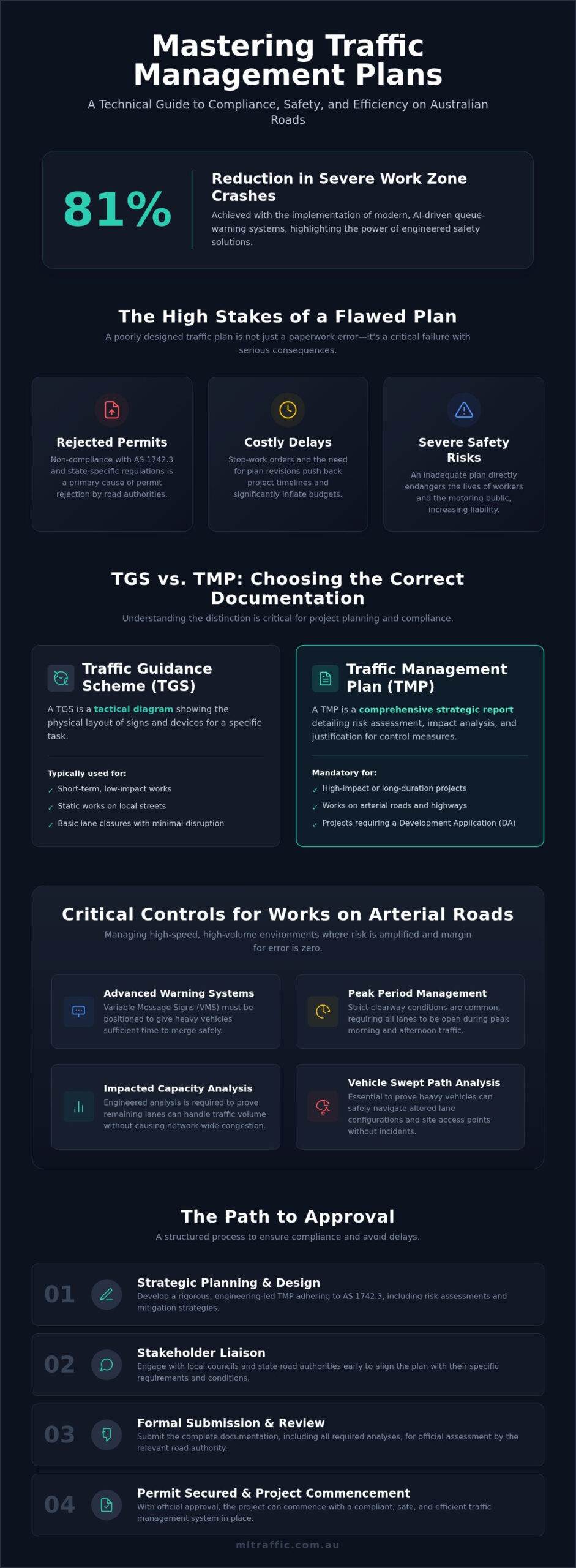
Did you know that recent data from AI-driven queue-warning systems shows a reduction in severe work zone crashes by as much as 81%? While technology is evolving, the foundation of site safety remains a rigorous, engineering-led traffic management plan for road works. A poorly designed plan is more than just a paperwork error; it’s a primary cause of rejected permits, costly project delays, and significant safety risks on high-speed arterial roads.
We understand that navigating complex state regulations and national standards like AS 1742.3 can be a significant burden for project commencement. You need a plan that guarantees compliance while keeping traffic flowing efficiently. This guide provides the technical clarity required to secure regulatory approval and maintain a zero-incident site. We’ll examine the essential components of a professional submission, including the necessity of vehicle swept path analysis and parking demand assessments. You’ll learn exactly how to structure your plan to satisfy road authorities and ensure the safety of every worker and motorist.
Key Takeaways
- Understand the legal necessity and strategic purpose of a traffic management plan for road works to ensure compliance with Australian workplace health and safety laws.
- Learn the critical distinction between a tactical Traffic Guidance Scheme (TGS) and the overarching strategic Traffic Management Plan (TMP) required for complex site operations.
- Identify why works on arterial roads demand more rigorous impact assessments and specialised engineering to manage high-speed, high-volume traffic environments.
- Discover how Vehicle Swept Path Analysis using industry-standard software eliminates guesswork and prevents site accidents involving heavy vehicle movements.
- Master the step-by-step approval process for liaising with local councils and state road authorities to secure necessary permits and avoid project delays.
Understanding the Traffic Management Plan for Road Works
A traffic management plan for road works serves as the primary safety architecture for any construction project impacting the public thoroughfare. It is far more than a simple map showing sign placement; it’s a technical report that evaluates risks and justifies specific control measures. By integrating principles of Road traffic control, engineers create a framework that prioritises the safety of site personnel while facilitating the movement of vehicles and pedestrians.
Protecting the workforce is paramount, but a successful plan must also consider the needs of the motoring public and vulnerable road users simultaneously. Temporary works, such as utility repairs, might only require short-term lane closures. In contrast, long-term infrastructure projects involve complex traffic displacement that can affect entire regional networks. A rigorous engineering approach ensures these impacts are mitigated through data-driven strategies rather than anecdotal assumptions.
The Legal Framework for Road Work Safety
The Australian Standard AS 1742.3 serves as the foundational document for traffic control on roads across the country. This standard dictates the technical requirements for everything from sign dimensions to taper lengths. State road authorities use these national guidelines to establish their own compliance benchmarks, often adding specific supplements that reflect local conditions and traffic volumes.
Non-compliance with these standards carries significant risks. Beyond the immediate danger to human life, authorities have the power to issue stop-work orders and levy heavy fines against contractors. In the event of a site incident, a flawed or missing traffic management plan for road works can lead to severe liability issues and the voiding of insurance policies. Meticulous adherence to the legal framework is the only way to ensure project continuity and personnel safety.
When is a Formal TMP Mandatory?
Determining whether a project requires a basic Traffic Guidance Scheme (TGS) or a comprehensive TMP is a critical early-stage decision. While a TGS provides a tactical layout of devices, a formal TMP is an analytical document required for high-risk or high-impact scenarios. This is particularly relevant during the Development Application (DA) process, where councils demand proof that new works won’t cause systemic congestion or safety hazards.
Mandatory trigger points for a full TMP include:
- Partial or full closures of arterial road networks.
- Rerouting traffic through detours that impact residential amenity.
- Works that interfere with public transport schedules or emergency access.
- High-frequency construction vehicle movements in pedestrian-heavy zones.
At ML Traffic Engineers Australia, we specialise in developing these complex submissions to meet the exacting standards of local and state authorities. You can view our full range of traffic engineering services to understand how we support compliant project delivery. By ensuring the same senior expert manages the project from start to finish, we provide the technical reliability required for successful permit acquisition and site safety.
Critical Requirements for Traffic Control for Works on Arterial Roads
Arterial roads serve as critical conduits for regional movement. Unlike minor streets, these thoroughfares carry high-speed, high-volume traffic that leaves little room for error. A traffic management plan for road works on an arterial route must account for the increased kinetic energy of approaching vehicles and the complex merging behaviours of heavy transport. Effective Work Zone Traffic Management requires engineers to calculate impacted capacity to prevent local works from causing city-wide congestion.
Maintaining throughput during peak periods is a primary concern for road authorities. Most permits for arterial works come with strict clearway conditions, requiring all lanes to be open during morning and afternoon peaks. If 24-hour occupancy is required, the plan must justify how the remaining lanes will handle the volume. This often involves detailed intersection analysis to ensure that temporary signal timings don’t lead to dangerous queue lengths. Advanced warning systems, including Variable Message Signs (VMS), must be positioned far enough in advance to allow heavy vehicles sufficient time to merge safely.
Safety Buffer Zones and Speed Reduction
Longitudinal and lateral safety buffers provide a crucial margin for error. We calculate these distances based on the prevailing approach speed, not just the temporary work zone limit. The hierarchy of speed control begins with advanced warning signage, progressing to VMS boards and flashing arrow lamps. For night works, we specify high-index reflective materials and consistent lighting to eliminate blind spots for motorists transitioning from dark stretches into illuminated work zones. This meticulous approach to speed management is essential for protecting both the public and site personnel.
Pedestrian and Cyclist Management
Vulnerable road users require dedicated protection on busy arterial routes. Detours shouldn’t just be safe; they must be accessible and DDA compliant. This includes maintaining a minimum clear width of 1.2 metres and ensuring all ramps meet grade requirements. While bollards might suffice on local roads, arterial environments usually demand physical separation using concrete or water-filled barriers. This prevents vehicle incursions into pedestrian paths. If you’re managing a complex site on a major thoroughfare, our traffic engineering services provide the technical precision needed for these high-risk environments.
TGS vs TMP: Choosing the Right Documentation
A traffic management plan for road works is frequently misinterpreted as being synonymous with a Traffic Guidance Scheme (TGS). While they’re intrinsically linked, they serve distinct functions in the engineering and approval hierarchy. A TGS is a tactical site map showing the exact placement of every sign, cone, and bollard. Conversely, a Traffic Management Plan (TMP) is an overarching strategic report that justifies these tactical choices through rigorous impact analysis and risk mitigation strategies.
In the context of complex projects, a TGS is merely one component of a larger TMP. The TGS provides the site crew with a “how-to” guide for setup, while the TMP provides the road authority with the “why” and “what if” required to issue a permit. Understanding the anatomy of these documents is essential for ensuring your submission isn’t rejected due to insufficient technical depth.
The Components of a Professional TGS
A professional TGS provides a high-resolution visual layout of the work zone, including specific sign codes as dictated by the relevant state supplements. Diagrams must be drawn to scale and reflect the actual geometry of the road, including existing intersections and driveway access points. Generic, non-scaled templates are a common cause of site accidents and regulatory fines. Every TGS requires certification by an accredited traffic designer who validates that the layout meets the safety requirements of the specific environment. This certification ensures that the tactical deployment on the ground matches the engineering intent of the project.
What Makes a Comprehensive TMP?
A comprehensive TMP addresses the broader operational risks that a simple diagram cannot capture. It includes a detailed risk management plan, a public transport impact analysis, and a stakeholder consultation strategy to manage the expectations of local businesses and residents. For projects on major thoroughfares, we often integrate specialised assessments like Intersection Analysis to ensure that temporary changes don’t lead to systemic network failure. Learn more about our Traffic Management Plan services to see how we manage these strategic requirements.
At ML Traffic Engineers Australia, we provide the technical expertise needed to develop both tactical and strategic documentation. Our personnel continuity promise means the same expert who initiates your site assessment performs the technical work, ensuring that your traffic management plan for road works is cohesive and compliant. This hands-on approach by senior leadership eliminates the communication gaps often found in larger firms, leading to faster approvals and safer site operations.
The Role of Swept Path Analysis in Road Work Planning
A robust traffic management plan for road works relies on empirical data rather than visual estimation. Guesswork regarding vehicle turning circles is a leading cause of site accidents and structural damage during construction. We use advanced simulation software like AutoTURN to model the precise movements of heavy vehicles through temporary detours and lane shifts. This technical validation ensures that every proposed change to the road geometry is physically viable for the largest legal vehicle types. The ultimate guide to Swept Path Analysis provides deeper insight into how these simulations protect infrastructure and public safety.
Maintaining access for emergency services is a non-negotiable requirement for regulatory approval. Fire engines and ambulances have specific manoeuvrability requirements that must be preserved even when lanes are narrowed or rerouted. Our engineers simulate these paths to guarantee that response times aren’t compromised by the work zone layout. This level of detail is what distinguishes a compliant engineering document from a basic map.
Heavy Vehicle Detour Planning
Detouring traffic on arterial roads often forces high-capacity vehicles like B-doubles or articulated buses into tighter turns than they usually encounter. Without rigorous analysis, these vehicles risk kerb-strikes or colliding with temporary barriers and signage. We analyse the swept path of these specific vehicles through every temporary lane shift. This process validates that detours are physically possible, preventing infrastructure damage and traffic gridlock caused by stuck vehicles. It’s a critical step in ensuring the site operates without incident.
Construction Site Access Engineering
Safe entry and exit points for construction machinery are essential for maintaining site safety and public traffic flow. We engineer these access points to ensure that trucks entering the traffic stream have sufficient sight distances. This reduces the risk of high-speed collisions on arterial routes. Planning these movements correctly requires the expertise of a professional who understands the intersection of site logistics and road safety. Why your project needs a traffic engineer explains the value of this specialised oversight in modern road works.
If your project involves complex vehicle movements or heavy machinery, request a professional Vehicle Swept Path Analysis to ensure your site remains safe and compliant from day one.
Navigating the Approval Process and Compliance
The administrative journey toward securing a permit for a traffic management plan for road works is a structured sequence that demands technical precision. It begins with a comprehensive site assessment where existing physical constraints, such as signalised crossings or established bus zones, are meticulously logged. This data informs the technical drafting of the report. Once the engineering documentation is finalised, it is submitted to the relevant governing body. For local and collector streets, this is typically the municipal council. However, works on arterial routes involve relevant state road authorities and often require a formal Road Occupancy Licence (ROL) alongside the traffic permit.
Permit rejection is a primary cause of project commencement delays and site downtime. Authorities frequently return submissions that lack technical justification or fail to meet the nuanced requirements of a specific local jurisdiction’s supplements. Professional certification is a non-negotiable requirement in this process. Only an accredited traffic designer or engineer can sign off on these documents to satisfy workplace health and safety (WHS) obligations and public liability standards. Without this professional endorsement, a submission will be rejected during the initial screening phase, leading to significant project setbacks.
Stakeholder Consultation Requirements
A successful approval often hinges on the quality of stakeholder consultation documented within the report. This process involves identifying all parties impacted by the works, including local business owners, residents, and emergency service providers. The final submission must detail how these parties were consulted and what specific measures are in place to minimise disruption. For example, scheduling works during off-peak hours or providing alternative pedestrian access routes can mitigate community concerns. Councils and state authorities view this documentation as essential proof of due diligence, making it a prerequisite for permit issuance.
Why Senior Engineering Oversight Matters
The complexity of modern road networks means that generic, template-based plans are no longer sufficient for regulatory approval. At ML Traffic Engineers Australia, we ensure that a senior principal remains directly involved in every project from inception to the final permit issuance. This level of oversight ensures that every technical assessment is robust enough to withstand the scrutiny of road authority auditors. We maintain a personnel continuity promise: the same expert who initiates your project performs the technical work, eliminating the communication gaps that often occur in larger, impersonal firms.
By maintaining this high standard of accountability, we help our clients navigate the bureaucratic requirements of local councils and state bodies without unnecessary revisions. This direct access to leadership ensures that your traffic management plan for road works is developed with a deep understanding of your site’s unique constraints. Contact ML Traffic Engineers Australia for expert TMP preparation to ensure your project remains on schedule and fully compliant with all relevant Australian standards.
Streamline Your Permit Acquisition and Site Safety
A compliant traffic management plan for road works is the difference between a stalled project and a successful, zero-incident site. You now understand the technical distinction between a tactical TGS and a strategic TMP, alongside the engineering necessity of Vehicle Swept Path Analysis for arterial routes. Navigating the bureaucratic requirements of local councils and state authorities doesn’t have to cause commencement delays when you rely on professional engineering oversight.
ML Traffic Engineers Australia provides over 15 years of traffic engineering experience with national coverage across all Australian states. We ensure senior principals are involved in every project, maintaining a personnel continuity promise where the expert who starts your project performs the technical work. This meticulous approach guarantees adherence to AS 1742.3 and national regulatory standards. Get a professional Traffic Management Plan for your road works today to ensure your project remains safe and fully compliant. We look forward to supporting your next infrastructure project.
Frequently Asked Questions
What is the difference between a Traffic Management Plan and a Traffic Guidance Scheme?
A Traffic Guidance Scheme (TGS) is a tactical diagram illustrating the physical placement of signs and devices. A traffic management plan for road works is a comprehensive strategic report that justifies these layouts through engineering evidence. While the TGS provides the site layout for crews, the TMP contains the risk assessments and impact analyses required by authorities for permit issuance. Professional engineering ensures both documents work in tandem.
How long does it take to get a traffic management plan approved by council?
Approval timeframes typically range from 10 to 20 business days depending on the local council or state road authority. Complex applications involving arterial roads or significant detours often require longer lead times for Road Occupancy Licence (ROL) processing. Engineering firms with established relationships with authorities can often navigate these timelines more efficiently. Early submission is critical to avoid project commencement delays caused by regulatory backlog or required plan revisions.
Do I need a professional engineer to sign off on my road work plan?
Yes, a qualified and accredited traffic designer or engineer must sign off on the plan to ensure regulatory compliance. Road authorities won’t accept submissions from uncertified individuals. This professional oversight guarantees that the plan adheres to legal safety standards and mitigates the contractor’s liability in the event of a site incident. Our senior principals are involved in every project to provide this essential level of accountability.
What Australian Standards govern traffic management for road works?
The primary standard is AS 1742.3, which covers traffic control for works on roads. This is often supplemented by state-specific manuals, such as the Traffic Control at Work Sites (TCAWS) manual in NSW or the Code of Practice in Victoria. Compliance with these standards is a mandatory legal requirement under Australian workplace health and safety laws. Every traffic management plan for road works must reflect the latest revisions of these national guidelines.
Is a swept path analysis required for every road work project?
Swept path analysis is mandatory for any road work project involving heavy vehicle detours or narrowed lane widths. While minor works on local streets might skip this step, arterial road projects require it to prove that buses and emergency vehicles can safely navigate the work zone. It eliminates guesswork that leads to kerb strikes and infrastructure damage. We use software like AutoTURN to provide this technical validation for complex sites.
How much does a professional traffic management plan cost to prepare?
The cost of preparing a professional plan depends on the project’s complexity and the specific requirements of the road authority. Factors include the road category, the number of required TGS diagrams, and whether specialised assessments like intersection analysis or parking demand assessments are necessary. We provide detailed quotes based on the unique technical constraints of your site. Professional preparation prevents the far higher costs associated with permit rejections and site accidents.
What happens if my road work site does not have a compliant TMP?
Operating without a compliant TMP results in immediate site shutdowns and substantial financial penalties from regulatory bodies. Non-compliance also exposes the contractor to significant legal liability if a collision or injury occurs within the work zone. Authorities may also blacklist contractors from future government tenders if they fail to maintain rigorous safety documentation. Meticulous planning is the only way to protect your business from these severe operational and legal risks.
Does a TMP cover pedestrian and cyclist safety during construction?
Yes, every compliant TMP must include dedicated provisions for the safety and accessibility of pedestrians and cyclists. This involves designing detours that meet Disability Discrimination Act (DDA) standards, including minimum path widths and appropriate ramp grades. Separation techniques, such as concrete barriers, are often required on arterial routes to protect these vulnerable road users from high-speed traffic. Ensuring their safety is as critical as managing vehicle flow through the work zone.

Disclaimer
The content on www.mltraffic.com.au, including all technical articles, guides, and resources, is provided for general informational and educational purposes only. It is not intended to constitute professional advice in traffic engineering, transportation planning, development approvals, or any other technical or legal field.
While ML Traffic Engineers makes every reasonable effort to ensure the accuracy, completeness, and timeliness of the information published, we do not provide any warranties or representations (express or implied) regarding its reliability, suitability, or availability for any particular purpose. Any reliance you place on the content is strictly at your own risk.
In no event shall ML Traffic Engineers, its directors, employees, authors, or affiliates be liable for any direct, indirect, incidental, special, consequential, or punitive damages (including, without limitation, loss of profits, data, or business opportunities) arising out of or in connection with the use of, or inability to use, any information provided on this website.
The articles and guides on this site are not a substitute for engaging a qualified, registered professional traffic engineer (such as an NPER or RPEQ engineer) to assess your specific project requirements. For tailored advice, compliance assessments, or traffic engineering services, please contact a competent professional.
This disclaimer may be updated from time to time without notice. By accessing or using this website, you agree to be bound by the most current version of this disclaimer.
