
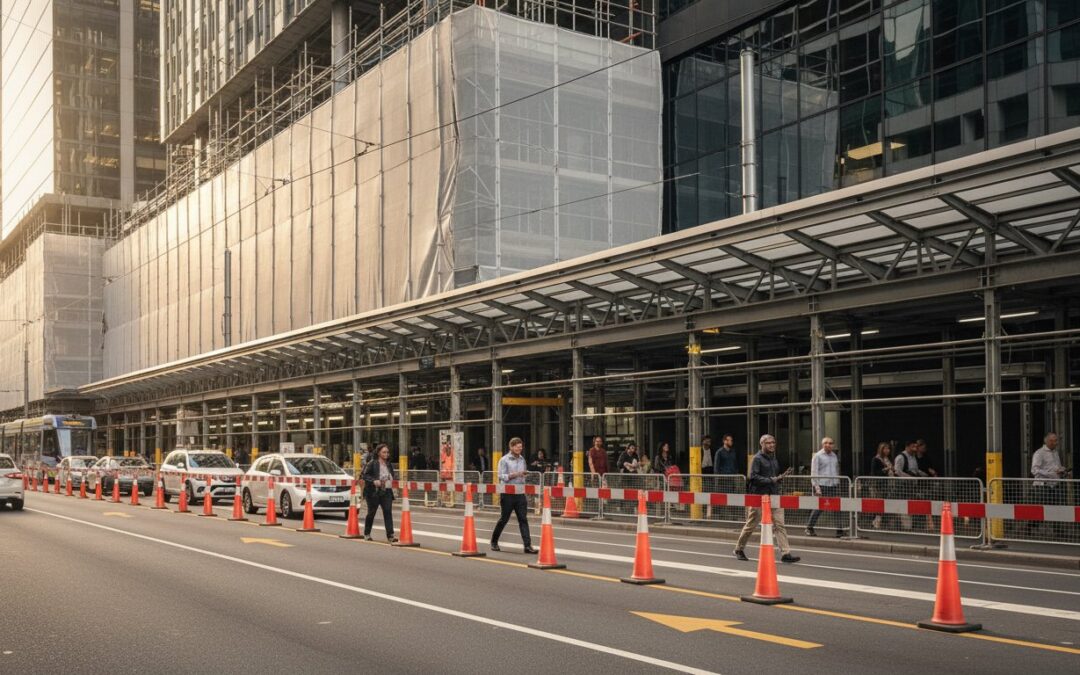
Scaffolding is a static obstruction that requires a dynamic traffic engineering approach to maintain flow and safety. You understand that local councils and road authorities are increasingly meticulous regarding how temporary structures impact public thoroughfares. A poorly designed traffic management plan for scaffolding often results in immediate permit rejections, safety breaches, or expensive project delays that stall your timeline before work even begins. Navigating these technicalities requires a professional understanding of both site-specific risks and the latest regulatory updates effective as of 2026.
This guide delivers a comprehensive technical framework for developing compliant plans that meet Australian regulatory standards and AS 1742.3 requirements. You’ll learn how to prioritize pedestrian safety in high-traffic zones while maintaining clear vehicle access. We’ll examine the essential components of site-specific assessments, including why a Traffic Impact Assessment (TIA) Report or Vehicle Swept Path Analysis is critical for approval. By following this guide, you can secure council permits without revisions and ensure your site remains safe and operational throughout the project duration.
Key Takeaways
- Understand the specific legal obligations under Australian WHS laws to maintain regulatory compliance and prevent project shutdowns.
- Learn the technical distinction between a high-level traffic management plan for scaffolding and a detailed Traffic Guidance Scheme (TGS).
- Identify the safety requirements and minimum clear widths necessary to protect pedestrians and cyclists in high-traffic scaffolding zones.
- Streamline the council permit process by identifying the specific documentation required by local and state road authorities.
- Discover how professional assessments like Vehicle Swept Path Analysis ensure heavy vehicle access remains uninterrupted during construction.
Regulatory Requirements for Scaffolding Traffic Management
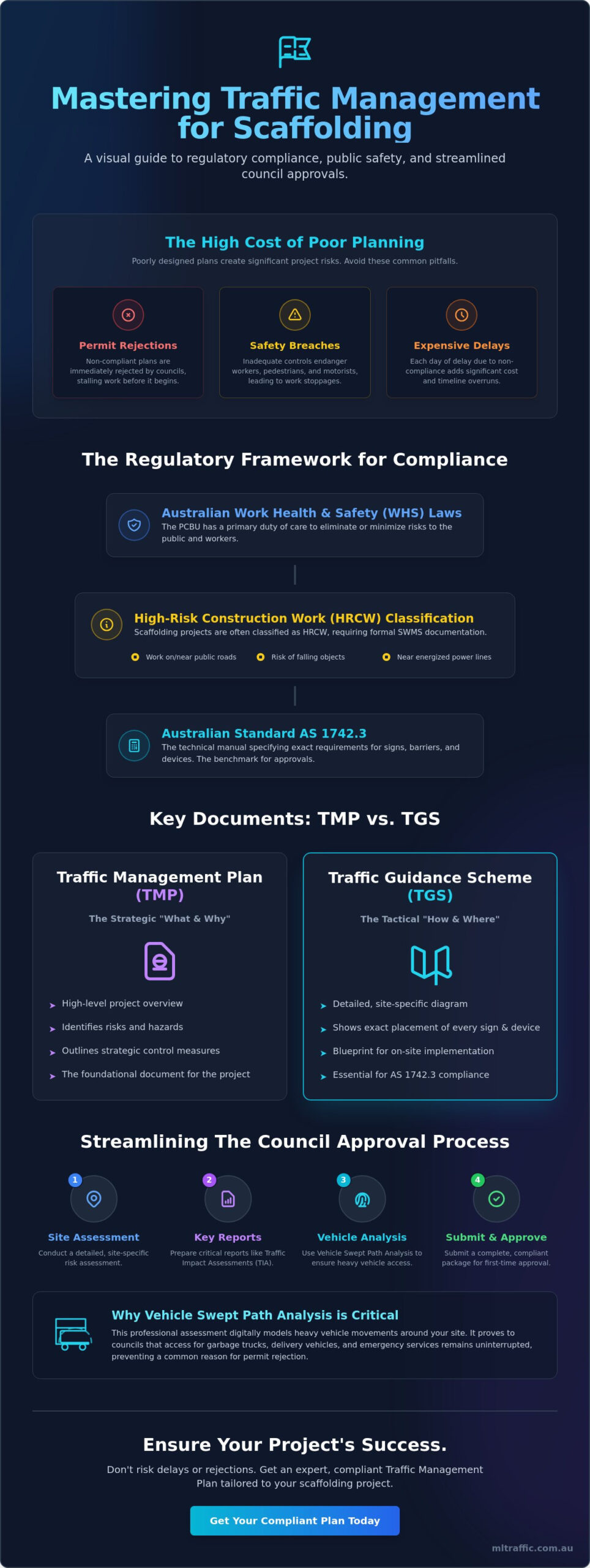
A traffic management plan for scaffolding is a specialized technical document. It outlines the specific control measures used to mitigate risks when temporary structures occupy or border public space. Under Australian Work Health and Safety (WHS) legislation, the Person Conducting a Business or Undertaking (PCBU) holds a primary duty of care. This duty requires the elimination or minimization of risks to both workers and the public. Effective road traffic control is a core component of this obligation. It ensures that vehicle and pedestrian movements remain predictable and safe despite the presence of construction obstructions.
To better understand the core principles of safety in these environments, watch this technical overview:
Scaffolding projects are frequently classified as High-Risk Construction Work (HRCW). This classification demands a higher level of scrutiny and formal documentation, including the preparation of a Safe Work Method Statement (SWMS). The PCBU must manage the interface between the site and the public meticulously. It’s not just about worker safety; it’s about ensuring that any person in the vicinity of the site is protected from harm. Failing to provide a compliant plan can lead to immediate work stoppages by regulators or local councils. These delays often result in significant financial penalties and project setbacks.
High-Risk Construction Work (HRCW) Triggers
Several factors trigger the HRCW status for scaffolding projects. Any work carried out on or near a public road used by vehicles or pedestrians requires a formal plan. The risk of falling objects is a primary concern. Scaffolding height and the proximity of the structure to traffic lanes dictate the complexity of the required controls. Additionally, if the scaffolding is located near energized overhead power lines, specific exclusion zones must be maintained. This often requires lane shifts or pedestrian diversions to ensure both electrical safety and traffic flow. Meticulous planning prevents accidental contact and maintains the required safety buffers.
Australian Standards for Traffic Control Devices
Adherence to AS 1742.3 is the foundation of any compliant traffic management plan for scaffolding. This manual specifies the exact requirements for temporary traffic control devices used across Australia. It covers everything from sign sizes and placement distances to the retroreflectivity of barriers used at night. Local councils and state road authorities use these national standards as the primary benchmark for permit approvals. If your plan doesn’t meet these technical specifications, it won’t be approved. Professional traffic engineering ensures that every sign and device is placed according to these rigorous standards. For complex sites, this often involves a Traffic Guidance Scheme (TGS) to provide the granular, site-specific detail required for safe on-site implementation and regulatory compliance.
Technical Components of a Scaffolding Traffic Guidance Scheme
A successful traffic management plan for scaffolding relies on the distinction between strategic planning and tactical execution. While a Traffic Management Plan (TMP) provides the high-level project overview and risk assessment, the Traffic Guidance Scheme (TGS) is the detailed technical diagram used by on-site personnel. The TGS specifies the exact location and type of every sign, cone, and barrier required to safely isolate the scaffold footprint from live traffic lanes and pedestrian paths. Without a precise TGS, contractors risk non-compliance with AS 1742.3 and potential site shutdowns during council inspections.
The Traffic Guidance Scheme (TGS) Explained
The TGS acts as a blueprint for the physical setup of the work zone. It must accurately reflect the dimensions of the scaffold, including any outriggers or hoarding that might encroach onto the road or footpath. When scaffolding requires lane narrowings, a professional swept path analysis is essential. This engineering assessment confirms that heavy vehicles, such as buses or emergency services, can still navigate the remaining road space safely. A generic template cannot account for these site-specific constraints, which is why councils often require a certified Traffic Guidance Scheme tailored to the unique geometry of the intersection or streetscape.
Signage and Delineation Standards
Effective delineation separates the public from high-risk construction activities. Signage must follow a logical sequence to give motorists and cyclists adequate reaction time. This sequence includes advanced warning signs, transition signs to guide traffic into new paths, and termination signs such as ‘End Roadwork’. For pedestrian management, signs like ‘Pedestrians Watch Your Step’ or ‘Use Other Footpath’ must be placed at decision points to prevent confusion. Adherence to OSHA scaffolding safety guidelines and Australian standards ensures that these devices are used to manage load capacities and fall protection risks effectively.
Physical protection is equally critical. You must use robust barriers, such as water-filled bollards or concrete T-offs, to provide a crash-rated buffer between vehicles and the scaffold structure. If the scaffolding remains in place overnight, visibility requirements increase. This includes the use of retroreflective signage and steady-on or flashing yellow lamps to delineate the hazard in low-light conditions. These technical components work together to maintain 100% site safety while facilitating the movement of traffic. For projects with complex site constraints, engaging a specialist to develop a professional Traffic Guidance Scheme ensures all technical and regulatory benchmarks are met before the first pole is erected.
Managing Pedestrian and Cyclist Safety Around Scaffolding
Pedestrians and cyclists represent the most vulnerable stakeholders in any urban construction environment. A robust traffic management plan for scaffolding must prioritize these users to prevent accidents and maintain public accessibility. When a scaffold structure encroaches on a public footpath, the risk of collision or injury from falling objects increases significantly. You must implement specific control measures that go beyond simple signage to ensure a safe, navigable path for all members of the public, including those with limited mobility or vision impairments.
Pedestrian Diversion Strategies
The choice between directing pedestrians to the opposite side of the street or providing an on-road diversion depends on traffic volume and available road width. If you use a ‘Pedestrians Cross Other Side’ strategy, you must place signs at the nearest safe crossing points to prevent mid-block jaywalking. For on-road diversions, the temporary path must be physically separated from live traffic using crash-rated barriers. These paths require a minimum clear width, often 1.2 to 1.5 meters, to accommodate wheelchairs, prams, and high-volume foot traffic.
Surfaces must remain level and free of trip hazards like scaffold base plates or loose gravel. If ramps are necessary to bridge kerbs, they must meet strict gradient standards to ensure accessibility. Technical frameworks such as the Caltrans TMP guidelines offer authoritative insights into managing these complex interactions in high-density areas. During peak hours, you might need additional personnel to manage the interface between construction deliveries and the heavy flow of commuters.
Hoarding and Overhead Protection
In many metropolitan areas, local councils require B-Class hoarding for scaffolds erected over public footpaths. This structural overhead protection is designed to withstand the impact of falling materials, providing a safe tunnel for pedestrians. It’s essential to integrate these structural requirements into the broader traffic management plan to ensure that the hoarding itself doesn’t become an obstruction to sightlines or vehicle swept paths.
Lighting is a non-negotiable requirement for any covered walkway. You must provide artificial illumination under the hoarding that remains active 24/7 or is triggered by low-light sensors. This prevents the creation of dark, unsafe zones for the public at night. Additionally, you should install tactile ground surface indicators at the start and end of any diverted path. These indicators, combined with clear, high-contrast signage, ensure that blind and vision-impaired pedestrians can navigate the changes to their environment safely. Meticulous attention to these details ensures your traffic management plan for scaffolding meets both safety benchmarks and social equity obligations.
The Council Approval Process for Scaffolding Permits
Securing approval for a traffic management plan for scaffolding requires a clear understanding of jurisdictional boundaries. You must identify whether the relevant authority is the Local Council or a State Road Authority. Local councils typically oversee footpaths and residential streets, while state authorities manage arterial roads and highways. As of early 2026, many authorities have transitioned to fully digital permitting systems to increase transparency and reduce processing times. These systems require precise technical documentation, and any discrepancy between your site plan and the proposed traffic control measures will result in an immediate rejection.
Standard permit applications must include a detailed Traffic Guidance Scheme (TGS), a site-specific risk assessment, and evidence of current public liability insurance. In major metropolitan areas, the “soft costs” associated with these filings, including engineering drawing estimates and permit fees, are a significant budget item. Applications are frequently rejected because they fail to account for the 11th Edition of the Manual on Uniform Traffic Control Devices (MUTCD) standards, which reached a mandatory conformance milestone on January 18, 2026. Ensuring your plan reflects these updated national and state-specific manuals is the most effective way to avoid costly revisions and project delays.
Road Occupancy Licences (ROL)
An ROL is mandatory whenever scaffolding delivery, erection, or the structure itself impacts a travel lane, parking bay, or bus zone. Authorities use the ROL process to manage road capacity and minimize congestion. You’ll often find that work hours are restricted to off-peak periods or night-time to maintain traffic flow. If your project impacts a high-frequency bus route, you may need to negotiate specific staging area requirements. For complex urban sites, integrating a professional traffic impact assessment into your application provides the data-driven evidence councils require to approve lane closures.
Council Footpath Occupation Permits
Placing scaffold standards on public land requires a Footpath Occupation Permit. This permit focuses on the safety of pedestrians and the protection of council assets. You must demonstrate that the scaffold footprint allows for the minimum clear widths required for accessible diversions. Most councils require a minimum of $20 million in public liability insurance to cover the duration of the occupation. To ensure your application meets all technical benchmarks, you should consult with our senior engineering team before submitting your final documentation. This proactive approach ensures your project moves from the planning phase to the construction phase without bureaucratic friction.
Why Professional Traffic Engineering is Essential for Scaffolding
Relying on a non-certified or “template” traffic management plan for scaffolding introduces unacceptable risks to your project. These generic documents rarely account for specific site geometry or the dynamic nature of urban traffic flow. Professional traffic engineering provides the technical certification that local councils and state road authorities now mandate. In the current regulatory environment, especially following the 2026 updates to state-specific manuals, a plan without professional endorsement is frequently rejected. This leads to immediate project delays and increases your total soft costs. Professional certification ensures that all safety protocols meet the highest national standards, effectively reducing your legal and operational liability.
Technical expertise is critical when managing heavy vehicle access near static obstructions. A professional engineer conducts detailed analysis to ensure that lane narrowings don’t impede buses, freight, or emergency services. This involves more than just measuring widths; it requires an advanced understanding of vehicle dynamics and sight distances. By identifying these issues during the planning phase, you avoid the need for emergency site modifications or expensive revisions after the scaffold is already erected. Professional engineering ensures that the scaffold remains a safe, static structure that doesn’t disrupt the essential movement of the city.
Senior Principal Oversight on Every Plan
ML Traffic Engineers Australia differentiates itself through senior principal oversight on every project. Our leadership brings over 15 years of specialized experience in traffic planning and urban infrastructure. You won’t deal with junior staff or administrative gatekeepers. We provide direct access to the experts who are actually performing the technical work. This personnel continuity promise means the engineer who understands your site constraints is the same one defending the plan during council negotiations. This level of accountability is essential for high-stakes scaffolding projects where every day of delay impacts your bottom line. We handle the technicalities and bureaucratic requirements so you can focus on construction.
Comprehensive Traffic Services for Developers
Our capabilities extend beyond basic traffic management. We provide a comprehensive range of specialized services, including car park design, Vehicle Swept Path Analysis, and Intersection Analysis. This holistic approach is particularly valuable for developers who need to integrate a traffic management plan for scaffolding with broader site access or long-term infrastructure requirements. ML Traffic Engineers Australia has a proven record of delivering results across a vast range of project environments nationwide. Whether your project is a high-rise CBD development or a complex suburban renovation, we ensure your traffic plans are meticulous and results-oriented. You can contact us to discuss your specific site requirements and obtain a compliant, professional plan that secures immediate approval.
Secure Site Compliance and Obtain Regulatory Approval
Developing a compliant traffic management plan for scaffolding requires a meticulous balance of technical precision and regulatory knowledge. Adherence to AS 1742.3 and the 2026 MUTCD conformance milestones is essential to avoid permit rejections and site shutdowns. By prioritizing pedestrian safety and utilizing site-specific assessments like Vehicle Swept Path Analysis, you ensure that your project remains safe and operational without disrupting urban traffic flow.
Professional engineering oversight is the most reliable way to mitigate liability and navigate complex council requirements. ML Traffic Engineers Australia offers national expertise in Australian Standards and over 15 years of specialized experience. We provide direct access to Senior Principals, ensuring that the expert who starts your project is the one performing the technical work and defending it during negotiations. This hands-on approach guarantees a results-oriented strategy tailored to your specific site constraints.
Don’t risk project delays with non-compliant or generic templates. You can contact ML Traffic Engineers Australia for a compliant scaffolding traffic management plan that meets all technical benchmarks. We look forward to ensuring your next scaffolding project is secure, compliant, and approved without revisions.
Frequently Asked Questions
Do I need a traffic management plan for scaffolding on a private site?
You require a plan if any part of the scaffolding delivery, erection, or operation impacts public land, roads, or footpaths. Even if the structure stands entirely on private property, a plan is mandatory if vehicles must occupy the street to unload or if there’s a risk of falling objects into public space. Regulatory compliance is triggered by the interface between your site and the public thoroughfare.
What is the difference between a TMP and a TGS for scaffolding?
A Traffic Management Plan (TMP) is a strategic document outlining high-level risk management and project impacts. A Traffic Guidance Scheme (TGS) is a technical diagram showing the exact placement of every sign, cone, and barrier. Most councils require a site-specific TGS to satisfy permit requirements and ensure precise on-site implementation of the traffic management plan for scaffolding.
How long does it take to get a scaffolding traffic plan approved by council?
Approval timelines vary by jurisdiction but typically range from 10 to 20 business days. Complex applications involving arterial roads or high-frequency bus zones often require additional time for authority review. You should verify current processing times with your specific local council, as many updated their digital permitting systems in early 2026 to manage application volumes.
Who is responsible for the traffic management plan on a construction site?
The Person Conducting a Business or Undertaking (PCBU) holds the legal responsibility for site safety and regulatory compliance. This duty usually falls on the principal contractor or the scaffolding company. They must ensure the traffic management plan for scaffolding is developed by qualified professionals and implemented correctly to protect workers and the public.
What are the minimum pedestrian clearance requirements for scaffolding on a footpath?
Minimum clear widths for pedestrian diversions generally range from 1.2 to 1.5 meters depending on the local council’s specific requirements. This space must remain completely unobstructed by scaffold standards, base plates, or hoarding. These dimensions ensure the temporary path remains accessible for wheelchairs and prams in accordance with Australian accessibility standards.
Does my scaffolding plan need to be signed off by a traffic engineer?
Most road authorities and councils require plans to be certified by a qualified traffic professional to ensure technical accuracy. This certification confirms that the proposed scheme adheres to AS 1742.3 and relevant state-specific manuals. Professional sign-off reduces your liability and ensures the plan is robust enough to handle complex site constraints like intersection sight distances.
What happens if I erect scaffolding without a compliant traffic management plan?
Erecting unauthorized scaffolding results in immediate stop-work orders, heavy financial penalties, and the potential forced removal of the structure. Regulators and councils actively monitor work zones for compliance. Failing to provide a certified plan can lead to long-term project delays and damage your professional standing with local road authorities.
How much does a professional traffic management plan for scaffolding cost?
Total costs depend on the site’s complexity and the specific technical assessments required, such as a Vehicle Swept Path Analysis or Intersection Analysis. While simple residential plans are less resource-intensive, projects on major arterial roads involve higher engineering requirements and more detailed documentation. You should request a tailored consultation to determine the specific engineering needs for your project environment.

Disclaimer
The content on www.mltraffic.com.au, including all technical articles, guides, and resources, is provided for general informational and educational purposes only. It is not intended to constitute professional advice in traffic engineering, transportation planning, development approvals, or any other technical or legal field.
While ML Traffic Engineers makes every reasonable effort to ensure the accuracy, completeness, and timeliness of the information published, we do not provide any warranties or representations (express or implied) regarding its reliability, suitability, or availability for any particular purpose. Any reliance you place on the content is strictly at your own risk.
In no event shall ML Traffic Engineers, its directors, employees, authors, or affiliates be liable for any direct, indirect, incidental, special, consequential, or punitive damages (including, without limitation, loss of profits, data, or business opportunities) arising out of or in connection with the use of, or inability to use, any information provided on this website.
The articles and guides on this site are not a substitute for engaging a qualified, registered professional traffic engineer (such as an NPER or RPEQ engineer) to assess your specific project requirements. For tailored advice, compliance assessments, or traffic engineering services, please contact a competent professional.
This disclaimer may be updated from time to time without notice. By accessing or using this website, you agree to be bound by the most current version of this disclaimer.
