

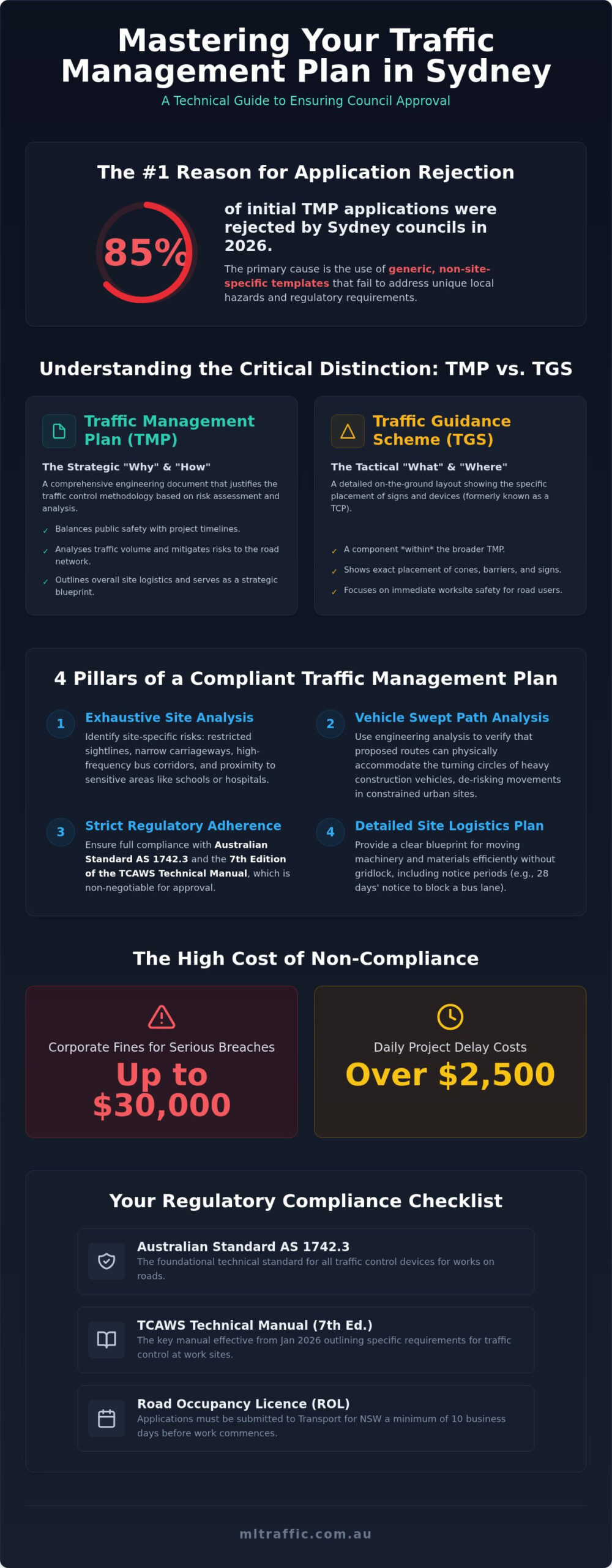
Did you know that in 2026, approximately 85% of initial traffic management plan application rejections by Sydney councils were caused by the use of generic, non-site-specific templates? Securing approval for your traffic management plan Sydney requires more than just a basic layout; it demands a rigorous engineering approach that satisfies both Transport for NSW and local government requirements. You’ve likely experienced the frustration of project delays caused by non-compliant reports or the technical complexity of interpreting Australian Standards AS 1742.3 and AS 2890 in restricted urban environments.
This guide provides the technical roadmap you need to master these engineering standards and ensure your submissions are approved without the need for multiple revisions. We’ll clarify the essential distinctions between a Traffic Guidance Scheme (TGS) and a comprehensive Traffic Management Plan (TMP), while addressing the complexities of vehicle swept path analysis and site logistics. By understanding the latest 2026 regulatory shifts and the 7th Edition of the TCAWS Technical Manual, you can maintain project timelines and avoid the substantial fines associated with non-compliance.
Key Takeaways
- Distinguish between a strategic Traffic Management Plan (TMP) and a tactical Traffic Guidance Scheme (TGS) to satisfy specific regulatory expectations.
- Master the technical requirements and hazard identification protocols necessary to secure a compliant traffic management plan Sydney for 2026 submissions.
- Recognise the role of Vehicle Swept Path Analysis in de-risking complex construction vehicle movements within constrained urban sites.
- Streamline your council approval timeline by aligning technical reports with the latest TCAWS Technical Manual and Australian Standards.
- Leverage the value of direct senior principal involvement to ensure technical accountability and personnel continuity throughout the development lifecycle.
Understanding Traffic Management Plans (TMP) in Australian Development
A Traffic Management Plan (TMP) is a comprehensive strategic document designed to manage the movement of vehicles, cyclists, and pedestrians around a construction site or development. It’s not a mere drawing of cones and signs. Instead, it applies traffic engineering principles to assess and mitigate risks to the existing road network. For any developer, a compliant traffic management plan Sydney is a prerequisite for site safety and operational efficiency. It ensures that construction activities don’t compromise the flow of Sydney’s 2.5 million daily vehicle trips.
A TMP is essential because it balances public safety with project timelines. Delays in council approvals often stem from reports that fail to account for specific local hazards. For example, blocking a bus lane in Sydney requires 28 days’ notice and specific mitigation strategies within the TMP. Without this level of detail, your project risks significant financial penalties. Corporate fines for serious safety breaches can exceed $30,000, and daily delay costs often surpass $2,500.
To better understand how these plans are implemented on the ground, watch this helpful video showing the daily operations of traffic control in Australia:
The role of a TMP extends beyond simple compliance. It serves as a blueprint for project logistics, ensuring heavy machinery and materials reach the site without causing gridlock. While construction TMPs focus on temporary disruptions during the build phase, permanent traffic arrangements address the long-term impact of a completed development on local intersections and parking demand.
Project logistics also include the responsible management of site waste; for professional disposal of industrial rubber, you can discover Tired Tyres to assist with your collection needs.
The Legal and Regulatory Framework
Regulatory bodies like Transport for NSW (TfNSW) and local councils enforce strict adherence to national standards. All traffic management plans must comply with Australian Standard AS 1742.3 and the 7th Edition of the TCAWS Technical Manual, published in January 2026. Failure to meet these technical requirements often leads to immediate DA rejection. In 2026, data showed that 85% of initial application rejections by Sydney councils resulted from using generic, non-site-specific templates. Furthermore, any Road Occupancy Licence (ROL) application must be submitted at least 10 business days before work commences to avoid scheduling conflicts.
TMP vs. TGS: Clarifying the Terminology
Industry terminology has shifted. A Traffic Guidance Scheme (TGS), formerly known as a Traffic Control Plan (TCP), is a tactical layout showing the specific placement of signs and devices. The TMP is the broader strategic document that explains the “why” and “how” of the chosen traffic control measures. While the TGS shows where the cones go, the TMP justifies the methodology based on traffic volume and safety analysis. You can find more detail on these requirements in The Ultimate Guide to Traffic Management Plans for Australian Developers. Understanding this distinction is critical for successful council submissions and efficient site logistics.
Key Technical Components of a Compliant Traffic Management Plan
A compliant traffic management plan Sydney requires an exhaustive site analysis that goes beyond identifying nearby intersections. It must account for the specific geometry of the local road network, existing traffic volumes, and the presence of sensitive land uses like schools or hospitals. Engineers must identify potential hazards such as restricted sightlines, narrow carriageways, and high-frequency bus corridors. Failing to address these site-specific variables is the primary reason councils reject generic submissions.
Route planning for heavy vehicles is a critical technical component. It isn’t enough to suggest a path; the plan must verify that the proposed route can physically accommodate the turning circles of the specific plant being used. This often involves detailed Vehicle Swept Path Analysis to prevent property damage or intersection blockages. Engineers must also ensure that routes avoid weight-restricted bridges or residential streets where heavy vehicle access is prohibited by local ordinances.
Pedestrian and cyclist management is increasingly scrutinised by Sydney councils. In 2026, authorities increased site inspections by 35%, focusing on dedicated safety measures for vulnerable road users. Your plan must include accessible detours that meet disability standards, ensuring that footpath closures don’t isolate community members or create unsafe crossing points. Emergency vehicle access must also remain unhindered at all times, with contingency plans outlining clear procedures for equipment failure or unexpected road closures.
Vehicle Movement Plans and Site Logistics
Designing efficient entry and exit points is fundamental to site logistics. A Vehicle Movement Plan (VMP) must detail how construction traffic enters the flow of existing vehicles without causing significant queuing. Managing “Works Zones” requires precise timing, especially during peak periods where kerbside space is at a premium. Compliance with AS 2890.2 ensures that off-street loading facilities are functional and don’t force vehicles to reverse onto high-speed roads. Minimising the impact on local resident parking is often a condition of consent, requiring engineers to balance project needs with community access.
Risk Assessment and Mitigation Strategies
Every TMP must feature a robust risk assessment that identifies high-risk conflict points. These are typically areas where heavy machinery interacts with the public. Mitigation strategies might include temporary traffic signals, specific signage as per AS 1742.3, or the use of accredited traffic controllers holding a “Prepare Work Zone Traffic Management Plan” (PWZTMP) qualification. Safety isn’t just about signs; it’s about reducing the risk profile through engineered solutions that prioritise the most vulnerable road users first.
Ensuring that site personnel have access to quality vocational education through providers like Apeiro Institute is vital for maintaining these high safety standards across the industry.
Engineering vs. General Traffic Control: Why Technical Analysis Matters
Engineering a solution requires technical validation that goes beyond simple visual representation. At ML Traffic Engineers Australia, we ensure every professional traffic management plan Sydney is grounded in data, ensuring all access points meet the stringent requirements of AS 2890.1 for residential parking or AS 2890.2 for commercial loading areas. While a general traffic controller might focus on where to place a sign, an engineer calculates the specific road capacity and identifies potential bottlenecks before they become operational failures. This process involves a rigorous assessment of existing infrastructure to determine if it can handle the increased load of construction vehicles or the eventual residents of a completed development.
Professional intersection analysis also plays a vital role in project feasibility. It provides the technical justification needed to convince transport authorities that your project won’t compromise the safety or efficiency of the surrounding network. Relying on a general traffic control provider for these assessments often results in plans that lack the necessary engineering depth, leading to delays during the council review process. By integrating these technical components early, developers can de-risk their site logistics and ensure a more predictable approval timeline.
The Power of Swept Path Analysis
Complex vehicle manoeuvres within restricted urban environments require precision simulations. We use specialised software like AutoTURN to model vehicle movements, ensuring that trucks can safely navigate tight corners and loading docks without striking kerbs or infrastructure. This simulation is essential for verifying that all vehicles can enter and exit the site in a forward direction. Detailed swept path analysis prevents property damage and ensures that large construction plant can operate within the site’s physical constraints. You can view our full range of technical capabilities and engineering solutions on our services page.
Traffic Impact Assessments (TIA)
A Traffic Impact Assessment (TIA) report is a strategic document that analyses the long-term effects of a development on local traffic flow. It quantifies trip generation based on the specific land use and models how these trips will distribute across nearby intersections. This report is a critical part of the Statement of Environmental Effects (SEE). It demonstrates to planners that the development is sustainable and that any increased traffic can be managed through engineered mitigation strategies or infrastructure upgrades. By providing a data-driven forecast of traffic patterns, a TIA supports a smoother approval process for a traffic management plan Sydney within complex developments.
Navigating the Approval Process for Traffic Management
Submitting a traffic management plan Sydney requires a structured approach to satisfy both local government and state transport authorities. The approval timeline for a TGS from a local Sydney council typically takes 10 to 20 business days. This period often extends if the initial submission lacks the technical rigour required by council engineers. Data from 2026 indicates that 85% of initial application rejections were due to the use of generic templates. Engaging with planners early in the development lifecycle allows for the identification of potential bottlenecks before they result in formal objections.
The standard approval lifecycle generally follows these steps:
- Initial site assessment and identification of local traffic hazards.
- Technical engineering analysis, including Swept Path and Traffic Impact Assessments.
- Drafting of site-specific TMP and TGS documents in compliance with AS 1742.3.
- Pre-DA consultation with council engineers to address local constraints.
- Formal submission and review by the Local Traffic Committee.
Addressing council objections regarding traffic density requires data-driven evidence. Planners often raise concerns about the cumulative impact of construction movements on local road networks. Professional engineers counter these objections by presenting detailed intersection analysis and trip generation modelling. This technical justification is necessary to prove that the proposed vehicle movements won’t exceed the capacity of the existing infrastructure. Providing this level of detail ensures that the project remains feasible while maintaining the safety and efficiency of the surrounding environment.
Liaising with Local Government Areas (LGAs)
Sydney’s dual-regulatory framework means developers must navigate requirements from over 30 local councils and Transport for NSW. Each LGA has specific nuances regarding work hours, noise restrictions, and site access. The Local Traffic Committee (LTC) plays a central role in the approval lifecycle, especially for projects affecting major thoroughfares or those requiring significant changes to traffic flow. Preparing for pre-DA meetings with council engineers is essential. Presenting a clear, site-specific plan at this stage reduces the likelihood of future revisions. It shows that you’ve considered the unique constraints of the local area, such as high-density pedestrian zones or proximity to public transport hubs.
Permits and Road Occupancy Licences (ROL)
An ROL is mandatory for any activity that requires partial or full road closures. Applications must be submitted at least 10 business days before work commences. For projects blocking a bus lane, a minimum of 28 days’ prior notice is required. Managing the application process for temporary “Works Zones” involves coordinating with council to secure dedicated kerbside space for loading and unloading. A single rejected ROL can cost a project over $5,000 in lost crew hours and rescheduled plant hire. Ensuring all permits are secured before construction starts is a fundamental requirement for project continuity.
If you require assistance with your council submission, you can contact our senior principals directly for expert guidance.
Professional Engineering Solutions for Complex Site Traffic
Engaging a specialised consultancy is the most effective method to ensure technical accountability for your project. At ML Traffic Engineers Australia, we operate on a model of direct access, where senior principals perform the technical work rather than delegating to junior staff. This personnel continuity promise means the expert who initiates the project is the same one performing the analysis and signing off on the documentation. For developers, this translates to a traffic management plan Sydney that is technically robust and prepared for immediate scrutiny by transport authorities.
We provide engineered solutions across an exhaustive list of project environments, including residential, commercial, and industrial developments. Our approach focuses on resolving complex site logistics before they impact your construction schedule. By leveraging multi-decade professional longevity, ML Traffic Engineers Australia provides a level of reliability that generic traffic control firms cannot match. This results-oriented philosophy ensures a seamless transition from the initial site assessment through to final council approval.
Why Senior Expertise Matters
Meticulous adherence to Australian Standards is the cornerstone of a successful submission. Senior principals at ML Traffic Engineers Australia apply deep-seated expertise to every assessment, ensuring that conflict points are mitigated through engineered design rather than simple signage. This seasoned perspective is particularly valuable in challenging urban environments where standard templates fail to account for unique site geometry or high-frequency public transport movements. By involving senior leadership in every project, we significantly lower the risk profile of your development applications.
Contacting a Traffic Engineering Expert
Securing a tailored quote for your project begins with a review of your specific site constraints and development goals. During the initial consultation, we identify the exact range of reports required, whether you need a Driveway Ramp Grade Assessment or a full Traffic Impact Assessment. Providing your site plans early allows our senior engineers to identify potential regulatory hurdles and develop a strategic path forward. To discuss your project requirements directly with our leadership team, you can Contact ML Traffic Engineers Australia today.
Secure Your Council Approval with Technical Precision
Achieving a compliant traffic management plan Sydney requires a shift from generic layouts to rigorous engineering analysis. The 2026 regulatory environment demands strict adherence to AS 1742.3 and AS 2890 standards to avoid the high rejection rates currently seen in local council submissions. By prioritising site-specific data and technical validation, such as Vehicle Swept Path Analysis, you ensure that your development remains safe, efficient, and logistically sound throughout its lifecycle.
ML Traffic Engineers provides over 15 years of specialist consultancy experience. We guarantee that senior principals remain directly involved in every project, providing the technical accountability and personnel continuity needed for complex urban developments. This hands-on approach removes unnecessary bureaucracy and ensures your reports meet the highest professional benchmarks. We’re ready to help you navigate the complexities of transport authority requirements and secure the approvals your project needs to move forward without delay.
Speak with a Senior Traffic Engineer about your project today and take the first step toward a seamless approval process.
Frequently Asked Questions
What is the difference between a Traffic Management Plan and a Traffic Guidance Scheme?
A Traffic Management Plan (TMP) is a comprehensive strategic document defining the “why” and “how” of traffic control. A Traffic Guidance Scheme (TGS) is the tactical layout showing exactly where signs and barriers are placed. The TMP addresses the broader impact on the local road network and community, while the TGS provides the specific diagram required by traffic controllers for daily site setup.
When is a construction traffic management plan required for a development?
A construction traffic management plan is typically required as a formal condition of development consent for most medium to high-impact projects. Local councils and Transport for NSW mandate these reports whenever construction activities, vehicle movements, or site deliveries affect the safety and efficiency of the public road network. It’s an essential requirement for securing a Construction Certificate (CC) in urban environments.
How long does it typically take to get council approval for a traffic plan?
Approval for a standard traffic guidance scheme from a local Sydney council typically takes between 10 and 20 business days. Complex traffic management plans for major developments may require additional time for review by the Local Traffic Committee or state authorities. Submitting a technically compliant traffic management plan Sydney on the first attempt is the most effective way to avoid the delays associated with requested revisions.
Does my traffic management plan need to be signed off by a qualified engineer?
Yes, any individual designing a traffic management plan in New South Wales must hold a current “Prepare Work Zone Traffic Management Plan” (PWZTMP) qualification. For complex sites, councils often require the technical sign-off of a qualified traffic engineer to verify that the proposed designs meet Australian Standards. Experienced industry professionals can use Right Pathway to convert their existing work experience into these necessary Australian qualifications. This ensures that the professional accountability for the safety and engineering rigour of the plan is clearly established.
What Australian Standards govern traffic management for construction sites?
The primary standard governing traffic control devices for works on roads is AS 1742.3. Additionally, AS 2890.1 and AS 2890.2 provide the technical requirements for off-street parking and commercial vehicle facilities. All plans must also comply with the 7th Edition of the TCAWS Technical Manual, which was updated by Transport for NSW in January 2026 to reflect current safety protocols and engineering best practices.
Can a traffic management plan help reduce the costs of my development?
A well-engineered plan reduces development costs by preventing expensive project delays and council rejections. In 2026, daily delay costs for major projects can exceed $2,500, while fines for minor signage non-compliance start at $2,200. Efficient site logistics and vehicle access strategies within the plan also lower operational costs by streamlining material deliveries and reducing plant hire idle time.
What happens if my traffic management plan is rejected by the council?
If a council rejects your submission, you’ll receive a request for further information or a list of required technical revisions. This process triggers significant delays, as the resubmission must undergo the full review cycle again. Rejections in Sydney are frequently caused by using generic templates that fail to address site-specific hazards or the technical requirements of the local road network.
How often does a traffic management plan need to be updated during a project?
Your traffic management plan Sydney must be updated whenever there’s a significant change in construction phases or site conditions. As a project moves from excavation to structural work, the volume and type of vehicle movements often shift, requiring new risk assessments and updated traffic guidance schemes. Regular audits ensure the plan remains compliant with the evolving needs of the site and the safety of the public.

Disclaimer
The content on www.mltraffic.com.au, including all technical articles, guides, and resources, is provided for general informational and educational purposes only. It is not intended to constitute professional advice in traffic engineering, transportation planning, development approvals, or any other technical or legal field.
While ML Traffic Engineers makes every reasonable effort to ensure the accuracy, completeness, and timeliness of the information published, we do not provide any warranties or representations (express or implied) regarding its reliability, suitability, or availability for any particular purpose. Any reliance you place on the content is strictly at your own risk.
In no event shall ML Traffic Engineers, its directors, employees, authors, or affiliates be liable for any direct, indirect, incidental, special, consequential, or punitive damages (including, without limitation, loss of profits, data, or business opportunities) arising out of or in connection with the use of, or inability to use, any information provided on this website.
The articles and guides on this site are not a substitute for engaging a qualified, registered professional traffic engineer (such as an NPER or RPEQ engineer) to assess your specific project requirements. For tailored advice, compliance assessments, or traffic engineering services, please contact a competent professional.
This disclaimer may be updated from time to time without notice. By accessing or using this website, you agree to be bound by the most current version of this disclaimer.
