

Project delays, council rejections, and a confusing alphabet soup of acronyms—TMP, TGS, TCP. For any Australian project that impacts public roads or footpaths, these are significant risks that can derail timelines and inflate budgets. A compliant and professionally prepared traffic management plan is not just a regulatory hurdle; it is the cornerstone of a safe, efficient, and approval-ready project.
This definitive guide removes the ambiguity. We will detail every critical component of a TMP, clarify when one is legally required for your works, and provide the expert insights needed to navigate the approval process with road authorities. Our objective is to equip you with the knowledge to ensure worker and public safety, minimise disruptions, and secure project approvals without costly, avoidable delays. Understand what is required from the start to keep your project moving forward.
What is a Traffic Management Plan (TMP) and Why is it Essential?
A Traffic Management Plan (TMP) is a strategic, technical document outlining how road users—including vehicles, cyclists, and pedestrians—will be safely managed around a work site, event, or any activity that disrupts normal traffic conditions. Its core purpose is to detail the implementation of temporary traffic control measures, ensuring the principles of Road traffic control are professionally applied to a specific site. A compliant TMP is non-negotiable for projects ranging from major civil construction and infrastructure works to smaller-scale developments and public events.
This video provides a practical overview of traffic management implementation on site:
Operating without a compliant traffic management plan is a significant risk. The consequences extend beyond project delays and include substantial fines from regulatory bodies, immediate work stoppages ordered by authorities, and severe legal liability in the event of an accident or injury. A professionally prepared TMP is not merely a procedural document; it is a critical component of site safety and risk management.
The Primary Objectives of a TMP
A comprehensive TMP is designed to achieve several critical safety and operational outcomes. The primary objectives are to:
- Protect vulnerable road users, such as pedestrians, cyclists, and mobility scooter users, by providing safe, alternative routes.
- Ensure the safety of all on-site personnel and workers from live traffic and construction vehicle movements.
- Maintain a reasonable and efficient flow of traffic for the general public, minimising delays and network disruption.
- Guarantee compliance with all relevant state and local authority regulations, including state-specific codes of practice (e.g., TfNSW in New South Wales).
When is a Traffic Management Plan Legally Required?
In Australia, a TMP is a legal and contractual requirement in numerous situations. It is mandatory for any project or activity that involves:
- Any work that alters normal road, footpath, or cycleway conditions for any duration.
- Fulfilling a specific condition of a Development Application (DA) approval from a local council.
- The application for a Road Occupancy Licence (ROL) or similar permit from the relevant road authority.
- Projects of significant scale, complexity, or duration that have a measurable impact on the surrounding road network.
Key Components of a Comprehensive Traffic Management Plan
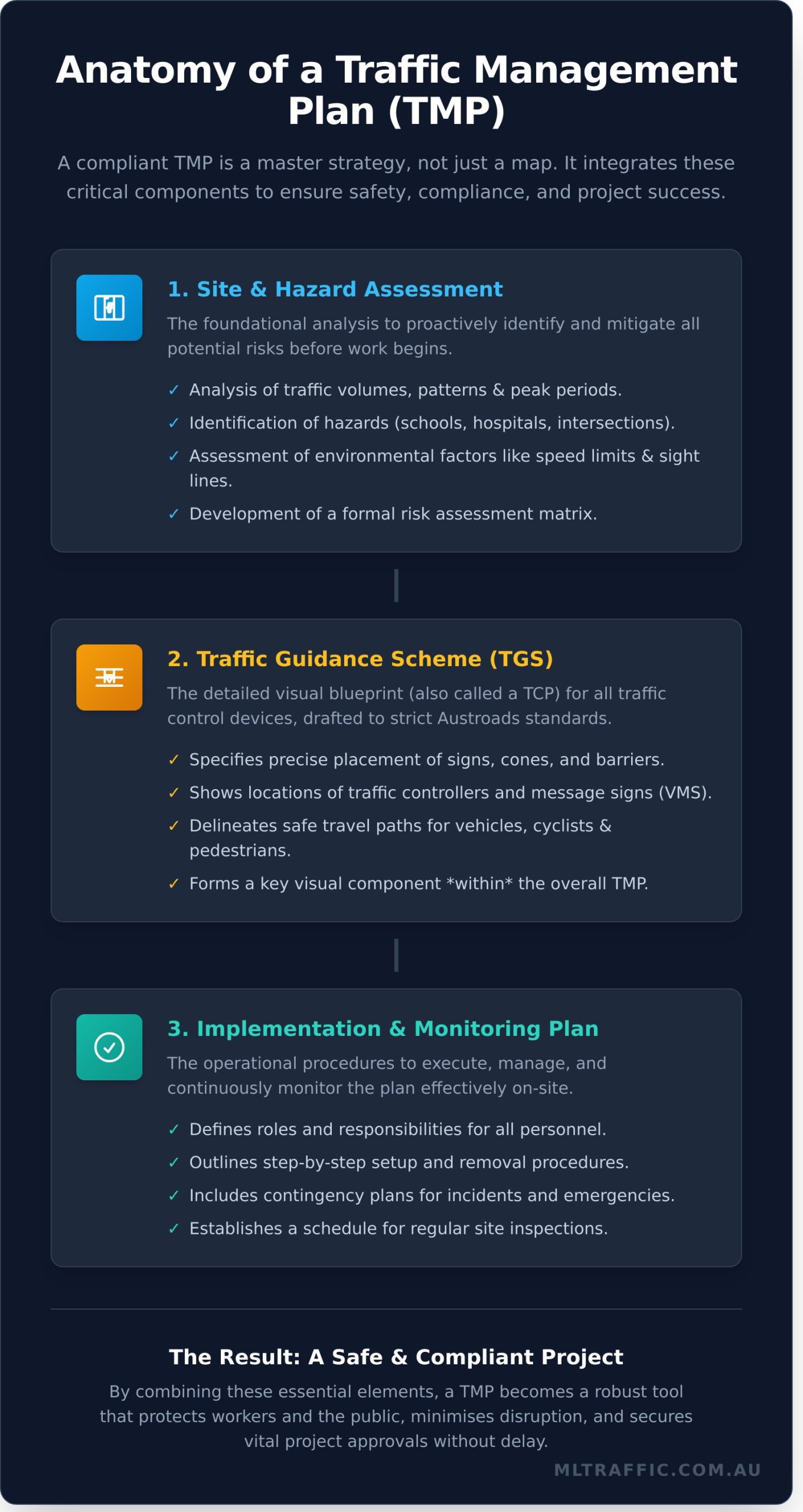
A compliant Traffic Management Plan (TMP) is a detailed strategic document, not merely a map. To gain approval from road authorities, it must be a site-specific plan that systematically identifies and mitigates all potential risks to workers and the public. A robust TMP integrates several critical components, each serving a distinct function but working together to create a comprehensive safety and traffic flow system for the duration of a project.
The following sections are essential for any formal traffic management plan and are required to meet Australian standards and regulations.
Site & Hazard Assessment
This is the foundational analysis upon which the entire plan is built. It involves a meticulous evaluation of the project site and its surrounding environment. The objective is to understand existing conditions and proactively identify risks before work commences. Key elements include:
- A detailed analysis of existing traffic volumes, patterns, and peak periods.
- Identification of potential hazards such as nearby schools, hospitals, high-volume intersections, and public transport stops.
- An assessment of environmental factors, including existing speed limits, driver sight lines, and road geometry.
- Development of a risk assessment matrix to classify identified hazards and define control measures.
Traffic Guidance Scheme (TGS)
Often referred to as a Traffic Control Plan (TCP), the TGS is the visual component of the TMP. It consists of a series of detailed diagrams illustrating the precise layout of all temporary traffic control devices. These diagrams must be drafted by a qualified professional in strict accordance with the standards set out in the Austroads Guide to Temporary Traffic Management (AGTTM). The TGS specifies the exact placement of signs, cones, and barriers, as well as the location of traffic controllers and Variable Message Signs (VMS). It clearly delineates safe travel paths for vehicles, cyclists, and pedestrians through or around the work site.
Implementation & Monitoring Plan
This section details the operational procedures required to execute the TMP safely and effectively. It moves from planning to on-the-ground action, ensuring every person understands their role. It must outline:
- The specific roles and responsibilities of all personnel, from the project manager to traffic controllers.
- Step-by-step procedures for the setup, modification, and removal of traffic control devices.
- Contingency plans for managing incidents, site emergencies, or adverse weather conditions.
- A defined schedule for regular site inspections to ensure ongoing compliance and effectiveness of the plan.
TMP vs. TGS vs. VMP: Clarifying Critical Traffic Acronyms
In Australian traffic engineering, the acronyms TMP, TGS, and VMP are fundamental to project execution. While often used interchangeably in conversation, they represent distinct, hierarchical documents with specific functions. Misunderstanding their roles can lead to compliance issues, project delays, and safety failures. A clear understanding of this hierarchy is essential for effective planning and execution.
The relationship is simple: the TGS and VMP are detailed components that sit within the comprehensive framework of the main traffic management plan.
Traffic Management Plan (TMP): The Master Strategy
A Traffic Management Plan (TMP) is the overarching strategic document for a project. It is a detailed written report that outlines the ‘why’ and ‘how’ of managing all traffic-related impacts. It goes beyond simple diagrams to provide a complete risk management framework. A TMP is a formal requirement for gaining approvals from road authorities and councils.
- Risk Assessments: Identifies all potential hazards to road users, pedestrians, and workers.
- Procedures: Details implementation, monitoring, and emergency response protocols.
- Responsibilities: Clearly defines the roles of all personnel involved in traffic management.
- Compliance: Ensures all activities align with relevant legislation and Australian Standards.
Traffic Guidance Scheme (TGS): The Visual Plan
The Traffic Guidance Scheme (TGS), also known as a Traffic Control Plan (TCP), is the detailed visual component of the TMP. It consists of technical drawings that illustrate the precise layout of a worksite and its interaction with public traffic. The TGS is the practical blueprint used by traffic controllers on the ground. It specifies the exact ‘what’ and ‘where’ of all traffic control devices, including the placement of signs, cones, barriers, and personnel.
Vehicle Movement Plan (VMP): On-Site Logistics
A Vehicle Movement Plan (VMP) focuses specifically on the logistics of construction vehicles within the worksite boundary. While a TGS manages the interface with public roads, a VMP manages internal traffic to ensure site safety and efficiency. It is a critical document for preventing on-site collisions, managing delivery schedules, and minimising disruption. Key elements include designated entry/exit points, internal haul roads, loading/unloading zones, and parking areas for machinery and site vehicles.
The 5-Step Process for Developing a Compliant TMP
Developing a successful Traffic Management Plan (TMP) is a systematic, multi-stage process that demands precision and expertise. It requires close collaboration between project managers and qualified traffic engineering consultants to ensure all regulatory requirements are met. Following a clear, logical process is the most effective way to minimise the risk of rejection by road authorities and prevent costly project delays. Each step builds upon the last to create a robust and compliant safety framework.
Step 1: Initial Consultation & Site Assessment
This foundational stage involves defining the exact scope of the project and all associated work activities. A thorough on-site assessment is conducted to analyse existing conditions, including road geometry, sight lines, and environmental factors. This involves gathering critical data on traffic volumes, vehicle speeds, and pedestrian and cyclist activity to inform every subsequent decision in the planning process.
Step 2: Risk Assessment & Strategy Development
With a clear understanding of the site, a formal risk assessment is conducted to identify all potential hazards to road workers, vehicle occupants, and the public. Based on this assessment, specific control measures are developed to eliminate or minimise these risks in line with safety-in-design principles. This analysis directly informs the selection of the most appropriate and effective traffic management strategy for the project’s unique requirements.
Step 3: Design of the TGS and VMP
This technical phase involves creating detailed diagrams for the Traffic Guidance Scheme (TGS) and, where required, a Vehicle Movement Plan (VMP). Using specialised design software, we produce clear, compliant plans that strictly adhere to Australian Standards, particularly AS 1742.3. These plans specify the precise location of all required resources, including:
- Regulatory and warning signage
- Barriers, cones, and bollards
- Variable Message Signs (VMS)
- Accredited traffic control personnel
Step 4: Plan Documentation & Submission
All preceding components—the site assessment, risk analysis, control measures, and design diagrams—are compiled into a single, professional document. This comprehensive traffic management plan provides a complete record of the safety and operational strategy. The finalised document is then prepared and submitted to the relevant road authority, such as the state’s Department of Transport or the local council, for formal review and approval.
Step 5: Implementation & Monitoring
An approved plan must be correctly implemented on-site by trained personnel. This includes pre-start briefings to ensure all workers understand the TGS and their roles. Throughout the project, the TMP’s effectiveness must be continuously monitored. Conditions can change, and the plan may require adjustments to maintain safety and efficiency. Regular reviews ensure the plan remains compliant for the duration of the works.
Navigating this detailed process requires specialised expertise to ensure compliance and avoid project setbacks. Let our experts handle the entire TMP process for you.
Common TMP Mistakes and How to Avoid Them
A flawed or incomplete Traffic Management Plan (TMP) is more than a documentation error; it is a direct cause of significant project delays, budget overruns, and critical safety risks. Road authorities will not hesitate to halt work due to non-compliance, leading to costly stand-down periods. Fortunately, the most common errors are entirely avoidable with professional oversight and a proactive approach to planning.
Understanding these pitfalls is essential for project managers and developers. It provides the necessary knowledge to assess the competency of a traffic consultant and ensure the plan submitted is robust, compliant, and genuinely protects the public and on-site personnel.
Using Generic, Non-Site-Specific Templates
One of the most frequent reasons for rejection is the use of a generic, ‘copy-paste’ template. Every project location has unique characteristics that a template cannot account for, such as:
- Proximity to schools, hospitals, or high-pedestrian areas.
- Complex intersections or nearby public transport stops.
- High-volume commercial or residential driveways.
- Unique topography or limited sight lines.
A site-specific assessment is not optional; it is a fundamental requirement for a compliant traffic management plan that provides real-world safety solutions.
Ignoring Pedestrian and Cyclist Needs
Failing to adequately provide for vulnerable road users, including pedestrians and cyclists, is a major compliance failure. A TMP must detail safe, accessible, and clearly signed alternative routes for non-motorists. This includes ensuring continuous accessible paths of travel for people with disabilities. Simply closing a footpath without providing a protected alternative is unacceptable and will result in immediate rejection by authorities.
Poor Communication and Implementation
A technically perfect plan is useless if it is not correctly implemented or understood by the on-site team. The plan must be communicated effectively through pre-start briefings (toolbox talks). Furthermore, the personnel responsible for setting up and managing traffic control devices must hold current, state-specific accreditation. An expertly designed plan fails the moment it is implemented by an unqualified individual, exposing the project to immense liability.
Ultimately, proactive planning is the best defence against these costly mistakes. Engaging an experienced traffic engineering consultant at the earliest stage ensures that all site-specific risks are identified and mitigated, resulting in a compliant plan that supports a safe and efficient project timeline.
Finalising Your Path to a Compliant Traffic Management Plan
A Traffic Management Plan is not merely a document; it is a critical framework for ensuring site safety, maintaining traffic flow, and achieving regulatory compliance for any Australian project. Understanding its key components and following a structured development process are non-negotiable steps to avoid costly delays and common pitfalls. Executing this correctly from the outset is fundamental to your project’s success.
For a seamless approval process, leverage our professional experience. ML Traffic Engineers offers over 15 years of specialised expertise and a proven track record with thousands of successful DA approvals across Australia. Every project we undertake receives direct access to our senior engineers, ensuring meticulous attention and accountability. To ensure your traffic management plan is robust and compliant, partner with a team dedicated to precision and results.
Contact our expert traffic engineers for a compliant Traffic Management Plan.
Secure your project’s compliance and move forward with confidence.
Frequently Asked Questions About Traffic Management Plans
Who is qualified to design a Traffic Management Plan in Australia?
In Australia, a Traffic Management Plan must be designed by a person holding the relevant state-based accreditation. For example, in New South Wales, this requires a Transport for NSW (TfNSW) ‘Prepare a Work Zone Traffic Management Plan’ qualification. Similarly, Queensland requires a TMR-accredited Traffic Management Designer. Engaging an experienced and appropriately certified traffic engineering consultant is non-negotiable to ensure the plan is compliant, safe, and effective, preventing project delays and liability issues.
How much does a professional Traffic Management Plan cost?
The cost for a professional Traffic Management Plan in Australia varies based on project complexity. A simple plan for a local road might start from A$500 – A$1,000. For more complex projects involving arterial roads, multiple stages, or significant pedestrian interaction, costs can range from A$2,000 to A$5,000 or more. Factors influencing the final price include the level of detail required by the road authority, the need for site visits, and the number of Traffic Guidance Schemes required.
How long does it take to get a TMP approved by the council or road authority?
Approval times for a TMP depend entirely on the reviewing authority, such as the local council or state road authority (e.g., Main Roads WA, VicRoads). A standard plan for a minor project may be approved in 5 to 10 business days. However, for complex works on major roads or projects requiring a Road Occupancy Licence (ROL), the process can take anywhere from 4 to 8 weeks or longer. Submitting a high-quality, compliant plan from the outset is critical to avoiding delays.
What is the difference between a Traffic Management Plan and a Traffic Impact Assessment?
A Traffic Management Plan (TMP) is an operational document detailing how to manage traffic safely around a temporary work site or event. It includes Traffic Guidance Schemes (TGS) showing signs and devices. In contrast, a Traffic Impact Assessment (TIA) is a strategic report prepared for a development application. It assesses the long-term impact of a new development on the surrounding road network, analysing traffic generation, parking demand, and intersection performance post-construction.
Can I modify an approved Traffic Management Plan if site conditions change?
An approved Traffic Management Plan cannot be modified on-site without a formal amendment process. If site conditions change unexpectedly, the original plan may become invalid. Any required changes must be documented by a qualified designer, and the amended plan must be resubmitted to the relevant road authority for review and approval. Unauthorised modifications compromise safety and compliance, exposing the project to significant penalties and immediate work stoppages. This ensures ongoing safety and legal adherence.
What Australian Standards apply to Traffic Management Plans?
The primary Australian Standard governing traffic control for works on roads is AS 1742.3:2019. This standard provides detailed requirements for the signs, devices, and procedures used in Traffic Guidance Schemes. Additionally, designers must adhere to the Austroads Guide to Temporary Traffic Management (AGTTM) and any state-specific codes of practice, such as the Traffic Control at Worksites Manual (NSW) or the Road Management Act 2004 Code of Practice (VIC), to ensure full compliance.