

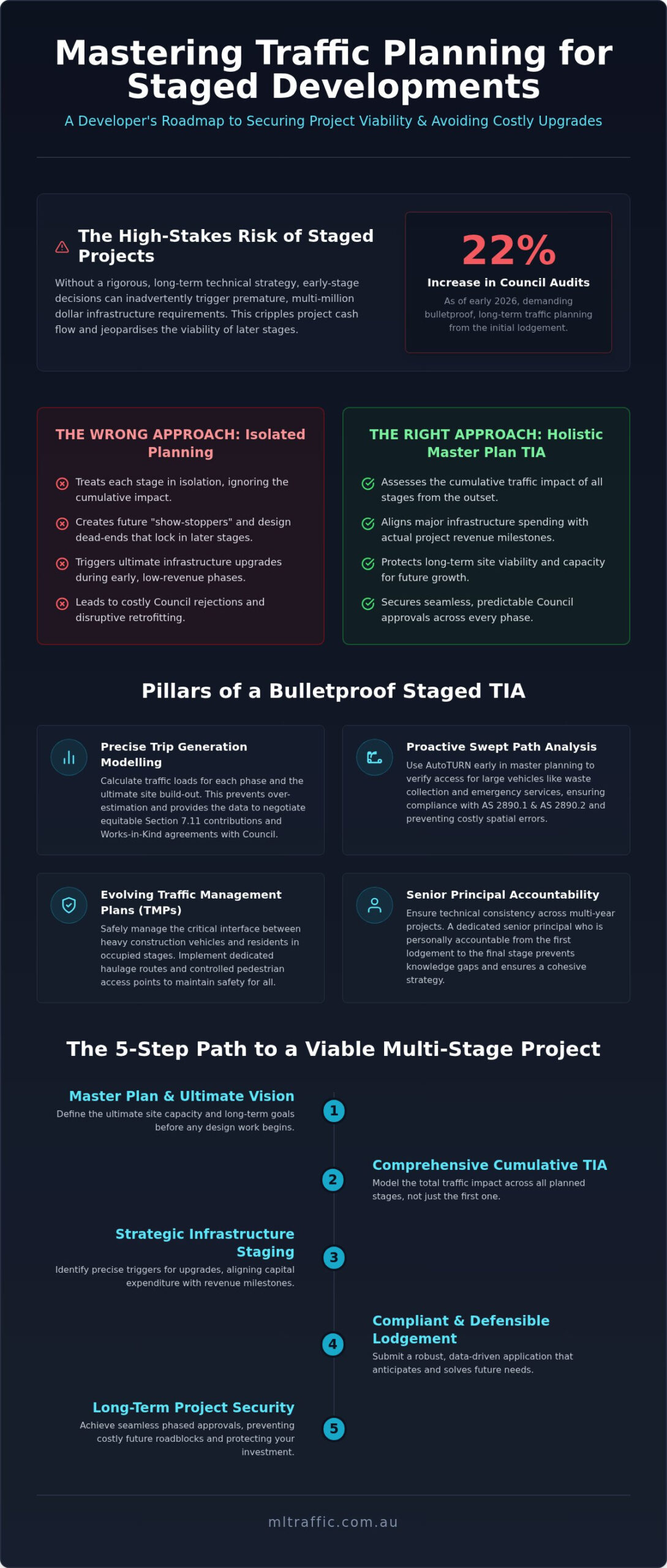
Designing a high-yield development in stages is often viewed as a strategic way to manage cash flow, yet without a rigorous technical strategy, the cumulative traffic impact can trigger million-dollar infrastructure upgrades years before your project revenue can support them. Local councils across Australia have increased audit rates by 22% as of early 2026, meaning your long-term traffic planning for staged developments must be bulletproof from the initial lodgement. A single oversight in how Stage 1 interacts with the ultimate site capacity can lead to costly Council rejections or locked-in designs that stifle future growth.
It’s frustrating to face expensive infrastructure requirements that are triggered too early in the project lifecycle, especially when you are also managing the logistics of construction vehicle access while residents have already moved into earlier stages. This guide provides the professional roadmap needed to master multi-stage Traffic Impact Assessments and ensure seamless compliance with AS 2890.1 and AS 2890.2 across every phase. You will learn how to optimise your infrastructure spend to align with project milestones and secure the long-term viability of your site. We will examine the nuances of swept path analysis for complex layouts and the precise documentation required for staged Council approvals.
Key Takeaways
- Understand how long-term traffic planning for staged developments protects site viability by preventing premature infrastructure triggers that impact project cash flow.
- Ensure strict compliance with AS 2890.1 and AS 2890.2 standards for waste collection and emergency access during all interim construction phases.
- Use precise trip generation modelling to negotiate equitable Section 7.11 contributions and Works-in-Kind agreements with local Councils.
- Deploy AutoTURN swept path analysis early in the master planning phase to identify spatial “show-stoppers” before they become permanent, expensive errors.
- Maintain technical consistency across multi-year projects by engaging a senior principal who remains personally accountable for every stage of the development.
The Strategic Importance of Long-Term Traffic Planning for Staged Developments
Staged developments involve the delivery of large-scale residential, commercial, or industrial precincts over several years or even decades. Unlike single-phase projects, these require a highly specific engineering approach because each phase is interdependent. Decisions made during the initial Development Application (DA) for Stage 1 can inadvertently restrict the capacity of later phases. The Strategic Importance of Long-Term Traffic Planning ensures that the physical layout of the site remains viable for its ultimate intended use. Without this foresight, developers risk “locking” infrastructure. This occurs when early-stage road widths or intersection treatments are undersized for the total future traffic load, making later stages impossible to approve without expensive, disruptive retrofitting.
A comprehensive Traffic Impact Assessment (TIA) serves as the technical foundation for this process. It balances the immediate requirements of the current DA with the overarching vision of the Master Plan. Effective long-term traffic planning for staged developments identifies the exact point in the project lifecycle where external road upgrades or signalisation must occur. This allows developers to align significant capital expenditure with actual revenue milestones rather than being forced into early-stage over-investment that strains project feasibility.
Cumulative Impact vs. Stage-Specific Assessments
Local Councils typically assess a development based on its ultimate traffic generation. You cannot justify Stage 1 in isolation if the cumulative impact of Stage 5 will eventually cause the local road network to fail. Planners require data proving that interim traffic arrangements are safe and functional while the site is only partially occupied. We use sophisticated trip generation modelling to calculate these loads for each specific phase. This ensures that the infrastructure delivery schedule is both compliant and commercially realistic, preventing Council from demanding ultimate-stage upgrades during the first phase of construction.
Managing Construction Traffic Alongside Occupied Phases
A significant operational challenge in staged projects is the co-existence of residents and heavy construction vehicles. Once Stage 1 is occupied, the site ceases to be a vacant construction zone. It becomes a live environment. A robust Traffic Management Plan (TMP) must evolve with each stage to maintain this separation. Safety considerations include dedicated heavy vehicle haulage routes that avoid residential street frontages and controlled pedestrian crossing points for residents in partially completed areas. We also conduct specific sight distance assessments at temporary construction gates to ensure compliance with national safety standards while residents are moving through the precinct.
Developing a Robust Traffic Impact Assessment (TIA) for Master Planning
A TIA for a master-planned precinct is much more than a regulatory hurdle. It acts as the technical roadmap for long-term traffic planning for staged developments. We begin by establishing a baseline of the existing road network performance. This process involves collecting current traffic counts and projecting future background growth based on local planning schemes and regional transport strategies. Accurate trip generation modelling for each specific phase is vital. It prevents the common error of over-estimating Stage 1 traffic, which can lead to the early triggering of expensive infrastructure upgrades before the project has the cash flow to support them.
Intersection analysis is the next critical step. We ensure that the surrounding road network can accommodate the ultimate capacity of the site. Using industry-standard software such as SIDRA, we model saturation flow rates, queue lengths, and average delays. This data is essential for Navigating Council Requirements and providing a defensible case for the development’s impact. Parking demand assessments also require a dynamic approach. Ratios often need to be adjusted as the development matures or as surrounding public transport infrastructure evolves, ensuring the site remains functional without wasting valuable land on excess hardstand.
Modelling for Ultimate Capacity
Predicting traffic flow at full site occupancy requires rigorous technical modelling. We identify specific “trigger points” where the cumulative traffic load necessitates external road widening or intersection signalisation. Ultimate capacity is defined as the maximum level of land-use intensity and traffic generation a site is designed to sustain at the final completion of all development stages. Identifying these thresholds allows for more efficient infrastructure spending aligned with project revenue. If you require technical support for your master planning, you can speak directly with our senior principals to ensure your modelling is accurate and compliant.
Interim Access and Parking Demands
Temporary access points are frequently necessary while permanent internal roads are still under construction. These designs must meet strict safety and sight distance standards to protect both residents and construction crews. Managing parking overspill is also a priority during transition periods between stages. Every interim design must ensure strict compliance with AS 2890.1 from the very first day of occupancy. This prevents residential complaints and potential Council enforcement actions that can delay subsequent approvals or result in heavy penalties for non-compliance.
Technical Compliance: Swept Paths and Australian Standards
Technical compliance in long-term traffic planning for staged developments ensures that the physical site geometry remains functional during every phase of construction. It’s not enough for the final Master Plan to comply with Australian Standards; the interim road network must also be safe and accessible. A critical tool in this process is Vehicle Swept Path Analysis. This modelling proves that waste collection trucks and emergency vehicles can safely navigate partially built roads, temporary cul-de-sacs, and interim turnarounds without hitting kerbs or parked cars.
Adhering to AS 2890.1 for off-street car parking and AS 2890.2 for commercial vehicle facilities is a non-negotiable requirement for Council approval. This technical rigour aligns with a broader Guide for Performance-Based Planning, where site objectives are met through measurable safety and efficiency standards. We future-proof driveway ramps and access points by designing for the largest anticipated vehicles that will enter the site, such as Heavy Rigid Vehicles (HRVs) for waste or articulated vehicles for commercial deliveries. If these isn’t done early, you may find that Stage 1 infrastructure physically blocks the access requirements for Stage 4.
Swept Path Analysis for Construction Phases
We use AutoTURN software to simulate how heavy construction machinery manoeuvres through narrow, staged access ways without encroaching on already occupied residential areas. This analysis identifies “pinch points” where temporary kerbs or barriers might fail compliance. By creating detailed diagrams, we prove to Council that Stage 1 remains fully functional and safe while Stage 2 is under active construction. This level of detail prevents project delays and ensures that resident safety isn’t compromised by heavy vehicle movements. It also provides the necessary evidence for a Traffic Guidance Scheme (TGS) that protects the developer from liability.
Maintaining Compliance with AS 2890.1 and AS 2890.2
Designing car parks that remain compliant as access points shift between stages requires meticulous planning. Disability parking (AS 2890.6) must be correctly located and accessible in every phase, even if the primary entry road changes. Ramp grades and sight distances are equally important. If a temporary ramp is too steep or lacks adequate visibility, it creates a significant liability risk and a potential breach of WHS legislation. We ensure that every interim design maintains the same technical integrity as the final product, protecting the developer from potential enforcement actions and ensuring a seamless transition as the site matures.
Navigating Council Requirements and Infrastructure Contributions
Securing approval for a multi-stage project requires a clear demonstration of the “nexus” between your development and the surrounding road network. Councils will not permit a project to proceed if the cumulative traffic load exceeds the capacity of existing infrastructure. Effective long-term traffic planning for staged developments includes a detailed Infrastructure Schedule. This document outlines exactly when specific road upgrades, such as new turn lanes or signalised intersections, will be delivered. By mapping these to project phases, you prevent the risk of being forced to complete ultimate-stage roadworks during the very first phase of construction, which can be a significant drain on initial capital.
Negotiating developer contributions is a technical process that relies on accurate trip generation data. Across Australia, various developer contribution frameworks exist at state and local government levels. While the specific sections and naming conventions differ by jurisdiction, these frameworks are designed to ensure new developments contribute equitably to the necessary infrastructure upgrades. Developers often prefer Works-in-Kind (WIK) agreements, where they physically construct the required road infrastructure in exchange for a credit against their monetary contribution requirements. A professional traffic engineer provides the necessary modelling to ensure these contributions are equitable and directly related to the actual impact of the site. To ensure your contribution negotiations are based on accurate data, you should contact our senior principals for a technical review of your master plan.
Negotiating Infrastructure Deeds
Strategic negotiation can often allow for the deferral of major external roadworks until higher-density stages are reached. We provide the data-backed evidence required to support Voluntary Planning Agreements (VPAs). This ensures that infrastructure demands from Council are realistic and aligned with the actual traffic growth observed on-site. By demonstrating that Stage 1 traffic will not breach current Level of Service (LoS) thresholds, we can often delay significant expenditure until the project has achieved higher revenue milestones. This approach protects project feasibility while maintaining long-term site viability.
Managing Traffic Management Plans (TMP) Across Phases
A Traffic Management Plan must be a living document that evolves as new stages are commissioned. Once residents move into earlier phases, the risk profile of the site changes. You must coordinate with local Councils and, for state-managed roads, the relevant state transport authority to manage ongoing approvals. A precise Traffic Guidance Scheme (TGS) is required for every temporary roadwork setup or construction access point. Compliance is critical; operating without an approved TGS can result in fines starting at A$2,200 per day, with corporate penalties for WHS breaches potentially exceeding $50,000. We ensure your TGS documentation is current, compliant, and designed to maintain pedestrian safety throughout a multi-year build.
Why Expert Traffic Engineering is Vital for Staged Success
A multi-year staged development is a high-stakes marathon where technical consistency is the primary safeguard against project failure. Engaging in long-term traffic planning for staged developments requires more than just a one-off report. It demands a partner who understands the technical evolution of the site from the first earthmoving works to the final resident move-in. Expert traffic engineering identifies potential “show-stoppers”, such as inadequate intersection capacity or unworkable swept paths, before they become permanent, expensive construction errors. Professional, data-backed reports streamline the DA process, reducing the frequency of Council Requests for Information (RFI) and accelerating the project timeline.
ML Traffic Engineers Australia brings over 15 years of transport planning experience to every project. Our approach is built on accountability and technical precision in long-term traffic planning for staged developments. We don’t just provide a document; we provide a strategy that protects your commercial interests. By identifying the exact infrastructure triggers and negotiating equitable contributions, we ensure your site remains viable through every market cycle. This continuity of service means the expert who designs your Stage 1 access is the same person certifying the final stage a decade later.
Direct Access to Senior Expertise
One of the most significant advantages of our consultancy is direct access to senior principals. You won’t be passed off to junior staff once the contract is signed. This “no-gatekeepers” approach ensures that the person performing the technical work fully understands the Australian regulatory landscape and the specific nuances of your site. This level of senior involvement provides a degree of reliability and meticulous detail that larger, more impersonal firms often struggle to replicate. It means your project benefits from deep-seated expertise and a hands-on philosophy from inception to completion.
Securing Your Project’s Future
Integrating traffic planning into your initial feasibility studies is the most effective way to avoid unforeseen costs. Before embarking on a staged project, consider this final checklist:
- Have you identified the ultimate traffic generation capacity for the entire site?
- Are your infrastructure triggers aligned with your revenue milestones?
- Does your interim layout maintain strict compliance with AS 2890 and WHS standards?
- Is there a clear plan for separating construction traffic from occupied residential zones?
If you are ready to secure the viability of your next project, you can contact ML Traffic Engineers Australia for a comprehensive site assessment and expert guidance on your master plan. We ensure that your technical documentation is robust enough to withstand Council scrutiny and flexible enough to support your long-term commercial goals.
Future-Proofing Your Staged Development Through Expert Traffic Strategy
Successful staged developments depend on a technical strategy that balances immediate Stage 1 requirements with the ultimate traffic capacity of the master plan. Precise trip generation modelling and swept path analysis protect your project from premature infrastructure triggers and costly retrofitting. Adherence to AS 2890 standards and the creation of evolving Traffic Management Plans ensures your site remains safe and compliant from the first occupancy to the final certification. Professional long-term traffic planning for staged developments is a commercial necessity for managing cash flow and council relations over a multi-year build.
ML Traffic Engineers offers 15+ years of Australian transport planning expertise with direct principal involvement in every project. We’re specialists in AS 2890 compliance and advanced swept path analysis who ensure your site geometry works in practice. You can discuss your staged development traffic planning with our senior engineers to identify potential show-stoppers and streamline your approval process. Our hands-on approach ensures your project remains technically sound and commercially viable through every phase of construction. We look forward to helping you deliver a successful, high-yield precinct.
Frequently Asked Questions
What is the difference between a TIA for a single-stage vs. a staged development?
A staged development TIA is a dynamic document that models traffic generation at each individual phase rather than just the final completion. It identifies specific infrastructure triggers to avoid premature capital expenditure. In contrast, a single-stage TIA treats the development as a static entity. Long-term traffic planning for staged developments ensures that the initial road design does not physically block the access requirements of future phases.
When does Council require a full Master Plan traffic study?
Councils generally require a full Master Plan traffic study during the initial rezoning or Concept DA stage for the entire precinct. This high-level assessment establishes the ultimate traffic impact and baseline road network performance. It allows planners to determine if the existing infrastructure can sustain the total project volume. Detailed TIAs are then required for each subsequent stage to confirm compliance with the overarching strategy.
Can I change my traffic plan between Stage 1 and Stage 2?
You can modify your traffic plan between stages through a formal planning amendment, such as a Section 4.55 modification in NSW. However, any changes to internal road widths or intersection layouts must not compromise the ultimate site capacity established in the Master Plan. We provide the technical modelling required to justify these changes to Council while maintaining long-term site viability and safety standards.
How does AS 2890 compliance work if the car park is built in sections?
Every interim car park section must be independently compliant with AS 2890.1 and AS 2890.2 from the first day of use. This includes maintaining correct stall dimensions, aisle widths, and disability parking locations under AS 2890.6. Temporary access points and ramp grades must also meet Australian Standards. If a car park is built in sections, the swept path analysis must prove that waste and emergency vehicles can turn safely within the completed area.
What happens if the surrounding road network changes during my 10-year project?
If the surrounding road network changes, you must update your traffic baseline and modelling for the next stage’s DA. External factors like new signalised intersections or increased regional traffic can shift your infrastructure trigger points. This is a core component of long-term traffic planning for staged developments. We monitor these changes to ensure your development contributions remain equitable and reflect the actual impact of your site.
How do I manage heavy vehicle swept paths on a site with active residents?
Managing heavy vehicle movements requires the strict separation of construction haulage routes from residential traffic areas. We use AutoTURN swept path analysis to design dedicated construction gates and temporary turning heads that accommodate large machinery without encroaching on occupied zones. This process is documented in a site-specific Construction Traffic and Pedestrian Management Plan (CTPMP) to ensure resident safety and maintain Council compliance.
Are traffic infrastructure contributions negotiable for staged developments?
Infrastructure contributions are negotiable through Voluntary Planning Agreements (VPAs) or Works-in-Kind (WIK) arrangements. We provide the data-backed evidence needed to prove that your development impact is lower than Council’s generic rates might suggest. By using precise trip generation modelling, we can often defer major road works or reduce the monetary contribution required by delivering physical infrastructure directly.
Do I need a new Traffic Management Plan for every construction stage?
You must update your Traffic Management Plan (TMP) or Traffic Guidance Scheme (TGS) for every new construction stage. As the site footprint and access points change, the safety risks to residents and workers also evolve. Operating under an outdated plan is a breach of WHS legislation and can result in heavy penalties. Each phase requires a fresh assessment of pedestrian movements, heavy vehicle access, and temporary signage placement.

Disclaimer
The content on www.mltraffic.com.au, including all technical articles, guides, and resources, is provided for general informational and educational purposes only. It is not intended to constitute professional advice in traffic engineering, transportation planning, development approvals, or any other technical or legal field.
While ML Traffic Engineers makes every reasonable effort to ensure the accuracy, completeness, and timeliness of the information published, we do not provide any warranties or representations (express or implied) regarding its reliability, suitability, or availability for any particular purpose. Any reliance you place on the content is strictly at your own risk.
In no event shall ML Traffic Engineers, its directors, employees, authors, or affiliates be liable for any direct, indirect, incidental, special, consequential, or punitive damages (including, without limitation, loss of profits, data, or business opportunities) arising out of or in connection with the use of, or inability to use, any information provided on this website.
The articles and guides on this site are not a substitute for engaging a qualified, registered professional traffic engineer (such as an NPER or RPEQ engineer) to assess your specific project requirements. For tailored advice, compliance assessments, or traffic engineering services, please contact a competent professional.
This disclaimer may be updated from time to time without notice. By accessing or using this website, you agree to be bound by the most current version of this disclaimer.
