

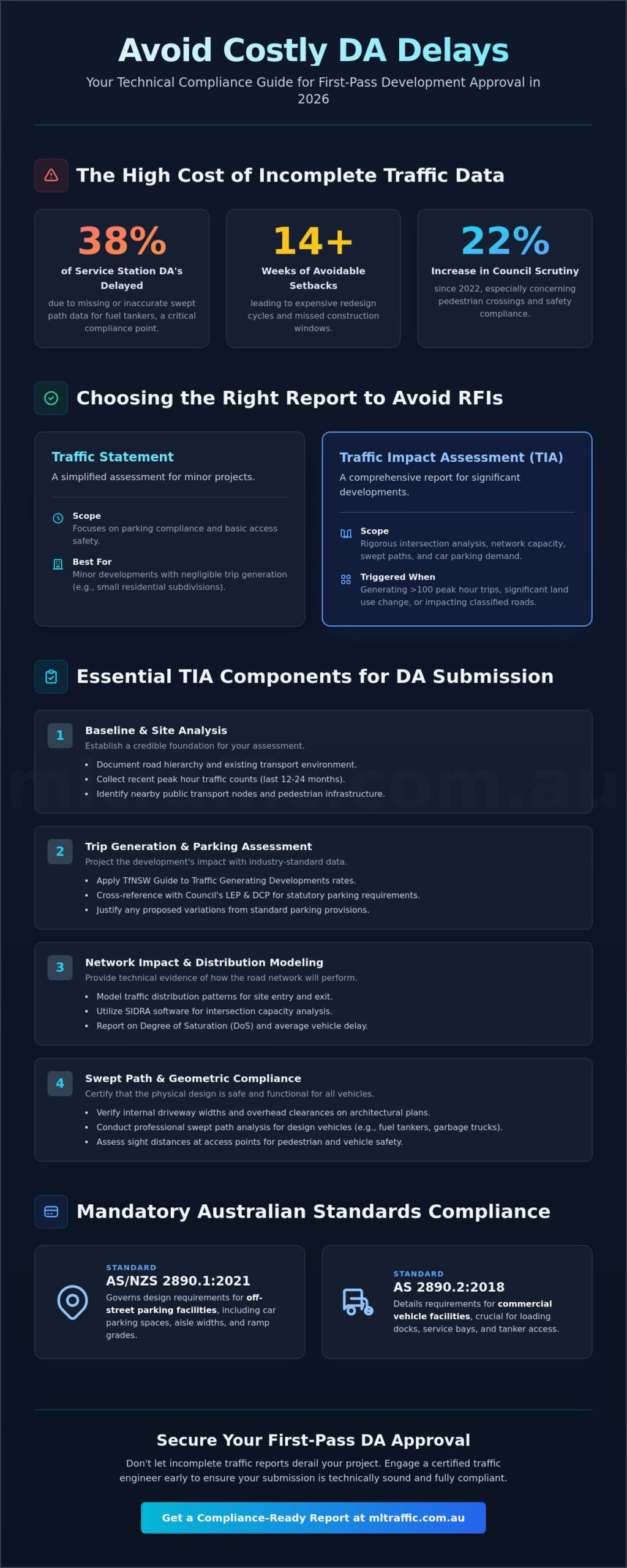
Did you know that 38% of service station development applications are delayed by at least 14 weeks because they lack specific swept path data for fuel tankers? These avoidable setbacks lead to expensive redesign cycles and missed construction windows. Using a comprehensive traffic report checklist for DA submission is no longer optional; council engineers now demand rigorous technical verification and strict adherence to AS/NZS 2890.1:2021.
Receiving a Request for Information (RFI) stalls projects and complicates budgeting, especially with the 22% increase in council scrutiny regarding pedestrian crossings since 2022. This guide provides the technical framework necessary to ensure your documentation meets current Australian engineering requirements. We’ll detail the specific depth required for Traffic Impact Assessments, vehicle swept path analysis, and driveway ramp grade assessments. By following this 2026 compliance guide, you can align with Local Environmental Plans, meet updated Australian Standards, and secure a first-pass DA approval.
Key Takeaways
- Identify the technical data required for a Traffic Impact Assessment (TIA), including current peak hour traffic counts and comprehensive road network descriptions.
- Ensure compliance with the latest Australian Standards, specifically AS 2890.1:2021 for parking facilities and AS 2890.2:2018 for commercial vehicle facilities.
- Apply a technical traffic report checklist for DA submission to verify architectural plan alignment with internal driveway widths and overhead clearance requirements.
- Understand why early professional certification of swept path analysis and sight distance assessments is critical for avoiding project-stalling Requests for Information (RFIs).
Understanding Traffic Report Requirements for DA Submission
A Traffic Impact Assessment (TIA) is a technical engineering report required by local councils to evaluate how a proposed development affects the surrounding transport infrastructure. It isn’t merely a supplementary document. It functions as a critical component of the Statement of Environmental Effects (SEE). The report provides evidence that the project maintains road safety, preserves network capacity, and adheres to current Australian Standards. Utilizing a comprehensive traffic report checklist for DA submission ensures that every technical variable, from parking dimensions to intersection delays, is documented before council review.
To better understand the core components of these assessments, watch this helpful video:
The primary objectives of a traffic report include demonstrating that the site design facilitates safe vehicle movements and that the local road network can absorb the projected load. Engineers use verified traffic generation models to predict future trip volumes based on specific land use. A standard checklist varies significantly depending on whether the project is a small-scale residential subdivision or a high-intensity commercial facility. Councils adjust their scrutiny based on the potential risk to public infrastructure and pedestrian safety.
Triggers for a Formal Traffic Impact Assessment
Not every development requires a full-scale TIA. Local councils and state authorities typically trigger a formal assessment when a project is expected to generate over 100 vehicle trips during peak hours. Significant changes in land use, such as converting an industrial warehouse into a high-density childcare centre, also necessitate deep technical analysis. If your site impacts a classified road or a major signalised intersection, the depth of the traffic report checklist for DA submission increases to meet the requirements of both the local council and state transport bodies.
Traffic Statement vs. Traffic Impact Assessment
The required level of detail depends entirely on project complexity. A Traffic Statement is a simplified version of a TIA, often sufficient for minor developments with negligible trip generation. It focuses primarily on parking compliance and basic access safety. Conversely, a full TIA involves rigorous intersection analysis and detailed car parking demand assessments. For a deeper look at the requirements for larger projects, refer to our TIA Guide. Choosing the wrong report type often results in immediate RFIs and project delays.
Technical Components: What Your Traffic Report Must Include
Council assessment officers prioritize technical substance over administrative compliance. A professional traffic report checklist for DA submission must start with a granular description of the proposed development and the existing transport environment. This includes identifying the road hierarchy, nearby public transport nodes, and current traffic volumes. Engineers use recent peak hour traffic counts, typically collected within the last 12 to 24 months, to establish a credible baseline. Without this site-specific data, the subsequent impact modeling lacks the necessary authority to pass council scrutiny.
Trip generation analysis forms the technical backbone of the assessment. Engineers apply industry-standard rates from the TfNSW Guide to Traffic Generating Developments to project daily and peak hour movements. This data must be cross-referenced against the local Council’s Local Environmental Plan (LEP) and Development Control Plan (DCP). These documents dictate statutory parking requirements that vary significantly between jurisdictions. Precise calculations here prevent the common RFI regarding insufficient parking provision or poorly justified variations.
Traffic Generation and Distribution Modeling
Accurate modeling requires more than raw trip numbers. Distribution patterns determine how new traffic enters and exits the site, directly affecting local intersection performance. Professional reports utilize SIDRA software to analyze intersection capacity, Degree of Saturation (DoS), and average delay. This technical depth allows councils to see the specific impact on Level of Service (LoS) for surrounding commuters. It provides a data-driven defense of the development’s feasibility within the existing infrastructure.
Parking and Loading Requirements
A parking demand assessment must calculate requirements based on specific land use categories. If a development proposes a parking shortfall, the report must provide a technical justification based on empirical data or site-specific constraints. Loading dock functionality is equally critical. Reports must demonstrate that service vehicle access meets operational needs without obstructing public thoroughfares. This often requires integrating vehicle swept path analysis to prove that the largest design vehicle can maneuver safely. Ensuring these technical components are addressed early is easier when you engage an expert traffic engineering firm during the design phase. A complete traffic report checklist for DA submission ensures no detail is overlooked before the final lodgement.
The Compliance Framework: AS 2890 and Swept Path Standards
Adherence to Australian Standards is the non-negotiable core of any traffic report checklist for DA submission. Council engineers do not accept “best effort” designs; they require strict technical verification against the AS 2890 series. AS 2890.1:2021 governs off-street car parking, dictating exact bay dimensions and aisle widths based on the specific user class of the development. For commercial or industrial projects, AS 2890.2:2018 sets the requirements for heavy vehicle loading areas and service facilities. Failure to meet these specific metrics results in immediate RFIs and expensive architectural revisions late in the planning process.
Sight distance at property boundaries is a critical safety metric that assessment officers scrutinize. Engineers must verify that drivers have clear lines of sight to pedestrians on footpaths and oncoming traffic on the public road, as specified in AS 2890.1 Clause 3.2.4. In addition, modern urban councils increasingly enforce AS 2890.3 for bicycle parking and end-of-trip facilities. These aren’t optional extras. They’re statutory requirements that must be integrated into the initial site design to satisfy 2026 planning benchmarks.
Vehicle Swept Path Analysis Essentials
Swept path analysis proves that the largest expected vehicle can navigate the site without striking curbs, columns, or other structures. Engineers must identify the correct design vehicle, ranging from a B99 passenger car to a 12.5-meter Heavy Rigid Vehicle (HRV), based on the development’s operational requirements. Using AutoTURN software, we simulate critical maneuvers including site entry, exit, and loading dock access. This technical verification is a mandatory item on any thorough traffic report checklist for DA submission, especially for service stations or industrial hubs where heavy vehicle movement is frequent.
Driveway and Ramp Grade Compliance
Driveway gradients must be carefully assessed to prevent vehicle scraping and ensure safe transitions between different levels. This involves checking the percentage of the slope and the precise length of transition zones. Australian Standards specify maximum grades for different facility types to maintain accessibility and safety. Our detailed AS 2890.1 Guide provides a deeper breakdown of these car park design requirements. Proper ramp grade assessment during the DA stage prevents the need for expensive post-construction remediation or site access failures.
The Pre-Submission Checklist for Developers and Architects
A final audit of all documentation is essential before formal lodgement. Discrepancies between architectural drawings and engineering reports remain a primary cause of project delays. A robust traffic report checklist for DA submission must include a rigorous cross-check of internal driveway widths and overhead clearances. These dimensions must align with the minimum requirements for the specific design vehicle identified in your swept path simulations. If the architectural plans change, the traffic report must be updated to reflect those modifications immediately.
Pedestrian safety measures require significant attention during this phase. Assessment officers look for physical separation or clearly defined apron areas, especially in high-risk environments. Accessible parking locations must also be verified against AS 1428.1:2021. They must be positioned as close as possible to the primary site entrance with the required shared zones. Site access locations must be confirmed relative to existing infrastructure. This includes checking for conflicts with power poles, street trees, and drainage pits to avoid expensive post-approval construction issues.
Ensuring your technical documentation is flawless requires expert oversight. Contact our senior principals today at ML Traffic Engineers Australia to finalize your pre-submission audit and avoid costly RFIs.
Plan Consistency and Technical Accuracy
All car park numbering in the Traffic Impact Assessment must match the architectural site plans exactly. Discrepancies lead to confusion during the council’s technical assessment. Verify that all vehicle swept path analysis overlays use the most current architectural floor plans. Check that driveway levels and gradients on the traffic report align with the civil engineering drawings. This ensures that vertical clearance compliance is maintained throughout the entire path of travel for heavy vehicles.
Council-Specific Documentation Requirements
Review the local Development Control Plan (DCP) for traffic clauses unique to your specific council jurisdiction. Some urban councils now mandate a Green Travel Plan or Workplace Travel Plan for high-intensity developments to manage trip generation. Audit your submission to ensure all technical appendices are present. This includes SIDRA intersection analysis outputs and AutoTURN swept path results. Missing technical data often triggers a formal RFI, which can delay your project significantly.
Engaging a Traffic Engineer for Your DA Submission
Most Australian councils require traffic assessments to be certified by qualified professional engineers to ensure the technical data presented in the Statement of Environmental Effects is accurate. A traffic report checklist for DA submission is most effective when the underlying analysis is performed by experts who understand the nuances of local government scrutiny. Professional certification provides the accountability councils demand for complex intersection analysis and parking demand assessments. Without this expert endorsement, reports are frequently dismissed during the initial adequacy check.
Engaging a traffic engineer during the preliminary site design phase offers significant advantages for developers and architects. It allows for immediate adjustments to site layouts before architectural plans are finalized and submitted. This proactive approach identifies potential access issues or restricted vehicle movements early in the process. When technical experts are involved from the start, they provide a data-driven basis for council negotiations. This is particularly valuable when site constraints require specific variations from standard Development Control Plan (DCP) requirements.
The ML Traffic Advantage
ML Traffic Engineers Australia ensures national compliance across all local government areas through a meticulous, results-oriented approach. We provide direct access to senior principals for every project, ensuring that high-level expertise is applied to every technical challenge. Our brand is built on personnel continuity; the engineer who initiates your project is the same expert who performs the technical work. This accountability distinguishes our firm from larger consultancies. Our comprehensive services cover every requirement on a traffic report checklist for DA submission, including Vehicle Swept Path Analysis and Driveway Ramp Grade Assessments.
Next Steps for Your Project
The first step toward a successful submission is requesting a formal fee proposal for a Traffic Impact Assessment (TIA). This document outlines the necessary scope of work tailored to your specific development type and scale. We also provide detailed Vehicle Swept Path Analysis to verify site functionality for the required design vehicles. To ensure your project avoids costly RFIs and meets all current compliance standards, contact ML Traffic Engineers Australia for a pre-DA consultation. Our team focuses on technical precision and clear communication with council engineers to facilitate a first-pass DA approval.
Securing Your Development Approval with Technical Precision
Success in the 2026 planning landscape requires moving beyond simple administrative compliance toward rigorous engineering verification. Following a comprehensive traffic report checklist for DA submission ensures that every aspect of your project, from parking dimensions to heavy vehicle maneuverability, meets the highest Australian Standards. Addressing these technical requirements before lodgement is the most effective way to protect your project timeline and prevent the financial strain caused by repeated redesign cycles.
ML Traffic Engineers Australia provides the seasoned expertise necessary to navigate the bureaucratic and technical complexities of modern development applications. With over 15 years of experience in the field, our consultancy offers national coverage across all local government areas. We prioritize direct principal involvement in every report, ensuring the engineer who starts your project is the one who delivers the final technical work. This commitment to personnel continuity and professional accountability builds the trust required for a smooth assessment process.
Get a compliant Traffic Report for your DA submission to ensure your development meets all regulatory benchmarks and avoids unnecessary council delays.
Frequently Asked Questions
What is the most common reason for a traffic report RFI?
Missing or inaccurate technical data is the primary driver of Requests for Information (RFIs). Specifically, 38% of service station applications face delays of 14 weeks or more because they lack adequate swept path data for heavy vehicles. A thorough traffic report checklist for DA submission must prioritize these engineering simulations to avoid costly project stalls and redesign fees.
Do I need a traffic report for a small residential development?
Most developments that alter a site’s trip generation or parking demand require a formal traffic assessment. Small residential projects may only require a simplified Traffic Statement focusing on AS/NZS 2890.1:2021 compliance. Larger developments reaching a threshold of 100 peak-hour vehicle trips will trigger a full Traffic Impact Assessment with more rigorous data requirements.
How long does it take to prepare a traffic report for a DA submission?
Preparation time depends entirely on the project’s technical complexity and the required depth of data collection. Reports involving intersection modeling or multi-day traffic counts require more time than basic parking assessments. It’s best to allow sufficient time for site-specific counts and rigorous internal auditing before the final lodgement date.
What Australian Standards are most relevant to traffic reports?
The most critical standards include AS/NZS 2890.1:2021 for off-street parking and AS 2890.2:2018 for commercial vehicle facilities. Compliance with AS 1428.1:2021 is also mandatory for accessible parking design and mobility requirements. These standards ensure the site meets national safety and functionality benchmarks for all vehicle types and users.
Can I use a general civil engineer for my traffic report?
Councils frequently demand reports certified by specialist traffic engineering consultants rather than generalists. This ensures the assessment includes specific expertise in SIDRA modeling and vehicle swept path analysis. Specialized firms provide the professional accountability and direct principal involvement necessary to navigate complex bureaucratic requirements and Australian Standards.
What is SIDRA modeling and is it required for my DA?
SIDRA is the industry-standard software used to model intersection capacity, degree of saturation, and average vehicle delays. It’s required for any DA where the development significantly impacts the local road network’s performance. The results allow council engineers to determine if the existing infrastructure can absorb the projected traffic load without compromising safety.
How often should traffic counts be updated for a compliant report?
Traffic counts should generally be updated every 12 to 24 months to remain compliant with council expectations. Using outdated data is a common reason for report rejection by assessment officers. Recent counts provide a credible baseline that reflects current network conditions and any changes in local travel patterns since the last count.
Does my traffic report need to cover construction traffic management?
A standard traffic report for a DA submission focuses primarily on the operational phase of the development. However, councils often require a separate Traffic Guidance Scheme (TGS) to manage vehicle movements during the construction phase. The DA report must still verify that site access points are physically capable of accommodating construction vehicle maneuvers safely.

Disclaimer
The content on www.mltraffic.com.au, including all technical articles, guides, and resources, is provided for general informational and educational purposes only. It is not intended to constitute professional advice in traffic engineering, transportation planning, development approvals, or any other technical or legal field.
While ML Traffic Engineers makes every reasonable effort to ensure the accuracy, completeness, and timeliness of the information published, we do not provide any warranties or representations (express or implied) regarding its reliability, suitability, or availability for any particular purpose. Any reliance you place on the content is strictly at your own risk.
In no event shall ML Traffic Engineers, its directors, employees, authors, or affiliates be liable for any direct, indirect, incidental, special, consequential, or punitive damages (including, without limitation, loss of profits, data, or business opportunities) arising out of or in connection with the use of, or inability to use, any information provided on this website.
The articles and guides on this site are not a substitute for engaging a qualified, registered professional traffic engineer (such as an NPER or RPEQ engineer) to assess your specific project requirements. For tailored advice, compliance assessments, or traffic engineering services, please contact a competent professional.
This disclaimer may be updated from time to time without notice. By accessing or using this website, you agree to be bound by the most current version of this disclaimer.
