
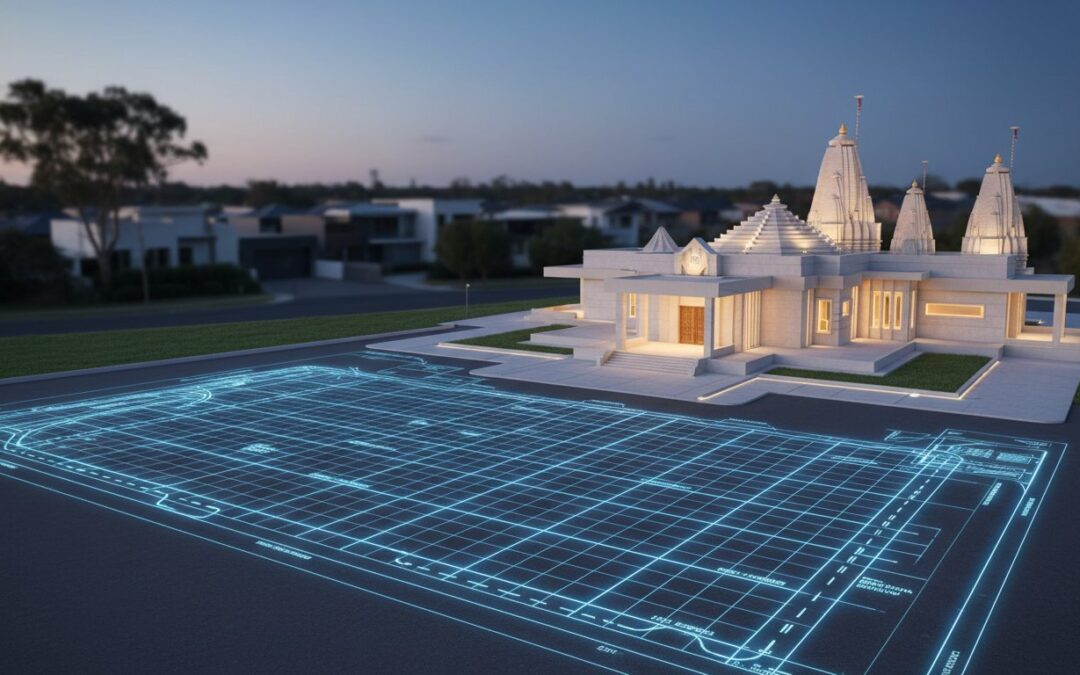
What if the only thing standing between your community’s spiritual home and a Council refusal is a single day of inaccurate parking data? Many developers find their projects stalled by community objections regarding congestion or insufficient car park design. You likely understand that local residents often worry about the impact of major festivals on the surrounding road network. These concerns, if not addressed with technical precision, lead to costly delays in the DA process. Since 2005, we’ve seen how precise data can overcome these hurdles across more than 10,000 sites.
Securing a comprehensive traffic report for a Hindu Temple is the most effective way to provide the assurance your Council requires. We understand the specific challenges of balancing daily worship with high-capacity events. This guide outlines how a specialized Traffic Impact Assessment ensures your place of worship meets Australian Standards, specifically AS 2890.1, while providing a clear path to approval. You’ll learn exactly how to minimize impact on local roads and design a safe, compliant parking facility that satisfies both planners and the community.
Key Takeaways
-
Understand the technical requirements of a Traffic Impact Assessment (TIA) to ensure your place of worship complies with local Council safety and planning policies.
-
Learn how a specialized traffic report for a Hindu Temple accurately projects trip generation based on seating capacity and specific prayer schedules.
-
Discover strategies for managing "extreme peak" traffic demands during major festivals like Diwali to maintain road safety and technical compliance.
-
Identify how to meet Australian Standards (AS 2890.1) through Swept Path Analysis to demonstrate safe vehicle manoeuvrability within your site design.
-
Gain insight into the direct-to-principal approach that ensures senior engineers with 15+ years of experience handle your project from quote to completion.
Table of Contents
Understanding the Traffic Impact Assessment (TIA) for Places of Worship
A Traffic Impact Assessment (TIA) is a mandatory technical document for any new or expanded Hindu Temple project in Australia. Local Councils require this report to determine if the local road network can absorb the additional vehicle movements generated by worshippers. Because a temple falls under the "Place of Public Worship" land-use category, it faces specific scrutiny regarding peak-hour activity and parking demand. It’s a technical necessity for obtaining development approval.
Preparing a comprehensive traffic report for a Hindu Temple involves justifying the proposed number of parking spaces by calculating the expected congregation size. This isn’t a guess; it’s a data-driven projection based on the building’s gross floor area (GFA) and seating capacity. Council planners use this data to ensure the development won’t create dangerous overflows or illegal parking in surrounding residential streets. If the report fails to demonstrate adequate on-site parking, the project may face significant delays or refusal.
Why Councils Require a TIA for Temples
Councils prioritize the safety of all road users. A TIA evaluates whether existing road capacity is sufficient for the high-volume movements seen during major festivals or weekend services. Engineers analyze the surrounding intersections to ensure they don’t reach a level of service that causes gridlock. The assessment addresses several critical safety factors:
-
The safe entry and exit of vehicles from the site to avoid queuing on public roads.
-
Pedestrian safety for worshippers walking from parking areas to the temple entrance, especially during night-time events.
-
The necessity for road upgrades, such as dedicated turn lanes, widened shoulders, or improved street lighting.
Regulatory Framework and Australian Standards
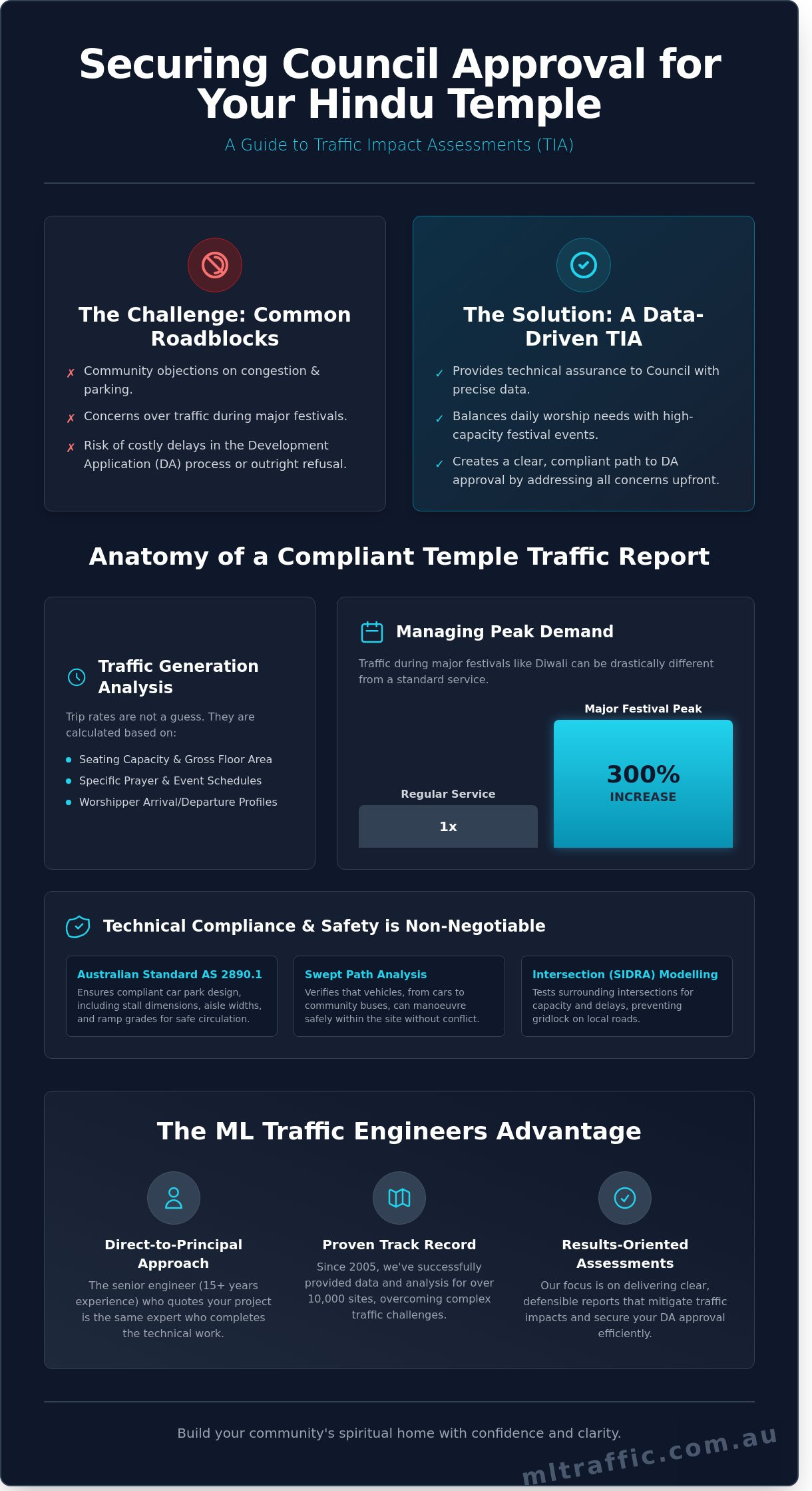
Compliance is non-negotiable. Every traffic report for a Hindu Temple must adhere to AS 2890.1:2004 for off-street car parking. This standard dictates stall dimensions, aisle widths, and ramp grades to ensure vehicles can circulate safely without causing bottlenecks. The design must accommodate everything from standard passenger cars to larger transport vans or buses used by the community.
The report must also align with State-specific guidelines, such as the Transport for NSW (TfNSW) Guide to Traffic Generating Developments. A qualified Traffic Engineer must certify these reports. At ML Traffic Engineers, we ensure that the consultant who provides your quote is the same expert who performs the technical work. This direct accountability ensures the report meets the rigorous standards required by the Council and the relevant Australian Standards. We focus on delivering results-oriented assessments that mitigate traffic impacts while supporting the growth of your community space.
Key Components of a Comprehensive Temple Traffic Report
A professional traffic report for a Hindu Temple must be built on empirical data rather than general estimates. We start with independent traffic counts. These counts capture the existing baseline flow on surrounding roads, typically over a 7-day period using pneumatic tube counters or manual peak-hour observations. We use this data to model how new traffic will integrate with current conditions. A robust report includes SIDRA modelling to test intersection capacity, degree of saturation, and average delay times. We also develop sustainable transport strategies. These strategies encourage carpooling or the use of nearby bus networks to reduce the total number of private vehicle trips generated by the site.
Traffic Generation Analysis
Traffic generation is not a fixed figure for places of worship. We calculate trip rates for both weekday afternoon peaks and weekend peak hours. This involves analyzing the total seating capacity and the specific prayer schedules provided by the temple committee. Trip generation for religious sites is a variable based on the lunisolar calendar peaks. We must account for major festivals like Diwali or Navratri where attendance might increase by 300% compared to a standard service. Our analysis focuses on the arrival profile of worshippers. If 150 vehicles arrive over a 90-minute window, the impact is manageable; however, if they arrive within a 20-minute window, it creates a significant bottleneck. We design internal circulation paths to keep these queues on-site and off public roads.
Impact on the Local Road Network
We assess the Level of Service (LoS) at every nearby intersection. This technical grade measures delay and congestion on a scale from A to F. If the temple development causes an intersection to drop from LoS B to LoS D, we propose specific mitigation strategies. This often involves physical upgrades like widening a road shoulder or installing a dedicated right-turn bay to protect stationary vehicles. Safety remains the primary concern. We verify that all proposed driveways meet the strict sight distance requirements specified in Australian Standard AS 2890.1. This ensures drivers have a clear line of sight to oncoming traffic before exiting the property. Our team provides a full range of traffic engineering services to ensure your development application meets all local council and transport authority requirements.
The final report also evaluates the parking demand. We compare the peak number of attendees against the available on-site bays to prevent overspill into residential side streets. By using real-world data from similar temples we’ve assessed across Australia, we provide a report that is both practical for the client and acceptable to the road authorities. This meticulous approach reduces the risk of costly requests for further information during the planning process.
Managing Peak Demand: Regular Use vs. Major Festivals
Hindu temples face unique logistical challenges characterized by extreme peaks in attendance. While a typical weekend might attract a steady flow of 50 to 100 worshippers, major festivals such as Diwali, Holi, or Janmashtami can see those numbers surge into the thousands. A standard Traffic Impact Assessment cannot treat these high-volume days as standard operating conditions. Instead, a comprehensive traffic report for a Hindu Temple must address these outliers as separate scenarios to satisfy Council safety and amenity concerns.
Local authorities often require an Event Traffic Management Plan (ETMP) to supplement the primary development application. This plan outlines how the site handles temporary spikes without causing gridlock on local collector roads. We focus on justifying parking shortfalls by utilizing shared parking or designated overflow arrangements; this prevents the site from being dominated by empty bitumen for 350 days of the year.
The Car Parking Demand Assessment
Determining if the proposed parking meets the actual demand of the congregation requires more than just following a generic Council code. We compare Council’s minimum requirements against empirical data collected from similar temple sites across Australia. This data-driven approach is vital when addressing the common objection that a site needs 500 spaces for festivals but only 100 for daily use. We use Australian Standards (AS 2890.1) to validate that daily needs are met on-site, while peak demand is managed through secondary measures. These measures include:
-
Formalised "shared parking" agreements with adjacent commercial properties.
-
Utilising reinforced grassed areas for temporary overflow parking.
-
Implementing shuttle bus services from nearby transit hubs or larger public car parks.
Event-Specific Traffic Guidance Schemes
For large gatherings, implementing temporary Traffic Management Plans (TMP) is a non-negotiable requirement for safety. This process involves detailed coordination with local authorities and police for potential temporary road closures or directional diversions. A traffic report for a Hindu Temple must detail how the internal flow of vehicles is maintained to prevent queuing back onto public streets. We specify the use of accredited marshals to manage internal parking aisles and pedestrian crossing points. These marshals ensure that vehicle swept paths remain clear for emergency services even during maximum capacity events. This structured approach provides Council with the assurance that the temple can host significant cultural events without compromising the local transport network’s integrity.
Technical Compliance: Swept Paths and Car Park Design
Local councils demand certainty regarding site safety. They won’t approve a development application if vehicle movements are hazardous or inefficient. A comprehensive traffic report for a Hindu Temple must prove that all expected vehicles can enter, circulate, and exit the site in a forward direction. Reversing onto a public road is a major safety violation under Australian planning instruments and usually leads to immediate DA refusal.
Our engineers focus on several critical technical areas to ensure compliance:
-
Vehicle Manoeuvrability: Proof that cars won’t collide with structural columns, walls, or other parked vehicles.
-
Site Throughput: Ensuring the layout handles peak arrival and departure flows without internal gridlock.
-
Vehicle Diversity: Accommodating everything from standard SUVs to medium rigid vehicles used for deliveries or maintenance.
-
Safety Segregation: Implementing pedestrian safety zones to protect worshippers walking from their cars to the temple entrance.
Swept Path Analysis for Temple Access
We use AutoTURN software to conduct a Vehicle Swept Path Assessment. This industry-standard tool simulates the exact wheel paths and body overhangs of vehicles at entry and exit points. It’s particularly vital for temple sites where space is often constrained. We simulate movements for standard cars and heavy rigid vehicles to ensure fire trucks can access the grounds during an emergency. For a deeper look at these technical requirements, refer to our Guide to Swept Path Analysis.
Compliant Car Park Layouts
All parking designs must adhere strictly to AS 2890.1 standards. This code dictates the minimum aisle widths and bay dimensions required for safe operation. We also pay close attention to driveway ramp grades. If a ramp is too steep, vehicles with low ground clearance will scrape their undercarriages. We calculate these grades to the millimetre to prevent property damage. A professional traffic report for a Hindu Temple also includes a detailed plan for pavement markings and directional signage. These elements are essential for directing traffic flow and reducing driver confusion during major festivals. We also integrate dedicated accessible parking bays near the main entry to ensure the site is inclusive and meets all disability access requirements.
Contact Michael Lee or Benny Chen for expert advice on your temple’s car park design and compliance.
Securing Your DA Approval with ML Traffic Engineers
ML Traffic Engineers Australia brings over 15 years of specialized experience to religious site developments. We’ve been trading since 2005 and have developed a reputation for technical precision. Our firm operates on a direct-to-principal model. This means the traffic consultant who provides your quote is the same professional who does the work. This accountability eliminates the communication gaps often found in larger, bureaucratic firms where junior staff handle the technical drafting.
Our reports are engineered to withstand rigorous Council scrutiny. We focus on reducing "Requests for Further Information" (RFI), which can delay a project by several months and increase costs. We assist during the initial design phase to ensure your car park layout complies with Australian Standard AS 2890.1. This proactive approach ensures your site is both compliant and cost-effective. We’ve assessed over 10,000 sites across Australia, giving us the depth of knowledge required to handle complex transport planning requirements.
Our Proven Process for Religious Sites
We follow a structured methodology to ensure your Development Application (DA) proceeds without technical hitches. Our process includes:
-
Initial Assessment: We conduct a thorough site visit and consult directly with the temple committee to understand specific operational needs, such as peak festival times and visitor turnover.
-
TIA Preparation: We prepare a professional Traffic Impact Assessment (TIA). This traffic report for a Hindu Temple is tailored to the specific arrival and departure patterns of your congregation.
-
Council Liaison: We take the lead in discussions with Council traffic departments. We resolve technical concerns and justify parking provisions based on empirical data and established precedents.
Why Experience Matters
Experience is the difference between a quick approval and a stalled project. Preparing a comprehensive traffic report for a Hindu Temple requires an understanding of how religious facilities differ from standard residential or commercial land uses. We’ve successfully assessed thousands of sites, including numerous places of worship, schools, and community centers. Our senior staff, Michael Lee and Benny Chen, personally oversee every report to ensure it meets our high standards of accuracy and reliability.
Our firm provides a no-nonsense, fact-based approach that builds confidence with Council authorities. We prioritize clarity and technical compliance in every document we produce. You can learn more about our full range of services to see how we support various development types. If you’re ready to move forward with your project, contact us today for a quote. We provide direct access to our principals to ensure your questions are answered by experts.
Secure Your Temple DA with Expert Traffic Engineering
Securing a Development Application for a Place of Public Worship requires technical precision and a deep understanding of Australian Standards. A comprehensive traffic report for a Hindu Temple must address both daily operations and the significant surges during major festivals. We focus on critical elements like AS 2890.1 car park compliance and vehicle swept path assessments to ensure your site functions safely. ML Traffic Engineers brings specialized expertise to these complex DAs. We’ve assessed over 10,000 sites across Australia since 2005. You’ll work directly with principals who possess over 30 years of experience in transport planning. This hands-on approach ensures your TIA is accurate and meets council requirements the first time. The consultant who provides your quote is the one who does the work; this eliminates bureaucratic delays and ensures accountability throughout the planning process. We understand the specific challenges of temple developments and provide the data needed for approval. We look forward to helping you move your project toward a successful outcome.
Get a compliant Traffic Report for your Temple; talk to our Senior Engineers today.
Frequently Asked Questions
How much does a traffic report for a Hindu Temple cost?
The cost of a traffic report for a Hindu Temple is determined by the project scale and the complexity of the local road network. Professional fees depend on whether the Council requires intersection modelling, detailed site inspections, or a basic parking study. We provide a fixed-fee proposal after reviewing your site address and development plans to ensure there are no hidden expenses.
Does a small temple expansion still require a Traffic Impact Assessment?
Yes, a small expansion usually requires a Traffic Impact Assessment (TIA) if the development increases the floor area or the maximum number of devotees. Most Australian Councils require a formal assessment to ensure additional traffic doesn’t compromise road safety or local amenity. Even a 15% increase in capacity can trigger the need for a professional report to support your Development Application.
What is the minimum number of parking spaces required for a place of worship?
Minimum parking requirements are defined by your local Council’s Development Control Plan (DCP), which often mandates 1 space per 5 seats or 1 space per 10 square metres of floor area. These rates vary significantly between different local government areas across Australia. Our engineers verify these requirements against current Australian Standards (AS 2890.1) to ensure your car park design is compliant and functional.
Can we use off-site parking to satisfy Council requirements for a temple?
Off-site parking can satisfy Council requirements if the temple has a formal shared parking agreement or if public parking is available within a 200-metre walking distance. We conduct a parking demand assessment to prove that peak temple usage doesn’t conflict with the peak usage of nearby facilities. This technical evidence helps justify a reduction in on-site parking spaces during the DA process.
How long does it take to prepare a TIA for a Development Application?
Preparing a Traffic Impact Assessment for a Development Application typically takes 10 to 15 business days. This timeframe includes the necessary site inspections, data collection, and technical analysis. If the project requires 24-hour traffic counts or complex SIDRA modelling, the duration may extend. We focus on efficiency to ensure your submission meets Council deadlines without compromising technical accuracy.
What happens if Council objects to our traffic report?
If Council objects to your traffic report for a Hindu Temple, we respond directly to their concerns through a formal technical rebuttal or an amended assessment. This process involves addressing specific points regarding sight-line distances or trip generation rates. Our senior engineers manage these discussions directly with Council staff to resolve objections and move the application toward approval.
Do we need a swept path analysis for a temple car park?
A swept path analysis is mandatory for most temple car parks to demonstrate that waste collection vehicles and emergency services can enter and exit the site in a forward direction. We use specialised software to simulate the movement of an 8.8-metre medium rigid vehicle or an 11-metre heavy rigid vehicle. This ensures the driveway layout complies with AS 2890.2 and prevents operational issues after construction.
Can a traffic engineer help reduce the required number of parking spots?
A traffic engineer can reduce parking requirements by performing a parking demand survey at a similar existing temple site. If data shows that actual demand is 30% lower than the DCP rate, we submit a justification for a parking variation. We also consider factors like proximity to public transport and the use of private shuttle buses to lower the on-site parking burden for your development.
Which areas do you cover?
We are traffic engineers servicing Melbourne, Sydney, Brisbane, Gold Coast, Hobart, Perth, Adelaide, Darwin, Canberra and surrounding areas.
Disclaimer
The content on www.mltraffic.com.au, including all technical articles, guides, and resources, is provided for general informational and educational purposes only. It is not intended to constitute professional advice in traffic engineering, transportation planning, development approvals, or any other technical or legal field.
While ML Traffic Engineers makes every reasonable effort to ensure the accuracy, completeness, and timeliness of the information published, we do not provide any warranties or representations (express or implied) regarding its reliability, suitability, or availability for any particular purpose. Any reliance you place on the content is strictly at your own risk.
In no event shall ML Traffic Engineers, its directors, employees, authors, or affiliates be liable for any direct, indirect, incidental, special, consequential, or punitive damages (including, without limitation, loss of profits, data, or business opportunities) arising out of or in connection with the use of, or inability to use, any information provided on this website.
The articles and guides on this site are not a substitute for engaging a qualified, registered professional traffic engineer (such as an NPER or RPEQ engineer) to assess your specific project requirements. For tailored advice, compliance assessments, or traffic engineering services, please contact a competent professional.
This disclaimer may be updated from time to time without notice. By accessing or using this website, you agree to be bound by the most current version of this disclaimer.
