
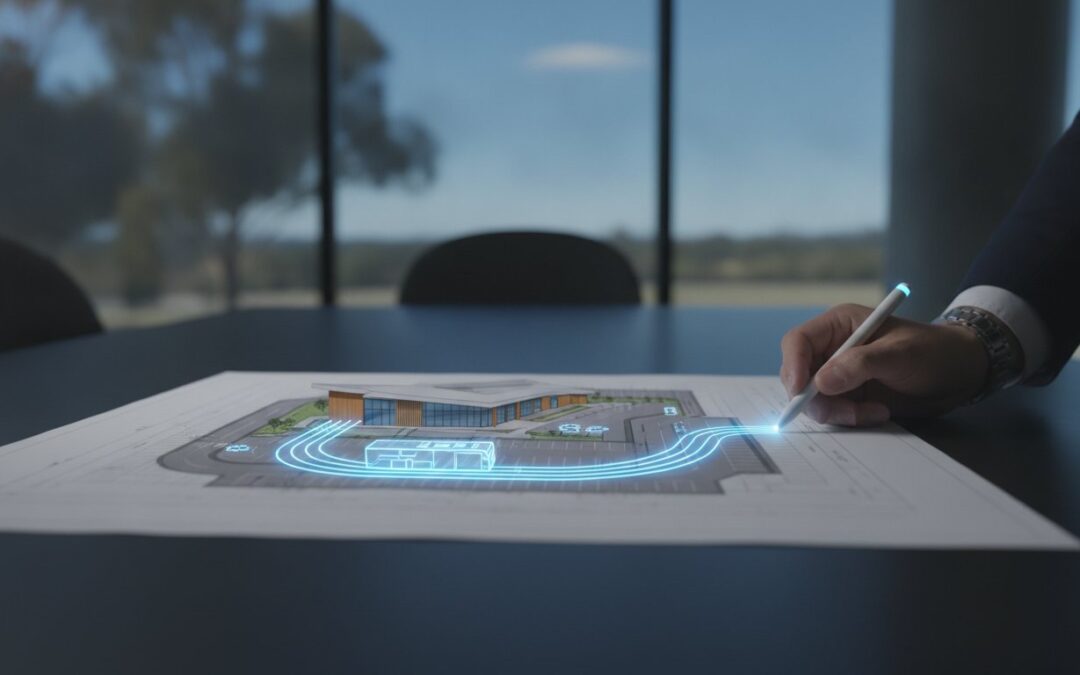
Why do so many church and temple developments stall at the council stage despite having what appears to be ample parking? The reality is that local councils often view religious sites with caution because their traffic profiles are intense yet infrequent. If you’re relying on generic parking rates, you’re likely headed for a rejection or costly delays. Securing a traffic report for a place of worship that stands up to scrutiny is a mandatory requirement for any new Development Application in Australia.
It’s common to feel frustrated when community concerns about street parking or the difficulty of fitting compliant bays onto tight sites threaten your project’s timeline. You need a clear path to compliance that addresses these technical challenges while meeting strict Australian Standards. This guide provides a direct roadmap to help you navigate the DA process with confidence. You’ll learn how to calculate accurate traffic generation for religious events, ensure your car park design meets AS 2890.1 and AS 2890.2, and present a technical case that satisfies council requirements with minimal conditions.
Key Takeaways
- Identify why a professional traffic report for a place of worship is a mandatory component of your Statement of Environmental Effects to satisfy local council requirements.
- Discover why traffic generation for religious sites must be calculated based on seating capacity rather than standard floor area to ensure technical accuracy.
- Learn how to use a Parking Demand Assessment to justify a reduction in the rigid parking rates often required by local Development Control Plans.
- See how swept path analysis proves that large vehicles, such as buses or delivery vans, can safely navigate your site in accordance with Australian Standards.
- Recognise the value of senior-led engineering in producing a compliant report that minimises the risk of community objections and council rejection.
Why a Traffic Report for a Place of Worship is Essential for DA Approval
Local councils categorise places of worship as high-impact developments. This classification stems from the unique way these sites operate, often generating significant vehicle surges in very short windows. Because hundreds of attendees may arrive and depart within a 30-minute period, the impact on the local road network is far greater than a standard residential or commercial build. Similar traffic management principles apply to other high-occupancy facilities like Flinn Taekwondo Academy, which also requires careful planning to manage vehicle flow during peak training hours. Ultimately, a traffic report for a place of worship provides the technical justification required to prove your development won’t cause gridlock or safety hazards.
This document is a mandatory component of the Statement of Environmental Effects (SEE) for most Australian councils. Without a formal assessment, planners cannot verify if the surrounding streets can handle the peak load or if the proposed parking is sufficient. Professional traffic engineering principles are applied to ensure the site design prioritises public safety and maintains the efficiency of existing infrastructure. A well-prepared report also serves as a critical tool to mitigate community objections regarding noise and street parking congestion.
To better understand the complexities of traffic management for religious facilities, watch this helpful video:
The Role of the Traffic Impact Assessment (TIA)
A TIA is a technical study that communicates the operational realities of your site to council planners. It balances the specific needs of your congregation with the broader requirements of public road safety. The assessment details how many vehicles will enter the site, where they will park, and how they will exit without creating queues on public roads. You can find more detail on specific TIA components that form the basis of a successful application.
Meeting Australian Standards and Regulatory Compliance
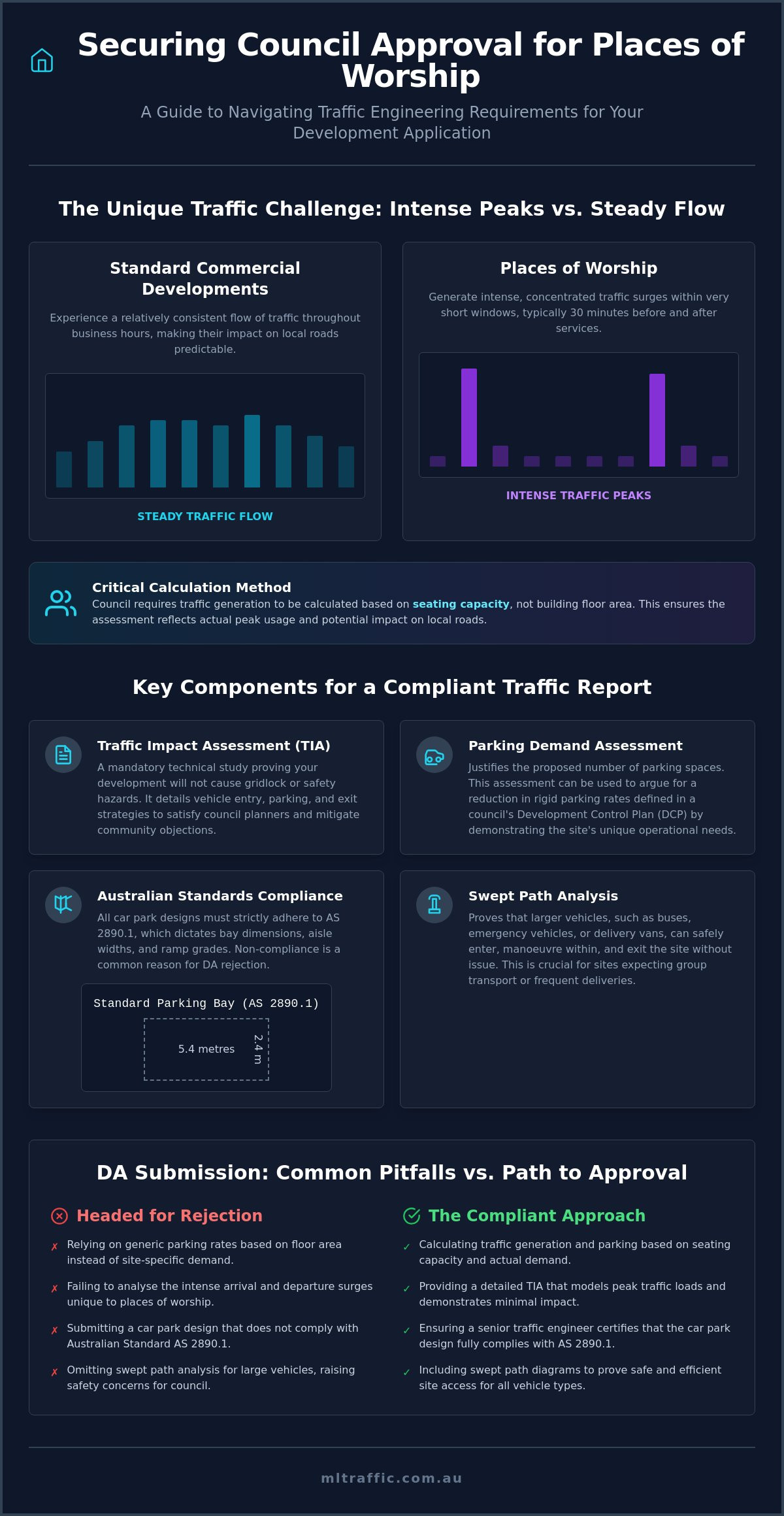
Compliance with national standards is non-negotiable for development approval. The primary standard for off-street parking is AS 2890.1:2004, which dictates strict requirements for bay dimensions, aisle widths, and ramp grades. For instance, standard parking spaces must be 2.4 metres wide by 5.4 metres long, though these dimensions may increase depending on the user class. It’s essential to have a qualified traffic engineer sign off on the design to ensure it meets these rigorous criteria. This professional oversight guarantees that your traffic report for a place of worship is legally defensible and technically sound.
Analysing the Unique Traffic Profile of Religious Developments
Religious developments present a distinct traffic challenge. Most commercial sites maintain a relatively steady flow of vehicles throughout the day. Places of worship produce extreme peaks during services and festivals. A traffic report for a place of worship must focus on the arrival and departure windows, which typically occur 30 minutes before and after scheduled events. This concentrated surge is the primary concern for council planners who need to ensure the local road network can absorb the temporary increase in volume.
Traffic generation is calculated based on seating capacity rather than gross floor area. This approach ensures the assessment reflects actual occupancy rather than empty space. Many modern facilities also support multi-purpose uses, such as weekday childcare or community halls. Each use requires a separate assessment to determine the cumulative impact on the local network. These diverse operational profiles necessitate a high-level technical analysis to avoid council rejection. If you’re managing a complex site with multiple uses, our senior engineering team can provide a detailed assessment of these overlapping demands.
Calculating Traffic Generation Rates
Engineers use the RMS Guide to Traffic Generating Developments or relevant state-based datasets to establish base rates. These figures are adjusted to match specific religious calendars, such as Friday afternoon prayers or Sunday morning services. When standard data doesn’t align with a unique denomination, a first principles assessment is conducted. This involves collecting empirical data from similar existing sites to provide a robust justification for the proposal. This data-driven approach removes the guesswork from the planning process. It provides a defensible evidence base that withstands scrutiny from both council officers and community objectors.
Managing Peak Period Congestion
Intersection performance is analysed using SIDRA software to simulate the effect of peak surges on local traffic flow. If the analysis shows unacceptable delays, strategies such as staggered service times are often implemented to reduce pressure on the road network. Level of Service (LoS) is a qualitative measure used by councils to describe the performance of an intersection, where a decline in rating can lead to the refusal of a development application. Maintaining a high LoS ensures the local community isn’t negatively impacted by the sudden influx of vehicles. Our engineers model these scenarios to find the most efficient access solutions for your site.
Solving the Parking Puzzle: Demand vs. Council Requirements
Local Council Development Control Plans (DCPs) typically apply rigid parking rates that fail to account for the unique operational profile of religious sites. These codes are often based on gross floor area, which can lead to an oversupply of parking that is physically impossible to fit on a constrained site. A professional traffic report for a place of worship provides the technical justification required to request a variation from these standards. By submitting a formal Parking Demand Assessment, you can prove that the actual needs of your congregation are lower than the generic rates suggested by the DCP.
Several factors influence this reduction in demand. Proximity to public transport hubs and established carpooling habits within the community significantly lower the number of vehicles arriving on-site. We also address one of the most common hurdles in the DA process: community objections regarding street parking. By conducting “on-street” parking surveys, we provide empirical evidence of the existing capacity in the surrounding neighbourhood. This data-driven approach allows us to demonstrate that any minor overflow can be absorbed without impacting local residents, effectively silencing anecdotal complaints from objectors.
Conducting a Parking Accumulation Study
An accumulation study involves observing existing, similar facilities to predict the future demand of your development. We collect data at 15-minute intervals during peak periods to identify exactly when the highest number of vehicles will be present. This methodology allows us to prove that your peak demand does not overlap with the peak hours of local businesses or schools. For more technical details on how these studies are structured, refer to our guide on Car Parking Demand Assessment.
Designing for Compliance with AS 2890.1
Meeting the technical requirements of AS 2890.1 (Off-street car parking) is essential for securing approval. Your car park design must strictly adhere to national standards for bay dimensions and aisle widths. For example, a standard parking space must measure 2.4 metres by 5.4 metres, with aisle widths typically ranging between 5.8 and 6.2 metres for 90-degree parking. We ensure your design avoids common pitfalls such as “dead-end” aisles that lack a proper turning area. Our engineers also verify that vertical clearances meet the 2.2-metre minimum for standard bays and 2.5 metres for accessible spaces, ensuring your site is fully compliant and accessible to all members of the community.
Swept Path Analysis and Site Access Logistics
Councils mandate that vehicles enter and exit high-occupancy sites in a forward direction to maintain public safety. For religious developments, this requirement is non-negotiable due to the high volume of pedestrians and vehicles present during services. A traffic report for a place of worship must include technical diagrams proving the site can accommodate these movements. We use AutoTURN software to simulate the specific turn circles of design vehicles, ensuring the car park layout doesn’t force drivers into dangerous reversing manoeuvres onto public roads.
Site access logistics also involve managing the physical constraints of the land. Steep sites often present challenges for driveway transitions where vehicles risk “bottoming out” on the pavement. Our engineers perform a Driveway Ramp Grade Assessment to ensure the vertical profile of the entry complies with Australian Standards. This technical precision prevents property damage and ensures that everything from a low-profile passenger car to a community bus can navigate the entrance without incident.
The Importance of Forward Entry and Exit
Reversing onto a public road from a high-impact development is a major safety risk that councils will not permit. This is why Swept Path Analysis is a critical component of your submission. We model the “B99” design vehicle, which represents the 99.8th percentile car on Australian roads, to confirm that even the largest standard passenger vehicles can turn safely within your site boundaries. This analysis provides the visual proof planners need to approve your site access arrangements.
Emergency and Service Vehicle Access
Your site must remain accessible to emergency services and heavy vehicles at all times. Fire appliances and ambulances require specific clearances and turning radiuses that differ significantly from standard car bays. Waste management logistics are equally vital; we verify that garbage trucks can reach bin storage areas and exit the site in a forward direction. We also conduct a Sight Distance Assessment at the driveway to ensure exiting drivers have a clear view of oncoming traffic and pedestrians. This comprehensive approach to site safety minimises the risk of council requesting expensive design changes late in the approval process. If you require a compliant access design for your development, contact our senior engineers to discuss your project requirements.
How ML Traffic Engineers Secures Your Project Approval
ML Traffic Engineers brings over 15 years of industry experience to every Development Application. We recognise that a traffic report for a place of worship is frequently the most scrutinised document in a submission. Our firm specialises in providing the technical evidence needed to overcome community objections and satisfy council planners. We deliver a comprehensive range of services designed to address every potential traffic and transport hurdle, including:
- Traffic Impact Assessment (TIA) Reports
- Vehicle Swept Path Analysis using AutoTURN
- Car Parking Demand Assessments
- Driveway Ramp Grade Assessments
- Intersection Analysis and SIDRA modelling
- Sight Distance Assessments
- Car Park Design and layout optimisation
- Waste Management Plans
Our reports are engineered to be robust. We don’t rely on generic assumptions or outdated data. By providing site-specific analysis, we ensure your application is defensible against rigorous council queries. This meticulous approach has allowed us to maintain a long track record of successful negotiations with local government authorities across Australia. We focus on results, ensuring your development meets all relevant Australian Standards while minimising the conditions of approval.
Direct Access to Senior Expertise
We operate with a “no-gatekeepers” philosophy. The senior principal who initiates your project is the same expert who performs the technical engineering work. This personnel continuity promise eliminates communication errors and ensures that high-level expertise is applied to every calculation and diagram. You have a direct line to the person responsible for your report. This hands-on approach leads to faster DA turnaround times because we anticipate council concerns before they are raised. You can learn more about our team and our extensive experience in civil and traffic consultancy.
Start Your Traffic Assessment Today
The first step in securing your approval is a preliminary review of your site plans. We examine your proposed layout to identify any immediate conflicts with AS 2890.1 or AS 2890.2. Once the initial assessment is complete, we prepare a detailed traffic report for a place of worship tailored to the specific requirements of your local council. Whether you are building a new temple, church, or community centre, we provide the technical roadmap to success. Contact ML Traffic Engineers today for a professional quote and ensure your project is handled by seasoned experts.
Secure Your Development Approval with Expert Engineering
Achieving DA approval for religious developments requires a technical strategy that addresses intense vehicle surges and specific peak-hour demands. You must provide a robust evidence base that justifies parking variations and proves site safety through compliant swept path analysis. Relying on generic council rates is a significant risk that often leads to avoidable delays or project rejection. By prioritising adherence to AS 2890 and conducting site-specific accumulation studies, you can navigate the planning process with technical certainty.
ML Traffic Engineers offers the reliability and meticulous detail your project deserves. With over 15 years of Australian experience, our senior principals personally prepare every traffic report for a place of worship, ensuring there are no technical errors in your submission. We specialise in AS 2890 compliance and provide a direct line to our leadership throughout the assessment process. Take the first step toward a successful approval today. Get a Professional Traffic Report for Your Place of Worship and let our seasoned experts manage the complexities of your development’s traffic requirements.
Frequently Asked Questions
Does every place of worship require a traffic report for a DA?
Yes, a professional traffic report for a place of worship is a mandatory requirement for nearly all new Development Applications in Australia. Local councils classify these developments as high-impact due to the concentrated arrival and departure of attendees within short windows. This technical document forms a core part of your Statement of Environmental Effects, proving that the local road network can absorb the peak surge safely and efficiently.
How much parking does the council require for a new church or temple?
Council parking requirements are dictated by the local Development Control Plan (DCP) and are generally calculated based on seating capacity rather than gross floor area. However, these rigid rates often don’t reflect the actual demand of a specific congregation. We frequently conduct a Parking Demand Assessment to justify a reduction in these rates by demonstrating carpooling habits, proximity to public transport, and off-peak operational times.
What is a swept path analysis and why do I need it?
Swept path analysis is a computer-simulated model used to prove that vehicles can enter and exit your site in a forward direction. Using software like AutoTURN, we demonstrate that the largest expected vehicles, such as community buses or waste collection trucks, can navigate the car park without dangerous reversing manoeuvres. This analysis is essential for meeting Australian Standards and satisfying council safety requirements for high-occupancy sites.
Can we use on-street parking to meet our council requirements?
On-street parking cannot usually be counted toward your primary parking provision, but it is a vital tool for justifying a shortfall in your traffic report for a place of worship. We conduct parking accumulation surveys to document available capacity in the surrounding streets during your peak service times. This data proves to the council that any minor overflow can be absorbed by the neighbourhood without causing congestion or community friction.
How long does it take to prepare a Traffic Impact Assessment?
Preparation of a Traffic Impact Assessment typically takes between two and four weeks. This timeline depends on the complexity of the site and the requirement for specific intersection counts or parking surveys. Because our senior principals handle the technical work directly, we eliminate the delays associated with junior staff handovers, ensuring a faster turnaround for your DA submission and a more robust technical document.
What happens if the council objects to our traffic report?
If a council objects or issues a Request for Further Information (RFI), we provide a formal technical response to address their specific concerns. This process may involve refining the car park design or providing additional data from first principles assessments. Our 15 years of experience in negotiating with local authorities allows us to resolve technical disputes efficiently and maintain the momentum of your project toward approval.
Do we need a traffic report for a small home-based religious gathering?
Small gatherings may not require a full TIA if they fit within existing residential use, but a formal application for a “place of public worship” usually triggers the requirement. Even for smaller sites, councils often demand a simplified traffic statement to address potential noise and parking impacts on neighbours. It’s essential to confirm the specific requirements of your local council planners to avoid unexpected delays in your application.
How do you calculate traffic for special events like weddings or funerals?
Traffic for special events is calculated using a “worst-case scenario” peak demand assessment based on maximum seating capacity. We apply car occupancy rates and arrival distributions to predict the total vehicle volume. While these events are infrequent, the assessment must demonstrate that the site can manage these surges without creating queues on public roads or compromising the safety of the surrounding intersection network.

Disclaimer
The content on www.mltraffic.com.au, including all technical articles, guides, and resources, is provided for general informational and educational purposes only. It is not intended to constitute professional advice in traffic engineering, transportation planning, development approvals, or any other technical or legal field.
While ML Traffic Engineers makes every reasonable effort to ensure the accuracy, completeness, and timeliness of the information published, we do not provide any warranties or representations (express or implied) regarding its reliability, suitability, or availability for any particular purpose. Any reliance you place on the content is strictly at your own risk.
In no event shall ML Traffic Engineers, its directors, employees, authors, or affiliates be liable for any direct, indirect, incidental, special, consequential, or punitive damages (including, without limitation, loss of profits, data, or business opportunities) arising out of or in connection with the use of, or inability to use, any information provided on this website.
The articles and guides on this site are not a substitute for engaging a qualified, registered professional traffic engineer (such as an NPER or RPEQ engineer) to assess your specific project requirements. For tailored advice, compliance assessments, or traffic engineering services, please contact a competent professional.
This disclaimer may be updated from time to time without notice. By accessing or using this website, you agree to be bound by the most current version of this disclaimer.
