
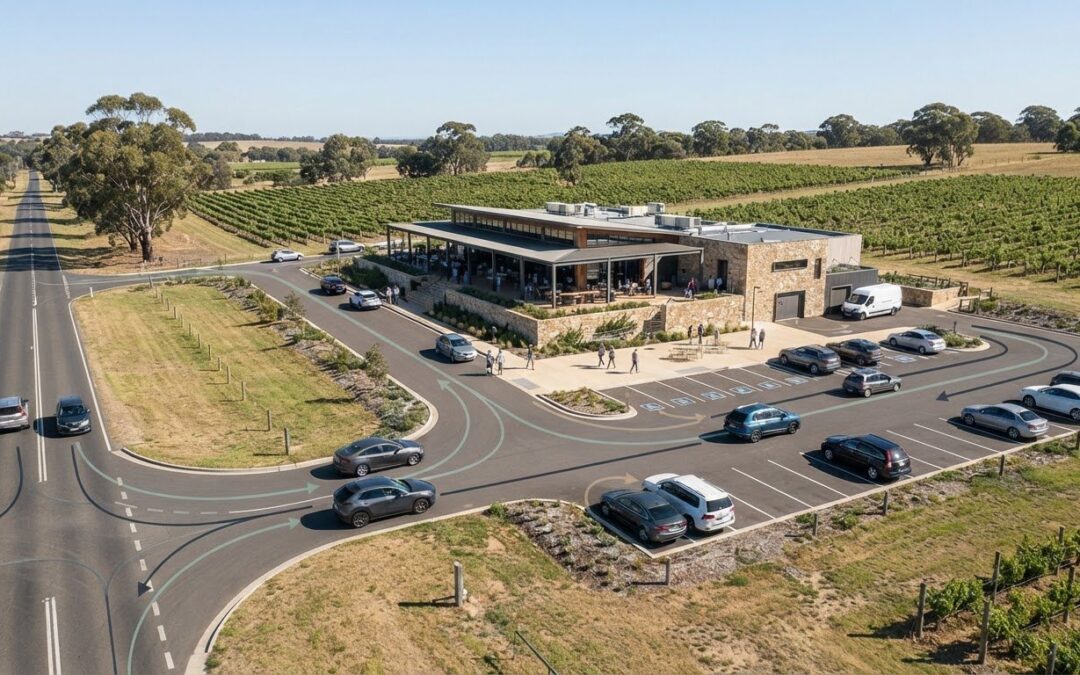
Could a cellar door’s access and parking work on an ordinary trading day but come under pressure during a visitor peak? A traffic report for a winery or cellar door needs to reflect how the site actually operates, not just its average daily activity. Councils may request a report as part of a development application, but the scope depends on the proposal and the relevant authority’s current requirements.
It’s reasonable to want clarity before engaging a traffic engineer. A useful report can assess visitor and vehicle patterns, parking demand, site access and effects on the surrounding road network. Depending on the development, it may also need to consider delivery vehicles, vehicle turning paths and intersection performance.
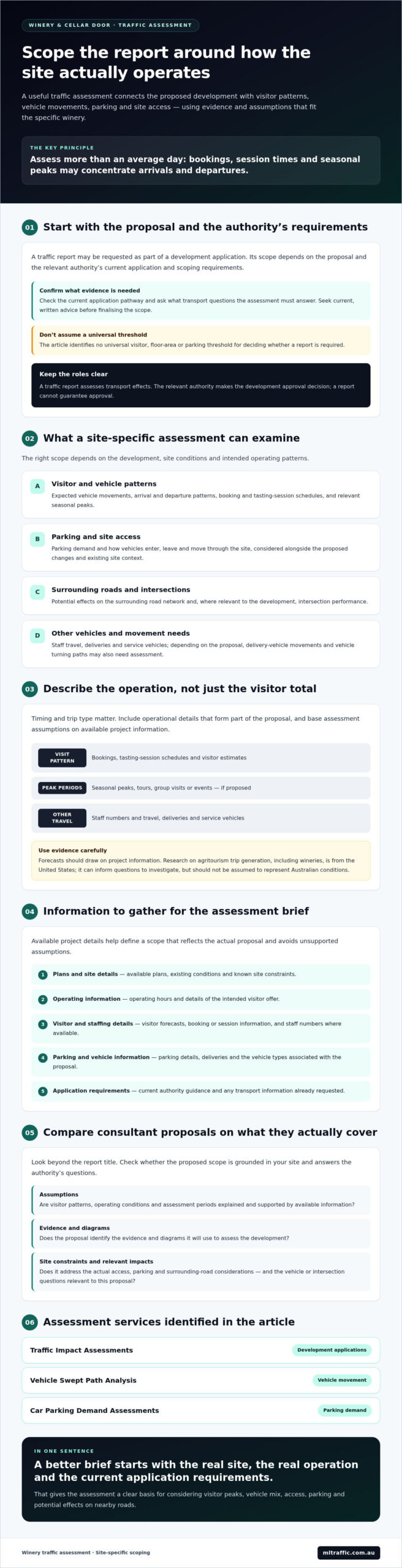
This article explains what a winery traffic report typically assesses, what project information can help define its scope and how to compare consultants’ proposals. You’ll also learn why a site-specific brief matters: it helps ensure the assessment considers your cellar door’s visitor peaks, vehicle mix and day-to-day operations, rather than relying on assumptions that may not suit your development application.
Key Takeaways
- Check the relevant authority’s current application and scoping requirements before deciding what assessment your proposal needs.
- A traffic report for a winery or cellar door should be scoped around the proposed development, site conditions and intended operating patterns.
- Compare consultant proposals by checking their assumptions, evidence, diagrams and how they address your actual site constraints.
- Gather available plans, operating hours, visitor forecasts and parking details to help define the assessment brief.
- ML Traffic Engineers prepares Traffic Impact Assessments, Vehicle Swept Path Analysis and Car Parking Demand Assessments for development applications.
When might a winery or cellar door need a traffic report?
A new cellar door, a larger tasting area or a change to the visitor offer can alter how people and vehicles use a winery site. A traffic report for a winery or cellar door provides project-specific evidence about transport effects, including vehicle access, parking and potential effects on the surrounding road network. Its purpose is to help the relevant authority assess the proposal, not to decide whether it should be approved.
The report’s scope should reflect the proposal and its operating model. Traffic assessment forms part of broader transportation planning, where the likely effects of changes to transport demand and facilities are considered. A report can inform a development application, but it can’t guarantee development approval.
For general background on attracting visitors to a winery, this webinar discusses search marketing:
What winery operations can affect traffic assessment?
Visitor numbers alone may not describe the transport demands of a cellar door. The timing and type of trips matter. Bookings, tasting session schedules and seasonal peaks can create concentrated arrival and departure periods, even if visitor activity is lower at other times.
Describe tours, group visits or events only if they form part of the proposed operation. Include staff travel, deliveries and service vehicles as well. For example, a proposal with scheduled group tastings and regular deliveries may need to account for different vehicle types and arrival patterns. The assumptions should be checked against available project information rather than treated as established facts.
What should you confirm before assuming a report is required?
Requirements depend on the proposal and the relevant authority’s assessment process. Don’t rely on a universal visitor, floor-area or parking threshold. Instead, review the application pathway and seek current, written advice from the relevant authority before finalising a consultant’s scope.
Ask whether transport information has been requested and what questions it must answer. Clarify whether the proposal involves a new venue, an expansion or a changed visitor offer, and provide the plans and operational details available. Check the authority’s current documentation and scoping requirements for your specific application.
A traffic report assesses transport effects; the relevant authority makes the development approval decision. Confirming the required evidence early can help you brief a traffic engineer on the actual proposal and avoid assumptions about what the application needs.
What should a cellar door traffic report assess?
A useful assessment connects the development proposal with the way the site operates. It should describe the existing site and surrounding transport context, the proposed changes, intended operations and assumptions used to assess travel demand. This gives the relevant authority a clear basis for considering access, parking and potential effects on nearby roads.
The scope is site-specific. A traffic report for a winery or cellar door may consider expected vehicle movements and whether particular periods could create concentrated arrivals or departures. Forecasts should be based on available project evidence, such as booking information, visitor estimates, staff numbers and operating hours. The Trip Generation at Virginia Agritourism Land Uses research examines trip-generation factors at agritourism sites, including wineries. Its findings are from the United States, so they should inform questions to investigate, not be assumed to represent Australian conditions.
How visitor patterns and traffic generation are assessed
Explain the proposed operation clearly. If tastings are booked in sessions, visitor arrivals may be more concentrated than at a venue with informal visits. If tours or events are part of the proposal, assess those conditions separately from typical operations where relevant. Seasonal peaks may also matter if they are supported by project information.
Traffic counts, survey methods and assessment periods should suit the proposal and the relevant authority’s requirements. A consultant should state what information the assessment relies on, what assumptions have been made and where estimates need confirmation. This makes it easier to review whether the analysis reflects the intended operation.
How access, parking and vehicle movements fit into the report
The report may examine how vehicles enter and leave the site, whether queues could affect the driveway or adjoining road, and how traffic circulates within the property. Sight distance at the access and internal circulation can be relevant, depending on the site layout and authority’s requested scope.
Parking demand should be considered against the proposed visitor and staff activity, available spaces and any relevant operational details. A Car Parking Demand Assessment can help explain the basis for the parking provision. Swept path diagrams may also be useful where larger vehicles need to enter, turn or exit. Consider the interaction between vehicles and pedestrians, cyclists, coaches or delivery vehicles where these users are part of the site’s context or proposed operation.
For broader context on report scope, see the Traffic Impact Assessment services offered by ML Traffic Engineers Australia. Defining the access, parking and vehicle-movement questions at the outset can help ensure the assessment responds to the actual proposal.
How to compare traffic report proposals for a winery
Compare proposals against the actual development and how the winery will operate, not just the service title. One consultant may include a broad traffic assessment while another scopes access, parking or vehicle movements as separate tasks. The lowest-fee or broadest-sounding scope isn’t automatically the best fit. Look for clear deliverables, stated assumptions and a defined connection to the development application.
| Proposal area | What to check |
|---|---|
| Scope | Does it address the proposed visitor offer, site access, parking and relevant effects on the surrounding road network? |
| Assumptions | Are operating hours, visitor forecasts, staff movements and any peak conditions identified, with their basis explained? |
| Evidence | Does the proposal specify what plans, site details, counts or other project information the assessment needs? |
| Diagrams | Are access or internal movement diagrams included? Is Vehicle Swept Path Analysis required for the vehicles using the site? |
| Application coordination | Does the scope explain how the assessment will respond to the authority’s stated requirements and any feedback or revisions? |
Distinguish the main assessment from related technical work. A Traffic Impact Assessment considers transport effects in the context of a development proposal. Vehicle Swept Path Analysis tests whether specified vehicles can manoeuvre through the proposed layout. Car Park Design addresses the layout of parking areas. These may be relevant to the same project, but confirm which deliverables are included, separately scoped or outside the proposal.
Questions to ask before appointing a traffic engineer
Ask what project documents and operating forecasts are needed, which analyses and drawings are included, and whether any task requires separate specialist input. Clarify how assumptions will be recorded, how authority feedback will be handled, and what revisions are allowed within the proposed scope. For broader context, see this Traffic Impact Assessment service overview.
How to assess technical fit and accountability
Look for relevant experience preparing development application assessments and completing comparable tasks, such as parking or access analysis. Ask who will undertake the technical work and communicate the findings. Review the consultant’s stated qualifications, assessment methods and written deliverables, then check that they match the authority’s current project-specific requirements.
A strong proposal makes its boundaries clear. It explains what the traffic report for a winery or cellar door will assess, what information it relies on and what remains outside scope. No consultant’s report can guarantee an approval outcome; the authority makes that decision.
What information should you prepare before commissioning a report?
A clear project brief helps a traffic engineer define an assessment that fits the proposed winery operation and the relevant authority’s requirements. Before commissioning a traffic report for a winery or cellar door, organise what you know, label estimates clearly and include any application correspondence. You don’t need to resolve every uncertainty first. The consultant should identify missing information and explain how it will be addressed.
Project and operating information to gather
Start with the development proposal, then add the available details about how the site will work. A useful preparation sequence is:
- Describe the proposal. Provide the development description, land-use details and any concept plans showing buildings, visitor areas and proposed changes.
- Share access and layout plans. Include driveway locations, internal roads, loading areas and parking layouts if available.
- Document the intended operation. Note proposed operating hours, expected visitor patterns and forecasts, staff movements and delivery arrangements where known.
- Identify additional activities. Include tours, group bookings or events only if they form part of the proposed business model. Separate ordinary operations from any proposed peak-day conditions where possible.
- Gather site and application records. Provide available information about existing access, parking and surrounding roads, along with application documents and written correspondence from the relevant authority.
Mark each item as confirmed, estimated or not yet known. For example, distinguish a visitor forecast based on bookings from an early planning estimate. Don’t present assumptions as verified traffic counts or field observations. Clear labels help the traffic engineer judge what can support the assessment and what may need further investigation.
Site and application information to confirm
Share the authority’s written advice, any requested supporting transport information and the specific questions the assessment needs to answer. If access visibility, parking capacity or vehicle movements have been raised, include that correspondence so the proposed scope can respond to it.
Available plans and records are useful starting points, but they don’t replace field evidence where the assessment requires it. Ask the traffic engineer to identify gaps, confirm whether additional information is needed and explain how uncertainty will be recorded. The final inputs depend on the site, proposal and authority feedback, so confirm current scoping requirements rather than relying on a generic checklist.
Review the relevant traffic engineering services to understand the assessment capabilities available for development applications. Once your project information is assembled, contact ML Traffic Engineers Australia about your assessment scope.
How ML Traffic Engineers can support a winery development assessment
Once you’ve identified the proposed operation, relevant site constraints and the assessment questions to address, you can compare your needs with a traffic engineering consultancy’s services. ML Traffic Engineers Australia prepares Traffic Impact Assessments and related access, parking and vehicle movement assessments for development applications. The firm has over 15 years of experience. This experience does not imply winery-specific project history or guarantee an approval outcome.
Matching assessment services to the project
The right scope depends on what the application needs to demonstrate. A Traffic Impact Assessment may examine how a proposal could affect the surrounding road network. If the site layout includes a constrained driveway or larger vehicles, Vehicle Swept Path Analysis can assess manoeuvres on the proposed layout. A Car Parking Demand Assessment can consider parking needs against the proposed use and project-specific evidence, such as visitor forecasts and operating information.
These assessments address different questions. They may be scoped together or separately, depending on the proposal and the relevant authority’s requirements. The team and experience at ML Traffic Engineers Australia provides further background on the consultancy.
A practical next step for winery owners and project teams
For a scope discussion, share the development description, available site and access plans, operating details, visitor forecasts and any written correspondence from the authority. Identify which figures are confirmed and which are estimates. This gives the consultant a clearer starting point for assessing the work required and identifying missing information.
Before work proceeds, confirm the proposed scope, required inputs, assumptions and deliverables. Check that the assessment responds to the current application requirements and reflects the winery’s intended operation. If the authority has asked specific transport questions, include them in the brief.
If you’re considering a traffic report for a winery or cellar door, contact ML Traffic Engineers Australia to discuss your project scope and the information available for your development assessment.
Set your winery development assessment up with a clear scope
A well-scoped traffic report for a winery or cellar door should reflect the proposed operation, site constraints and the relevant authority’s current requirements. Confirm what evidence the application needs, then compare consultant proposals by their assumptions, analyses and deliverables. Prepare available plans, operating details, visitor forecasts and authority correspondence so the traffic engineer can identify what’s known and what still needs checking.
ML Traffic Engineers has over 15 years of experience preparing Traffic Impact Assessments and related services, including Vehicle Swept Path Analysis and Car Parking Demand Assessment. These assessments can address different questions about surrounding road-network effects, vehicle manoeuvres and parking demand. The right scope depends on your proposal, and a report informs the authority’s assessment rather than guaranteeing approval.
Ready to clarify the next step? Discuss your winery development traffic assessment with ML Traffic Engineers. Bring the project information you have, and start with a focused conversation about the assessment scope that may suit your application.
Frequently Asked Questions
Does a winery or cellar door development need a traffic report?
Not every winery or cellar door proposal automatically requires a traffic report. The relevant authority determines the application material needed for the specific development, based on its proposal and potential transport effects. Before commissioning an assessment, check the current application guidance and seek written advice on whether transport information is required and what it must address. Don’t assume a universal visitor, floor-area or parking threshold applies to your project.
What does a traffic report for a cellar door include?
A traffic report for a cellar door generally describes the proposal, site context, intended operations and assessment assumptions. Depending on the authority’s requirements and site conditions, it may examine expected vehicle movements, peak periods, access, parking and effects on the surrounding road network. It can also consider vehicle manoeuvres, sight distance and interactions with pedestrians or cyclists where relevant. The final scope should reflect the actual development, not a generic checklist.
Can seasonal visitor peaks affect a winery traffic assessment?
Yes. Seasonal peaks can be relevant if they form part of the proposed operation and are supported by project information. The assessment may need to distinguish typical trading conditions from busier periods, such as concentrated arrivals for tasting sessions or proposed group visits. Provide available visitor forecasts, booking information and operating details, and identify estimates as estimates. The assessment period and any traffic survey requirements depend on the project and the authority’s current scope.
How do I compare traffic report proposals for a winery?
Compare each proposal against your winery’s planned operation and site constraints. Check whether it clearly states the assessment scope, assumptions, required evidence, drawings and how it will address the authority’s application questions. Confirm whether related work, such as Vehicle Swept Path Analysis or a Car Parking Demand Assessment, is included or scoped separately. A broad-sounding proposal may not cover your key needs, so ask what each deliverable will assess.
Will a traffic report guarantee development application approval?
No. A traffic report provides technical evidence to inform the development application assessment. It can explain anticipated transport effects and address questions about access, parking or the surrounding road network, but it doesn’t determine the application outcome. The relevant authority makes the approval decision and considers the proposal as a whole. Confirm the authority’s current requirements and make sure the report scope responds to them, without treating any consultant’s assessment as a guarantee.
What information should I give a traffic engineer before requesting a report?
Provide the development description, available concept and access plans, site details, proposed operating hours, visitor forecasts, parking information and known staff or delivery movements. Include authority correspondence and any specific questions raised about transport impacts. Mark information as confirmed, estimated or not yet available. The engineer can then identify missing inputs and confirm how uncertainties will be reported. The final information needed depends on the proposal, site and authority feedback.
Does a cellar door traffic report include parking and vehicle access?
It can, if those matters are relevant to the site and included in the agreed scope. A report may assess driveway access, vehicle entry and exit, internal circulation and parking demand. A Car Parking Demand Assessment can examine parking needs against the proposed use and available evidence, while Vehicle Swept Path Analysis can test vehicle movements on a proposed layout. Confirm which assessments and diagrams are included, as related services may be scoped separately.

Disclaimer
The content on www.mltraffic.com.au, including all technical articles, guides, and resources, is provided for general informational and educational purposes only. It is not intended to constitute professional advice in traffic engineering, transportation planning, development approvals, or any other technical or legal field.
While ML Traffic Engineers makes every reasonable effort to ensure the accuracy, completeness, and timeliness of the information published, we do not provide any warranties or representations (express or implied) regarding its reliability, suitability, or availability for any particular purpose. Any reliance you place on the content is strictly at your own risk.
In no event shall ML Traffic Engineers, its directors, employees, authors, or affiliates be liable for any direct, indirect, incidental, special, consequential, or punitive damages (including, without limitation, loss of profits, data, or business opportunities) arising out of or in connection with the use of, or inability to use, any information provided on this website.
The articles and guides on this site are not a substitute for engaging a qualified, registered professional traffic engineer (such as an NPER or RPEQ engineer) to assess your specific project requirements. For tailored advice, compliance assessments, or traffic engineering services, please contact a competent professional.
This disclaimer may be updated from time to time without notice. By accessing or using this website, you agree to be bound by the most current version of this disclaimer.
