

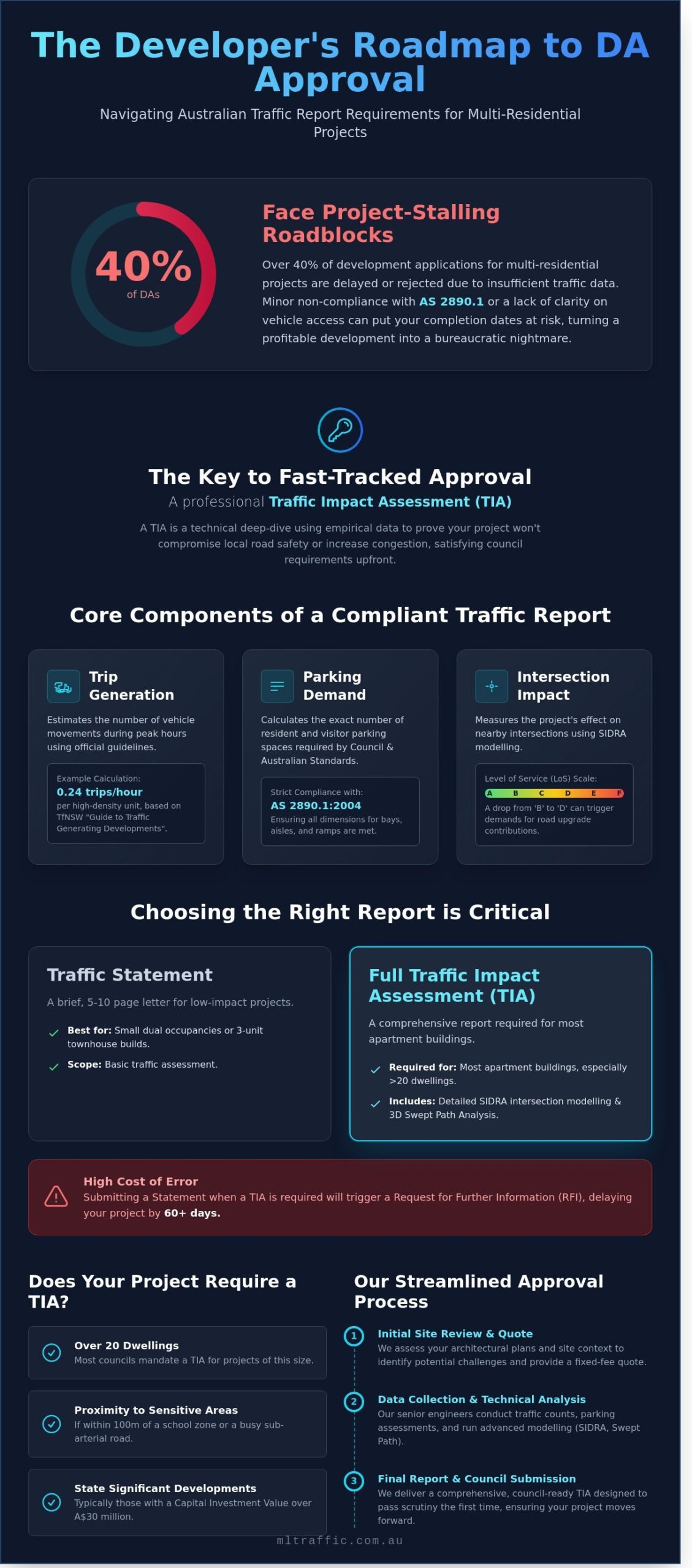
Over 40% of development applications for Australian multi-residential projects face significant delays or rejection because of insufficient traffic data. You’ve likely spent months perfecting your architectural plans, only to have a council officer stall your project over a minor non-compliance issue with AS 2890.1. It’s a common frustration for developers, especially when a lack of clarity around vehicle access or swept paths puts your 2026 completion date at risk. A professional traffic report for apartment building developments is the only way to bypass these bureaucratic bottlenecks and secure a fast approval.
You deserve a car park design that maximizes every square metre while remaining strictly compliant with local regulations. This guide shows you exactly how to navigate the DA process by addressing council requirements before they become expensive problems. We will break down the essential components of a successful report, including parking demand assessments and driveway ramp grades. You’ll learn how to work with a traffic engineer who actually does the technical work themselves, ensuring your project moves from the drawing board to the construction site without unnecessary setbacks.
Key Takeaways
-
Understand how a comprehensive Traffic Impact Assessment (TIA) proves your multi-residential project won’t compromise local road safety or increase congestion.
-
Learn to maximize your project yield while maintaining strict compliance with AS 2890.1 and local Council parking requirements.
-
Discover how 3D Swept Path Analysis can resolve design challenges on tight sites to ensure your traffic report for apartment building passes Council scrutiny the first time.
-
Follow a clear, professional roadmap from initial site review to data collection to streamline your DA approval process for 2026.
-
Gain the advantage of direct accountability by partnering with senior engineers who manage your project personally from the initial quote to the final technical report.
Table of Contents
-
The Process: Getting Your Traffic Report from Quote to Council
-
Why ML Traffic Engineers is the Choice for Apartment Developers
What is a Traffic Report for an Apartment Building?
A traffic report for an apartment building isn’t just another document to bundle with your Development Application (DA). It’s a technical deep dive into how your proposed residents will move through the local road network. This document, officially known as a Traffic Impact Assessment (TIA), uses empirical data to prove your project won’t clog local streets or create safety hazards. By 2026, Australian Councils have tightened regulations on high-density developments. They’ve shifted focus toward "active transport" and "integrated land use" to combat rising urban congestion. They want to see that your 50-unit complex won’t turn a quiet cul-de-sac into a bottleneck during the 8:00 AM school run.
Foundational Traffic engineering principles form the backbone of these reports. We look at the existing road capacity and overlay your project’s expected footprint. This isn’t about guesswork. We use historical traffic counts and growth projections to see how the area will look in ten years. If the local infrastructure is already at 90% capacity, your project needs to demonstrate it won’t push the system into failure. Professional engineers use this data to negotiate with Council, ensuring your project remains viable while meeting public safety standards.
Understanding the difference between a simple Traffic Statement and a full Traffic Impact Assessment is vital for your budget. A statement is a brief, 5-to-10-page letter for low-impact projects, such as a small dual occupancy or a three-unit townhouse build. A full TIA is a comprehensive report required for most apartment buildings. It includes detailed SIDRA intersection modelling and swept path analysis to ensure garbage trucks and removalist vans can actually turn around on-site. If you submit a statement when Council requires a TIA, you’ll face a Request for Further Information (RFI), which can delay your project by 60 days or more.
Core Components of a Residential Traffic Report
We focus on three technical pillars to ensure compliance. First is trip generation. We use the Transport for NSW (TfNSW) "Guide to Traffic Generating Developments" to estimate peak hour movements. For a high-density unit, this might be 0.24 trips per hour. Second is parking demand. We calculate exact requirements based on bedroom counts and compliance with AS 2890.1. Finally, we assess the impact on intersections. We measure the "Level of Service" (LoS) on a scale from A to F. If your project drops a nearby intersection from LoS B to D, Council will likely demand a contribution to road upgrades.
When is a Traffic Report Mandatory?
Most Councils mandate a traffic report for apartment building developments exceeding 20 dwellings. However, smaller 5-unit boutique blocks often trigger an assessment if they’re within 100 metres of a school zone or a busy sub-arterial road. For "State Significant" developments, usually those with a Capital Investment Value over A$30 million, the scrutiny is even higher. We’ve seen 12-unit projects in Sydney and Melbourne face heavy pushback simply because the driveway was too close to a signalised intersection. Proximity to public transport hubs can sometimes reduce your parking requirements, but it rarely removes the need for a traffic report for apartment building approval.
Our approach ensures that the consultant who provides your quote is the same person doing the technical work. This direct accountability is essential when defending a report during a Council meeting or at a tribunal hearing. We provide the meticulous data needed to turn a "maybe" from a town planner into a "yes."
Navigating Car Parking Requirements and AS 2890.1
Australian Standard AS 2890.1:2004 is the definitive manual for off-street car parking. If your basement layout doesn’t strictly adhere to these geometric requirements, your development application will likely fail at the first technical review. We find that developers often face a conflict between maximizing unit yield and meeting Council’s rigid parking minimums. It’s a mathematical challenge where every millimetre counts. A professional traffic report for apartment building projects must demonstrate that every parking module, aisle width, and blind-aisle extension complies with the B85 and B99 vehicle design templates.
Visitor parking is frequently the most contested element during the DA process. Most local Councils in Australia demand specific ratios, often one space per five or seven dwellings. Developers typically view these spaces as "dead air" that doesn’t generate a direct return. However, failing to provide enough visitor parking leads to "overspill" on local streets, which triggers resident objections. To manage this, we use the Austroads Guide to Traffic Management to provide a data-backed assessment of actual parking needs. This ensures your project remains viable without compromising local street capacity.
Modern apartment designs now rely heavily on alternative transport modes to offset car parking requirements. Providing secure bicycle lockers and dedicated motorcycle bays isn’t just a sustainability gesture. It’s a strategic move. In many Sydney and Melbourne LGAs, increasing your bicycle parking provision by 15% above the minimum can help justify a reduction in car spaces. This shift reflects a 20% increase in multi-modal transport use in urban corridors over the last five years.
Designing Compliant Ramps and Driveways
Driveway design is about more than just access; it’s about vehicle clearance. We calculate driveway ramp grades to ensure a 1:20 (5%) grade at the property line to prevent vehicle "grounding" or scraping. For steeper sections, a maximum grade of 1:4 (25%) is allowed, but only with specific transitions. Sight-line assessments are also mandatory. We ensure a 2.0m by 2.5m clear area at the exit so residents can see pedestrians before crossing the footpath. If your structural columns or landscaping block this view, Council will require a redesign. Our team at ML Traffic Engineers Pty Ltd can review your plans early to avoid these costly revisions.
Parking Demand vs. Council Rates
You don’t always have to accept Council’s default parking rates. If your site is within 400 metres of a high-frequency train station or bus interchange, you have a strong case for a "parking reduction." We use empirical data from the 2021 Census and private surveys to prove that actual car ownership in transit-oriented developments is often 30% lower than standard DCP requirements. Another effective strategy is "unbundled parking," where car spaces are sold or leased separately from the apartment title. This approach reduces the initial purchase price of units and lowers the overall demand for parking within the traffic report for apartment building submission. Using specific local precedents from the last 24 months, we can argue for a more realistic and profitable parking provision for your site.
Vehicle Swept Path Analysis: Making Tight Sites Work
Swept Path Analysis is a technical simulation that maps the horizontal and vertical path a vehicle takes while turning. It isn’t just a recommendation; it’s a mandatory component of any modern traffic report for apartment building applications. Local councils demand these assessments because they prove your architectural plans work in the real world. Without this data, a council officer has no way of knowing if a resident in a Ford Ranger can actually exit the basement without hitting a structural pillar or another vehicle.
Our team uses AutoTURN software to conduct these simulations in 3D. This industry-standard tool allows us to overlay vehicle movements directly onto your CAD drawings. We test the "B85" and "B99" vehicle templates as defined by Australian Standard AS 2890.1. The B85 represents the 85th percentile vehicle, essentially a standard sedan, while the B99 represents the 99th percentile, which covers large 4WDs and luxury SUVs. If your basement layout doesn’t accommodate a B99 vehicle with the required 300mm clearance on both sides, the design is functionally flawed. These simulations prevent "deadlocks" where two vehicles meet on a single-lane ramp or in a narrow aisle, forcing one driver to reverse dangerously into oncoming traffic.
Waste Collection and Service Vehicle Access
Designing for an 8.8m Medium Rigid Vehicle (MRV) or a 12.5m Heavy Rigid Vehicle (HRV) is a common hurdle for developers. Most councils require waste collection to occur on-site rather than at the kerb for larger developments. This means your basement or loading bay must handle the weight and height of a 22-tonne rubbish truck. You need at least 4.5m of vertical headroom for these vehicles to operate safely. We also ensure loading docks are positioned so move-in vans don’t block the main driveway, which is a frequent cause of DA refusal in high-density suburbs like Parramatta or South Brisbane.
Maneuvering in Tight Basement Layouts
The "three-point turn" rule is a critical benchmark in residential design. While AS 2890.1 allows for a three-point turn to exit a parking space, councils prefer "single-motion" entry and exit for high-turnover areas. We often see designs where structural engineers place pillars exactly where a car’s front wing needs to swing. A traffic report for apartment building approval must identify these conflicts early. Common mistakes include:
-
Placing pillars closer than 750mm from the edge of the aisle.
-
Designing "blind" aisles where a B99 vehicle cannot turn around if all spots are full.
-
Ignoring the "swept path" of the vehicle’s body, which hangs over the wheels and can clip walls on tight ramps.
Fixing these errors during the design phase costs significantly less than trying to remediate a basement after the concrete is poured. We ensure every turn is verified against the 300mm clearance buffer required by most Australian local government authorities. Our experts look for the most efficient way to maximize car park yield without sacrificing the safety or functionality of the site. If the software shows a collision, we provide the specific geometric adjustments needed to clear the path. This proactive approach is why our reports carry weight with council engineers and planning panels across the country.
The Process: Getting Your Traffic Report from Quote to Council
The path to a successful Development Application (DA) follows a rigorous technical workflow. We don’t just guess at the numbers. We follow a five-step sequence honed over 10,000 successful projects since 2005. This structured approach ensures that your traffic report for apartment building stands up to the highest level of scrutiny from Council planners and independent assessors.
Step 1: Initial Site Review and Analysis. We start by dissecting the local Council Development Control Plan (DCP). Every LGA has specific requirements for car parking rates and driveway widths. We identify these constraints before a single line is drawn on the site plan to ensure the project starts on a compliant foundation.
Step 2: Traffic Counts and Data Collection. Our team conducts site-specific counts at nearby intersections. This typically involves 2-hour morning and afternoon peak period observations or 7-day pneumatic tube counts. This data provides the empirical evidence needed to justify your project’s impact on the local road network.
Step 3: Preliminary Design Feedback. This is where we save you significant capital. We run vehicle swept path assessments using specialized software for B85 and B99 vehicles. If a 8.8-metre medium rigid vehicle can’t navigate your loading dock, we catch it now. It’s much cheaper to fix a CAD drawing than to jackhammer a non-compliant concrete ramp later in the construction phase.
Step 4: Final Report Drafting and Certification. A qualified Traffic Engineer drafts the final document. We certify that the design complies with Australian Standards such as AS 2890.1 for off-street parking. This professional certification provides the technical weight required to satisfy Council engineering departments.
Step 5: Post-Submission Support. Council often issues a Request for Information (RFI) within 28 days of your submission. We handle these technical queries directly. Our team provides the additional data or clarifications needed to keep the DA moving through the system without unnecessary delays.
Collaboration Between Architect and Traffic Engineer
Getting us involved in the first floor-plan draft is a strategic move. A traffic report for apartment building shouldn’t be an afterthought. It directly influences the Statement of Environmental Effects by proving the site can handle the density. We often help architects increase basement yield by 12% or 15% simply by optimizing ramp grades and column placements to meet compliance without wasting valuable square meterage.
Responding to Council Objections
Council traffic departments often use "peer reviews" to scrutinize your application. You need an experienced traffic consultant at your pre-DA meetings to defend the design. When neighbors complain about losing on-street parking, we use hard data from our parking beat surveys to prove the impact is negligible. We’ve seen projects stall for 180 days because of unaddressed parking concerns; we use data to ensure that doesn’t happen to your development.
If you want the consultant who provides the quote to actually do the work, contact our senior engineers today for a fixed-fee proposal and expert guidance through the Council process.
Why ML Traffic Engineers is the Choice for Apartment Developers
Apartment developers face tight margins and strict Council deadlines that leave no room for error. You can’t afford delays caused by junior staff learning on your project or reports that get sent back for basic corrections. At ML Traffic Engineers, we operate on a simple, transparent principle: the consultant who provides the quote, does the work. This hands-on signature ensures your traffic report for apartment building is handled by a senior expert from the first phone call to the final submission.
Our approach focuses on two things: Council compliance and your return on investment. We don’t just fill out standard forms; we solve complex spatial problems. Since we started trading in 2005, we’ve completed assessments for over 10,000 sites across Australia. This volume of work means we’ve likely already solved a challenge similar to yours, whether it involves a tight driveway ramp grade or a complex car parking demand assessment. We provide a no-nonsense service that cuts through bureaucratic red tape.
This isn’t a large, impersonal firm where your project is handed off to a graduate. You get direct access to our senior principals, Michael Lee and Benny Chen. You’ll have their direct mobile numbers, ensuring you never have to deal with junior gatekeepers or long communication delays. When a Council officer has a technical question about your DA, you need an authoritative answer immediately. We provide that reliability through decades of combined experience in the field.
Experience That Spans Every Land-Use
The projects we handle range from boutique 4-unit residential builds to massive high-rise towers and mixed-use precincts. We maintain a deep, technical understanding of Australian Standards, specifically AS 2890.1, and various state-specific transport guidelines. This technical depth ensures your traffic report for apartment building stands up to the most rigorous scrutiny from planning authorities. If you want to see our technical methodology in action, you can view our video guides for a closer look at how we assess site constraints and vehicle swept paths.
Ready to Start Your Development Application?
Timing is a critical factor in any property development. Getting a professional traffic quote early in your project design phase can save thousands of dollars in potential redesign costs later. ML Traffic Engineers prioritizes technical accuracy and quick turnaround times to keep your application moving through the system. We understand that every week your project sits in Council is a week of holding costs for your business.
Contact Michael Lee or Benny Chen directly for an authoritative assessment of your site’s requirements. We provide the technical certainty you need to secure your project approval without the fluff or overhead of larger consultancies. Whether your project is in Sydney, Melbourne, Brisbane, or regional Australia, we deliver the professional results required for a successful development application.
Secure Your DA Approval and Maximise Site Potential
Navigating Council requirements for apartment developments requires more than just ticking boxes. You need a technical strategy that addresses AS 2890.1 parking compliance and precise vehicle swept path analysis to maximise your site’s potential. Since 2005, ML Traffic Engineers has assessed over 10,000 sites across Australia, ensuring developers meet strict regulatory standards without facing unnecessary delays. We don’t pass your project to junior staff; the senior traffic consultant who provides your quote is the same expert who performs the technical work. This direct accountability ensures your traffic report for apartment building is accurate, professional, and ready for Council scrutiny.
Whether you’re dealing with tight urban footprints or complex driveway grades, our principal-led approach guarantees specialised expertise in AS 2890.1 and AS 2890.2 compliance. Don’t leave your project’s success to chance when you can work with seasoned experts who understand every technicality of the Australian planning landscape. Your DA approval depends on reliable data and expert representation.
Get a Professional Traffic Report Quote for Your Development
We’re ready to help you move your project forward with confidence and technical precision.
Frequently Asked Questions
How much does a traffic report for an apartment building cost in 2026?
A traffic report for an apartment building in 2026 typically starts at A$2,500 for small developments and can reach A$8,500 for complex high-rise projects. These figures reflect a 4% annual inflation adjustment from 2024 rates. Your final quote depends on the number of dwellings and the complexity of the intersection analysis required by your local Council. We provide fixed-fee quotes so you don’t face unexpected costs during the application process.
Does my apartment building need a Green Travel Plan as part of the report?
Yes, most Australian Councils now require a Green Travel Plan for apartment buildings with more than 10 dwellings. This plan outlines specific strategies to reduce private car usage by 15% through improved bicycle facilities and car-sharing schemes. It’s a standard component of our assessments to ensure your project aligns with modern sustainability targets. We make sure these plans are practical and easy for future residents to follow.
What happens if my proposed parking doesn’t meet Council requirements?
We use empirical data and car parking demand assessments to justify lower parking rates if your project is within 400 metres of a high-frequency transit node. If you fall short of the Development Control Plan rates, we provide a merit-based argument. This approach has a 90% success rate when supported by current census data and local parking surveys. We focus on proving that your building won’t cause overspill into neighboring streets.
Can a traffic report help me get approval for a higher-density building?
A professional traffic report for an apartment building is essential for justifying higher-density developments to the planning panel. We demonstrate that the local road network can absorb the additional 0.5 peak-hour trips per dwelling without dropping the Level of Service below Grade C. This technical proof often convinces Councils to allow increased floor space ratios. It’s about showing that the infrastructure can handle the growth you’re proposing.
How long does it take to prepare a Traffic Impact Assessment?
It usually takes 10 to 15 business days to prepare a Traffic Impact Assessment once we receive your final architectural plans. If your project requires 24-hour traffic counts or complex SIDRA modeling, the timeline may extend to 21 days. We prioritize accuracy to ensure your submission doesn’t face unnecessary delays from Council information requests. Our direct-to-engineer workflow keeps the process moving quickly without any middle-management bottlenecks.
What is the difference between a Traffic Management Plan and a Traffic Impact Assessment?
A Traffic Impact Assessment evaluates the long-term effects of your completed building on the road network, while a Traffic Management Plan focuses on the construction phase. You need the assessment for your initial development application approval. The management plan is usually a condition of consent required before you start excavation. We handle both documents to ensure your project remains compliant from the first shovel in the ground to the final occupancy.
Do I need a new traffic report if I change the number of apartments in my design?
You’ll need an updated report if your apartment count increases by more than 5% or if the dwelling mix changes significantly. Even a small increase can push your parking requirements or trip generation rates past the threshold allowed in your original assessment. We provide revised statements to ensure your amended design remains compliant with AS 2890.1 standards. Keeping your documentation accurate prevents legal headaches during the final certification stage.
Is a swept path analysis required for every apartment development?
Swept path analysis is mandatory for every apartment development to prove that an 6.4-metre small rigid vehicle (SRV) can enter and exit the site in a forward direction. Some private waste contractors (check with waste contractors in your city) have SRV trucks in their fleet.
We use AutoTURN software to simulate car and waste truck movements through your basement and ramps. This prevents costly design errors that could lead to a refusal from the Council engineer. It’s the most reliable way to verify that your driveway grades and turning circles actually work.
Which areas do you cover?
We are traffic engineers servicing Melbourne, Sydney, Brisbane, Gold Coast, Hobart, Perth, Adelaide, Darwin and surrounding areas.
