

Your land-use transition is more than a simple change of signage; it’s a fundamental shift in traffic generation that most Australian councils view with extreme scrutiny. You probably know that a successful development application depends on more than just floor plans, yet the uncertainty surrounding parking shortfalls and AS 2890 compliance often leads to debilitating project delays. Securing a professional traffic report for change of use application is the only way to prove the delta between old and new traffic profiles is manageable and compliant with current infrastructure requirements.
We understand the frustration of receiving a Request for Information (RFI) that stalls your project for months and inflates your consultancy fees. This 2026 developer’s guide teaches you exactly when a specialist assessment is mandatory and how to present data that satisfies council requirements on the first submission. You’ll learn how to optimise car park layouts and balance parking demand versus supply according to strict Australian Standards. We provide a clear roadmap to achieving council approval without traffic-related conditions, ensuring your land-use transition remains on schedule and within budget.
Key Takeaways
- Identify the specific triggers, such as parking shortfalls or increased trip generation, that make a traffic report for change of use application a mandatory requirement for council approval.
- Differentiate between a concise Traffic Statement and a full Traffic Impact Assessment (TIA) to ensure you commission the appropriate level of detail for your project’s scale.
- Learn how to utilise parking demand assessments and AS 2890 compliance to justify parking shortfalls and optimise your site’s car park layout.
- Understand the technical role of traffic modelling in proving your land-use transition will not adversely affect the capacity of the surrounding local road network.
- Recognise how direct principal involvement and personnel continuity ensure your technical documentation meets rigorous regulatory standards without the risk of costly RFIs.
What is a Traffic Report for a Change of Use Application?
A traffic report for change of use application is a specialised technical document prepared by a qualified traffic engineer to evaluate the impact of transitioning a property from its current permitted use to a new one. Unlike a report for a greenfield development, this assessment focuses specifically on the “net increase” in traffic and parking demand. Councils require this data to confirm that the existing road network, intersections, and on-site parking facilities can accommodate the intensified activity without compromising safety or efficiency. This document serves as a core component of your Statement of Environmental Effects (SEE), providing the technical evidence needed to justify the proposal during the development application process.
Why ‘Change of Use’ is Treated Differently by Council
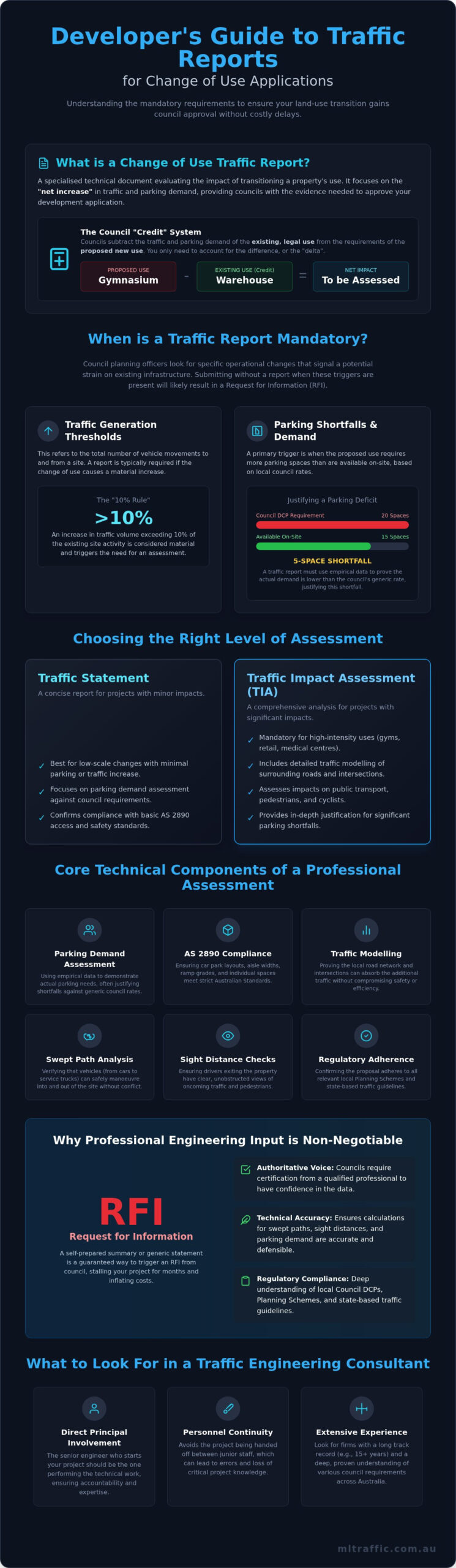
Councils utilise a “credit” system for land-use transitions. This means the parking and traffic generation associated with your existing, legally established use is subtracted from the requirements of the proposed use. You only need to provide for the additional demand created by the new business. For example, converting a warehouse into a high-intensity fitness centre allows you to receive a credit for the warehouse’s historical demand. A professional traffic report for change of use application quantifies this delta. This is vital because an intensification of use, moving from low-frequency storage to high-frequency retail, often shifts the peak demand periods. We analyse these specific peak hours to ensure they don’t coincide with local traffic congestion, which is a primary concern for planning officers. To support the commercial success of such a transition, SY Mathews provides small businesses with dedicated on-site business advisory services.
The Legal Requirement for Professional Engineering Input
Submitting a self-prepared parking summary or a generic statement is a guaranteed way to trigger a Request for Information (RFI). Councils demand certification from a qualified professional who understands the nuances of local Planning Schemes and state-based traffic guidelines. At ML Traffic Engineers Australia, we leverage over 15 years of consultancy experience to ensure every assessment adheres to AS 2890 standards and specific council policies. Our technical services provide the authoritative voice required to give council peace of mind. Professional engineering input ensures that your calculations for swept paths, sight distances, and parking demand are accurate and defensible. We maintain a personnel continuity promise, meaning the senior principal who initiates your project is the one performing the technical work. This direct access to leadership at ML Traffic Engineers Australia eliminates the bureaucracy found in larger firms and ensures your application meets rigorous regulatory standards.
Key Triggers: When is a Traffic Report Mandatory?
Australian councils focus on how a new business activity changes the demand on the public road network. Even if you aren’t laying a single brick, a change in land use can trigger a mandatory requirement for a professional assessment. Council planning officers look for specific operational changes that suggest the existing infrastructure might be overwhelmed by the proposed intensification. Identifying these triggers early prevents the common mistake of submitting an application that is immediately stalled by a Request for Information (RFI).
Traffic Generation Thresholds
Parking Shortfalls and Demand Assessments
A primary trigger for a traffic report is a shortfall in on-site car parking spaces based on the local council’s Development Control Plan (DCP) rates. If your new land use requires 20 spaces but the site only provides 15, you must justify the five-space deficit. We use empirical data from similar sites to demonstrate that the actual parking demand is lower than the generic council rates. In urban centres with high public transport accessibility, we often integrate Green Travel Plans. these strategies encourage walking, cycling, and transit use to further mitigate the perceived impact of a parking shortfall. You can discuss your project requirements with a senior principal to determine if a demand assessment is the right strategy for your site.
Vehicle Manoeuvring and Access Changes
Changes to delivery requirements or site access points also mandate technical engineering input. If your transition involves moving from small delivery vans to Heavy Rigid Vehicles (HRVs), you must prove the larger trucks can enter and exit the site in a forward direction. This requires a professional swept path analysis to verify that the internal circulation and loading dock configurations are functional. Safety is the priority; council will not approve a change of use if the revised vehicle “Type” creates a risk to pedestrians or impedes the flow of traffic on the adjacent roadway. Our experts ensure your site layout complies with AS 2890.2 for commercial vehicles, providing the technical certainty needed for approval.
Traffic Statement vs. Traffic Impact Assessment (TIA)
Selecting the appropriate scale for your technical documentation is a critical decision in the development application process. A traffic report for change of use application isn’t a one-size-fits-all document. Councils generally categorise requirements based on the intensity of the proposed activity and its potential to disrupt the local road network. Choosing a full assessment for a minor change leads to over-capitalisation on consultancy fees, while a basic statement for a complex project results in an immediate rejection or a lengthy RFI period.
When a Traffic Statement is Sufficient
A Traffic Statement is a concise document designed for low-impact developments where the transition generates minimal additional vehicle movements. This is typical for changes such as converting a small professional office into a boutique retail space. A statement is usually sufficient if your proposal meets the following criteria:
- The net increase in peak hour vehicle trips is negligible.
- The existing on-site parking fully complies with the local council’s Development Control Plan rates.
- No physical changes are proposed to the existing driveway or site access points.
The primary advantage of a Traffic Statement is efficiency. It focuses on site access and basic parking compliance, allowing for a faster turnaround and lower technical costs without compromising the quality of the submission. It provides the necessary professional assurance that the land-use change fits within the existing infrastructure capacity.
When a Full TIA is Non-Negotiable
A Traffic Impact Assessment (TIA) is mandatory for high-impact land-use transitions that fundamentally alter the traffic profile of a site. Detailed modelling is required for uses like childcare centres, medical clinics, or large-scale industrial facilities. These developments often involve significant heavy vehicle movements or complex internal circulation patterns. At ML Traffic Engineers Australia, we ensure that high-impact applications include rigorous intersection analysis and swept path modelling. A full TIA is non-negotiable when your project:
- Fronts a classified road or impacts a major signalised intersection.
- Requires a significant parking shortfall justification through empirical demand data.
- Involves a completely revised car park layout that must demonstrate AS 2890.1 compliance for parking stall geometry and ramp grades.
Our experts at ML Traffic Engineers Australia address council concerns regarding road safety and network capacity before they become roadblocks to your development. This level of detail is vital for complex sites where parking demand and vehicle manoeuvring are under heavy scrutiny. By providing a comprehensive TIA, we ensure the technical depth is sufficient to justify the “delta” between the old and new use.
Technical Components of the Assessment Process
The technical preparation of a traffic report for change of use application begins with a rigorous data collection phase. We conduct on-site surveys to establish a baseline of current traffic and parking volumes, ensuring the “credit” for the existing use is accurately quantified. This is followed by proposed use modelling, where we apply industry-standard rates from sources like Transport for NSW or the Institute of Transportation Engineers (ITE) to predict the future demand of the new business activity. A detailed audit then compares this predicted demand against the available on-site and off-site supply, identifying any potential shortfalls that require engineering justification.
Vehicle Swept Path Analysis for New Deliveries
When a land-use transition introduces new delivery requirements, we utilise AutoTURN software to simulate vehicle movements. This is essential for proving that waste collection trucks or delivery vans can enter and exit the property in a forward direction without striking infrastructure or encroaching on pedestrian zones. We test the site against the ‘B99’ design vehicle as specified in Australian Standards to ensure universal accessibility for the majority of passenger vehicles. Swept path analysis provides a digital blueprint of a vehicle’s turning circle to ensure it fits within the proposed site layout.
Parking Layout and AS 2890 Compliance
Compliance with AS 2890.1 for off-street car parking and AS 2890.6 for accessible parking is non-negotiable for council approval. We verify that bay widths, aisle widths, and blind-aisle extensions meet the specific requirements of the user class associated with your new land use. Integrating professional car park design during the early planning phase prevents costly structural changes later in the development cycle. Our assessments also include driveway ramp grade checks and sight distance reviews to ensure the safety of all road users entering the public road network.
Intersection and Road Network Impact
For developments located near high-volume roads, we perform Sidra modelling to assess the impact on local intersections. This software calculates the Level of Service (LoS), which measures the delay and congestion experienced by motorists. If the modelling indicates a decrease in LoS, we propose mitigation measures such as revised line-marking, turn bans, or minor infrastructure adjustments to maintain network efficiency. Contact our senior principals to ensure your technical documentation meets these rigorous standards and prevents unnecessary council delays.
Securing Approval: How ML Traffic Engineers Australia Assist
Navigating the bureaucratic requirements of Australian local councils requires a technical partner who understands the nuances of planning schemes and infrastructure capacity. With over 15 years of consultancy experience, ML Traffic Engineers Australia specialises in delivering the technical documentation needed to secure council approval without traffic-related conditions. Our firm focuses on providing a professional traffic report for change of use application that is both defensible and practical, ensuring your land-use transition remains commercially viable. We maintain a proven track record in preventing costly Requests for Information (RFIs) by addressing potential parking and access issues before the application is lodged.
The ML Traffic Engineers Australia Advantage for Developers
We operate with a personnel continuity promise that distinguishes our consultancy from larger, more impersonal firms. There are no gatekeepers here. The senior principal who initiates your project is the same expert who performs the technical work and signs off on the final report. This direct access to leadership at ML Traffic Engineers Australia ensures accountability and a deep understanding of your project’s specific constraints. Our comprehensive range of traffic engineering services includes everything from vehicle swept path analysis to complex intersection modelling. We provide national expertise, having successfully managed applications across all Australian local councils, which allows us to adapt our technical strategies to meet varying state and local planning policies.
Next Steps for Your Change of Use Application
Preparing for a successful submission begins with an initial review of your current site plans. To ensure a streamlined process, developers should have the following information ready for our engineering team:
- Detailed floor plans of the existing and proposed land use.
- Site layouts showing current parking configurations and access points.
- Operational details, including expected staff numbers and delivery frequencies.
Once we receive these documents, we provide a project-specific fee proposal and a clear timeline for delivery. A standard traffic report for change of use application typically involves a site visit, data collection, and technical modelling to justify any parking shortfalls or access changes discussed in previous sections. Our goal is to maximise your site’s potential while ensuring full compliance with AS 2890 standards. You can contact ML Traffic Engineers Australia today to discuss your development goals and secure the technical expertise required for a successful council outcome.
Finalising Your Land-Use Transition for Council Approval
A successful change of use application hinges on accurately quantifying the net increase in traffic and parking demand. Whether your project requires a streamlined Traffic Statement or a full-scale TIA, the technical documentation must adhere to AS 2890 standards and local government policies to avoid the risk of costly RFIs. Securing a professional traffic report for change of use application is the most effective way to address council concerns regarding network capacity and safety early in the planning process. Proactive engineering ensures that your development remains on schedule and avoids the frustration of administrative delays.
ML Traffic Engineers provides over 15 years of consultancy experience and national Australian coverage to ensure your submission meets these rigorous requirements. Our senior principal involvement ensures you receive direct access to the expert performing your technical work, providing accountability and results-oriented solutions for every land-use transition. We focus on practical engineering that supports your development goals without unnecessary bureaucracy. You can Request a Traffic Report Quote for Your Change of Use Application to receive a project-specific fee proposal and timeline. We look forward to assisting you with your next development application.
Frequently Asked Questions
Do I need a traffic report if I am not changing the building footprint?
Yes, a traffic report for change of use application is often mandatory even when the building footprint remains unchanged. Councils assess the intensity of the land use rather than just the physical structure. For instance, transitioning from a low-impact warehouse to a high-frequency gymnasium significantly increases vehicle movements and parking demand. Engineers must quantify this shift to prove the existing road network and on-site facilities can handle the new operational requirements.
How much does a traffic report for a change of use cost?
The cost of a professional assessment depends entirely on the complexity of the land-use transition and the specific requirements of your local council. A concise Traffic Statement for a low-impact change generally requires fewer technical resources than a full Traffic Impact Assessment involving intersection modelling. Factors such as the need for swept path analysis or parking demand surveys will influence the final fee proposal. We provide project-specific quotes based on your site plans and council requirements.
Can I use the traffic report from the previous tenant for my application?
You cannot typically reuse a previous tenant’s report because councils require an assessment specific to your proposed operations. Traffic generation rates vary significantly between different business types, even within the same land-use category. An outdated report will not account for your specific peak-hour movements, delivery requirements, or parking demand. A fresh traffic report for change of use application ensures all data reflects current Australian Standards and reflects the specific impact of your new business model.
What happens if my new business doesn’t meet the council’s parking requirements?
If your site cannot provide the number of spaces required by the Development Control Plan, we must prepare a formal parking demand assessment. We utilise empirical data from similar developments to prove that the actual demand is lower than the generic council rates. We may also propose a Green Travel Plan or highlight proximity to public transport to justify the shortfall. This technical justification is essential for securing approval without being forced to reduce your floor area.
How long does it take for a traffic engineer to prepare a report?
Preparation timelines vary based on the scale of the assessment and the availability of site-specific data. A standard Traffic Statement can often be completed within one to two weeks, whereas a full TIA requiring multi-day traffic counts or intersection modelling may take longer. We prioritise personnel continuity, meaning the senior principal managing your project handles the technical work directly to ensure a streamlined delivery that aligns with your development application deadlines and project milestones.
Will a traffic report guarantee my DA approval?
No consultant can guarantee a Development Application (DA) approval, as the final decision rests with the council planning officers. However, a professional report significantly increases your chances by addressing technical concerns before they become roadblocks. By providing defensible data on AS 2890 compliance and traffic impact, we mitigate the risk of refusal. Our focus is on presenting a compliant, evidence-based case that satisfies the bureaucratic requirements of the local government authority on the first submission.
Is a swept path analysis always required for a change of use?
Swept path analysis is mandatory if your land-use transition involves changes to delivery vehicle sizes or modifications to the internal car park layout. If you are moving from small vans to heavy rigid vehicles, you must prove these larger trucks can safely enter and exit the site in a forward direction. Councils require this digital blueprint to verify that vehicle movements comply with Australian Standards and do not pose a safety risk to other road users.
What is the difference between a Traffic Management Plan and a Traffic Report?
A traffic report is a technical assessment used to secure planning approval by evaluating the long-term impact of a development. In contrast, a Traffic Management Plan (TMP) or Traffic Guidance Scheme (TGS) outlines the specific methods for managing vehicle and pedestrian flow during construction or special events. While a report focuses on land-use suitability and parking supply, a management plan deals with the physical implementation of temporary traffic control measures on the public road network.

Disclaimer
The content on www.mltraffic.com.au, including all technical articles, guides, and resources, is provided for general informational and educational purposes only. It is not intended to constitute professional advice in traffic engineering, transportation planning, development approvals, or any other technical or legal field.
While ML Traffic Engineers makes every reasonable effort to ensure the accuracy, completeness, and timeliness of the information published, we do not provide any warranties or representations (express or implied) regarding its reliability, suitability, or availability for any particular purpose. Any reliance you place on the content is strictly at your own risk.
In no event shall ML Traffic Engineers, its directors, employees, authors, or affiliates be liable for any direct, indirect, incidental, special, consequential, or punitive damages (including, without limitation, loss of profits, data, or business opportunities) arising out of or in connection with the use of, or inability to use, any information provided on this website.
The articles and guides on this site are not a substitute for engaging a qualified, registered professional traffic engineer (such as an NPER or RPEQ engineer) to assess your specific project requirements. For tailored advice, compliance assessments, or traffic engineering services, please contact a competent professional.
This disclaimer may be updated from time to time without notice. By accessing or using this website, you agree to be bound by the most current version of this disclaimer.
