

Your development finance application isn’t just a test of your creditworthiness; it’s a rigorous audit of your site’s operational viability. With typical interest rates for ten-year fixed commercial loans reaching up to 7.75% as of May 2026, lenders have zero tolerance for projects that can’t prove their technical functionality. Securing a professional traffic report for development finance application is no longer a mere regulatory hurdle. It’s a critical financial de-risking tool that protects your project equity from being sidelined by unexpected lender requirements or parking-related yield reductions.
We understand the pressure of meeting urgent finance deadlines while facing Request for Information (RFI) delays that stall your funding. Lenders are increasingly risk-averse as 1.5 trillion dollars in commercial debt nears maturity by the end of 2026. This guide demonstrates how a professional traffic report mitigates lender risk and secures your development finance approval by utilizing the latest ITE Trip Generation Manual 12th Edition standards. You’ll learn how technical accuracy in swept path analysis and sight distance assessments minimizes delays and ensures your site design remains fully compliant.
Key Takeaways
- Understand the technical distinction between a standard Council TIA and the specific traffic report for development finance application required to satisfy lender due diligence.
- Identify how detailed parking demand assessments and vehicle swept path analysis protect project equity by ensuring site functionality and preventing Council rejection.
- Learn why a traffic engineer’s signature on a finance submission validates asset accessibility and significantly reduces the frequency of lender-issued Requests for Information.
- Discover how early-stage traffic analysis identifies design flaws before loan draw-down, allowing you to maximize commercial yield while remaining compliant.
- Gain insights into how direct principal involvement in your assessment ensures technical accountability and a streamlined approval process for your development.
Table of Contents
What is a Traffic Report for Development Finance?
A traffic report for development finance application is a specialized technical document that validates the operational feasibility of a project’s transport design. While a local council focuses on public infrastructure impacts, a financier uses this report to protect their capital investment. It confirms that the site can physically accommodate the vehicles required for its intended use. This assessment is a standard component of What is Transportation Planning? on a site-specific level; it ensures that future tenants won’t face accessibility issues that could lead to lease defaults or reduced asset value.
To better understand the technical requirements of this assessment, watch this detailed explanation:
For Tier 1 and Tier 2 lenders, this report is often a non-negotiable requirement within the ‘Conditions Precedent’ (CP) of a loan offer. Funding isn’t released until the lender’s risk department reviews a professional assessment signed by a qualified engineer. This ensures the developer hasn’t overlooked critical constraints like inadequate parking or non-compliant driveway grades. These issues could trigger expensive rectifications or Council rejection after the loan is drawn down, jeopardizing the project’s financial stability.
Traffic Impact Assessment (TIA) vs. Traffic Statement
Financiers require different levels of detail based on the project’s scale and expected trip generation. A brief Traffic Statement may suffice for small boutique offices or four-unit residential builds where traffic generation is low. However, large-scale retail or industrial projects trigger the need for a full Traffic Impact Assessment (TIA). These comprehensive reports use data from the ITE Trip Generation Manual 12th Edition, released in August 2025, to provide high-fidelity trip estimates that satisfy institutional risk profiles. The scale of the document depends entirely on the ‘Trigger Points’ defined by the lender’s due diligence team.
The Scope of Traffic Reports in Finance Applications
A finance-ready report must go beyond basic planning compliance. It requires a detailed Car Parking Demand Assessment to prove the site has enough spaces to be commercially viable without wasting valuable square meterage on excessive parking. Our services include Vehicle Swept Path Analysis, which provides visual proof that service vehicles and passenger cars can safely maneuver the site. This verification is essential for compliance with Australian Standards AS 2890.1 and AS 2890.2. Without this technical proof, a lender cannot guarantee the site’s long-term operational success or its ability to attract high-quality tenants.
Why Lenders Require Traffic Due Diligence
Financiers prioritize capital security over urban planning ideals. While a local council reviews a development for public impact, a lender scrutinizes a traffic report for development finance application to ensure the underlying asset remains liquid and functional. If a site suffers from poor ingress or egress, it becomes a ‘stranded asset.’ These properties are difficult to lease and even harder to sell in a distressed scenario. Professional traffic engineering provides the empirical evidence a lender needs to verify that the project’s projected yield is physically achievable and legally compliant.
Protecting the Lender’s Security
A project’s final valuation is inextricably linked to its accessibility. For a commercial development, a lack of compliant parking can lead to a significant reduction in appraised value. Lenders require traffic due diligence to mitigate the risk of future litigation. Non-compliant driveway ramp grades or poor sight-line assessments create immediate safety liabilities. By verifying these technical details during the application phase, we ensure the security remains robust throughout the loan term. You can view our full range of technical assessment services to see how we address these specific lender concerns.
Avoiding Costly Delays and Council RFIs
Lenders demand certainty before committing funds. A professional report prevents project-halting Requests for Information (RFIs) from the Council. In some jurisdictions, a TIA review fee can cost $2,500 per submittal, with turnaround times exceeding six weeks. Every RFI represents a month of stalled progress and additional interest costs on your facility. A preemptive traffic report ensures that the traffic engineering components of the Statement of Environmental Effects (SEE) are beyond reproach. This streamlines the transition to ‘DA-approved’ status, which is the primary milestone for most finance draw-downs.
To ensure operational longevity, our assessments focus on four critical technical pillars:
-
Yield Verification: Confirming the proposed parking layout meets AS 2890.1 requirements without sacrificing sellable floor space.
-
Access Viability: Proving that driveway placements don’t conflict with existing intersections or utility assets.
-
Maneuverability: Using Vehicle Swept Path Analysis to show that delivery trucks and waste vehicles can service the site without blocking traffic.
-
Safety Compliance: Verifying sight distances at all exit points to meet strict Australian Standards.
Operational longevity is the final pillar of lender due diligence. A site designed for light residential use that later seeks a mixed-use or industrial tenant must prove it can handle heavier vehicle movements. By delivering a report that addresses these factors, we provide the technical assurance lenders need to guarantee the site’s long-term relevance and profitability.
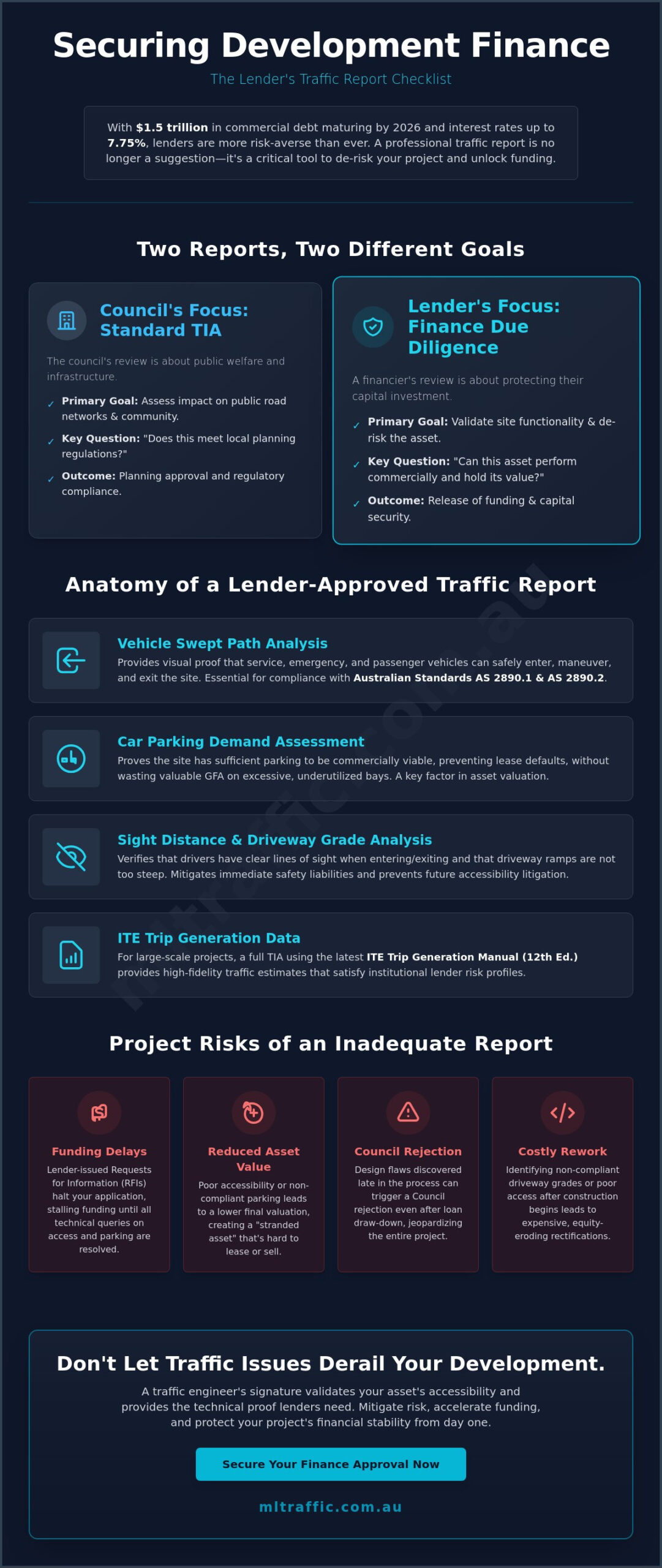
Core Components of a Finance-Ready Traffic Assessment
A robust traffic report for development finance application must include four technical pillars to satisfy institutional risk departments. Lenders do not just look for a Council approval stamp. They require independent verification that the site’s operational design is flawed-free. This technical audit prevents the funding of developments that might later require expensive structural modifications to meet safety standards. Every component of the report serves to validate the project’s commercial viability and long-term asset security.
The first pillar is a Detailed Parking Demand Assessment. This goes beyond minimum statutory requirements. It proves the site has enough parking to attract high-quality tenants while ensuring the developer has not over-capitalized on excessive parking spaces. We utilize the ITE Trip Generation Manual 12th Edition, released in August 2025, which includes data from over 550 new study sites. This ensures our trip generation and parking demand estimates are based on the most current, verified industry data available. Precision in these numbers is mandatory for a bank’s Quantity Surveyor (QS) to verify the project’s projected yield.
Parking Layout and AS 2890.1 Compliance
Every finance application requires a car park design that is explicitly certified against Australian Standards. We focus on AS 2890.1 for residential and AS 2890.2 for commercial developments. Common errors in parking bay dimensions or aisle widths are frequent causes for finance rejection. Our engineers specifically certify driveway ramp grades to ensure they don’t exceed maximum permissible slopes. A non-compliant ramp can prevent vehicle access entirely, creating an immediate default risk for the lender. We provide the technical assurance that every square meter of the parking design is functional and compliant.
Access and Swept Path Analysis for Commercial Assets
For industrial and retail developments, proving heavy vehicle access is a critical requirement. Lenders demand visual evidence that delivery trucks can enter, maneuver, and exit the site in a forward direction. We use AutoTURN software to generate these simulations. This provides the high-fidelity visual proof required for complex finance submissions. You can learn more about this process in our article, Swept Path Analysis: A Complete Guide for Australian Developments. This analysis ensures that internal circulation is safe and that garbage collection or delivery vehicles won’t obstruct tenant traffic, protecting the property’s operational reputation.
Finally, our reports provide explicit Compliance Certification. This is a formal statement from a qualified traffic engineer confirming the design meets all relevant safety and engineering codes. This signature is often the final piece of evidence needed to clear a lender’s technical ‘Conditions Precedent.’ By delivering a comprehensive assessment that includes sight distance verification and intersection analysis, we remove the technical ambiguity that leads to funding delays.
Mitigating Project Risks Through Expert Traffic Analysis
Expert traffic analysis serves as the primary defense against "deal-breaker" design flaws that can derail a project’s funding. A professional traffic report for development finance application identifies technical risks before they reach the lender’s risk department. For instance, a site plan that fails to account for sight distance requirements at a major intersection can lead to a total redesign or a significant loss of units. By verifying these parameters early, we protect the project’s commercial yield and prevent future liability. Our engineers focus on identifying these constraints during the initial design phase to ensure the site remains viable for its intended use.
Complex sites require even more rigorous scrutiny. Developments located near classified roads or major public transport hubs face stricter oversight from state authorities. We assess these locations to ensure proposed access points don’t conflict with high-frequency traffic movements or public transit corridors. This technical foresight is why a senior traffic engineer’s signature is a prerequisite for most institutional loan approvals. It provides the assurance that the site is physically capable of supporting the intensity of its proposed land use without creating safety hazards or operational bottlenecks.
Early Involvement: The Key to Finance Approval
Waiting until the Development Application (DA) stage to engage a specialist is a strategic error. Early consultation allows for the optimization of the site layout, which can directly increase the number of units or parking spaces provided. This optimization improves the project’s financial profile, making the finance application more attractive to lenders. You can read more about how this integration works in our article on The Role of a Traffic Engineer in Developments. Proactive engineering ensures that the traffic and parking components are integrated into the architecture rather than added as a non-compliant afterthought.
Addressing Lender Objections and Concerns
Lenders occasionally request an "independent" review of traffic generation figures, especially for large-scale commercial assets. We address these objections by providing data-backed justifications based on our experience with over 10,000 sites across Australia. Since we’ve been trading since 2005, our principals Michael Lee and Benny Chen bring between 30 and 40 years of individual expertise to every assessment. This depth of experience allows us to defend traffic generation figures against overly conservative lender estimates that could otherwise restrict your borrowing capacity.
We ensure all reports are prepared by registered professionals, including RPEQ certification where required. This level of accountability satisfies the most stringent due diligence requirements. The traffic consultant who provides your quote is the person who does the work, ensuring no technical details are lost in communication. If you need a finance-ready assessment that minimizes risk, contact our senior engineers today for a direct consultation.
Securing Your Finance Approval with ML Traffic Engineers
ML Traffic Engineers provides the technical accountability that institutional lenders demand. We understand that a traffic report for development finance application is a time-critical document. Delays in engineering assessments often lead to missed funding windows or increased holding costs. Our firm operates on a direct-access model. This means the senior traffic engineer who provides your initial quote is the same professional who performs the technical analysis and signs the final report. This eliminates the bureaucratic delays common in larger firms and ensures every technical detail is defended with expert authority.
Our firm provides national coverage, offering expert advice for developments in any Australian state or territory. We’ve been trading since 2005 and have successfully assessed over 10,000 sites. This volume of work has given us deep insights into the specific risk profiles that different lenders prioritize. Whether your project is a boutique residential build or a high-volume fast-food restaurant, we deliver the technical precision required to clear your loan’s Conditions Precedent.
Why Experience Matters for Finance Applications
We leverage between 30 and 40 years of individual engineering expertise to streamline your application. This experience is vital when justifying parking shortfalls or non-standard access arrangements to a lender’s risk department. Our exhaustive land-use experience includes apartments, bars, childcare centers, medical clinics, temples, and warehouses. This breadth of knowledge ensures we can handle the specific trip generation patterns of any development type. You can Contact ML Traffic Engineers for a project-specific quote that addresses your financier’s unique technical requirements.
Our Process: From Quote to Approval
Our workflow is designed for speed and technical accuracy to meet strict finance deadlines. We focus on delivering a seamless path from initial inquiry to final submission. Our three-step process includes:
-
Step 1: Rapid assessment of your architectural site plans and a review of specific lender due diligence requirements.
-
Step 2: Detailed technical analysis and compliance checks against Australian Standards, including AS 2890.1 and AS 2890.2.
-
Step 3: Delivery of a professional, finance-ready Traffic Impact Assessment that proactively addresses potential RFI points.
Every assessment we produce aims to minimize delays and maximize your project’s commercial yield. We don’t just provide a document; we provide a financial de-risking tool that protects your equity. Our direct principal involvement ensures your traffic report for development finance application stands up to the most rigorous lender scrutiny. To begin your technical assessment, Get a Quote for Your Traffic Report Today and secure the expert engineering signature your funding requires.
Secure Your Funding with Technical Precision
A high-quality traffic report for development finance application is the final technical bridge between your project and its capital draw-down. You’ve seen how rigorous compliance with AS 2890.1 and detailed swept path analysis protect your project’s commercial yield from lender-side rejection. These documents ensure your site is operationally sound and commercially viable for long-term lease or sale. By identifying technical constraints early, you prevent the costly RFIs that stall progress and inflate interest expenses.
ML Traffic Engineers brings over 15 years of industry experience and a track record of 10,000 completed projects nationally to your submission. You gain direct access to senior traffic engineers who understand the urgency of finance deadlines. We ensure the professional who provides your quote is the one who executes the technical work. Don’t let technical ambiguity delay your project’s commencement. Get a Finance-Ready Traffic Report Quote today and move your development forward with absolute confidence.
Frequently Asked Questions
Is a traffic report mandatory for all development finance applications?
A traffic report is mandatory for most Tier 1 and Tier 2 development finance applications involving commercial or multi-residential assets. Lenders use these documents to verify that the project is operationally viable and meets Australian Standards. Without professional verification, a financier can’t accurately assess the risk of a "stranded asset" that lacks proper access or parking functionality.
How much does a traffic report for a finance application cost?
Engineering fees for these reports vary based on project scale and technical complexity. External benchmarks show that the City of Raleigh Department of Transportation charges a $2,500 review fee per submittal as of July 2024. Your specific engineering costs depend on whether the lender requires a brief statement or a comprehensive assessment involving complex intersection analysis.
What is the difference between a Traffic Impact Assessment and a Traffic Statement?
A Traffic Impact Assessment (TIA) is a comprehensive technical document required for large-scale developments with high trip generation. A Traffic Statement is a shorter report for smaller sites with minimal impact. Lenders determine the requirement based on whether the project exceeds specific trip generation thresholds defined in the ITE Trip Generation Manual 12th Edition, released in August 2025.
Can I use the same traffic report for my Council DA and my bank loan?
You can use the same traffic report for development finance application that you submitted to Council if it addresses the bank’s specific due diligence criteria. Financiers often require additional details, such as a more granular car parking demand assessment or specific swept path simulations. We design our reports to satisfy both regulatory and financial requirements simultaneously.
How long does it take to prepare a finance-ready traffic report?
Standard turnaround times for a professional traffic report range from five to ten business days. This timeline depends on the availability of finalized site plans and the complexity of the required technical simulations. Urgent finance deadlines often require expedited assessments to ensure the loan offer’s Conditions Precedent are met before the facility offer expires.
What happens if my traffic report identifies a compliance issue?
If an assessment identifies a compliance issue, such as a non-compliant driveway grade, we recommend design modifications before the report is finalized. Identifying these "deal-breakers" early prevents the lender from rejecting the application later. We work with your architect to adjust the layout so it meets AS 2890.1 standards without sacrificing your project’s commercial yield.
Do lenders require a specific type of traffic engineer?
Lenders require reports prepared by registered professional engineers with a proven track record in transport planning. This includes RPEQ or CPeng certifications depending on the specific state jurisdiction. Using an experienced consultant who has completed over 10,000 sites ensures the lender trusts the technical findings and the professional signature provided on the final submission.
What is a Vehicle Swept Path Analysis and why does my bank want it?
Vehicle Swept Path Analysis is a computer-generated simulation showing the path a vehicle takes while turning. Banks require this to prove that delivery trucks, waste vehicles, and passenger cars can maneuver safely within the site. It provides the visual evidence needed to guarantee that the development’s internal circulation is functional and compliant with Australian safety codes.
Which areas do you cover?
We are traffic engineers servicing Melbourne, Sydney, Brisbane, Gold Coast, Hobart, Perth, Adelaide, Darwin, Canberra and surrounding areas.

Disclaimer
The content on www.mltraffic.com.au, including all technical articles, guides, and resources, is provided for general informational and educational purposes only. It is not intended to constitute professional advice in traffic engineering, transportation planning, development approvals, or any other technical or legal field.
While ML Traffic Engineers makes every reasonable effort to ensure the accuracy, completeness, and timeliness of the information published, we do not provide any warranties or representations (express or implied) regarding its reliability, suitability, or availability for any particular purpose. Any reliance you place on the content is strictly at your own risk.
In no event shall ML Traffic Engineers, its directors, employees, authors, or affiliates be liable for any direct, indirect, incidental, special, consequential, or punitive damages (including, without limitation, loss of profits, data, or business opportunities) arising out of or in connection with the use of, or inability to use, any information provided on this website.
The articles and guides on this site are not a substitute for engaging a qualified, registered professional traffic engineer (such as an NPER or RPEQ engineer) to assess your specific project requirements. For tailored advice, compliance assessments, or traffic engineering services, please contact a competent professional.
This disclaimer may be updated from time to time without notice. By accessing or using this website, you agree to be bound by the most current version of this disclaimer.
