

Securing local council support for your project is only half the battle when your site borders a state-managed artery. For these high-stakes locations, the State Road Authority holds a level of power that can stall a Development Application indefinitely if your technical documentation is lacking. You’ve likely felt the frustration of receiving a late-stage Request for Information (RFI) that demands specific concurrence from Transport for NSW. These requests often catch developers off guard with unexpected technical requirements and significant cost implications.
This guide ensures you understand exactly what triggers a traffic report for development on a classified road and how to move through the approval process with minimal friction. Since the Guide to Transport Impact Assessment (GTIA) 2024 superseded the old 2002 guidelines on November 4, 2024, the requirements for multimodal assessments and state-level compliance have become more rigorous. We’ll break down the distinction between referral and concurrence, the updated trip generation rates, and the specific technical components required to satisfy state regulators and secure your planning approval.
Key Takeaways
- Identify why developments adjacent to high-capacity arterial roads trigger a higher tier of scrutiny from state road authorities compared to local street projects.
- Understand the specific technical requirements for a traffic report for development on a classified road, including SIDRA intersection analysis and sight distance assessments.
- Differentiate between “referral” and “concurrence” to navigate the binding approval processes required by state-level road authorities.
- Learn the essential data components needed for a compliant assessment, such as detailed arterial survey data and trip generation modeling.
- Recognize the importance of engaging a specialized consultant to manage complex state-level approvals and minimize the risk of costly Requests for Information (RFIs).
Table of Contents
-
Understanding Classified Roads and Their Impact on Planning Approvals
-
Technical Requirements for a Traffic Report on a Classified Road
-
The Concurrence Process: Navigating State Road Authority Review
-
Essential Components of a Classified Road Traffic Impact Assessment
-
Why Expert Traffic Engineering is Non-Negotiable for Classified Roads
Understanding Classified Roads and Their Impact on Planning Approvals
A classified road is a high-capacity arterial route managed directly by state government authorities rather than local councils. These roads form the critical backbone of the road hierarchy, designed to facilitate the efficient movement of freight, public transport, and high-volume commuter traffic over long distances. While local streets prioritize property access, classified roads prioritize mobility and network throughput. This functional difference is why any site fronting these corridors faces a significantly higher level of regulatory scrutiny during the development application process.
State authorities have a legal mandate to protect the safety and efficiency of these arterial networks. Any proposed development that seeks to add a new driveway, increase traffic volume, or alter existing access points must be rigorously vetted. A traffic report for development on a classified road serves as the primary technical document to prove that your project won’t compromise the state’s transport objectives. Without this specialized assessment, applications are frequently met with immediate objections or lengthy delays from the relevant road authority.
To better understand the core components of these assessments, watch this technical overview:
Terminology for these routes varies across Australia. In New South Wales, the Roads Act 1993 classifies them as "Main Roads," "Highways," or "Freeways." Victoria uses the term "declared roads" under the Road Management Act 2004, while Queensland refers to "state-controlled roads." Regardless of the local name, the implication is the same: the state government is a primary stakeholder in your planning approval, often holding the power of concurrence or refusal over the local council.
The Legal Triggers: When a Traffic Report Becomes Mandatory
Legislative frameworks, such as the NSW State Environmental Planning Policy (Transport and Infrastructure) 2021, dictate when a referral to a state authority is compulsory. Proximity to the road reserve is the most common trigger. If your property boundary touches a classified road, or if your development exceeds specific traffic generation thresholds, a formal traffic report for development on a classified road is mandatory. For instance, some jurisdictions trigger a review if the project increases traffic by more than 100 vehicles per hour in any lane. Since the Guide to Transport Impact Assessment (GTIA) 2024 commenced on November 4, 2024, these triggers now include stricter multimodal considerations for pedestrians and cyclists.
Classified vs. Local Roads: Key Differences for Developers
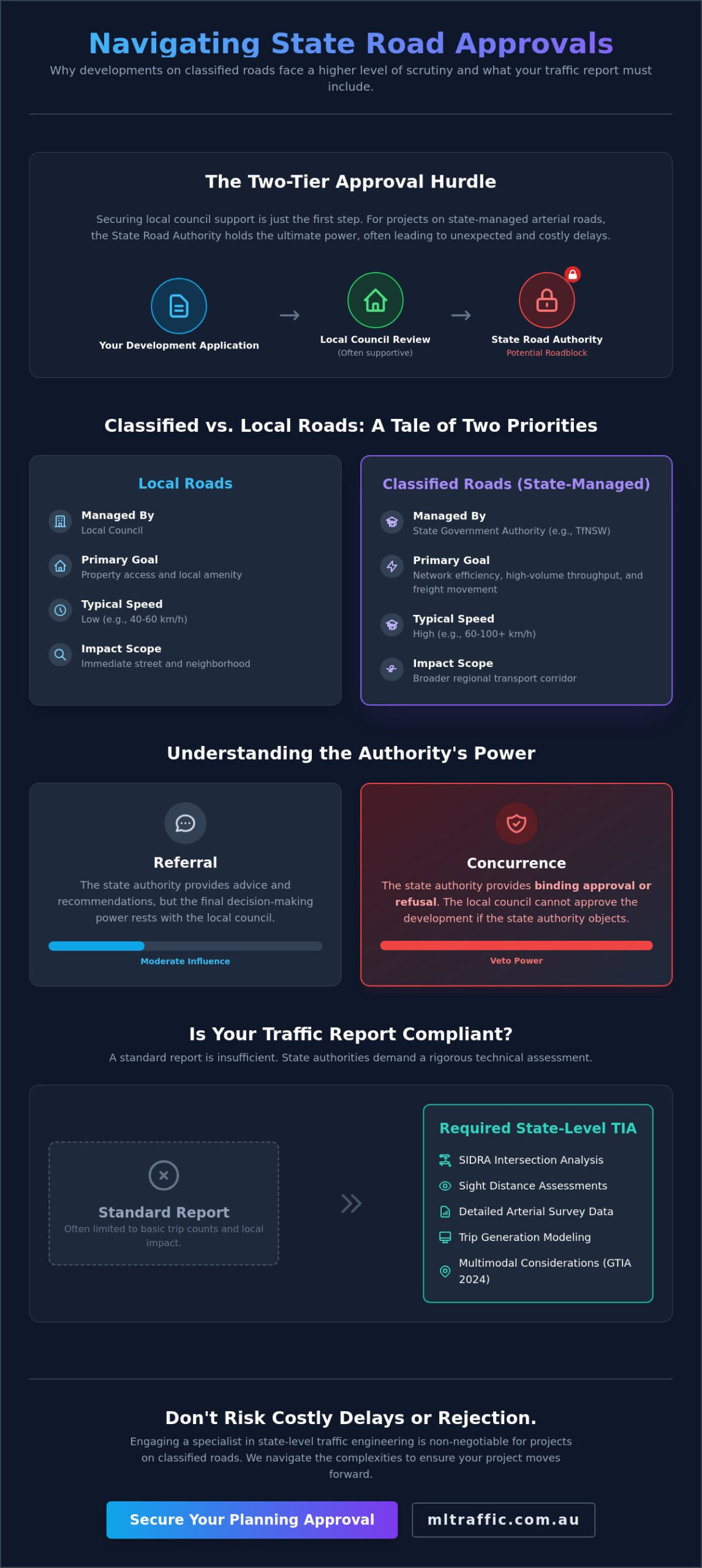
Developing on an arterial road requires a shift in engineering focus from "local impact" to "network-wide efficiency." Local roads often allow for flexible access design; however, classified roads operate in high-speed environments, typically 60km/h to 100km/h. This necessitates much larger safety margins and stringent sight distance requirements. State authorities prioritize the preservation of traffic flow, meaning they may restrict right-turn movements or demand significant intersection upgrades. While a local council might only look at the immediate street, state authorities evaluate how your project impacts the broader regional transport corridor and freight reliability.
Technical Requirements for a Traffic Report on a Classified Road
A standard traffic statement is insufficient for sites bordering arterial networks. State road authorities require a high-fidelity traffic report for development on a classified road that accounts for high-speed safety and regional network capacity. These reports must move beyond simple trip counts to include rigorous software-based modeling and geometric verification. The technical depth of these assessments is designed to protect the integrity of the state’s most critical transit corridors.
Detailed intersection analysis using SIDRA software is a core requirement. This modeling evaluates how additional development traffic influences existing signalized or unsignalized nodes. Authorities use this data to determine if a project will necessitate physical upgrades to the road network, such as dedicated turning lanes or signal phasing adjustments.
Advanced Intersection and Capacity Modeling
Simple vehicle counts don’t capture the complexity of classified roads. Authorities focus on the Degree of Saturation (DoS) and Level of Service (LoS) across the arterial network. A DoS exceeding 0.90 often indicates a failing intersection that cannot absorb more volume. Modeling must demonstrate that project-related trips won’t cause queues to spill back into through-lanes. If a queue blocks a through-lane on a highway, it creates a significant safety hazard and compromises regional efficiency.
Sight distance assessments are critical because classified roads often operate at speeds of 60km/h or higher. Engineers assess Safe Intersection Sight Distance (SISD) to ensure drivers exiting the site have adequate time to react to oncoming traffic. Additionally, vehicle swept path analysis must be conducted for the largest anticipated vehicle. For commercial or industrial sites, this usually involves modeling a 12.5m Heavy Rigid Vehicle (HRV) or a 19m semi-trailer to prove that turning maneuvers don’t encroach on adjacent lanes.
Access and Driveway Design Standards
All designs must comply with the Austroads Guide to Road Design and specific state supplements. On classified roads, authorities frequently mandate "left-in, left-out" access to prevent dangerous right-turn movements across multiple lanes of high-speed traffic. Driveway ramp grade assessments are also vital. We ensure that vertical profiles prevent heavy vehicles from scraping or bottoming out at the road interface, which can cause sudden braking on the main carriageway. Ensuring your access design meets these rigid standards is the most effective way to avoid a costly RFI during the DA process.
The impact on road safety is the ultimate metric for state road authorities. They prioritize the preservation of traffic flow and the reduction of conflict points. If a development introduces new risks, the traffic report must propose concrete mitigation strategies to maintain the existing safety rating of the corridor.
The Concurrence Process: Navigating State Road Authority Review
Navigating the concurrence process is a critical phase of any development application bordering an arterial network. Unlike a standard referral, where a state body provides non-binding advice to a council, concurrence grants the road authority the power to effectively veto a proposal. If the state authority refuses concurrence, the local council cannot legally approve the development. A high-quality traffic report for development on a classified road is the primary tool used to secure this binding approval and avoid a deadlock in the planning phase.
State authorities evaluate development impacts through the lens of regional transport health. They prioritize the reliability of public transport corridors and the efficiency of freight networks over individual site access convenience. This means a site plan that functions perfectly for a local street might be rejected if it introduces delays to a strategic bus corridor or creates friction on a primary freight route. The timeline for these approvals is inherently longer, typically adding 21 to 40 days to the statutory referral period, making precision in your initial documentation vital.
Key Principles for Development on Major Arterials
State authorities operate under strict guiding principles to protect the public interest in the road network. These include:
-
The "No Net Worse" Principle: Developers must demonstrate that the safety and efficiency of the classified road will remain at least at its current level post-development.
-
Priority of Movement:
Essential Components of a Classified Road Traffic Impact Assessment
A comprehensive traffic report for development on a classified road requires a rigorous data-driven approach that satisfies both local and state-level objectives. The report must move beyond basic site observations to provide a deep technical analysis of how the project interacts with the arterial network. Authorities expect to see high-fidelity data on existing traffic conditions, typically sourced from 7-day automatic tube counts or peak-period intersection surveys. This baseline data is the foundation for all subsequent modeling.
Proposed development details must include precise trip generation and distribution modeling. Since the commencement of the Guide to Transport Impact Assessment (GTIA) 2024 on November 4, 2024, trip generation rates have been updated. For example, low-density residential rates in Sydney are now lower than the previous 2013 technical direction, while regional rates have increased. The report must accurately distribute these trips across the network to identify potential bottlenecks. We also include a thorough safety analysis, reviewing five-year crash history data to ensure the development doesn’t exacerbate known safety risks on the corridor.
Mitigation strategies form the final core component. If modeling indicates a drop in the Level of Service, the report must propose concrete solutions. These might include signal timing adjustments or physical road works like deceleration lanes. Parking demand is equally critical. We verify that all parking requirements are met on-site in accordance with AS/NZS 2890.1:2021 and AS 2890.6:2022 to ensure no "spill-over" occurs onto classified road clearways. Any reliance on on-street parking along an arterial corridor is generally prohibited by state authorities to maintain network efficiency.
Vehicle Swept Path and Maneuvering
State authorities strictly prohibit vehicles from reversing onto a classified road. We use AutoTURN software to conduct a vehicle swept path analysis for the largest anticipated service vehicle, such as a 12.5m heavy rigid vehicle. This demonstrates that the vehicle can enter and exit the site in a forward direction while complying with AS 2890.2 standards. Any design that fails to prove safe maneuvering will likely face a refusal from the state road authority.
Pavement and Infrastructure Impact
Increased heavy vehicle traffic can significantly accelerate the degradation of arterial road surfaces. Authorities may request a Pavement Impact Assessment (PIA) if the development generates a high volume of heavy vehicle movements. This assessment determines the structural impact on the road reserve and may lead to requirements for developer-funded infrastructure upgrades. If your project involves high-frequency freight or logistics, ensuring these technical components are addressed early is vital. Contact our team for a professional Traffic Impact Assessment (TIA) Report to secure your state-level approvals.
Why Expert Traffic Engineering is Non-Negotiable for Classified Roads
Engaging a generalist engineer for a site fronting a state-managed artery is a high-risk strategy that often leads to project stagnation. State road authorities operate under technical and legislative mandates that differ significantly from local council requirements. A traffic report for development on a classified road must anticipate the specific priorities of state-level reviewers who focus on regional network efficiency and freight reliability. ML Traffic Engineers provides the specialized expertise required to navigate these complex approvals. With over 15 years of professional experience, we ensure that technical components like SIDRA modeling and sight distance assessments meet the most current national standards and state supplements.
Our firm operates on a "Personnel Continuity Promise." This means the senior principal who initiates your project is the one who performs the technical analysis and manages the authority negotiations. In a field where bureaucratic delays can cost developers thousands in holding fees, having direct access to a seasoned expert is vital. We don’t delegate your project to junior staff. This hands-on approach ensures that the technical nuances of your site are accurately represented to regulators from the first submission. By addressing state-level triggers proactively, we significantly reduce the likelihood of receiving a late-stage Request for Information (RFI) that could stall your DA for months.
Direct Access to Senior Expertise
Negotiating with state road authorities requires a sophisticated understanding of both local planning schemes and state transport objectives. Senior-level representation is essential when discussing mitigation measures or intersection upgrades with authority engineers. Our principals provide a "no-gatekeepers" approach, giving you a direct line to the experts managing your case. This level of accountability is a core marker of our professional service. You can reach out to ML Traffic Engineers for an initial site review to identify potential regulatory roadblocks before you lodge your formal application.
Proven Track Record in Complex Approvals
We have successfully delivered approvals across a diverse range of project environments. Our experience includes high-density residential developments, commercial retail hubs, industrial logistics centers, childcare facilities, and medical precincts. This vast range of practical experience allows us to apply proven strategies to your specific project constraints. Whether your site is in NSW, QLD, or VIC, we ensure your Traffic Impact Assessment adheres to the relevant state-specific guidelines, such as the NSW Guide to Transport Impact Assessment 2024. Specialized reporting is the most reliable way to prevent project rejection and secure a successful planning outcome with minimal friction.
Secure Your State Road Authority Approval
Developing adjacent to an arterial corridor requires technical precision that standard planning reports cannot provide. Successful outcomes depend on your ability to satisfy the rigid safety and efficiency standards set by state road authorities. By prioritizing comprehensive SIDRA modeling and ensuring your access design adheres to the latest Austroads standards, you’ll minimize the risk of costly bureaucratic delays. A compliant traffic report for development on a classified road is your primary tool for navigating the concurrence process and securing a timely approval.
ML Traffic Engineers offers over 15 years of specialist experience in managing these high-stakes assessments. Our senior principals handle every technical detail, ensuring your project benefits from direct expertise and a proven track record of success with both local councils and state authorities. We provide the meticulous reporting needed to protect your project from rejection and unnecessary RFIs. Get a compliant Traffic Report for your classified road development from ML Traffic Engineers. We’re ready to assist with your technical requirements to ensure your project moves forward without delay.
Frequently Asked Questions
What exactly is a classified road in the context of my DA?
A classified road is a high-capacity arterial route managed by a state authority rather than a local council. These roads are designated under state legislation to prioritize regional mobility, freight movement, and public transport efficiency over local property access. If your development application involves a site bordering one of these routes, the state authority becomes a primary stakeholder in your approval process.
Why does my traffic report need to be referred to a state authority?
Referral is mandatory because state authorities have a legal responsibility to protect the safety and efficiency of the arterial network. Any development that seeks to add new access points or increase traffic volumes on a state-controlled route could impact regional through-traffic. The authority reviews your documentation to ensure the project doesn’t compromise network performance or safety for the broader community.
How much does a traffic report for a classified road cost?
The cost of a traffic report for development on a classified road depends on the scale of the project and the technical complexity required by the state authority. Factors like the number of intersections requiring SIDRA modeling and the depth of vehicle swept path analysis influence the final fee. You should obtain a site-specific quote from a qualified traffic engineer to account for these technical variables.
Can I use a standard traffic statement for a site on a main road?
No, a standard traffic statement is usually insufficient for sites bordering classified roads. State authorities require a more rigorous Traffic Impact Assessment (TIA) that includes detailed capacity modeling and safety analysis. While a local street development might only need a basic summary, arterial road developments require technical verification that the regional network can safely absorb the additional demand.
What is SIDRA modeling and why is it required for my development?
SIDRA is an industry-standard software tool used to analyze intersection capacity, delay, and Level of Service (LoS). State authorities require this modeling to see exactly how your development traffic affects the Degree of Saturation on the arterial network. It provides a data-driven way to determine if your project will cause queuing that interferes with through-traffic or strategic public transport corridors.
How long does the state road authority review process typically take?
The review process generally takes between 21 and 40 days once the referral is formally lodged with the state authority. This timeline is in addition to the local council’s standard assessment period. Delays often occur if the initial report is missing critical technical data, which triggers a Request for Information (RFI) and effectively pauses the assessment clock.
What happens if the state road authority objects to my development access?
If an authority objects, the developer must either modify the site access design or propose mitigation measures like intersection upgrades. Because the authority often holds concurrence power, their objection can block a planning approval entirely. A skilled traffic engineer will negotiate these technical sticking points with the authority to find a design solution that satisfies safety requirements while maintaining project viability.
Do I need a road safety audit for a development on a classified road?
Road safety audits are often requested by authorities for complex projects involving significant changes to the state road reserve. While these audits provide an independent safety assessment, they are a separate specialized service. You should check your specific development conditions or consult with the state road authority to determine if an audit is a mandatory requirement for your project approval.
Which areas do you cover?
We are traffic engineers servicing:
Metro North Region: Auburn, Baulkham Hills, Blacktown, Holroyd, Parramatta, Blue Mountains, Hawkesbury, Penrith, Hornsby, Hunters Hill, Ku-ring-gai, Lane Cove, Manly, Mosman, North Sydney, Pittwater, Ryde, Warringah, Willoughby .
Metro South Region: Ashfield, Burwood, Canada Bay, Canterbury, Leichhardt, Marrickville, Strathfield, Botany Bay, Hurstville, Kogarah, Randwick, Rockdale, Sutherland Shire, Sydney, Waverley, Woollahra, Bankstown, Camden, Campbelltown, Fairfield, Liverpool, Wingecarribee, Wollondilly
Hunter Region: Gosford, Wyong, Cessnock, Dungog, Lake Macquarie, Maitland, Muswellbrook, Newcastle, Port Stephens, Singleton, Upper Hunter Shire
Western Region: Bathurst Regional, Blayney, Cabonne, Cowra, Forbes, Lachlan, Lithgow, Oberon, Orange, Parkes, Weddin, Balranald, Bogan, Bourke, Brewarrina, Broken Hill, Central Darling, Cobar, Coonamble, Dubbo, Gilgandra, Mid-Western Regional, Narromine, Walgett, Warren, Warrumbungle Shire, Wellington, Wentworth, Unincorporated NSW (Far West), Albury, Berrigan, Bland, Carrathool, Conargo, Coolamon, Cootamundra, Corowa Shire, Deniliquin, Greater Hume Shire, Griffith, Gundagai, Hay, Jerilderie, Junee, Leeton, Lockhart, Murray, Murrumbidgee, Narrandera, Temora, Tumbarumba, Tumut Shire, Urana, Wagga Wagga, Wakool
Northern Region: Ballina, Byron, Clarence Valley, Kyogle, Lismore, Richmond Valley, Tweed, Bellingen, Coffs Harbour, Gloucester, Great Lakes, Greater Taree, Hastings, Kempsey, Nambucca, Unincorporated NSW (Lord Howe Island), Armidale Dumaresq, Glen Innes Severn, Gunnedah, Guyra, Gwydir, Inverell, Liverpool Plains, Moree Plains, Narrabri, Tamworth Regional, Tenterfield, Uralla, Walcha
Southern Region: Kiama, Shellharbour, Shoalhaven, Wollongong , Bega Valley, Bombala, Boorowa, Cooma-Monaro, Eurobodalla, Goulburn Mulwaree, Harden, Palerang, Queanbeyan, Snowy River, Upper Lachlan, Yass Valley, Young

Disclaimer
The content on www.mltraffic.com.au, including all technical articles, guides, and resources, is provided for general informational and educational purposes only. It is not intended to constitute professional advice in traffic engineering, transportation planning, development approvals, or any other technical or legal field.
While ML Traffic Engineers makes every reasonable effort to ensure the accuracy, completeness, and timeliness of the information published, we do not provide any warranties or representations (express or implied) regarding its reliability, suitability, or availability for any particular purpose. Any reliance you place on the content is strictly at your own risk.
In no event shall ML Traffic Engineers, its directors, employees, authors, or affiliates be liable for any direct, indirect, incidental, special, consequential, or punitive damages (including, without limitation, loss of profits, data, or business opportunities) arising out of or in connection with the use of, or inability to use, any information provided on this website.
The articles and guides on this site are not a substitute for engaging a qualified, registered professional traffic engineer (such as an NPER or RPEQ engineer) to assess your specific project requirements. For tailored advice, compliance assessments, or traffic engineering services, please contact a competent professional.
This disclaimer may be updated from time to time without notice. By accessing or using this website, you agree to be bound by the most current version of this disclaimer.
