
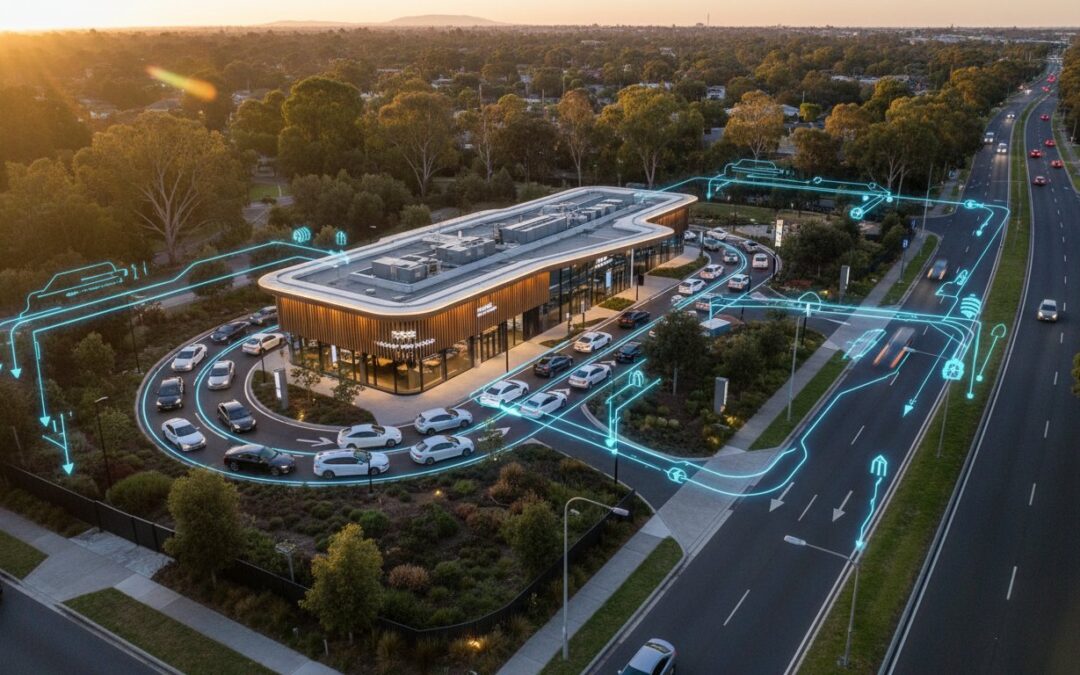
What if the only thing standing between your new franchise and a council rejection is just four metres of queuing space? You likely already know that local councils have become hyper-focused on preventing queue spillback onto public roads, which often results in immediate DA refusals for unprepared applicants. Securing a professional traffic report for a drive-thru restaurant is no longer just a box-ticking exercise; it’s the technical backbone of your entire development application.
We understand the frustration of trying to decipher AS 2890.1 requirements while worrying if your site layout actually works for real-world customers. This 2026 guide promises to show you exactly what your report needs to clear those bureaucratic hurdles and ensure maximum site efficiency. You’ll learn how to handle technical jargon, master vehicle swept path assessments, and present a data-backed case that councils can’t ignore. We’ve simplified the process based on our experience with over 10,000 sites across Australia, so you can move from planning to construction with total confidence.
Key Takeaways
- Understand why Australian councils prioritise “queue spillback” and how to design your site to prevent traffic from backing up onto public roads.
- Learn how to prepare a professional traffic report for drive-thru restaurant applications that uses mathematical trip generation to prove site efficiency to planning authorities.
- Discover how to apply AS 2890 standards and Swept Path Analysis to eliminate “dead-end” traps and ensure seamless vehicle movement for both customers and delivery trucks.
- Identify the common peak-period mistakes that sink Development Applications and how to accurately model “Friday night” rushes to satisfy council requirements.
- Benefit from over 15 years of Australian expertise with a “no-gatekeepers” approach where the consultant who quotes your work is the one who delivers the results.
Table of Contents
- Why Local Councils Are So Strict About Drive-Thru Traffic Reports
- The Essential Components of a Drive-Thru Traffic Impact Assessment
- Beyond Compliance: Using AS2890 and Swept Path Analysis to Optimize Your Site
- Common Traffic Pitfalls That Sink Drive-Thru Development Applications
- Getting Your Drive-Thru Approved: How ML Traffic Engineers Can Help
Why Local Councils Are So Strict About Drive-Thru Traffic Reports
Local councils in Australia don’t just look at daily traffic counts. They focus on the 15-minute peak window. A typical fast-food outlet can generate 60 to 100 trips per hour during lunch or dinner rushes. This high-intensity burst creates immediate pressure on local road networks. If your Drive-through design isn’t perfect, those cars end up idling on public tarmac. This is known as queue spillback. It’s the single biggest reason Development Applications (DAs) get knocked back in New South Wales, Queensland, and Victoria. Authorities want to ensure that your private commercial gain doesn’t become a public safety hazard or a source of local congestion.
To better understand the real-world impact of these planning challenges, watch this video illustrating how even established brands struggle with queue management:
A professional traffic report for drive-thru restaurant serves as the technical backbone of your DA. It isn’t just a document; it’s a defensive shield for your project. In Australia, planning authorities rely on the Traffic Impact Assessment (TIA) to ensure a project won’t degrade the Level of Service (LoS) of nearby intersections. When we sign off on a report, we’re acting as your expert witness. We use SIDRA modelling and empirical data from over 10,000 sites to prove your internal queuing can handle the demand. Our reports satisfy the requirements of Australian Standards (AS 2890.1) and specific council DCPs (Development Control Plans) by addressing:
- Peak hour trip generation rates based on gross floor area (GFA).
- On-site queuing capacity and bypass lane functionality.
- Vehicle swept path analysis for heavy rigid vehicles (HRVs) and delivery trucks.
- Sight-line assessments for exiting traffic to protect cyclists and pedestrians.
The Shift in QSR Planning in 2026
By 2026, the Quick Service Restaurant (QSR) model has moved far beyond the traditional family car. Delivery drivers for platforms like UberEats and Menulog now account for up to 35% of peak-hour traffic at modern Australian sites. These drivers have different parking needs and shorter dwell times compared to standard customers. Councils now demand specific assessments for pedestrian safety, especially where delivery couriers cross active drive-thru lanes. A generic traffic report for drive-thru restaurant from five years ago won’t pass. You need a 2026-standard analysis that accounts for these specific logistics and courier parking zones.
Validating Your Site Choice Early
You shouldn’t wait until the DA submission to find out your site is a ‘red flag’ location. Identifying issues early can save you upwards of A$25,000 in wasted architectural redesign fees. We look at the link between your proposed access points and the existing road capacity. If a site sits too close to a signalised intersection, the council will likely reject it due to ‘weaving’ issues or restricted right-turn movements. Getting a traffic consultant involved during the due diligence phase allows you to walk away from a bad lease before you’re locked in. We evaluate driveway ramp grades and road network capacity to ensure your site is actually viable for high-volume use.
The Essential Components of a Drive-Thru Traffic Impact Assessment
A comprehensive traffic report for drive-thru restaurant development serves as a technical defense of your project. It isn’t just about showing where cars park; it’s a rigorous demonstration that your business won’t cripple the local road network. At ML Traffic Engineers Pty Ltd, we’ve completed over 10,000 assessments, and we know that council planners focus on five core technical pillars. These components transform a simple site plan into a compliant, low-risk development application.
The foundation of any submission is a formal Traffic Impact Analysis (TIA). This document uses empirical data to predict how the surrounding streets will perform once your doors open. We don’t guess these numbers. We use SIDRA Intersection software to model delay times and level of service (LoS) at nearby junctions. If your site adds even 30 vehicles to a saturated intersection during the 8:00 AM peak, you’ll need a clear mitigation strategy to win approval.
Mastering Queueing Theory for DA Approval
Planners obsess over ‘stacking capacity’ because it represents the physical limit of your drive-thru lane. We calculate this by measuring the distance from the order point to the site exit, typically allowing 6.0 metres per car. Using Poisson distribution models, we simulate worst-case scenarios, such as a 95th-percentile queue during a Friday lunch rush. Spillback is the point where site queues exceed internal storage and impact public road safety. Avoiding this scenario is the primary goal of our internal circulation design.
Trip Generation Data: Beyond the RTA Guide
While the TfNSW (formerly RTA) Guide provides a baseline, it’s often outdated for modern multi-use sites. We look at comparable sites from our database of 10,000+ projects to find real-world numbers that reflect current consumer habits. We distinguish between ‘new’ trips and ‘pass-by’ traffic. For instance, a 2023 study showed that up to 60% of drive-thru customers are already on the road and simply turning in, meaning they don’t add 60% more volume to the total network. A coffee-only outlet peaks at 7:15 AM, while a full-menu restaurant might not see its true peak until 12:45 PM.
Parking demand is the next hurdle. Councils often demand more spaces than a drive-thru actually needs, which wastes valuable real estate. We balance Australian Standard AS 2890.1 requirements with actual turnover rates. If your business model relies on 85% drive-thru sales, we can often justify a reduction in on-site parking by proving that customers don’t stay long enough to occupy a bay. This requires a professional traffic assessment that uses hard data to challenge generic council codes.
Finally, we address site logistics through Access, Egress, and Swept Path Analysis. We must prove that a 12.5-metre Heavy Rigid Vehicle (HRV) can enter, unload, and exit in a forward direction without mounting a kerb or hitting a parked car. We use specialized CAD software to plot the exact wheel paths of delivery trucks and waste collectors. If a truck has to reverse out onto a main road, the DA will likely be refused immediately. By providing these technical proofs upfront, you demonstrate that your site is safe, functional, and ready for business.
Beyond Compliance: Using AS2890 and Swept Path Analysis to Optimize Your Site
Your site plan might look perfect on paper, but reality hits when a delivery truck tries to navigate a tight corner. A traffic report for drive-thru restaurant is more than a bureaucratic hurdle. It’s a technical blueprint that ensures your business operates without bottlenecks. We rely on Australian Standards, specifically AS 2890.1 for off-street car parking and AS 2890.2 for commercial vehicles, to dictate the geometry of your site. These standards provide the exact dimensions required for aisle widths, ramp grades, and parking bay sizes. If your design deviates from these, you risk a swift rejection from the Council.
Modern drive-thrus must accommodate a shifting fleet. While older designs focused on small sedans, today’s drivers often arrive in large SUVs like the Toyota LandCruiser or Ford Ranger. These vehicles have wider turning circles and longer bodies. If your drive-thru lane is too narrow or the curves are too sharp, you’ll see clipped curbs and frustrated customers. Our reports account for the B99 vehicle, which represents the 99.8th percentile of cars on Australian roads, ensuring your site works for almost everyone.
What is Swept Path Analysis?
Swept Path Analysis is a computer-generated simulation that tracks the path a vehicle’s body and wheels take during a turn. We use specialized software like AutoTURN to overlay these paths onto your architectural plans. Councils demand these diagrams for every driveway and loading bay. They are looking for one specific thing: proof that the largest expected vehicle, such as a 12.5-metre heavy rigid truck for waste collection, can enter and exit your property in a forward direction. Reversing onto a public road is almost never permitted for new developments. These simulations prevent “dead-end” traps where a driver enters a lane they cannot exit without a 20-point turn.
Parking Design and AS2890 Compliance
There is a constant tension between maximizing the number of parking spots and meeting mandatory aisle width standards. You might want 30 spots, but if the aisle width doesn’t meet AS 2890.1 requirements, those spots are useless. We help you find the balance. A critical part of this process is the sight-line assessment. We check the property boundary to ensure drivers exiting the site have a clear view of oncoming traffic and pedestrians. This is a safety requirement that cannot be ignored. If your site has heavy landscaping, we ensure that trees and shrubs don’t block these vital lines of sight. You can Learn more about our parking design services to see how we resolve these design conflicts.
When preparing your application, it helps to look at broader standards. The Official Traffic Assessment Guidelines provide a clear framework for what constitutes a thorough traffic impact study. While local Australian regulations are your primary concern, these international benchmarks highlight why technical accuracy is so vital. Your traffic report for drive-thru restaurant must prove that your site handles delivery trucks and customer cars simultaneously without causing a queue that spills back onto the street. We focus on the technical details so you can focus on running your business.
Common Traffic Pitfalls That Sink Drive-Thru Development Applications
Developers often lose months of progress because of simple technical oversights in their initial submissions. A traffic report for drive-thru restaurant must be bulletproof to pass council scrutiny. Underestimating the Friday night rush is a classic mistake. Between 6:00 PM and 8:30 PM, traffic volumes at Australian quick-service restaurants frequently spike 35% above the standard midday peak. If your data doesn’t reflect these surges, the council will assume your site will cause local congestion and block the application.
Delivery vehicles present another hurdle that many applicants overlook. We’ve seen many designs fail because they didn’t account for the 8.8m Medium Rigid Vehicle (MRV) required for stock deliveries. If a truck can’t navigate the site without crossing into oncoming lanes or mounting a kerb, the design is flawed. Beyond stock deliveries, the rise of third-party delivery drivers (like UberEats or Menulog) adds another layer of complexity. These drivers need dedicated short-term parking spaces that don’t interfere with the primary drive-thru queue.
- Pedestrian Safety: Planning officers prioritize safety above all else. Any design that forces customers to walk through a live drive-thru lane is a liability. You need clearly marked, raised pedestrian crossings and physical barriers to separate foot traffic from the queue.
- Signage Placement: Poorly placed signage is often overlooked but leads to “micro-delays.” If a driver can’t see the menu board or the exit path from 15 metres away, they’ll hesitate. This hesitation causes ripples through the queue, leading to unnecessary site congestion.
- Acoustic Impacts: Councils are increasingly sensitive to noise. A queue of 15 idling cars at 11:00 PM near a residential zone will trigger complaints. Your report must address how you’ll mitigate this, perhaps through acoustic fencing or strategic site orientation.
The ‘Forward Direction’ Rule
Australian councils strictly enforce the forward-entry and forward-exit rule under AS 2890.1. Reversing onto a public road is considered a major safety breach and is a fast way to get a refusal. For smaller or awkwardly shaped corner sites, this often requires a dedicated turn-around area or a redesigned internal loop. We provide detailed Vehicle Swept Path Assessments to prove that even the largest permitted vehicles can exit the site safely without ever needing to reverse.
Inadequate Stacking Space
Inadequate stacking is the fastest way to get a “no” from the council. The ‘1 in 20’ rule is the industry standard; your queue shouldn’t spill onto the road more than 5% of the time. Implementing dual-lane ordering is a strategic way to increase your capacity by up to 50% within a compact footprint. This allows two cars to order simultaneously, which significantly shortens the physical length of the line. Every traffic report for drive-thru restaurant we produce uses site-specific data to ensure the stacking distance is sufficient for even the busiest periods.
Don’t let a technical error stall your project. Contact ML Traffic Engineers today to secure a compliant traffic report for your drive-thru development.
Getting Your Drive-Thru Approved: How ML Traffic Engineers Can Help
The success of your development application depends on more than just a standard traffic report for drive-thru restaurant. It requires a technical document that withstands the intense scrutiny of council engineers who prioritize road safety and queuing efficiency above all else. Since 2005, ML Traffic Engineers has provided this exact level of certainty for over 10,000 sites across Australia. We don’t just produce reports; we deliver engineering solutions that bridge the gap between your commercial goals and strict regulatory requirements.
We operate on a transparent promise: the consultant who quotes your work is the same person who performs the engineering analysis. Many larger firms use senior staff to win the contract and then delegate the technical heavy lifting to graduates. We don’t do that. You get direct access to our principals, Michael Lee and Benny Chen, throughout the entire lifecycle of your project. This ensures that every calculation, from peak hour trip generation to the smallest driveway ramp grade, is backed by between 30 and 40 years of individual professional experience.
Our role involves translating complex engineering data into persuasive arguments. When a council raises concerns about peak-hour congestion, we don’t just provide raw numbers. We use industry-standard software and historical data from our vast database of previous projects to prove that your site remains compliant with Australian Standards (AS 2890.1). We’ve successfully navigated approvals for a massive range of land uses, including fast-food outlets, pharmacies, banks, car washes, and multi-deck commercial hubs.
Our Hands-On Approach to Your DA
We don’t use junior staff for critical traffic assessments because drive-thru developments carry high stakes. A single error in a Vehicle Swept Path Assessment can lead to a rejected application or, worse, a site that doesn’t function safely once built. By keeping our team senior-heavy, we ensure that every traffic report for drive-thru restaurant we produce is RPEQ certified where necessary and technically robust. This seniority is particularly valuable during direct negotiations with council engineers. We speak their language, understand their specific local concerns, and can often resolve potential roadblocks in a single technical meeting before they become formal “Requests for Further Information.” You can meet our senior engineering team to learn more about the specialists who will be handling your file.
Ready to Start Your Traffic Report?
To provide you with a fast and accurate quote, we typically need a preliminary site plan and an overview of your proposed operating hours. If you have data on expected customer turnover or vehicle volumes, that helps us refine our impact projections. For most drive-thru projects, we aim to deliver a comprehensive Traffic Impact Assessment (TIA) or Statement (TIS) within 5 to 10 business days. We know that in the world of property development, time is literally money. Our streamlined internal process cuts out the bureaucracy found in larger consultancies, allowing us to move from quote to completed report with high speed and precision. Contact us today for a project-specific quote and let’s get your drive-thru project moving toward approval.
- Direct principal involvement on every project.
- 30+ years of specialist experience in the Australian market.
- Over 10,000 successful site assessments completed since 2005.
- Expertise in SIDRA intersection modelling and swept path analysis.
- No-nonsense, fact-based reporting designed for council approval.
Fast-Track Your Drive-Thru DA with Expert Traffic Engineering
Securing a DA for a drive-thru project in 2026 requires more than just a basic layout. Local councils now demand rigorous proof that your site won’t cause traffic congestion or safety hazards. You’ve seen how critical it is to master AS2890 compliance and use Swept Path Analysis to ensure every vehicle moves through your site without a hitch. Avoiding common pitfalls like inadequate queueing space can save you thousands in A$ redesign fees and months of project delays.
You don’t have to navigate these technical requirements alone. When you need a traffic report for drive-thru restaurant success, we provide the precision councils expect. Our team has assessed over 10,000 sites nationwide; this gives us the deep local knowledge needed to handle even the toughest planning challenges. You’ll work directly with senior engineers who bring over 30 years of experience to your project. We ensure the person who quotes your job is the one doing the technical work.
Ready to move your development forward? Get a professional traffic report for your drive-thru project from ML Traffic Engineers. We’ll help you clear the hurdles and get your site open for business.
Frequently Asked Questions
What is a traffic report for a drive-thru restaurant?
A traffic report for a drive-thru restaurant is a technical assessment that evaluates how your proposed development affects local road safety and vehicle flow. Our engineers analyse trip generation rates using data from the RTA Guide to Traffic Generating Developments, which shows fast-food outlets can generate over 100 trips per hour during peak times. This document is essential for your Development Application to prove your site won’t cause local gridlock.
How much does a Traffic Impact Assessment (TIA) cost for a QSR?
A standard Traffic Impact Assessment for a Quick Service Restaurant typically costs between A$2,500 and A$5,500 plus GST. If your specific site requires complex SIDRA intersection modelling or 24-hour traffic counts, the price can exceed A$8,000. At ML Traffic Engineers, the consultant who provides your quote is the same senior expert who does the work, ensuring you don’t pay for unnecessary middle management.
Why does the council care about my drive-thru queue?
Councils focus on queue lengths because overflowing traffic blocks public roads and creates safety hazards for the 1,500 or more commuters who might pass your site daily. If your “stacking” capacity is insufficient, cars will spill onto the footpath or main carriage-way. We calculate the required space for 10 to 15 vehicles to ensure your operations stay contained within your property boundaries.
What is Swept Path Analysis and do I really need it?
Swept Path Analysis is a digital simulation that maps the exact path a vehicle takes while turning, and it’s a non-negotiable requirement for planning approval. We use specialised software to prove that an 8.8-metre medium rigid vehicle can enter, deliver goods, and exit in a forward direction. Without this visual proof, councils will likely reject your plans based on potential manoeuvrability issues or curb damage.
How long does it take to prepare a traffic report for a DA?
It generally takes 10 to 15 business days to prepare a comprehensive traffic report for a drive-thru restaurant once we have your final architectural plans. This period allows our team to conduct site inspections and gather accurate traffic volume data. If your project sits on a state-managed road, we might need an additional 5 days to meet specific Transport for NSW or VicRoads requirements.
Can a traffic engineer help if my DA has already been rejected?
We can certainly help you lodge a Section 8.2 Review or an appeal if your application was refused due to traffic concerns. Our team has a 95% success rate in resolving council objections by adjusting internal site layouts or providing more precise trip data. We’ll analyse the council’s formal reasons for refusal and provide a targeted technical response to overcome their specific objections.
What are the Australian Standards for drive-thru parking?
Drive-thru developments must comply with AS 2890.1:2004 for off-street car parking and AS 2890.2 for commercial vehicle facilities. These standards require a standard parking bay to be 2.4 metres wide and 5.4 metres long with specific aisle widths for safe reversing. We ensure your site plan hits these 2004 benchmarks so you don’t face expensive redesigns during the construction certificate phase.
What happens if my site doesn’t have enough room for a standard queue?
If your site lacks the physical space for a traditional 12-car queue, we look at operational solutions like dual-lane ordering to increase throughput. We can also provide a Parking Demand Assessment to justify reducing parking spaces in favour of more stacking room. Our goal is to find a technical workaround that satisfies the council’s safety requirements while keeping your business model profitable.
Which areas do you service?
We are traffic engineers covering Melbourne, Sydney, Brisbane, Gold Coast, Hobart, Perth, Adelaide, Darwin and surrounding areas.
