
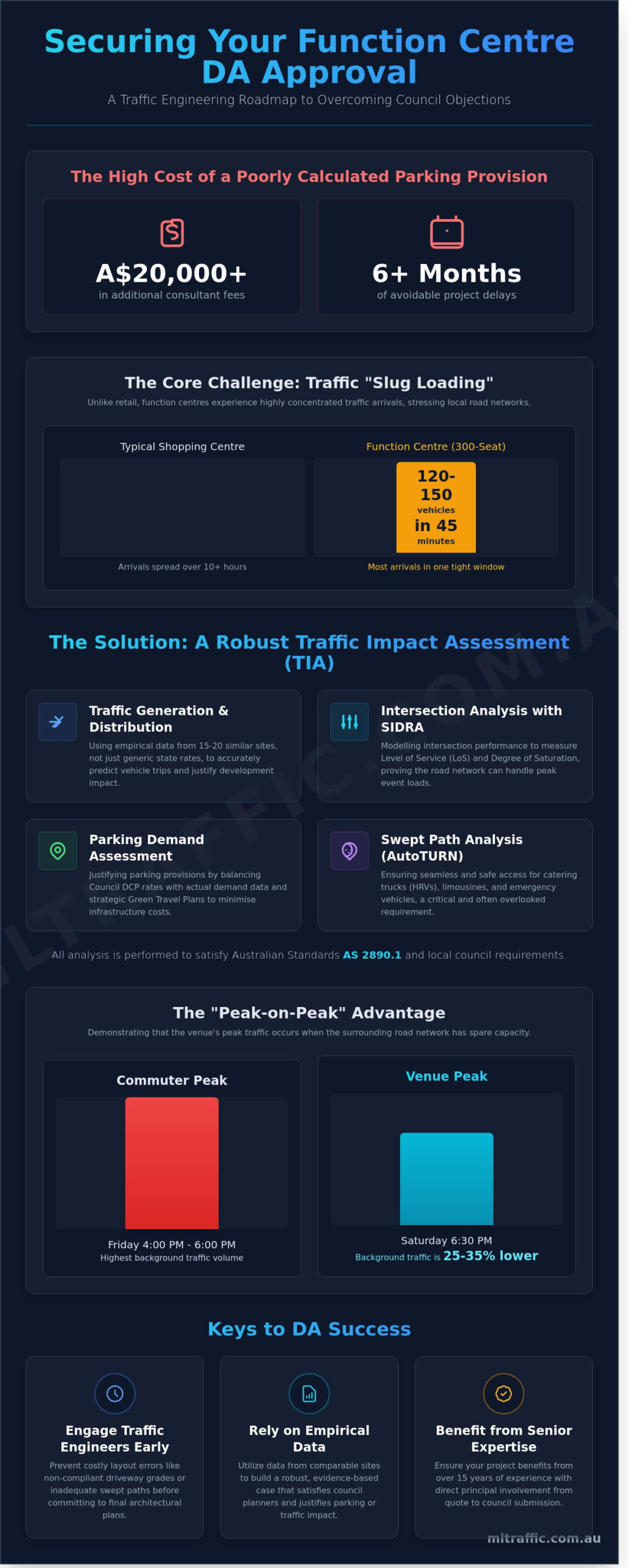
A single council rejection due to a poorly calculated parking provision can set a development project back by over A$20,000 in additional consultant fees and six months of avoidable delays. You likely understand that securing a Development Application (DA) for a hospitality venue is rarely about the architecture. It’s about proving your site won’t congest the local road network. A technical traffic report for function centre developments is the critical document needed to address these concerns and satisfy the rigorous requirements of Australian Standards AS 2890.1.
It’s frustrating when community objections regarding late-night noise and street parking stall a promising venue, but these hurdles are manageable with the right technical approach. This guide provides a direct roadmap to DA approval by focusing on smart parking design and robust traffic impact assessments. You’ll learn how to minimise infrastructure costs through precise data and gain insights into the technical work required for council compliance. We’ll cover everything from swept path analysis to peak hour trip generation. This ensures your project moves from the drawing board to construction without unnecessary bureaucratic friction.
Key Takeaways
- Understand why a comprehensive traffic report for function centre applications is critical for managing high-occupancy event peaks and securing DA approval.
- Learn how to utilize SIDRA modelling and intersection analysis to demonstrate compliance with Australian Standards and local council requirements.
- Discover how to justify parking shortfalls by balancing empirical demand data with Council DCP rates and strategic Green Travel Plans.
- Identify the importance of swept path analysis using AutoTURN to ensure seamless access for catering trucks, limousines, and emergency vehicles.
- Benefit from direct principal involvement and over 15 years of experience to ensure your technical assessments meet rigorous regulatory scrutiny.
Table of Contents
- Why a Traffic Report for a Function Centre is Critical for DA Approval
- Core Components of a Function Centre Traffic Impact Assessment
- Solving the Parking Dilemma: Demand vs. Council Requirements
- Swept Path Analysis: Ensuring Access for Limos and Caterers
- Securing Your Approval with ML Traffic Engineers
Why a Traffic Report for a Function Centre is Critical for DA Approval
A Traffic Impact Assessment (TIA) is a formal technical study required by Australian councils to evaluate the effect of a new development on the existing transport network. For high-occupancy venues, a traffic report for function centre projects is mandatory. These reports analyze site access, safety, and the capacity of nearby intersections. Traffic engineering principles are applied to ensure that the influx of guests doesn’t create gridlock or safety hazards for the public. A TIA provides the empirical evidence council planners need to approve a development application.
Function centres present a unique challenge because their traffic profile is highly concentrated. Unlike a shopping centre where arrivals are spread over 10 hours, a 300-seat function centre often sees 120 to 150 vehicles arrive within a tight 45-minute window. This creates “slug loading” on the local road network. If the design fails to account for this concentration, the resulting queueing can block main arterial roads, leading to immediate DA refusal. The report must demonstrate that the site can “absorb” these vehicles without failing the surrounding infrastructure.
Ignoring parking demand assessments during the early design phase is a high-risk strategy. Councils often demand higher parking rates than the minimums found in local environmental plans (LEPs) if the venue size exceeds standard thresholds. Retrofitting a basement or expanding a parking lot after the initial design is submitted can cost upwards of A$65,000 in redesign fees and structural modifications. A traffic report for function centre developments identifies these requirements before you commit to a final architectural layout.
Understanding the “Peak-on-Peak” Traffic Phenomenon
Traffic engineers distinguish between the “commuter peak” and the “venue peak.” Most road networks experience their highest volumes on Friday afternoons between 4:00 PM and 6:00 PM. A wedding venue might peak on a Saturday at 6:30 PM when background road traffic is 25% to 35% lower than weekday levels. Engineers use this data to justify the development’s impact by showing that the roads have more spare capacity when the venue is busiest. Peak-on-peak is the intersection of venue activity and peak background traffic.
The Role of the Traffic Engineer in the Planning Lifecycle
Engaging a consultant before finalizing the site layout is essential. This prevents layout errors, such as non-compliant driveway grades or inadequate swept paths for heavy rigid vehicles (HRVs) delivering catering supplies. At ML Traffic Engineers, we operate on a principle of direct accountability. The traffic consultant who provides the quote, does the work. This ensures that the senior expertise promised at the start is what’s delivered to the council. You can view our full range of traffic engineering services to see how we assist with complex DA submissions for event-based land uses.
Core Components of a Function Centre Traffic Impact Assessment
A professional traffic report for function centre applications must provide a technical analysis of how the development interacts with the existing road hierarchy. This process starts with comprehensive traffic generation and distribution modelling. We don’t rely on guesswork; we use SIDRA software to model intersection performance, measuring specific metrics like Level of Service (LoS) and the degree of saturation. This ensures the surrounding road network can handle peak event periods without causing 15-minute or longer delays for local commuters.
Developers must adhere to the WA government transport assessment guidelines to ensure their submission meets statutory expectations. This involves assessing the capacity and safety of the surrounding road network, identifying any required upgrades to turn lanes or shoulder widths. Our engineers conduct site-specific assessments to confirm that the existing infrastructure supports the proposed intensification of land use.
Traffic Generation: Beyond Generic Data
Standard traffic generation rates from state authorities often overestimate the impact of boutique venues. We rely on empirical data from 15 to 20 similar sites to justify realistic trip rates. For instance, a 200-person wedding typically generates 70 to 85 vehicle trips rather than 200. This reduction is supported by carpooling trends where vehicle occupancy averages 2.5 to 3.0 people per car. We also model the 5 to 10 service vehicles required for catering and waste removal to ensure total site movements remain within the capacity of the local street.
Safety and Sight Distance Compliance
Safety assessments focus on the physical geometry of the site access. We calculate Stopping Sight Distance (SSD) and Safe Intersection Sight Distance (SISD) for all entry points. For roads with 80km/h limits, this requires clear sightlines of at least 175 to 181 metres. We ensure all driveway ramp grades comply with AS 2890.1 to prevent floor scraping for low-clearance vehicles. Night-time safety is addressed through lighting assessments and drainage reviews to manage the risks associated with late-night event finishes. Our team provides these detailed traffic engineering services to help secure your DA approval.
A robust traffic report for function centre developments must also address the “plus-one” attendance phenomenon. By accounting for guests arriving together, we can often reduce the required number of on-site parking spaces, saving developers significant construction costs. Every assessment we produce is designed to satisfy Council requirements while maintaining the functional efficiency of the venue.
Solving the Parking Dilemma: Demand vs. Council Requirements
Local Environmental Plans (LEP) and Development Control Plans (DCP) often mandate parking rates that do not reflect how modern venues actually operate. When preparing a traffic report for function centre applications, we analyze the gap between these generic rates and your project’s specific operational needs. If your development shows a parking shortfall, we justify the deficit through a formal Green Travel Plan or by demonstrating proximity to high-frequency transit hubs. We have found that sites within 400 metres of a major train station can often support a 20% to 35% reduction in on-site parking requirements without impacting local street capacity.
Bicycle parking and end-of-trip facilities are now mandatory considerations for most councils. Under Clause 52.34 concepts, developers must provide secure storage and change facilities for staff and patrons. This encourages sustainable transport and provides a technical lever to offset car parking deficits during the DA assessment process. Our reports quantify these benefits to ensure the proposal remains viable under strict council scrutiny.
AS 2890.1 Compliance for Function Centres
Every parking layout must adhere strictly to Australian Standard AS 2890.1. We design facilities to accommodate the B99 vehicle, which represents the 99.8th percentile car. This ensures that even the largest passenger vehicles can navigate the site without conflict. Our technical assessments focus on:
- Aisle Widths: Ensuring minimum widths of 5.8 metres for two-way traffic or specific dimensions based on the parking angle.
- Turn Circles: Providing sufficient swept path clearance for efficient event ingress and egress.
- Ramp Grades: Maintaining compliant gradients to prevent vehicle scraping and ensure pedestrian safety.
For a detailed breakdown of these technical requirements, see our AS 2890.1 Explained guide.
Empirical Parking Assessments
Generic council rates are frequently outdated and fail to account for site-specific variables. We conduct empirical surveys of similar existing venues to provide an accurate reflection of peak demand. This data is critical for mixed-use developments where shared parking arrangements are possible. For instance, a hotel and function centre can often share parking bays because their peak usage times rarely overlap. Empirical data often overrides generic council rates in a TIA because it provides site-specific evidence rather than theoretical assumptions. Since 2005, we have used this evidence-based method across over 10,000 sites to secure approvals for projects that would have otherwise been rejected due to parking constraints.
Swept Path Analysis: Ensuring Access for Limos and Caterers
Standard car park designs usually focus on B85 or B99 passenger vehicles. Function centres operate differently. A comprehensive traffic report for function centre applications must include detailed swept path analysis for non-standard vehicles. We use AutoTURN software to simulate the physical space required for a vehicle to complete a turn. This prevents costly design errors where a 12 metre coach gets stuck or a catering truck clips a kerb. It’s a technical requirement that councils scrutinise heavily during the DA process.
Common failure points in site design include port-cocheres with insufficient overhead clearance or narrow driveways that don’t account for the “off-tracking” of longer wheelbases. Our analysis ensures your site remains accessible for waste collection vehicles and emergency services, such as fire tankers, as per local council requirements. We provide the following technical assessments:
- Simulation of Small Rigid Vehicles (SRV) and Medium Rigid Vehicles (MRV) for deliveries.
- Turning templates for Heavy Rigid Vehicles (HRV) where required for waste collection.
- Clearance checks for basement entries and overhead canopies.
- Sight-line assessments at driveway exit points to ensure pedestrian safety.
Designing for Event-Specific Vehicles
Stretch limousines and 14.5 metre luxury coaches have significantly larger turning circles than standard cars. If your entry point or drop-off zone isn’t designed for these dimensions, you face operational chaos and potential property damage. Catering trucks require dedicated paths that don’t interfere with the guest arrival experience. We model these movements to ensure smooth transitions. For a deeper look at different vehicle classifications and their requirements, see our Swept Path Analysis Guide.
Loading Dock and Service Access
Separating guest traffic from service movements is a safety priority. We design loading areas to comply with AS 2890.2, the Australian Standard for commercial vehicle facilities. This includes assessing the “bump-out” period. Late-night event pack-downs involve heavy vehicles and noise. Your traffic report for function centre must address how these movements occur without disturbing neighbouring residents or creating bottlenecks. We focus on:
- Dedicated service bays that don’t overlap with guest parking.
- Forward-in, forward-out movement requirements for heavy vehicles.
- Compliance with local council noise and vibration constraints during late-night hours.
Ensure your development meets all technical access requirements by speaking with our team. Contact our senior engineers for a site-specific assessment.
Securing Your Approval with ML Traffic Engineers
ML Traffic Engineers has been a fixture in Australian traffic consultancy since 2005. We provide a level of expertise that junior-heavy firms cannot match. Our team has completed over 10,000 successful site assessments across the country, ranging from small-scale residential changes to massive commercial hubs. We understand the specific pressure points councils identify when reviewing a traffic report for function centre applications. Our reports are built on technical precision and a deep understanding of Australian Standards, including AS 2890.1 for parking facilities. We don’t produce generic templates. We deliver rigorous, site-specific data that stands up to the closest scrutiny from council engineers and transport authorities.
Our firm is led by Michael Lee and Benny Chen, who each bring between 30 and 40 years of individual experience to the table. This seniority is the foundation of our “no-nonsense” approach. We focus on the critical metrics that determine DA success: vehicle swept path assessments, sight-line requirements, and driveway ramp grades. By addressing these technicalities upfront, we minimize the need for costly Requests for Further Information (RFIs). Our history of working on diverse land uses, including bars, temples, warehouses, and reception centres, gives us the perspective needed to negotiate effectively with local government planners.
Our Direct-to-Engineer Process
We operate on a simple, accountable principle: the traffic consultant who provides the quote is the one who does the work. This eliminates the common industry problem where a senior principal sells the project, only to hand the technical analysis off to an inexperienced graduate. You deal directly with Michael or Benny throughout the entire process. This ensures total transparency in both our pricing and our technical delivery. You’ll get straight answers about your project’s feasibility and any potential hurdles. You can learn more about our senior leadership team and our 15-plus years of history by visiting our About Us page. This direct access model ensures that every traffic report for function centre we produce is backed by decades of professional judgment.
Next Steps for Your Development Application
Moving forward with your project requires a clear, professional fee proposal. To ensure we provide an accurate quote for your function centre, we need a few specific documents. Please have your site plan, internal floor layouts, and a summary of your proposed operations ready. We need to know your peak guest capacity and expected staff numbers to calculate accurate parking demand. Once we have these details, we can provide a rapid assessment of your requirements. Don’t leave your DA approval to chance with a cut-price report that lacks technical depth. Contact ML Traffic Engineers today to secure a report that meets every regulatory standard and keeps your development moving forward.
Secure Your Function Centre DA Approval
A successful development application hinges on technical precision and a deep understanding of local traffic impacts. You must address the parking demand dilemma and ensure large vehicle access through rigorous swept path analysis. A professional traffic report for function centre developments provides the empirical data councils need to approve your project without unnecessary delays. ML Traffic Engineers has traded since 2005, delivering over 10,000 successful assessments across Australia. We guarantee all designs meet AS 2890.1 and AS 2890.2 requirements, protecting your investment from costly compliance issues.
Our firm prioritizes direct accountability. The senior principal who quotes your project is the same expert who performs the technical work. This ensures your specific challenges are solved by professionals with over 15 years of traffic engineering experience. Don’t leave your DA to chance; leverage our proven track record to navigate the complexities of transport planning and site access. We’re ready to help you move your project from the drawing board to reality.
Get a Professional Traffic Report for Your Function Centre
Frequently Asked Questions
Do I always need a traffic report for a function centre DA?
Yes, you’ll almost certainly need a traffic report for a function centre to secure Development Application approval. Local councils in Australia require these reports to assess how your venue affects the existing road network and local parking availability. Because function centres generate high vehicle volumes during specific peak windows, a professional assessment is mandatory to prove the site can handle the load without compromising safety.
What is the difference between a Traffic Impact Assessment and a Traffic Management Plan?
A Traffic Impact Assessment (TIA) is a technical study submitted during the planning stage to evaluate the long-term effects of your development on local roads. It focuses on capacity, safety, and parking requirements. A Traffic Management Plan (TMP) is an operational document that outlines how you’ll manage actual vehicle and pedestrian movements on event days. The TIA gets your DA approved; the TMP ensures your daily operations run safely.
How much does a traffic report for a function centre typically cost?
Preparation of a professional traffic report typically costs between A$2,500 and A$5,500 for standard function centre developments. These costs vary based on the venue’s total floor area and the complexity of the required intersection modelling. If your project requires 24-hour traffic counts or detailed SIDRA analysis for multiple intersections, fees can exceed A$7,500. We provide fixed-price quotes where the senior engineer who quotes the work also performs the assessment.
Can a traffic engineer help if I have less parking than council requires?
Yes, we can often justify a parking shortfall by conducting a formal Car Parking Demand Assessment. We use empirical data from similar venues and 2021 Census data to demonstrate that actual parking demand is lower than the generic rates found in Council’s Development Control Plan (DCP). If your site is within 400 metres of a train station or high-frequency bus stop, we use these factors to argue for a reduction in required on-site spaces.
What is Swept Path Analysis and why is it needed for my venue?
Swept Path Analysis is a computer simulation that tracks the path of a vehicle’s tyres and body during turns and manoeuvres. It’s essential for your venue to prove that service vehicles, such as an 8.8-metre Medium Rigid Vehicle (MRV) for catering deliveries, can enter and exit the site in a forward direction. We also use it to verify that guest cars can navigate tight parking aisles and ramps according to AS 2890.1 standards.
How long does it take to prepare a TIA for a function centre?
A standard Traffic Impact Assessment for a function centre takes approximately 10 to 15 business days to complete. This timeframe allows for site inspections, data collection, and technical drafting. If your local council requires 7-day traffic surveys or if the site has complex access issues, the process may extend to 20 business days. We maintain a direct, no-nonsense workflow to ensure your report is ready for your DA submission deadline.
What happens if the council objects to my traffic report?
If Council objects, your traffic engineer will prepare a formal response to the Request for Information (RFI) or the specific grounds of objection. We analyze the council’s technical concerns, such as sight-line deficiencies or queuing distances, and provide data-driven rebuttals or minor design tweaks to resolve the issue. With experience across over 10,000 sites, we’ve successfully negotiated approvals for even the most scrutinized developments.
Does the report cover noise impacts from guest vehicles?
No, a traffic report focuses on vehicle volumes, safety, and parking compliance rather than acoustics. While we provide the data regarding the number of vehicle movements, a separate Acoustic Report is usually required to assess noise from car doors, engines, and guest departures. We frequently coordinate with acoustic consultants to ensure the vehicle data in our traffic report for a function centre aligns perfectly with their noise impact models.
Which areas do you cover?
We are traffic engineers servicing Melbourne, Sydney, Brisbane, Gold Coast, Hobart, Perth, Adelaide, Darwin, Canberra and surrounding areas.
Disclaimer
The content on www.mltraffic.com.au, including all technical articles, guides, and resources, is provided for general informational and educational purposes only. It is not intended to constitute professional advice in traffic engineering, transportation planning, development approvals, or any other technical or legal field.
While ML Traffic Engineers makes every reasonable effort to ensure the accuracy, completeness, and timeliness of the information published, we do not provide any warranties or representations (express or implied) regarding its reliability, suitability, or availability for any particular purpose. Any reliance you place on the content is strictly at your own risk.
In no event shall ML Traffic Engineers, its directors, employees, authors, or affiliates be liable for any direct, indirect, incidental, special, consequential, or punitive damages (including, without limitation, loss of profits, data, or business opportunities) arising out of or in connection with the use of, or inability to use, any information provided on this website.
The articles and guides on this site are not a substitute for engaging a qualified, registered professional traffic engineer (such as an NPER or RPEQ engineer) to assess your specific project requirements. For tailored advice, compliance assessments, or traffic engineering services, please contact a competent professional.
This disclaimer may be updated from time to time without notice. By accessing or using this website, you agree to be bound by the most current version of this disclaimer.
