

Is your development project stalled because a standard Traffic Impact Assessment failed to satisfy a skeptical council? Many developers mistakenly assume their initial TIA will suffice during an appeal, but a standard report often lacks the legal weight required by the bench. You’ve likely already invested significant capital into your project, only to face a DA refusal based on parking or traffic concerns. Obtaining a compliant traffic report for land and environment court proceedings is the only way to protect that investment when court-imposed deadlines for evidence are often as short as 14 days.
We are traffic engineers servicing Sydney metropolitan area, Central Coast, Hunter Region, South Coast and the rest of New South Wales.
A specialized report is a piece of expert evidence that must strictly adhere to the Expert Witness Code of Conduct. We’ll show you how to secure planning approval by transitioning from a general assessment to a defensible expert statement. This guide explains the technical standards needed to meet LEC requirements, the critical role of an expert witness in joint conferencing, and how to avoid the common evidentiary traps that lead to dismissed appeals.
Key Takeaways
- Understand why councils frequently refuse development applications based on traffic concerns and how specialized expert evidence can address these technical objections.
- Learn the essential compliance requirements for a traffic report for land and environment court, including strict adherence to the Expert Witness Code of Conduct.
- Distinguish between Class 1 merits reviews and Class 4 judicial proceedings to ensure your traffic evidence is tailored to the court’s specific legal framework.
- Gain insights into the Joint Conference process and how the Joint Expert Report (JER) serves to narrow contested issues between applicant and council experts.
- Recognize the importance of senior-level involvement in court-bound assessments to ensure your expert witness remains accountable and resilient under cross-examination.
Table of Contents
-
The Critical Role of a Traffic Report for Land and Environment Court Appeals
-
Expert Witness Statements vs. Standard Traffic Impact Assessments
-
Navigating Traffic Evidence in Class 1 and Class 4 Proceedings
-
Selecting a Traffic Expert: Why Senior Experience is Non-Negotiable
The Critical Role of a Traffic Report for Land and Environment Court Appeals
A traffic report for land and environment court is a specialized technical assessment prepared by a qualified expert witness to address contested issues in a planning appeal. Unlike a standard preliminary statement, this document serves as formal evidence within the Land and Environment Court of New South Wales. It provides a rigorous analysis of how a proposed development interacts with the existing transport network, focusing specifically on points of law and planning merit. Since the court’s establishment in 1979, the requirement for precise, data-driven evidence has become the standard for resolving complex urban disputes.
Councils often refuse Development Applications (DAs) based on specific traffic concerns. These typically involve parking shortfalls where the proposal doesn’t meet the minimum requirements of a local Development Control Plan (DCP). Other common triggers include safety risks at site access points or the perceived impact on road capacity. When these disputes arise, the role of the traffic engineer shifts from a standard consultant to an Expert Witness under the Land and Environment Court Act 1979. This professional report becomes the backbone of your evidence, providing the technical justification needed during merits review proceedings.
To better understand how evidence and discovery function in a legal setting, watch this helpful video:
When is an LEC Traffic Report Required?
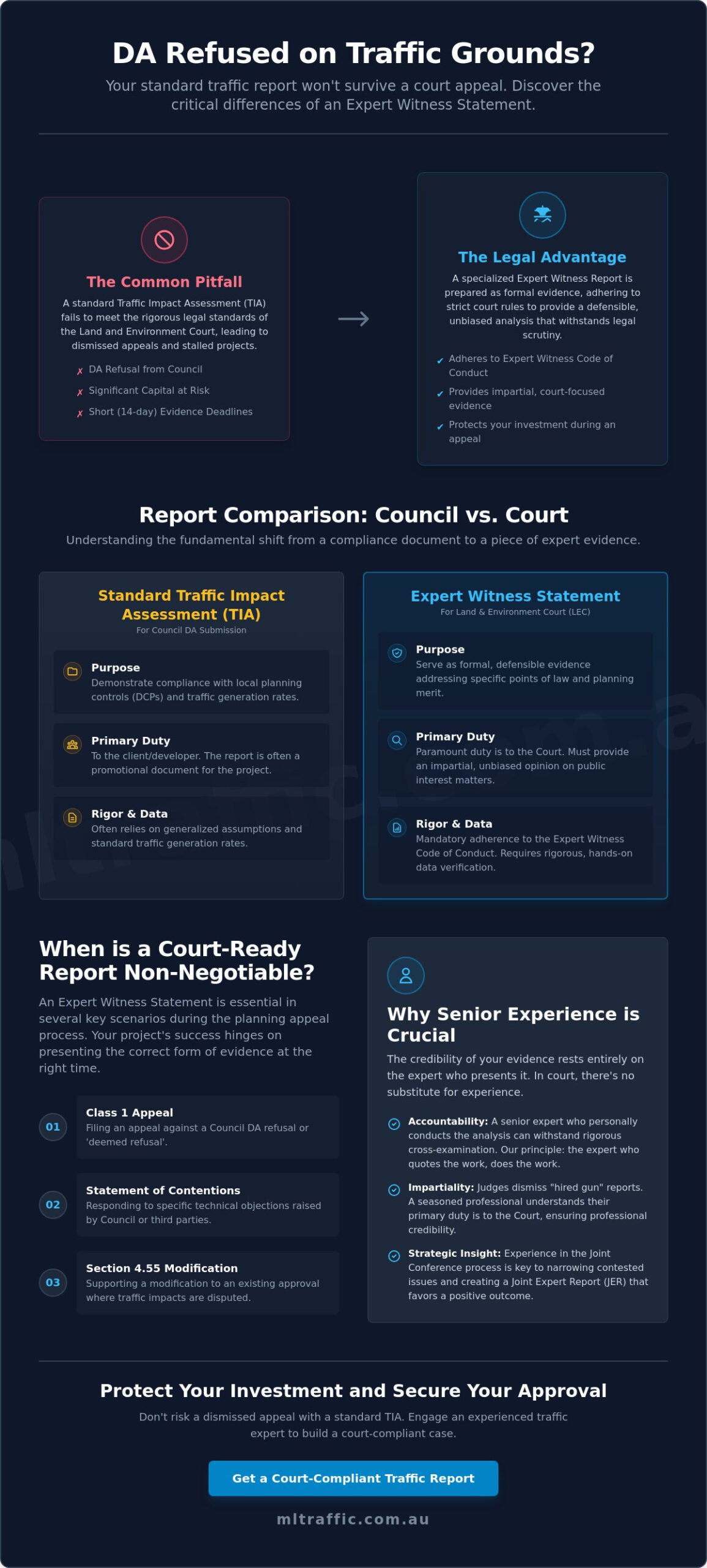
You’ll need a specialized traffic report for land and environment court when filing a Class 1 appeal against a DA refusal or a ‘deemed refusal’. It’s also critical when responding to specific ‘Statements of Contentions’ filed by Council or third-party objectors. If you’re modifying an existing approval under Section 4.55 of the Environmental Planning and Assessment Act and the traffic impacts are in dispute, a fresh expert assessment is necessary to support the application. Our traffic engineering services cover these technical requirements across all Australian jurisdictions.
The Primary Duty to the Court
The traffic engineer’s paramount duty is to the Court, not the client. This obligation requires the provision of impartial, unbiased evidence that adheres to the Expert Witness Code of Conduct. Commissioners and Judges frequently dismiss ‘hired gun’ reports that fail to acknowledge technical realities or ignore adverse data. Professional credibility is the most valuable asset in an LEC proceeding. At ML Traffic Engineers, we operate on the principle that the traffic consultant who provides the quote, does the work. This ensures that the expert defending the report in the witness box has a meticulous, hands-on understanding of every data point and swept path assessment included in the evidence.
Expert Witness Statements vs. Standard Traffic Impact Assessments
A standard Traffic Impact Assessment (TIA) prepared for a local council Development Application focuses on demonstrating compliance with local planning controls and traffic generation rates. A traffic report for land and environment court operates under a different legal framework. It’s no longer a promotional document for a project; it’s a piece of expert evidence. The primary duty of the engineer shifts from the developer to the Court. This means the expert must provide an independent, unbiased opinion on "public interest" matters, including road safety, site access, and network capacity.
Adherence to the Expert Witness Code of Conduct, found in Schedule 7 of the Uniform Civil Procedure Rules 2005 (UCPR), is mandatory. Failure to follow these expert evidence guidelines can result in the evidence being ruled inadmissible. The Court expects rigorous data verification. We don’t rely on generalized assumptions or outdated traffic counts. Evidence must be based on site-specific observations, current SIDRA modelling, and verified swept path analysis to ensure every conclusion is defensible under cross-examination.
Mandatory Components of Court-Ready Evidence
To meet the requirements of the Land and Environment Court (LEC), an expert statement must include specific structural elements. These ensure the Court can assess the weight of the testimony provided. Key requirements include:
-
Qualifications and Experience: A detailed statement of the principal engineer’s professional background. At ML Traffic Engineers, our principals bring between 30 and 40 years of experience to every matter.
-
Code of Conduct Acknowledgment: A signed declaration that the expert has read the Expert Witness Code of Conduct and agrees to be bound by it.
-
Facts and Assumptions: A clear identification of the specific data, plans, and assumptions used to form the opinion. This includes references to Australian Standards like AS 2890.1 for parking facilities.
Addressing Council’s Statement of Contentions
The Statement of Contentions is the roadmap for all expert evidence in the LEC. Every traffic report for land and environment court must directly respond to the specific points of refusal raised by the Council or the relevant planning authority. This process requires a meticulous, point-by-point analysis of the technical disputes.
Our role involves identifying where the Council’s contentions lack technical merit and where the development might actually require modification. If a design element, such as a driveway ramp grade or a sight-line assessment, is non-compliant, the expert’s duty is to concede that point and suggest a practical engineering solution. This transparency builds credibility with the Commissioner. If you’re facing a refusal based on traffic grounds, you can review our traffic engineering services to see how we address complex site constraints in a legal context. We ensure the consultant who quotes the job is the one who does the work and appears in Court.
Navigating Traffic Evidence in Class 1 and Class 4 Proceedings
The role of expert evidence varies significantly depending on the type of legal challenge. In the NSW Land and Environment Court, most development disputes fall under Class 1 or Class 4 proceedings. Each requires a specific approach to how a traffic report for land and environment court is presented and defended. Understanding the Land and Environment Court – Development Appeals Process is the first step for any developer facing a refusal or deemed refusal.
In Class 1 proceedings, the Court conducts a merits review. It effectively steps into the shoes of the council to make the best planning decision based on the facts. Conversely, Class 4 proceedings involve judicial review. Here, the Court isn’t deciding if the development is a good idea, but whether the council’s decision was legally valid. Traffic engineers must tailor their testimony to meet these different legal thresholds.
Merits Review: Assessing the Planning Balance
During a Class 1 appeal, the traffic engineer’s primary task is demonstrating that the proposal’s impacts are acceptable. We evaluate parking demand against the specific rates in the council’s Development Control Plan (DCP). If a proposal provides fewer spaces than the DCP requires, we provide empirical evidence to justify the shortfall. This often involves site-specific surveys or comparisons with similar land uses. We use the foundational criteria outlined in our Traffic Impact Assessment guide to determine if the local road network can safely absorb the projected trip generation. The goal is to prove the ‘reasonableness’ of the traffic impact within the broader planning context.
Judicial Review: Technical Compliance and Procedural Fairness
Class 4 cases are narrower in scope. The traffic engineer provides evidence on whether the council followed the correct technical procedures. We analyze if a refusal based on traffic grounds was ‘Wednesbury unreasonable’, a legal standard where a decision is so irrational that no reasonable authority could’ve made it. This requires a meticulous review of technical planning instruments and Australian Standards like AS 2890.1. We don’t argue about the merits of the driveway location; we argue whether the council correctly interpreted the technical requirements governing that driveway.
Traffic engineers are also essential during Section 34 Conciliation Conferences. These meetings aim to reach an early settlement without a full hearing. Our role includes:
-
Engaging in ‘without prejudice’ technical discussions with the council’s traffic experts.
-
Identifying design compromises, such as modifying swept paths or adjusting parking layouts, to resolve objections.
-
Providing immediate technical feedback on proposed conditions of consent.
A well-prepared traffic report for land and environment court acts as the baseline for these negotiations. It’s often the quality of this technical documentation that determines if a settlement is reached or if the matter proceeds to an expensive contested hearing.
The Joint Expert Report (JER) and Conciliation Process
The Joint Expert Report (JER) is a pivotal document for any traffic report for land and environment court proceedings. It originates from the ‘Joint Conference’. This is a private meeting between the applicant’s traffic expert and the Council’s expert. Lawyers and developers don’t attend. This ensures the discussion remains strictly technical. The primary objective is to narrow the scope of the dispute by identifying exactly where the experts agree and where they differ.
The report serves as a roadmap for the Court. It documents ‘Points of Agreement’ and ‘Points of Disagreement’. Each point requires a technical justification based on the NSW RTA Guide to Traffic Generating Developments or relevant Australian Standards. By resolving minor technicalities early, experts can reduce hearing time by as much as 50%. This significantly lowers the developer’s legal costs and focuses the Court’s attention only on the most critical issues.
How to Prepare for a Joint Expert Conference
Preparation requires a meticulous review of the opposing expert’s claims. We look for technical omissions or misinterpretations of the NSW RTA Guide. It’s essential to have updated traffic data. If your tube counts or intersection surveys are over 24 months old, they’re vulnerable to challenge. We prepare a refined Swept Path Analysis to demonstrate that the site layout functions according to AS 2890.1 requirements. Accurate simulations often resolve access disputes before the experts even meet.
Our traffic consultants focus on the data. We ensure every claim in the traffic report for land and environment court is defensible under cross-examination. This involves verifying:
-
Current intersection degree of saturation (DOS) levels.
-
Compliance with driveway ramp grades.
-
Adequacy of on-site car parking supply versus Council LEP requirements.
-
Sight-line assessments at the property boundary.
The Section 34 Conciliation Conference
The Section 34 conference is a formal meeting chaired by a Court Commissioner. It’s a structured opportunity for parties to reach a settlement without a full hearing. The traffic engineer plays a vital role here. We explain technical compromises directly to the Commissioner and the Council representatives. These discussions are ‘without prejudice’, meaning they can’t be used as evidence if the matter proceeds to a hearing.
During this process, we often propose modified plans. If a minor design change satisfies a safety concern or improves a vehicle’s turning circle, a settlement can be reached on the spot. If the parties don’t reach an agreement, the JER becomes the primary evidence for the formal hearing. It defines the technical boundaries that the Judge will eventually rule upon.
Ensure your expert evidence is defensible and technically sound.
Contact ML Traffic Engineers today to discuss your Land and Environment Court matter.
Selecting a Traffic Expert: Why Senior Experience is Non-Negotiable
Choosing an expert for your Land and Environment Court (LEC) appeal is a high-stakes decision. Many large consultancy firms delegate the heavy lifting of technical analysis to junior staff. This creates a dangerous disconnect between the report author and the witness providing testimony. At ML Traffic Engineers, we eliminate this risk through a core operational principle: the traffic consultant who provides the quote, does the work. This ensures that the expert standing in the witness box has a granular understanding of every calculation and site observation.
Junior staff often lack the situational awareness to identify subtle site constraints that can derail a DA during a hearing. When you rely on a principal engineer like Michael Lee or Benny Chen, you’re hiring decades of experience. Each has between 30 and 40 years of professional practice. They’ve completed over 10,000 site assessments across Australia. This track record is essential when defending a traffic report for land and environment court against rigorous scrutiny from Council experts or legal counsel.
The Value of Hands-On Principal Involvement
Direct accountability from a senior engineer leads to more robust cross-examination performance. In the LEC environment, Commissioners and opposing solicitors look for inconsistencies. If the witness didn’t personally perform the site inspection or run the swept path simulations, they’re vulnerable. Meticulous file familiarity reduces the risk of surprises during the hearing. Our principals handle the technical work themselves, meaning they don’t just read the report; they own the data. You can learn more about our professional traffic engineer services and how our senior-led approach supports complex civil projects.
Final Checklist for Your Court Traffic Report
Before your evidence is filed, it must pass a strict quality control process. A flawed traffic report for land and environment court can lead to costly delays or a refusal. Ensure your documentation meets these non-negotiable standards:
-
Does the design strictly adhere to Australian Standards (AS 2890.1) for off-street car parking?
-
Are all vehicle swept paths verified using industry-standard software like AutoTURN?
-
Is the report written in a concise, declarative style that avoids unnecessary technical fluff?
-
Has the expert personally verified sight-line requirements and driveway ramp grades on-site?
-
Does the report provide a clear, professional opinion that directly addresses the Council’s reasons for refusal?
Expert evidence is only as strong as the engineer behind it. Don’t leave your project’s success to chance by using a firm that treats your appeal as a training exercise for junior staff. Experience matters when the outcome of your development is on the line. Contact ML Traffic Engineers today to discuss your LEC appeal requirements with our senior principals.
Secure Your Development Approval Through Expert Traffic Evidence
Navigating the Land and Environment Court requires more than a standard traffic impact assessment. Success in Class 1 and Class 4 proceedings depends on a robust traffic report for land and environment court appeals that meets specific evidentiary standards. You need a witness who understands the Joint Expert Report (JER) process and can defend technical data under cross-examination. At ML Traffic Engineers, the consultant who provides your quote is the one who does the work. This hands-on approach eliminates communication gaps during critical conciliation phases.
We bring over 15 years of LEC experience and a track record of assessing more than 10,000 sites nationally. You get direct access to our principal engineers, Michael Lee and Benny Chen, ensuring your evidence is handled by senior experts rather than junior staff. This level of accountability is vital when addressing Australian Standards like AS 2890.1 or complex parking demand assessments. Don’t leave your project’s future to chance with consultants who lack specialized court-room experience.
Secure an Expert Traffic Witness for Your LEC Appeal
Reliable traffic evidence is the foundation of a successful appeal, and we’re ready to help you move your project forward.
Frequently Asked Questions
What is an Expert Witness Code of Conduct in the Land and Environment Court?
The Expert Witness Code of Conduct is a mandatory set of rules under Schedule 7 of the Uniform Civil Procedure Rules 2005. It dictates that a traffic engineer’s primary duty is to the Court, not the party paying their fees. Every traffic report for land and environment court proceedings must include a signed statement confirming the expert has read and agrees to follow these specific requirements.
Can I use my initial DA traffic report for the court appeal?
You generally can’t use a standard DA traffic report for an LEC appeal without significant modifications. Court evidence must comply with the Expert Witness Code of Conduct and directly address the specific contentions or reasons for refusal issued by the Council. While your original Traffic Impact Statement (TIS) provides a baseline, it’s updated and reformatted into a formal Statement of Evidence for legal proceedings.
How much does a traffic report for an LEC appeal cost?
Costs for a court-ready traffic report depend on the volume of contentions raised by the Council and the project’s technical complexity. Professional fees are calculated based on the hours required for site inspections, SIDRA modeling, and drafting the expert statement. Since 2005, we’ve found that developments with complex access issues or high parking requirements involve more intensive analysis, which is reflected in the final quote.
What is a Joint Expert Report (JER) in traffic engineering?
A Joint Expert Report (JER) is a document co-authored by the applicant’s traffic engineer and the Council’s expert after a private conference. This report lists technical points of agreement and clearly identifies any remaining areas of dispute. Under the Land and Environment Court’s Practice Notes, this process is designed to narrow the issues that the Judge or Commissioner needs to resolve during the hearing.
Does the traffic expert work for me or for the court?
The traffic expert works for the Court, even though the developer engages them and pays their professional fees. This duty of impartiality is paramount and overrides any contractual obligation to the client. Our principals, Michael Lee and Benny Chen, ensure all evidence is based on objective technical facts, such as AS 2890.1 compliance, to maintain professional credibility during cross-examination.
What happens if the traffic experts cannot agree in the Joint Conference?
If experts don’t agree during their conference, they must document their differing professional opinions in the Joint Expert Report. Each expert provides a technical justification for their stance, often citing specific RTA Guide or Austroads standards. These unresolved technical points are then argued during the formal hearing, where the Court makes the final determination based on the evidence presented.
How long does it take to prepare a court-ready traffic report?
Preparing a traffic report for land and environment court success typically takes 14 to 28 days. This period allows for fresh traffic counts, updated intersection modeling, and a detailed response to the Council’s Statement of Contentions. Because the consultant who provides the quote does the work at our firm, we maintain a direct and efficient timeline without the delays of administrative handovers.
Can a traffic engineer help settle a case before it goes to a full hearing?
Traffic engineers often help settle cases before a full hearing through the Section 34 conciliation process. By negotiating engineering solutions, like modified driveway ramp grades or revised parking layouts, experts can resolve the Council’s objections early. In approximately 75 percent of our LEC matters, proactive technical adjustments lead to a mediated agreement, which avoids the costs of a multi-day hearing.
Which areas do you cover?
Abbotsbury, Abbotsford, Acacia Gardens, Agnes Banks, Airds, Alexandria, Alfords Point, Allambie Heights, Allawah, Ambarvale, Angus, Annandale, Annangrove, Arcadia, Arncliffe, Arndell Park, Artarmon, Ashbury, Ashcroft, Ashfield, Asquith, Auburn, Austral, Avalon Beach, Badgerys Creek, Balgowlah, Balgowlah Heights, Balmain, Balmain East, Bangor, Banksia, Banksmeadow, Bankstown, Bankstown Aerodrome, Barangaroo, Barden Ridge, Bardia, Bardwell Park, Bardwell Valley, Bass Hill, Baulkham Hills, Bayview, Beacon Hill, Beaconsfield, Beaumont Hills, Beecroft, Belfield, Bella Vista, Bellevue Hill, Belmore, Belrose, Berala, Berkshire Park, Berowra, Berowra Heights, Berowra Waters, Berrilee, Beverley Park, Beverly Hills, Bexley, Bexley North, Bidwill, Bilgola Beach, Bilgola Plateau, Birchgrove, Birrong, Blackett, Blacktown, Blair Athol, Blairmount, Blakehurst, Bligh Park, Bondi, Bondi Beach, Bondi Junction, Bonnet Bay, Bonnyrigg, Bonnyrigg Heights, Bossley Park, Botany, Bow Bowing, Box Hill, Bradbury, Bradfield, Breakfast Point, Brighton-Le-Sands, Bringelly, Bronte, Brooklyn, Brookvale, Bundeena, Bungarribee, Burraneer, Burwood, Burwood Heights, Busby, Cabarita, Cabramatta, Cabramatta West, Caddens, Cambridge Gardens, Cambridge Park, Camellia, Cammeray, Campbelltown, Camperdown, Campsie, Canada Bay, Canley Heights, Canley Vale, Canoelands, Canterbury, Caringbah, Caringbah South, Carlingford, Carlton, Carnes Hill, Carramar, Carss Park, Cartwright, Castle Cove, Castle Hill, Castlecrag, Castlereagh, Casula, Catherine Field, Cattai, Cecil Hills, Cecil Park, Centennial Park, Chatswood, Chatswood West, Cheltenham, Cherrybrook, Chester Hill, Chifley, Chippendale, Chipping Norton, Chiswick, Chullora, Church Point, Claremont Meadows, Clarendon, Clareville, Claymore, Clemton Park, Clontarf, Clovelly, Clyde, Coasters Retreat, Cobbitty, Colebee, Collaroy, Collaroy Plateau, Colyton, Como, Concord, Concord West, Condell Park, Connells Point, Constitution Hill, Coogee, Cottage Point, Cowan, Cranebrook, Cremorne, Cremorne Point, Cromer, Cronulla, Crows Nest, Croydon, Croydon Park, Curl Curl, Currans Hill, Currawong Beach, Daceyville, Dangar Island, Darling Point, Darlinghurst, Darlington, Davidson, Dawes Point, Dean Park, Dee Why, Denham Court, Denistone, Denistone East, Denistone West, Dharruk, Dolans Bay, Dolls Point, Doonside, Double Bay, Dover Heights, Drummoyne, Duffys Forest, Dulwich Hill, Dundas, Dundas Valley, Dural, Eagle Vale, Earlwood, East Hills, East Killara, East Lindfield, East Ryde, Eastern Creek, Eastgardens, Eastlakes, Eastwood, Edensor Park, Edgecliff, Edmondson Park, Elanora Heights, Elderslie, Elizabeth Bay, Elizabeth Hills, Elvina Bay, Emerton, Enfield, Engadine, Englorie Park, Enmore, Epping, Ermington, Erskine Park, Erskineville, Eschol Park, Eveleigh, Fairfield, Fairfield East, Fairfield Heights, Fairfield West, Fairlight, Fiddletown, Five Dock, Forest Glen, Forest Lodge, Forestville, Frenchs Forest, Freshwater, Gables, Galston, Georges Hall, Gilead, Girraween, Gladesville, Glebe, Gledswood Hills, Glen Alpine, Glendenning, Glenfield, Glenhaven, Glenmore Park, Glenorie, Glenwood, Gordon, Grantham Farm, Granville, Grays Point, Great Mackerel Beach, Green Valley, Greenacre, Greendale, Greenfield Park, Greenhills Beach, Greenwich, Gregory Hills, Greystanes, Guildford, Guildford West, Gymea, Gymea Bay, Haberfield, Hammondville, Harrington Park, Harris Park, Hassall Grove, Haymarket, Heathcote, Hebersham, Heckenberg, Henley, Hillsdale, Hinchinbrook, Hobartville, Holroyd, Holsworthy, Homebush, Homebush West, Horningsea Park, Hornsby, Hornsby Heights, Horsley Park, Hoxton Park, Hunters Hill, Huntingwood, Huntleys Cove, Huntleys Point, Hurlstone Park, Hurstville, Hurstville Grove, Illawong, Ingleburn, Ingleside, Jamisontown, Jannali, Jordan Springs, Kangaroo Point, Kareela, Kearns, Kellyville, Kellyville Ridge, Kemps Creek, Kensington, Kenthurst, Kentlyn, Killara, Killarney Heights, Kings Langley, Kings Park, Kingsford, Kingsgrove, Kingswood, Kirkham, Kirrawee, Kirribilli, Kogarah, Kogarah Bay, Ku-ring-gai Chase, Kurnell, Kurraba Point, Kyeemagh, Kyle Bay, La Perouse, Lakemba, Lalor Park, Lane Cove, Lane Cove North, Lane Cove West, Lansdowne, Lansvale, Laughtondale, Lavender Bay, Leets Vale, Leichhardt, Len Waters Estate, Leppington, Lethbridge Park, Leumeah, Lewisham, Liberty Grove, Lidcombe, Lilli Pilli, Lilyfield, Lindfield, Linley Point, Little Bay, Liverpool, Llandilo, Loftus, Londonderry, Long Point, Longueville, Lovett Bay, Lower Portland, Lucas Heights, Luddenham, Lugarno, Lurnea, Macquarie Fields, Macquarie Links, Macquarie Park, Maianbar, Malabar, Manly, Manly Vale, Maraylya, Marayong, Maroota, Maroubra, Marrickville, Marsden Park, Marsfield, Mascot, Matraville, Mays Hill, McCarrs Creek, McGraths Hill, McMahons Point, Meadowbank, Melonba, Melrose Park, Menai, Menangle Park, Merrylands, Merrylands West, Middle Cove, Middle Dural, Middleton Grange, Miller, Millers Point, Milperra, Milsons Passage, Milsons Point, Minchinbury, Minto, Minto Heights, Miranda, Mona Vale, Monterey, Moore Park, Moorebank, Morning Bay, Mortdale, Mortlake, Mosman, Mount Annan, Mount Colah, Mount Druitt, Mount Kuring-Gai, Mount Lewis, Mount Pritchard, Mount Vernon, Mulgoa, Mulgrave, Narellan, Narellan Vale, Naremburn, Narrabeen, Narraweena, Narwee, Nelson, Neutral Bay, Newington, Newport, Newtown, Nirimba Fields, Normanhurst, North Balgowlah, North Bondi, North Curl Curl, North Epping, North Kellyville, North Manly, North Narrabeen, North Parramatta, North Rocks, North Ryde, North St Marys, North Strathfield, North Sydney, North Turramurra, North Wahroonga, North Willoughby, Northbridge, Northmead, Northwood, Norwest, Oakhurst, Oakville, Oatlands, Oatley, Old Guildford, Old Toongabbie, Oran Park, Orchard Hills, Oxford Falls, Oxley Park, Oyster Bay, Paddington, Padstow, Padstow Heights, Pagewood, Palm Beach, Panania, Parklea, Parramatta, Peakhurst, Peakhurst Heights, Pemulwuy, Pendle Hill, Pennant Hills, Penrith, Penshurst, Petersham, Phillip Bay, Picnic Point, Pitt Town, Pleasure Point, Plumpton, Point Piper, Port Botany, Port Hacking, Potts Hill, Potts Point, Prairiewood, Prestons, Prospect, Punchbowl, Putney, Pymble, Pyrmont, Quakers Hill, Queens Park, Queenscliff, Raby, Ramsgate, Ramsgate Beach, Randwick, Redfern, Regents Park, Regentville, Revesby, Revesby Heights, Rhodes, Richards, Richmond, Riverstone, Riverview, Riverwood, Rockdale, Rodd Point, Rookwood, Rooty Hill, Ropes Crossing, Rose Bay, Rosebery, Rosehill, Roselands, Rosemeadow, Roseville, Roseville Chase, Rossmore, Rouse Hill, Rozelle, Ruse, Rushcutters Bay, Russell Lea, Rydalmere, Ryde, Sackville North, Sadleir, Sandringham, Sandy Point, Sans Souci, Schofields, Scotland Island, Seaforth, Sefton, Seven Hills, Shalvey, Shanes Park, Silverwater, Singletons Mill, Smeaton Grange, Smithfield, South Coogee, South Granville, South Hurstville, South Maroota, South Penrith, South Turramurra, South Wentworthville, South Windsor, Spring Farm, St Andrews, St Clair, St Helens Park, St Ives, St Ives Chase, St Johns Park, St Leonards, St Marys, St Peters, Stanhope Gardens, Stanmore, Strathfield, Strathfield South, Summer Hill, Surry Hills, Sutherland, Sydenham, Sydney, Sydney Olympic Park, Sylvania, Sylvania Waters, Tallawong, Tamarama, Taren Point, Telopea, Tempe, Tennyson Point, Terrey Hills, The Ponds, The Rocks, Thornleigh, Toongabbie, Tregear, Turramurra, Turrella, Ultimo, Varroville, Vaucluse, Villawood, Vineyard, Voyager Point, Wahroonga, Waitara, Wakeley, Wareemba, Warrawee, Warriewood, Warwick Farm, Waterfall, Waterloo, Watsons Bay, Wattle Grove, Waverley, Waverton, Wedderburn, Wentworth Point, Wentworthville, Werrington, Werrington County, Werrington Downs, West Hoxton, West Pennant Hills, West Pymble, West Ryde, Westleigh, Westmead, Wetherill Park, Whalan, Whale Beach, Wheeler Heights, Wiley Park, Willmot, Willoughby, Willoughby East, Windsor, Windsor Downs, Winston Hills, Wisemans Ferry, Wolli Creek, Wollstonecraft, Woodbine, Woodcroft, Woodpark, Woollahra, Woolloomooloo, Woolooware, Woolwich, Woronora, Woronora Heights, Yagoona, Yarrawarrah, Yennora, Yowie Bay, Zetland.

Disclaimer
The content on www.mltraffic.com.au, including all technical articles, guides, and resources, is provided for general informational and educational purposes only. It is not intended to constitute professional advice in traffic engineering, transportation planning, development approvals, or any other technical or legal field.
While ML Traffic Engineers makes every reasonable effort to ensure the accuracy, completeness, and timeliness of the information published, we do not provide any warranties or representations (express or implied) regarding its reliability, suitability, or availability for any particular purpose. Any reliance you place on the content is strictly at your own risk.
In no event shall ML Traffic Engineers, its directors, employees, authors, or affiliates be liable for any direct, indirect, incidental, special, consequential, or punitive damages (including, without limitation, loss of profits, data, or business opportunities) arising out of or in connection with the use of, or inability to use, any information provided on this website.
The articles and guides on this site are not a substitute for engaging a qualified, registered professional traffic engineer (such as an NPER or RPEQ engineer) to assess your specific project requirements. For tailored advice, compliance assessments, or traffic engineering services, please contact a competent professional.
This disclaimer may be updated from time to time without notice. By accessing or using this website, you agree to be bound by the most current version of this disclaimer.
