

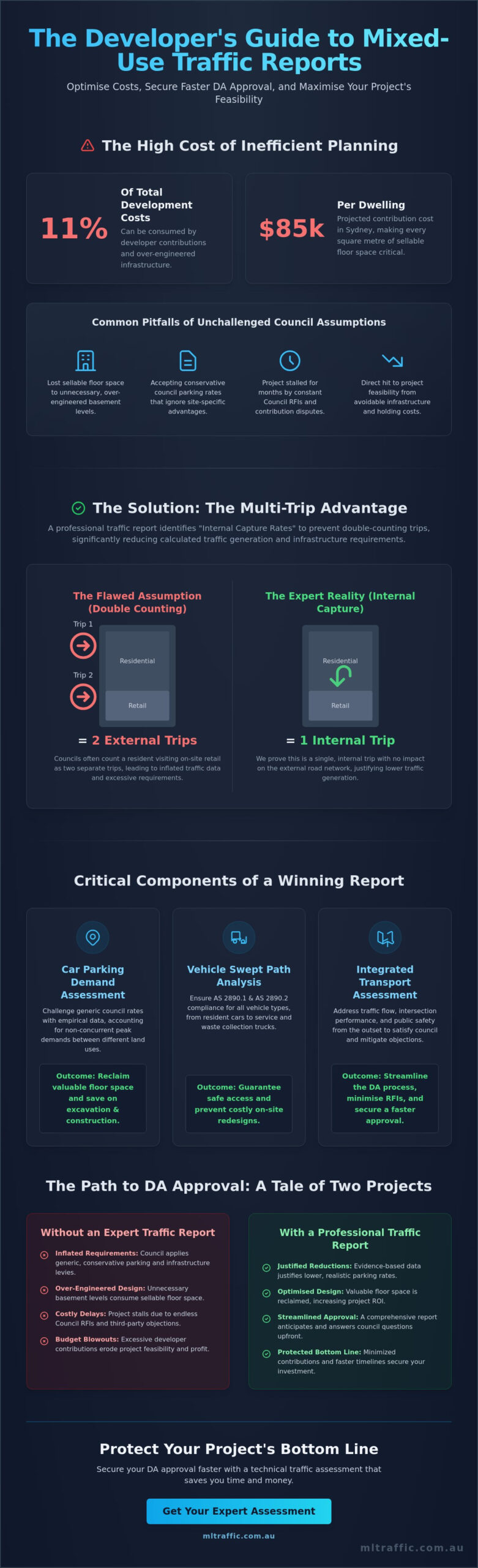
Developer contributions now account for up to 11% of total development costs in Australia, meaning every square metre of over-engineered parking is a direct hit to your project’s feasibility. With Sydney growth area contributions reaching as high as $85,000 per dwelling as of late 2025, you cannot afford to lose sellable floor space to unnecessary basement levels. You likely find that local councils default to conservative parking rates that ignore the multi-trip advantage of your specific site. Constant RFIs and excessive Section 7.11 or 94 contributions can stall your timeline for months. A technical traffic report for mixed-use development is your primary tool to challenge these assumptions and secure a faster DA approval.
We understand that a successful application requires proving internal synergy where different land uses share trips. This guide explains how to use car parking demand assessments to justify lower ratios and reduce your infrastructure burden. You’ll learn how to leverage the latest AS/NZS 2890.1:2021 standards and Austroads integrated transport guides to optimize your access design. We will show you how a professional assessment minimizes council conditions, accelerates your approval timeline, and protects your bottom line.
Key Takeaways
- A professional traffic report for mixed-use development identifies internal capture rates to prevent the double-counting of vehicle trips across retail and residential components.
- Utilize technical Car Parking Demand Assessments to challenge conservative council rates and reclaim valuable floor space from over-engineered basement designs.
- Ensure site layout compliance with AS 2890.1 and AS 2890.2 standards through precise Vehicle Swept Path Analysis and Driveway Ramp Grade Assessments.
- Streamline the DA approval process and minimize costly council RFIs by submitting an integrated transport assessment that addresses infrastructure requirements from the outset.
- Leverage senior-level expertise where the consultant who provides the quote also completes the technical assessment to ensure accountability and project continuity.
Table of Contents
-
Critical Components: Parking Demand and Vehicle Access Design
-
The Multi-Trip Advantage: Reducing Traffic Generation Figures
-
Navigating the DA Process and Australian Standards Compliance
-
Expert Traffic Engineering for Complex Mixed-Use Developments
What is a Traffic Report for Mixed-Use Development?
A technical traffic report for mixed-use development is a specialized Traffic Impact Assessment (TIA) that evaluates the transport implications of projects combining multiple land uses. Unlike single-use sites, a mixed-use development creates a complex ecosystem where residential, commercial, and retail traffic streams intersect. This document is a mandatory component of your Development Application (DA). It serves as the primary evidence that your project’s density aligns with the existing road capacity and complies with Australian Standards, specifically AS 2890.1:2021.
The primary objective is to balance the competing requirements of different users within a single footprint. Residents need secure, long-term parking and quiet access. Retail customers require high-turnover spaces and clear wayfinding. Service vehicles, such as waste collection and delivery trucks, need heavy-duty loading zones and specific swept paths. An expert report reconciles these needs without over-engineering the infrastructure. This is critical because developer contributions can account for 8% to 11% of total development costs according to Housing Australia (2021). You can view our full range of technical traffic engineering services to see how we address these specific requirements.
To better understand the relationship between land use and traffic flow, watch this research summary:
The Complexity of Overlapping Land Uses
Mixed-use sites don’t follow a linear traffic pattern. Residential peaks typically occur in the early morning and late afternoon, while retail peaks often hit mid-morning or weekends. We identify these temporal offsets to optimize parking and access. Shared access points are a critical focus. If they aren’t designed correctly, the interaction between high-frequency retail traffic and residential movements can create safety hazards or bottlenecks. A holistic transport planning approach allows us to calculate "internal capture" rates. This represents the percentage of trips that stay within the site, such as a resident visiting the downstairs cafe. This data prevents the double-counting of traffic figures that often leads to excessive infrastructure levies.
Why Councils Require Detailed Assessments
Councils use the traffic report for mixed-use development to gauge the cumulative impact on the local road network. They must ensure the project complies with Local Environmental Plans (LEPs) and the NSW Housing and Productivity Contribution framework that took effect on April 1, 2026. Without an evidence-based report, your project is vulnerable to third-party objections regarding street parking and congestion. We provide the technical data required to mitigate these concerns. Our assessments include Intersection Analysis and Sight Distance Assessments to prove that the development won’t compromise public safety or traffic efficiency. This professional approach minimizes the risk of costly RFIs that delay your project timeline.
Critical Components: Parking Demand and Vehicle Access Design
The technical core of a traffic report for mixed-use development lies in its ability to reconcile conflicting spatial requirements. Most council Development Control Plans (DCPs) use generic parking rates that don’t account for the unique operational reality of a site. By conducting a Car Parking Demand Assessment, we can often demonstrate that a project requires fewer spaces than the prescribed minimums. This is particularly effective when land uses have non-concurrent peak demands. Minimizing unnecessary parking levels can save hundreds of thousands in excavation and construction costs.
Ensuring the structural health of these optimized basement levels is just as critical for long-term ROI; for example, utilizing expert 滲水檢查 (leakage inspection) services can prevent water ingress from undermining the integrity of your project’s foundation.
Car Parking Demand Assessment
We use empirical data and tools like the EPA’s Mixed-Use Trip Generation Model to justify reduced parking ratios. For example, if your residential peak occurs at 7:00 PM and your retail peak at 11:00 AM, shared parking arrangements can significantly reduce the total basement area needed. Our reports also ensure compliance with modern requirements, including electric vehicle (EV) charging infrastructure and specific accessible parking ratios required under AS 2890.6. We focus on providing a data-led defense for your design to prevent councils from imposing over-engineered requirements that waste sellable floor space.
Swept Path and Access Assessment
A complex mixed-use layout requires rigorous testing of vehicle movements. We utilize AutoTURN software to simulate the exact paths vehicles take when entering and exiting the site. It’s not enough to design for standard cars; we must differentiate between B85 and B99 vehicles to ensure all residents can navigate the basement safely. This is especially critical in tight urban infill sites where every centimetre counts. For a deeper dive into these technical requirements, read our Swept Path Analysis guide. This level of detail in your traffic report for mixed-use development gives council engineers the confidence to approve your access design without requesting further modifications.
Service vehicle management is a common point of failure in mixed-use DAs. We design loading docks and waste collection areas that accommodate Heavy Rigid Vehicles (HRVs) without blocking residential access or creating street-level congestion. This includes verifying driveway ramp grades to prevent vehicle scraping and conducting Sight Distance Assessments to ensure pedestrian safety at the property boundary. These assessments must align with the latest AS 2890.1:2021 standards to pass technical review. If you need a technical review of your current plans, you can view our traffic engineering services for a detailed compliance check before you submit your application.
The Multi-Trip Advantage: Reducing Traffic Generation Figures
Mixed-use developments offer a unique opportunity to reduce calculated vehicle movements through the "Multi-Trip Advantage." Traditional traffic assessments often treat residential and retail components as isolated entities. This leads to double-counting trips and over-estimating the impact on local roads. We apply "trip chaining" principles to reflect how modern users actually behave. A resident who stops at the ground-floor supermarket on their way home from work hasn’t generated two separate trips; they’ve completed one journey with multiple purposes. Identifying these patterns in a traffic report for mixed-use development is essential for a realistic and defensible impact assessment.
We define internal capture as the percentage of trips that stay within the site, effectively eliminating the need for a vehicle to enter the external road network. By accurately calculating these rates, we can present a case for lower infrastructure levies. Developer contributions account for 8% to 11% of total project costs according to Housing Australia (2021). In Sydney growth areas, these fees reached $85,000 per dwelling as of November 2025. Reducing your project’s traffic generation profile directly lowers these Section 7.11 or Section 94 contributions, protecting your project’s feasibility.
Methodology for Trip Reduction
Our methodology relies on industry-standard guidance from the Austroads Guide to Traffic Management Part 12 and TfNSW factored rates. We analyze the "walk-in" traffic potential from residential units to commercial spaces. This involves more than just guesswork; we apply specific reduction factors based on the land-use mix and proximity to transit hubs. Understanding the ins and outs of traffic studies helps developers realize that these figures are negotiable when backed by empirical data. We provide the technical evidence required to prove that your site will generate less congestion than a standard council model suggests.
Strategic Benefits for Developers
Presenting a robust trip generation model provides a strong rebuttal to Council Requests for Information (RFIs). It prevents the need for over-engineered traffic facilities or costly intersection treatments that can stall a project for months. You can optimize your floor space by proving that the surrounding road network can handle the proposed density without major upgrades. This strategic approach ensures your DA is assessed on its actual merits rather than conservative estimates. If you require a quote for a detailed assessment, you can contact our senior engineers directly. We ensure the principal who quotes the job is the one who performs the technical analysis, ensuring accountability throughout the DA process.
Navigating the DA Process and Australian Standards Compliance
The journey from site survey to DA approval requires a structured technical approach. A traffic report for mixed-use development must follow a specific roadmap to withstand council scrutiny. We begin with comprehensive data collection, including peak hour intersection counts and existing street parking surveys. This data forms the baseline for our Traffic Impact Assessment (TIA). We then move through car parking demand assessments and vehicle swept path analysis before drafting the final report. Our process ensures that by the time your application reaches the council, every technical detail aligns with local planning controls and state policies.
Pedestrian safety and active transport are now central to the assessment process. Councils require evidence that high-frequency retail foot traffic will not conflict with residential vehicle movements. We design specific separations and sight-line assessments to protect pedestrians at all property boundaries. This includes addressing cycling requirements, such as secure resident storage and visitor parking hoops, which are mandatory under most modern Development Control Plans (DCPs). If you are currently preparing your submission, you can contact us for a technical quote to ensure your plans meet these benchmarks.
Australian Standards for Mixed-Use
Mixed-use sites are technically demanding because they must satisfy multiple Australian Standards simultaneously. Residential components must comply with AS/NZS 2890.1:2021, while retail loading docks and service areas must meet the heavy vehicle requirements of AS 2890.2. Managing the interface between these zones is critical. For example, the driveway ramp grade must accommodate a standard B85 car for residents while allowing a Heavy Rigid Vehicle (HRV) to access loading bays without scraping or bottoming out. For a detailed breakdown of these design rules, refer to our AS 2890.1 Guide. We ensure your design provides clear differentiation between public retail parking and private residential zones to prevent operational issues post-occupancy.
Council Negotiation and RFIs
Council engineers frequently issue Requests for Information (RFIs) regarding traffic volume assumptions. They often rely on conservative models that don’t reflect the multi-trip advantage discussed earlier. This is where senior engineer involvement becomes indispensable. We represent our clients in council meetings to provide technical rebuttals to these queries. Our accountability is a core signature of our service; the traffic consultant who provides the quote is the one who does the work and defends it. We also prepare the necessary Traffic Management Plans (TMPs) for the construction phase to ensure that your project remains compliant from the initial ground-breaking through to final completion.
Expert Traffic Engineering for Complex Mixed-Use Developments
ML Traffic Engineers specializes in providing technical solutions for private developers. We have been trading since 2005 and our team has assessed over 10,000 sites across Australia. This extensive experience ensures your traffic report for mixed-use development is prepared by consultants who understand every technical and bureaucratic requirement. We don’t use junior staff for technical assessments. Our unique promise is that the traffic consultant who provides the quote is the same expert who does the work. This ensures accountability and technical precision throughout the entire DA process.
Clients have direct access to our principals, Michael Lee and Benny Chen. Each brings between 30 and 40 years of experience to every project. This senior-level involvement is critical for high-stakes mixed-use applications where parking and access negotiations are complex. We provide a full suite of services, including Vehicle Swept Path Analysis, Car Parking Demand Assessments, and Intersection Analysis. This comprehensive approach ensures that all aspects of your site’s design are compliant with AS 2890.1:2021 and local planning controls. Our reports are designed to be council-ready, minimizing the risk of costly RFIs and project delays.
Why Experience Matters in Mixed-Use
Mixed-use developments require a deep understanding of diverse land-use categories. We have successfully delivered reports for a vast range of developments, including:
-
Apartments and residential flat buildings
-
Retail centers and supermarkets
-
Childcare centers and schools
-
Medical centers and hospitals
-
Warehouses and industrial units
-
Bars, cafes, and restaurants
This breadth of knowledge allows us to identify specific trip-chaining opportunities that less experienced firms often miss. By applying precise technical data, we have a proven track record of reducing infrastructure contribution costs and reclaiming sellable floor space from over-engineered parking designs. You can review our full range of traffic engineering services to see how we support complex applications with evidence-based reporting.
Ready to Progress Your Development?
Early-stage involvement is the most effective way to optimize your site planning. Engaging a traffic engineer during the initial design phase prevents costly redesigns after the DA has been lodged. We provide clear, fixed-fee quotes that outline exactly what your project needs for council approval. Our assessments provide the technical defense required to justify lower parking rates and reduced infrastructure levies. To secure a professional assessment for your project, contact ML Traffic Engineers today. We provide direct mobile numbers for our senior staff to ensure you get immediate, expert advice for your traffic report for mixed-use development.
Secure Your DA Approval Through Technical Expertise
A rigorous traffic report for mixed-use development serves as a strategic tool to protect your project’s bottom line. You now understand how to leverage internal capture rates and shared parking data to challenge conservative council estimates. Accurate application of AS/NZS 2890.1:2021 standards ensures your site design is both compliant and efficient. These technical defenses are essential for reducing Section 7.11 contributions and avoiding unnecessary infrastructure upgrades that can stall project feasibility.
ML Traffic Engineers has been trading since 2005. We have successfully assessed over 10,000 sites across Australia with a focus on private development applications. Our clients benefit from direct access to our principals, Michael Lee and Benny Chen, who ensure the consultant quoting the job is the one performing the work. This direct accountability eliminates bureaucracy and delivers meticulous results for every submission.
Get a Professional Traffic Report for Your Mixed-Use Development and progress your application with confidence. We look forward to helping you achieve a successful DA outcome with minimal conditions.
Frequently Asked Questions
What is the purpose of a traffic report for a mixed-use development?
A traffic report for mixed-use development provides technical evidence that a project’s traffic and parking impacts comply with Australian Standards and local planning controls. It’s a mandatory document for DA approval that proves the site can safely accommodate residential, customer, and service vehicle movements. The report reconciles different peak demands and access requirements within a single footprint to ensure operational efficiency.
How much parking is required for a mixed-use site?
Parking rates are determined by local council Development Control Plans (DCPs), but these figures are often conservative and over-engineered. We use Car Parking Demand Assessments to justify lower parking ratios by analyzing the specific mix of land uses. Retail and residential peaks often occur at different times, which allows for shared parking efficiencies that reclaim valuable sellable floor space for the developer.
Can I reduce my infrastructure contributions with a traffic report?
Yes, a professional assessment can lower Section 7.11 or Section 94 infrastructure contributions by proving lower traffic generation figures. Developer contributions reached as high as $85,000 per dwelling in Sydney growth areas as of November 2025. By demonstrating internal capture and trip chaining, we provide the empirical data required to negotiate reduced levies and protect your project’s feasibility.
What is a multi-trip purpose justification?
This justification accounts for trip chaining, where a single vehicle journey serves multiple purposes within the development. It calculates the percentage of trips that stay within the site, such as a resident visiting an on-site cafe. This methodology prevents the double-counting of traffic figures that often leads to unnecessary road upgrade requirements and inflated infrastructure costs.
Is a Swept Path Analysis mandatory for mixed-use DAs?
Most councils require a Vehicle Swept Path Analysis to ensure all vehicles can enter and exit the site in a forward direction. This is critical for mixed-use sites to prove that Heavy Rigid Vehicles (HRVs) for waste collection can navigate the layout without conflicting with residential parking. We use AutoTURN software to verify these movements against AS 2890.1 and AS 2890.2 standards.
How long does it take to prepare a Traffic Impact Assessment?
Preparation typically takes 10 to 15 business days depending on site complexity and the availability of intersection count data. This timeline includes site surveys, data analysis, and technical drafting. Engaging a consultant during the early design phase prevents delays by ensuring architectural plans are compliant with driveway ramp grades and sight distance requirements before you lodge the application.
What happens if the council requests more information (RFI) about my traffic report?
We provide direct principal involvement to address Requests for Information (RFIs) through technical rebuttals and council meetings. Our engineers defend the data presented in the traffic report for mixed-use development to prevent the imposition of excessive conditions. The consultant who provides your quote performs the technical work, ensuring they are prepared to answer specific queries from council engineers.
Do I need a different report for the construction phase?
Yes, councils require a separate Traffic Management Plan (TMP) or Traffic Guidance Scheme (TGS) as a condition of consent before construction begins. While the TIA focuses on the long-term impact of the completed development, the TGS outlines how vehicle and pedestrian safety is managed during the build. We provide these technical schemes to ensure compliance with Australian Standards throughout the project lifecycle.
Which areas do you cover?
We are traffic engineers servicing Melbourne, Sydney, Brisbane, Gold Coast, Hobart, Perth, Adelaide, Darwin, Canberra and surrounding areas.

Disclaimer
The content on www.mltraffic.com.au, including all technical articles, guides, and resources, is provided for general informational and educational purposes only. It is not intended to constitute professional advice in traffic engineering, transportation planning, development approvals, or any other technical or legal field.
While ML Traffic Engineers makes every reasonable effort to ensure the accuracy, completeness, and timeliness of the information published, we do not provide any warranties or representations (express or implied) regarding its reliability, suitability, or availability for any particular purpose. Any reliance you place on the content is strictly at your own risk.
In no event shall ML Traffic Engineers, its directors, employees, authors, or affiliates be liable for any direct, indirect, incidental, special, consequential, or punitive damages (including, without limitation, loss of profits, data, or business opportunities) arising out of or in connection with the use of, or inability to use, any information provided on this website.
The articles and guides on this site are not a substitute for engaging a qualified, registered professional traffic engineer (such as an NPER or RPEQ engineer) to assess your specific project requirements. For tailored advice, compliance assessments, or traffic engineering services, please contact a competent professional.
This disclaimer may be updated from time to time without notice. By accessing or using this website, you agree to be bound by the most current version of this disclaimer.
