

A single Request for Further Information (RFI) from Council regarding your traffic report for retail development can delay a project by 90 days and significantly inflate holding costs. You understand that retail success depends on seamless customer access and efficient service vehicle logistics. It’s frustrating when technical objections over parking demand or swept path analysis stall your Development Application (DA) and force expensive design revisions. Our senior engineers have seen these delays firsthand across more than 10,000 sites. We know that technical precision at the planning stage is the only way to avoid these bureaucratic bottlenecks.
This article explains how a professionally prepared traffic report mitigates project risk and secures Council approval for your retail development in 2026. We’ll show you how to optimize car park design according to Australian Standard AS 2890.1 and ensure your service vehicle access requirements meet strict local government criteria. You’ll learn the specific technical assessments needed to bypass RFIs and move straight to project commencement.
Key Takeaways
- Understand how a comprehensive traffic report for retail development identifies potential bottlenecks and mitigates project risk to streamline the Council approval process.
- Learn to apply precise traffic generation modelling based on Gross Floor Area (GFA) to ensure site distribution and customer access meet rigorous technical requirements.
- Discover how a Car Parking Demand Assessment balances development costs with AS 2890.1 compliance to satisfy Council parking quotas and operational needs.
- Identify the necessity of Swept Path Analysis for heavy rigid vehicles (HRV) to ensure retail loading docks function safely without impeding local traffic flow.
- Gain insight into why principal-led consultancy ensures your technical documentation is prepared by the same senior expert who provides your initial quote.
Table of Contents
- The Role of a Traffic Report in Retail Development Applications
- Essential Components of a Retail Traffic Impact Assessment
- Navigating Parking Demand and AS 2890.1 Compliance
- Managing Service Vehicles and Swept Path Analysis Requirements
- Expert Traffic Engineering: Securing Your Project’s Future
The Role of a Traffic Report in Retail Development Applications
A traffic report for retail development serves as a technical bridge between a commercial proposal and Council approval. In the Australian planning system, this document is formally known as a Traffic Impact Assessment (TIA). It quantifies how a new shop, supermarket, or shopping centre will influence the existing road network. Councils prioritize these reports because retail land uses generate significantly higher vehicle turnover compared to residential or industrial zones. The assessment ensures that the local infrastructure can handle the increased load without compromising safety or efficiency.
For smaller retail projects, such as a local cafe or a boutique storefront under 300 square metres, a simplified Traffic Impact Statement (TIS) often suffices. Larger developments like supermarkets or regional malls require a comprehensive TIA. These reports utilize Trip generation models to forecast exactly how many vehicles will enter and exit the site during peak Saturday morning and weekday afternoon periods. Professional engineers use this data to identify road network bottlenecks before they become grounds for a DA refusal.
To better understand the fundamentals of this technical study, watch this helpful video:
A well-prepared report doesn’t just list problems; it provides engineering solutions. Whether it’s adjusting a driveway location to improve sight-lines or redesigning a loading dock to accommodate 12.5-metre Heavy Rigid Vehicles (HRVs), the report ensures the development remains compliant with AS 2890.1 and AS 2890.2 standards. By resolving these issues during the design phase, developers avoid the friction that often occurs during the public exhibition period of a DA.
Securing Council Approval Without Delays
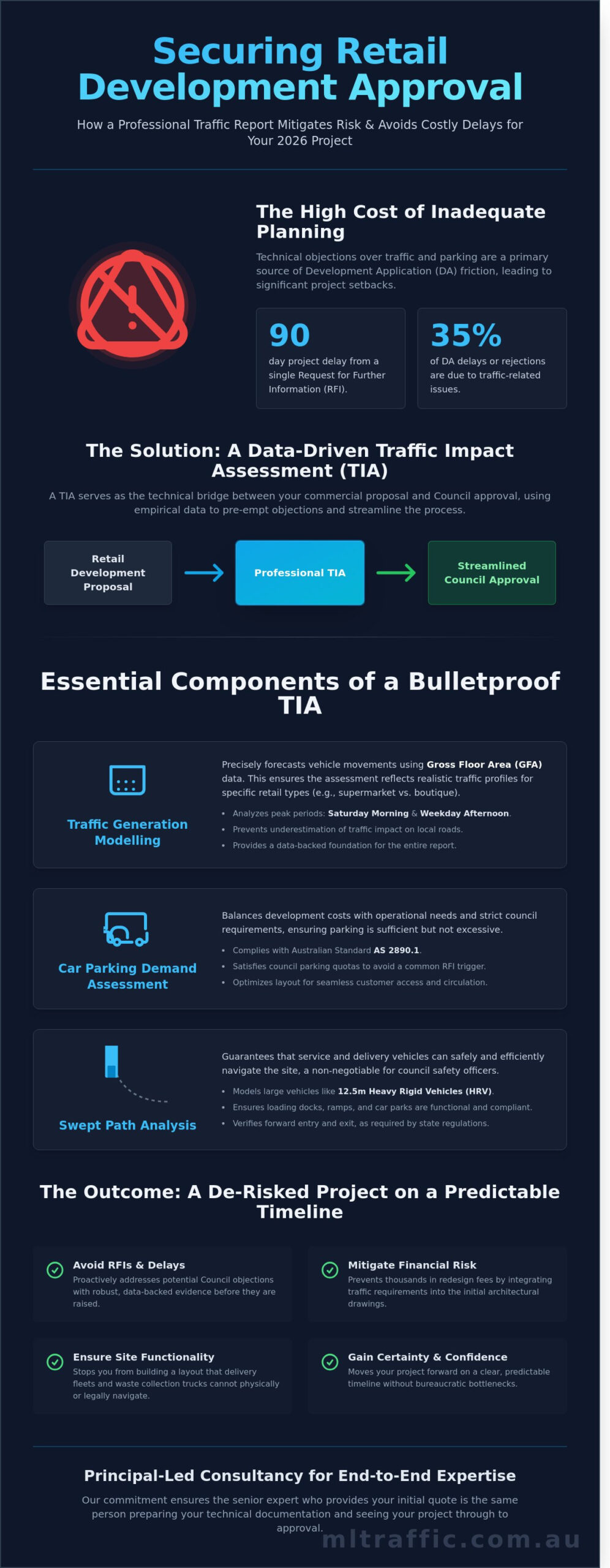
Traffic-related issues account for approximately 35% of DA delays or rejections in growing Australian corridors. Councils often object to retail developments based on perceived local congestion or insufficient on-site parking. We provide data-backed reports that use empirical evidence from similar sites to pre-empt these objections. Engaging in early-stage traffic engineering allows developers to integrate Council requirements into the initial site plan. This prevents the need for expensive “Requests for Further Information” (RFIs) later in the 2026 planning cycle.
Mitigating Financial and Project Risk
A traffic report for retail development acts as a critical risk management tool. It stops you from building a layout that delivery trucks can’t navigate. We conduct Vehicle Swept Path Assessments to ensure that waste collection and delivery fleets can enter and exit in a forward direction, as required by most Australian state regulations. Establishing clear planning milestones early ensures that traffic constraints don’t cause design revisions after you’ve already paid for architectural drawings. This proactive approach saves thousands in redesign fees and keeps the project on a predictable timeline.
Essential Components of a Retail Traffic Impact Assessment
A professional traffic report for retail development must provide a granular analysis of how a proposed site interacts with the existing transport network. Council assessors in 2026 require more than simple volume estimates; they demand high-fidelity modelling based on Gross Floor Area (GFA) and specific retail sub-types. A supermarket generates vastly different traffic profiles compared to a showroom or a specialty boutique. We use empirical data to establish these trip rates, ensuring the traffic report for retail development reflects realistic vehicle movements.
Data accuracy is the foundation of a successful DA. Engineers must follow established Traffic Impact Analysis Requirements to ensure the study area, data collection periods, and growth factors align with regulatory expectations. This involves mapping every entry and exit point to prevent queuing that could block through-traffic on arterial roads.
- GFA-Based Modelling: Precise trip generation rates for every square metre of retail space.
- Distribution Analysis: Mapping the exact path customers take to enter and leave the site.
- Software Modelling: Using SIDRA to simulate intersection performance under increased load.
- Safety Audits: Assessing pedestrian and cyclist connectivity to ensure zero-harm outcomes.
Traffic Generation and Peak Period Analysis
We calculate trip rates using the RMS Guide to Traffic Generating Developments or updated 2025/2026 industry benchmarks. It’s vital to distinguish between new trips and pass-by traffic. For a standard local shopping centre, pass-by trips often constitute 30% to 45% of total movements during the afternoon peak. We model the “worst-case” scenario, usually the Saturday midday peak or Friday afternoon, to satisfy Council safety margins and ensure the local network won’t fail during high-demand periods.
External Road Network Impact
The assessment must extend beyond the site boundary to neighbouring intersections. We evaluate the Level of Service (LoS) and Degree of Saturation (DoS) using SIDRA software. If a retail project increases delays by more than 15 seconds at a critical junction, we propose road upgrades. These might include extended turn bays, signal timing adjustments, or new line marking. We also verify that delivery vehicle paths don’t interfere with existing bus stops or public transport corridors. If you need a technical review of your site’s constraints, our traffic engineering services provide the necessary data for a compliant submission.
Navigating Parking Demand and AS 2890.1 Compliance
Retailers must balance high construction costs against the necessity of customer access. Over-providing parking stalls wastes valuable floor space and increases capital expenditure. Conversely, under-providing parking leads to site congestion and lost revenue. A professional Car Parking Demand Assessment is the most effective way to determine the exact requirements for a specific site. This assessment is a critical component of any traffic report for retail development in 2026.
Modern retail developments must account for more than just standard vehicle bays. You need to integrate Electric Vehicle (EV) charging stations to meet federal emissions targets. Click-and-collect bays are now a standard requirement for major supermarkets and specialty retailers. These bays require strategic placement near exits to maintain high turnover rates. Our engineers ensure these specialized zones don’t interfere with the general circulation of the car park.
- EV Charging: Allocation of fast-charging bays based on projected 2026 adoption rates.
- Disabled Access: Strict adherence to AS 2890.6 for dedicated space and shared zones.
- Click-and-Collect: Short-stay bays designed for 5 to 10-minute turnaround times.
- Pedestrian Safety: Marked crossings and separated walkways to protect shoppers.
Compliance with AS 2890.1 and AS 2890.6
Adherence to AS 2890.1 is the non-negotiable benchmark for Australian car park design. This standard dictates specific bay dimensions, usually ranging from 2.4m to 2.7m in width depending on the user class. Aisle widths must typically maintain 5.8m to 6.2m for two-way traffic to prevent bottlenecks. We verify that ramp grades don’t exceed 1:5 (20%) to ensure all vehicle types can navigate the site without scraping. AS 2890.6 compliance is equally vital, ensuring that disabled parking spaces provide the necessary 2.4m wide shared area for wheelchair access.
Justifying Parking Shortfalls
Council Development Control Plans (DCPs) often apply rigid parking rates that don’t reflect the reality of modern shopping habits. When site constraints prevent you from meeting these generic rates, we provide technical justifications. We use empirical data from similar retail sites to prove that actual demand is lower than the DCP suggests. If your development is within 400 metres of a high-frequency bus interchange or train station, we leverage this proximity to argue for a reduction in required spaces. This data-driven approach is essential for a successful traffic report for retail development when seeking a parking waiver or reduction.
Managing Service Vehicles and Swept Path Analysis Requirements
Council traffic engineers prioritize the design of loading docks because service vehicle mismanagement creates immediate safety risks and off-site congestion. Your traffic report for retail development must prove that heavy vehicles can operate without obstructing public roads or endangering shoppers. It’s not just about space; it’s about operational safety. We ensure that customer traffic remains entirely separate from service vehicle movements. This separation prevents conflict points where pedestrians and 12.5m trucks might otherwise occupy the same space. Our assessments also include dedicated planning for waste collection cycles and emergency vehicle access to ensure the site remains functional under all conditions.
A technical Swept Path Analysis is the standard requirement for any retail DA. This assessment uses mathematical modeling to trace the path of a vehicle’s tires and body as it moves through a turn. For most retail developments, we test against the Heavy Rigid Vehicle (HRV) or Small Rigid Vehicle (SRV) templates. Council won’t accept vague promises of access; they require visual proof that the largest expected vehicle can navigate the site safely.
Designing Functional Loading Docks
Loading docks must strictly adhere to AS 2890.2 for off-street commercial vehicle facilities. This standard dictates the minimum overhead clearances and maximum ramp gradients required for heavy vehicles. We design these areas to include adequate turning circles and queuing space so delivery trucks don’t back up onto public streets. If your development is adjacent to residential zones, we implement mitigation strategies. This often includes acoustic screening or specific operational management plans to limit noise impacts during late-night or early-morning deliveries. We focus on getting the geometry right the first time to avoid costly redesigns during the RFI stage.
The Swept Path Analysis Process
Our team uses specialized AutoTURN software to simulate complex vehicle maneuvers on your site plan. This software allows us to verify that all trucks can enter and exit the property in a forward direction. Most Australian Councils refuse applications that require heavy vehicles to reverse onto or off a public road. We provide high-resolution, CAD-based diagrams that show the outer wheel paths and body swing margins. These diagrams prove access feasibility to Council assessors by showing exactly how much clearance remains between the vehicle and structural elements like columns or kerbs. It’s a data-driven approach that removes subjectivity from the approval process.
To ensure your retail loading dock meets all Australian Standards and Council requirements, contact our senior consultants for a technical assessment.
Expert Traffic Engineering: Securing Your Project’s Future
Retail developments in 2026 face unprecedented scrutiny from local Councils and state transport authorities. A standard template isn’t enough to clear the hurdles of modern urban planning. You need a technical partner who understands the specific mechanics of driveway ramp grades, sight-line assessments, and heavy vehicle movements. ML Traffic has traded since 2005. Our principals, Michael Lee and Benny Chen, bring over 30 years of individual experience to every project. We don’t pass your file to a junior staff member once the contract is signed. The consultant who provides your quote is the one who performs the analysis and writes the traffic report for retail development.
Our firm has completed assessments for over 10,000 sites across Australia. This volume of work provides us with a deep database of “real world” traffic generation rates that often contradict the conservative estimates found in older RTA guidelines. We use this data to justify lower parking requirements or higher density where appropriate. Our focus is private clients who need their development applications approved without unnecessary delays or costly redesigns. We deliver professional, direct, and authoritative reports that Council officers can trust.
Choosing the Right Traffic Consultant
Large engineering firms often operate on a “junior delegate” model. A senior partner signs the proposal, but a graduate engineer with limited experience actually handles the data. This leads to errors and slow responses when Council issues a Request for Further Information (RFI). We eliminate this bottleneck. Clients get direct mobile access to Michael Lee or Benny Chen. This accountability ensures your project complies with AS 2890.1 and specific local government codes from day one. Our experience spans a vast range of land uses, including shopping centres, childcare facilities, medical clinics, and mixed-use towers. You can review our full history of expertise on our about page.
Get Started with Your Retail Traffic Report
Securing a traffic report for retail development begins with a detailed site plan. To provide a rapid and accurate quote, we need to see your proposed floor areas, access points, and parking layouts. We support your project from the initial concept design through to the final Council sign-off. Our technical suite includes:
- Traffic Impact Statements (TIS) and Assessments (TIA)
- Vehicle Swept Path Assessments using industry-standard software
- Car Parking Demand Assessments to optimize land use
- Sight-Line Assessments for safety compliance
- RPEQ certified reports where required
Don’t let your DA submission stall due to poor traffic planning. Our no-nonsense approach focuses on results and compliance. View our traffic engineering services to see how we assist with complex retail sites. When you’re ready to proceed, contact us to discuss your site requirements with a senior engineer.
Secure Your Retail DA Approval with Technical Precision
Securing a Development Application in 2026 requires more than just meeting basic requirements. You need a comprehensive traffic report for retail development that addresses complex AS 2890.1 compliance and high-fidelity SIDRA modelling. We’ve assessed over 10,000 sites across Australia since 2005. Our process ensures that technical hurdles like vehicle swept path analysis and parking demand assessments don’t stall your project at the council level. Michael Lee and Benny Chen handle every assessment personally. It’s a simple promise: the traffic consultant who provides your quote is the same expert performing the technical work. You won’t deal with junior staff or bureaucratic delays. Our senior engineers bring between 30 and 40 years of individual experience to every retail project. This level of technical oversight is essential for navigating modern transport planning requirements and securing your project’s commercial future. We’re ready to help you move forward.
Get a Professional Traffic Report Quote for Your Retail Development
Frequently Asked Questions
Why do I need a specific traffic report for a retail development?
Councils require a traffic report for retail development to ensure the proposed shop doesn’t compromise road safety or local traffic flow. Retail sites generate higher trip rates than residential uses, requiring specific analysis of peak hour impacts. This report is a mandatory component of a Development Application (DA) to demonstrate compliance with local planning schemes and state transport guidelines.
What is the difference between a Traffic Impact Assessment and a Traffic Statement?
A Traffic Impact Assessment (TIA) is a comprehensive study for large-scale developments, while a Traffic Impact Statement (TIS) is a shorter report for smaller projects with minor impacts. TIAs involve detailed intersection modelling and traffic counts. A TIS focuses on site-specific access and parking compliance based on the gross floor area (GFA) and the expected trip generation rates of the retail shop.
How much parking does Council require for a new retail shop?
Parking requirements vary by local council, but rates typically range from 1 space per 20 square metres to 1 space per 40 square metres of retail floor area. For example, a 200sqm shop in a Sydney metropolitan council might require between 5 and 10 dedicated spaces. These rates are determined by the local Development Control Plan (DCP) or the Transport for NSW Guide to Traffic Generating Developments.
What is a Swept Path Analysis and is it mandatory for retail?
A Swept Path Analysis uses CAD software to simulate the turning movements of vehicles to ensure they can enter and exit the site in a forward direction. It’s mandatory for retail developments to prove that delivery trucks and customer cars can navigate the car park safely. AS 2890.1 and AS 2890.2 dictate the design vehicles used for these simulations to prevent property damage and traffic congestion.
Can a traffic report help if my site has limited parking space?
A traffic report can justify a parking shortfall through a Car Parking Demand Assessment or by highlighting proximity to public transport. We use empirical data and census statistics to show that actual parking demand is lower than the Council’s DCP requirements. This technical justification is essential for securing a DA when the physical site cannot accommodate the full number of required spaces.
How long does it take to prepare a retail traffic report for a DA?
Preparing a professional traffic report for retail development generally takes 5 to 10 business days depending on the project complexity. This timeframe includes site inspections, traffic data collection, and the completion of swept path diagrams. Urgent assessments can often be expedited if the architectural plans are finalised and site access is available for immediate inspection.
What Australian Standards apply to retail car park design?
Retail car parks must comply with AS 2890.1:2004 for off-street car parking and AS 2890.6:2009 for off-street parking for people with disabilities. Loading areas must meet AS 2890.2 for commercial vehicle facilities. These standards specify exact dimensions for parking bays, aisle widths, and driveway gradients to ensure the facility is functional and safe for all users.
Does a traffic report cover pedestrian safety around the shop entrance?
A traffic report includes a Sight-Line Assessment to ensure drivers can see pedestrians before crossing the property boundary. We evaluate the interaction between vehicle movements and foot traffic at the shop entrance to mitigate conflict points. This analysis ensures compliance with safety requirements and reduces the risk of accidents within the retail precinct.
Which areas do you cover?
We are traffic engineers servicing Melbourne, Sydney, Brisbane, Gold Coast, Hobart, Perth, Adelaide, Darwin, Canberra and surrounding areas.
Disclaimer
The content on www.mltraffic.com.au, including all technical articles, guides, and resources, is provided for general informational and educational purposes only. It is not intended to constitute professional advice in traffic engineering, transportation planning, development approvals, or any other technical or legal field.
While ML Traffic Engineers makes every reasonable effort to ensure the accuracy, completeness, and timeliness of the information published, we do not provide any warranties or representations (express or implied) regarding its reliability, suitability, or availability for any particular purpose. Any reliance you place on the content is strictly at your own risk.
In no event shall ML Traffic Engineers, its directors, employees, authors, or affiliates be liable for any direct, indirect, incidental, special, consequential, or punitive damages (including, without limitation, loss of profits, data, or business opportunities) arising out of or in connection with the use of, or inability to use, any information provided on this website.
The articles and guides on this site are not a substitute for engaging a qualified, registered professional traffic engineer (such as an NPER or RPEQ engineer) to assess your specific project requirements. For tailored advice, compliance assessments, or traffic engineering services, please contact a competent professional.
This disclaimer may be updated from time to time without notice. By accessing or using this website, you agree to be bound by the most current version of this disclaimer.
