
Treating a Section 4.55 modification like a brand-new Development Application is the fastest way to blow your budget and stall your project at the Council gates. You’ve already invested significant capital into securing your original consent, so it’s understandable that you’d expect minor design tweaks to be straightforward. However, failing to provide a precise traffic report for modification of a DA (s4.55) often leads to unnecessary RFI cycles and “deemed refusal” delays that could have been avoided with a surgical, delta-based approach.
We understand the frustration of navigating the March 2026 planning reforms, especially the confusion between minimal environmental impact under s4.55(1A) and more substantive changes under s4.55(2). This guide provides the technical assurance you need to ensure your new design meets the latest AS 2890.1:2004 and TfNSW 2024 benchmarks. You’ll learn how to target your reporting on the net change between approved and proposed schemes to secure swift approval and minimise consultancy overheads. We’ll also break down the new statutory 14-day and 40-day assessment windows to help you manage your project timeline with certainty.
Key Takeaways
- Learn why targeting the “net change” in traffic impact is more effective than duplicating your original DA report for Council review.
- Understand how a traffic report for modification of a DA (s4.55) satisfies the “substantially the same” legal test to avoid a full new DA submission.
- Discover the critical updates required for Swept Path Analysis and parking assessments to maintain compliance with updated AS 2890 series standards.
- Identify the specific statutory timeframes under the 2026 planning reforms that can fast-track your modification approval within 14 to 40 days.
- Maximise approval certainty by utilising senior-led expertise from ML Traffic Engineers Australia to eliminate technical friction and reduce Council RFIs.
Understanding Section 4.55 Modifications and Traffic Requirements
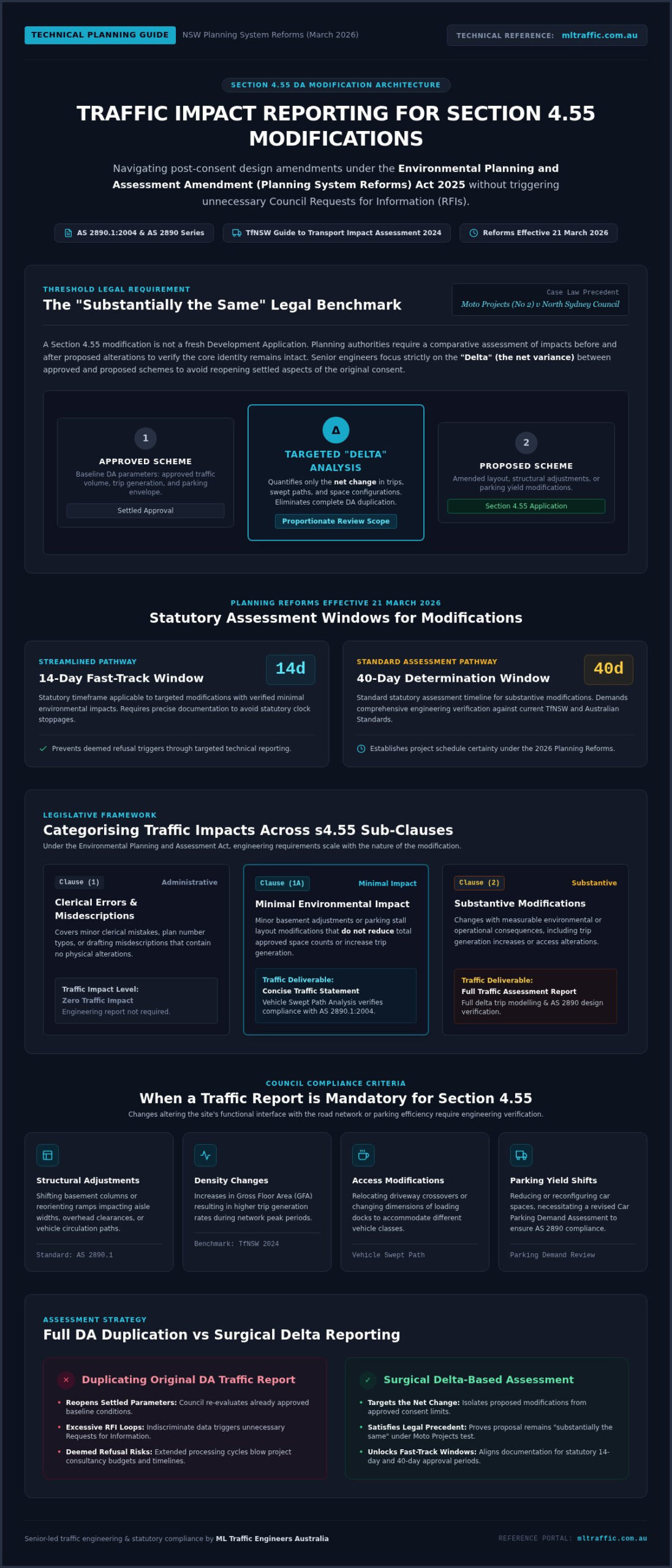
A Section 4.55 modification is the primary legal mechanism used to amend an existing development consent. Unlike a new Development Application, this pathway relies on the proposal remaining “substantially the same development” as the original approval. This threshold, established in the case of Moto Projects (No 2) Pty Ltd v North Sydney Council, requires a meticulous comparison of the project’s impacts before and after the change. When design tweaks affect vehicle movements or parking, a traffic report for modification of a DA (s4.55) becomes essential to prove that the development’s core identity hasn’t shifted. In complex cases, developers may also consult Aquarius Lawyers to ensure their application aligns with current NSW property development regulations.
To better understand the methodology behind these assessments, watch this technical overview:
The Legal Framework for DA Modifications
The Environmental Planning and Assessment Amendment (Planning System Reforms) Act 2025, effective from 21 March 2026, governs how modifications are processed. These reforms ensure that assessments are proportionate to the scale of the change. Senior consultants at ML Traffic Engineers Australia focus on the “delta”, or the net difference, between the approved and proposed schemes. This targeted approach prevents Council from reopening settled aspects of the original DA. By providing technical assurance that the modification aligns with the TfNSW Guide to Transport Impact Assessment 2024, developers can leverage the statutory 14-day or 40-day determination windows more effectively. The technical justification provided by an expert engineer ensures that the new design meets the qualitative and quantitative tests required by planning authorities.
When is a Traffic Report Mandatory?
Council mandates a traffic assessment whenever a modification alters the site’s functional interface with the road network or its internal parking efficiency. These material changes require senior-led engineering verification to avoid costly Requests for Information (RFIs). A traffic report for modification of a DA (s4.55) is typically required for:
- Structural adjustments: Shifting basement columns or reorienting ramps that impact aisle widths or vehicle clearance.
- Density changes: Increases in Gross Floor Area (GFA) that result in higher trip generation rates during peak periods.
- Access modifications: Relocating driveway crossovers or changing the dimensions of loading docks to accommodate different vehicle classes.
- Parking yield shifts: Reducing or reconfiguring car spaces, which necessitates a revised Car Parking Demand Assessment to ensure compliance with AS 2890.1:2004.
Categorising Your Modification: Traffic Impacts for s4.55(1), (1A), and (2)
Not all modifications require the same level of technical scrutiny. Under the March 2026 planning reforms, the Environmental Planning and Assessment Act distinguishes between administrative corrections and changes with environmental consequences. Developers must align the depth of their traffic report for modification of a DA (s4.55) with the specific sub-clause to avoid unnecessary consultancy costs or Council friction. While Section 4.55(1) covers minor clerical errors or misdescriptions with zero traffic impact, Section 4.55(1A) and (2) require engineering verification.
Minimal Environmental Impact (s4.55 1A) and Traffic
Section 4.55(1A) applies where the modification results in “minimal environmental impact.” In traffic engineering terms, this typically involves minor basement reconfigurations or changes to parking stall layouts that don’t reduce the total space count. A concise Traffic Statement is often sufficient here. It proves that the new design maintains compliance with AS 2890.1:2004 without altering trip generation rates. If you’re unsure which pathway applies, our senior engineers can provide a Vehicle Swept Path Analysis to verify that these minor changes don’t compromise safety or access.
Substantial Modifications (s4.55 2) and Complex Assessments
Section 4.55(2) is reserved for “other” modifications that are more substantive but still satisfy the “substantially the same” test. These changes often involve relocating site entry points, increasing Gross Floor Area (GFA), or altering loading dock positions. Because these modifications can significantly affect local traffic flow and safety, Council typically requires a full update to the original Traffic Impact Assessment (TIA). The assessment must focus on the delta between the approved scheme and the new proposal.
For these complex assessments, the engineer must evaluate:
- Net changes in peak hour trip generation using TfNSW 2024 benchmarks.
- Intersection performance impacts through updated modelling if trip rates increase.
- Compliance with AS 2890.2:2018 for heavy vehicle access in modified loading areas.
- Sight distance assessments for relocated driveway crossovers to ensure pedestrian and motorist safety.
Navigating these categories requires precision. While s4.55(1) applications benefit from a 14-day statutory determination window, s4.55(1A) and (2) applications are subject to a 40-day assessment period. Providing the correct level of technical documentation from the outset is the only way to ensure your project stays within these timeframes and avoids a deemed refusal appeal.
DA Traffic Reports vs. s4.55 Modification Reports: Key Differences
A primary Development Application requires a broad-spectrum analysis of the entire project’s impact on the local road network. In contrast, a traffic report for modification of a DA (s4.55) is a surgical document. It treats the existing approval as the established baseline. The objective shifts from justifying the development’s existence to proving that the proposed amendments don’t materially alter the traffic outcomes already accepted by Council. This targeted scope prevents the reassessment of settled project elements, provided the changes remain within the “substantially the same” legal threshold.
The ‘Net Change’ Methodology
The core of an s4.55 assessment is the “delta” analysis. While an original report calculates total trip generation, a modification report focuses exclusively on the net increase or decrease resulting from the design change. For example, if a developer increases Gross Floor Area (GFA) by 5%, the report must quantify exactly how many additional peak hour trips this creates based on TfNSW 2024 benchmarks. The same logic applies to parking. A Car Parking Demand Assessment for a modification determines if the revised yield still meets the peak requirements established in the initial consent.
Engineers must justify why the modification doesn’t worsen local traffic conditions. This involves:
- Comparing the trip generation rates of the approved scheme versus the modified scheme.
- Analysing if the modified layout maintains the same Level of Service (LoS) at nearby intersections.
- Verifying that any reduction in parking spaces doesn’t lead to overspill into surrounding streets.
Maintaining Compliance with Original Consent Conditions
Modifications can’t be viewed in isolation from the original conditions of consent. If the initial DA approval required specific road upgrades or intersection treatments, the s4.55 report must confirm these remain feasible under the new design. A conflict between a modified site entry and a mandated median strip, for instance, can lead to immediate Council refusal. To understand the foundational requirements of these reports, you can learn about Traffic Impact Assessments in our comprehensive guide.
Our senior engineers ensure that every modification report respects the parameters of the original approval. By focusing strictly on the modified elements, we reduce the volume of technical data Council officers must review. This results-oriented approach minimises the risk of new, restrictive conditions being imposed on your development. Accountability is maintained through our senior-led model, where the principal engineer who starts your assessment remains the primary point of contact until approval.
Critical Components of a Compliant s4.55 Traffic Assessment
Technical precision is the foundation of a compliant traffic report for modification of a DA (s4.55). Council officers require empirical evidence that design changes do not degrade the site’s functionality or safety. It is insufficient to describe a change as minor; the report must provide technical validation that the proposal still adheres to national standards. This section outlines the essential components required to secure a swift approval and avoid unnecessary RFIs.
Updated Swept Path Analysis (AutoTURN)
When a modification reconfigures parking aisles or shifts structural columns, previous turn templates are no longer valid. We utilise AutoTURN software to re-simulate B85 and B99 vehicle envelopes within the revised layout. This re-testing ensures that the 99th percentile vehicle can still manoeuvre without multiple-point turns or encroaching on adjacent spaces. For commercial or mixed-use developments, we also verify that service vehicles, such as Medium Rigid Vehicles (MRV) or Heavy Rigid Vehicles (HRV), can access loading areas safely. You can review our Guide to Swept Path Analysis for more on these vehicle movement requirements.
Parking and Ramp Grade Compliance
Modifications to basement levels often necessitate ramp grade adjustments. We perform a detailed Driveway Ramp Grade Assessment to ensure the new design adheres to AS 2890.1:2004. This prevents vehicle scraping and ensures transition zones are correctly calculated for the modified floor heights. Additionally, the parking supply must be certified against the Council’s Development Control Plan (DCP). If the modification involves a reduction in parking yield, the report must include a Car Parking Demand Assessment to prove the site remains self-sufficient and won’t cause overspill into the surrounding street network.
Trip generation analysis also remains a critical pillar of compliance. If the modification increases the intensity of the land use, we quantify the net change in vehicle movements using the TfNSW 2024 benchmarks. Finally, a driveway and access review is conducted to check sight distances at the property boundary. This ensures that any changes to landscaping or boundary structures don’t obstruct the 2.0m x 2.5m pedestrian splays required for motorist and pedestrian safety. Providing this level of detail ensures the consent authority has the technical assurance needed to approve the modification without delay.
Contact our senior engineers for a compliant traffic report for your s4.55 modification.
Expert Traffic Engineering for Seamless s4.55 DA Approvals
Securing approval for a modification requires more than just updated drawings. It demands a technical narrative that anticipates Council’s concerns regarding network capacity and safety. Professional traffic engineering input significantly reduces the likelihood of a Request for Information (RFI), which can otherwise add months to your development timeline. With over 15 years of consultancy experience, ML Traffic Engineers Australia provides the authoritative data required to prove your proposal remains substantially the same as the original consent.
Our approach is results-oriented. We understand the specific benchmarks set by national regulatory standards and the latest TfNSW 2024 guidelines. By providing a technical traffic report for modification of a DA (s4.55) that is both meticulous and compliant, we ensure your application moves through the statutory assessment windows without technical friction. ML Traffic Engineers Australia organises assessments across a vast range of project environments, from high-density residential towers to complex industrial estates, ensuring every report is tailored to the specific land-use category.
The ML Traffic Engineers Australia Advantage
We operate with a “no-gatekeepers” philosophy. Every client has direct access to our senior principals, ensuring a high level of accountability and technical expertise for every project. This senior-led involvement is a core marker of our reliability and professional status. We also provide a specific promise of personnel continuity. The same expert who initiates the project and understands your design intent will be the one performing the technical work and finalising the report.
This hands-on methodology ensures that critical details, such as technical swept path diagrams and parking demand calculations, are accurate from the first lodgement. We don’t rely on junior staff for complex assessments. Instead, our senior engineers personally verify every manoeuvre and ramp grade to ensure compliance with AS 2890.1:2004 and AS 2890.2:2018. This meticulous attention to detail is what distinguishes our reporting in the eyes of planning authorities.
Next Steps for Your Modification
To begin the assessment process, developers should prepare updated architectural plans that clearly highlight the proposed changes. This includes any shifts in basement levels, column placements, or site access points. Once your plans are ready, you can request a formal fee proposal for an s4.55 traffic statement. We provide clear, information-dense reporting that allows you to manage your project costs with certainty while ensuring regulatory certification.
Timing is critical in the modification process. Engaging a traffic engineer early ensures that your design changes are technically viable before you lodge with Council. Contact our senior engineers for an s4.55 Traffic Report to discuss your project requirements and secure a compliant, professional assessment that supports a swift approval.
Securing Your Modification Approval with Technical Certainty
Navigating the March 2026 planning reforms requires a precise understanding of how design changes impact site functionality. Successful modifications rely on proving that the project remains substantially the same as the original consent while maintaining strict AS 2890 compliance. By focusing on the net change in trip generation and vehicle manoeuvres, developers can avoid the delays associated with broad-scale reassessments and Council RFIs.
A professional traffic report for modification of a DA (s4.55) provides the technical assurance needed to satisfy consent authorities within statutory timeframes. Our senior-led approach ensures that every assessment is handled by a principal engineer with 15+ years of consultancy experience. This direct access to leadership guarantees accountability and meticulous attention to detail in every swept path diagram and parking assessment we produce. We don’t leave your approval to chance.
Ready to finalise your development amendments? Get a Compliant s4.55 Traffic Report Today and ensure your project moves forward without administrative friction. We look forward to supporting your next successful approval.
Frequently Asked Questions
What is a traffic report for an s4.55 modification?
A traffic report for modification of a DA (s4.55) is a specialised technical assessment required when amendments to an approved development impact vehicle access, parking, or trip generation. Unlike an initial DA report, this document focuses strictly on the “delta” or net change between the approved scheme and the new proposal. It provides Council with technical assurance that the modified design remains compliant with Australian Standards like AS 2890.1.
Do I need a new swept path analysis for a minor DA change?
Yes, a revised Vehicle Swept Path Analysis is essential if your modification reconfigures parking aisles, driveway crossovers, or internal structural elements like basement columns. Minor architectural tweaks can significantly alter vehicle turn circles. We utilise AutoTURN software to re-test B99 and B85 vehicle movements against the new layout. This ensures that the 99th percentile vehicle can still navigate the site safely without encroaching on adjacent parking spaces or structural walls.
How much does a traffic report for a DA modification cost?
The cost of a traffic report for modification of a DA (s4.55) depends on the complexity of the design changes and the specific legislative sub-clause involved. A simple s4.55(1A) Traffic Statement for minor parking reconfigurations requires less intensive modelling than an s4.55(2) assessment involving significant trip generation shifts. We provide tailored fee proposals based on your updated architectural plans to ensure consultancy costs remain proportionate to the scale of the modification.
Can I use my original traffic report for an s4.55 application?
You cannot simply resubmit your original report, but it serves as the critical baseline for your modification. Council requires a new, targeted assessment that explicitly compares the approved traffic outcomes with the proposed changes. Our senior engineers review your initial consent conditions to ensure the modification doesn’t conflict with mandated road upgrades. The new report justifies why the proposal remains “substantially the same” development while addressing any specific traffic-related concerns raised by the amendments.
What is the difference between s4.55(1A) and s4.55(2) regarding traffic?
Section 4.55(1A) covers modifications involving “minimal environmental impact,” such as minor basement tweaks that don’t reduce parking yield. These typically require a concise Traffic Statement. Section 4.55(2) applies to more substantive changes, like relocating a site entry or increasing floor area, which may significantly alter local traffic flow. The latter requires a more detailed assessment to quantify trip generation changes and ensure the road network can still accommodate the development’s revised requirements.
How long does it take to prepare a traffic statement for Council?
Preparation timeframes vary based on the depth of analysis required and the availability of finalised architectural plans. A standard Traffic Statement for a minor modification can often be completed within five to seven business days. More complex s4.55(2) assessments involving intersection modelling or detailed parking demand studies may take longer. We prioritise senior-led involvement to ensure the report is technically robust from the first draft, reducing the time spent on Council RFIs.
Will a DA modification affect my car parking requirements?
A modification can affect your parking requirements if it alters the Gross Floor Area (GFA) or the intended use of specific tenancies. Council evaluates the revised plans against their Development Control Plan (DCP) parking rates. If your modification reduces the number of approved spaces, we must provide a Car Parking Demand Assessment. This study proves that the site still meets peak demand and complies with AS 2890.1:2004, preventing overspill into surrounding residential streets.
What happens if my modification increases trip generation?
If your modification increases trip generation, you must demonstrate that the local road network and nearby intersections maintain an acceptable Level of Service (LoS). We quantify the additional vehicle movements using updated TfNSW 2024 benchmarks. If the increase is substantive, Council may require intersection modelling to ensure no significant delays occur. Our senior engineers focus on justifying these changes to prevent Council from finding the development is no longer “substantially the same” as the original approval.

Disclaimer
The content on www.mltraffic.com.au, including all technical articles, guides, and resources, is provided for general informational and educational purposes only. It is not intended to constitute professional advice in traffic engineering, transportation planning, development approvals, or any other technical or legal field.
While ML Traffic Engineers makes every reasonable effort to ensure the accuracy, completeness, and timeliness of the information published, we do not provide any warranties or representations (express or implied) regarding its reliability, suitability, or availability for any particular purpose. Any reliance you place on the content is strictly at your own risk.
In no event shall ML Traffic Engineers, its directors, employees, authors, or affiliates be liable for any direct, indirect, incidental, special, consequential, or punitive damages (including, without limitation, loss of profits, data, or business opportunities) arising out of or in connection with the use of, or inability to use, any information provided on this website.
The articles and guides on this site are not a substitute for engaging a qualified, registered professional traffic engineer (such as an NPER or RPEQ engineer) to assess your specific project requirements. For tailored advice, compliance assessments, or traffic engineering services, please contact a competent professional.
This disclaimer may be updated from time to time without notice. By accessing or using this website, you agree to be bound by the most current version of this disclaimer.
