
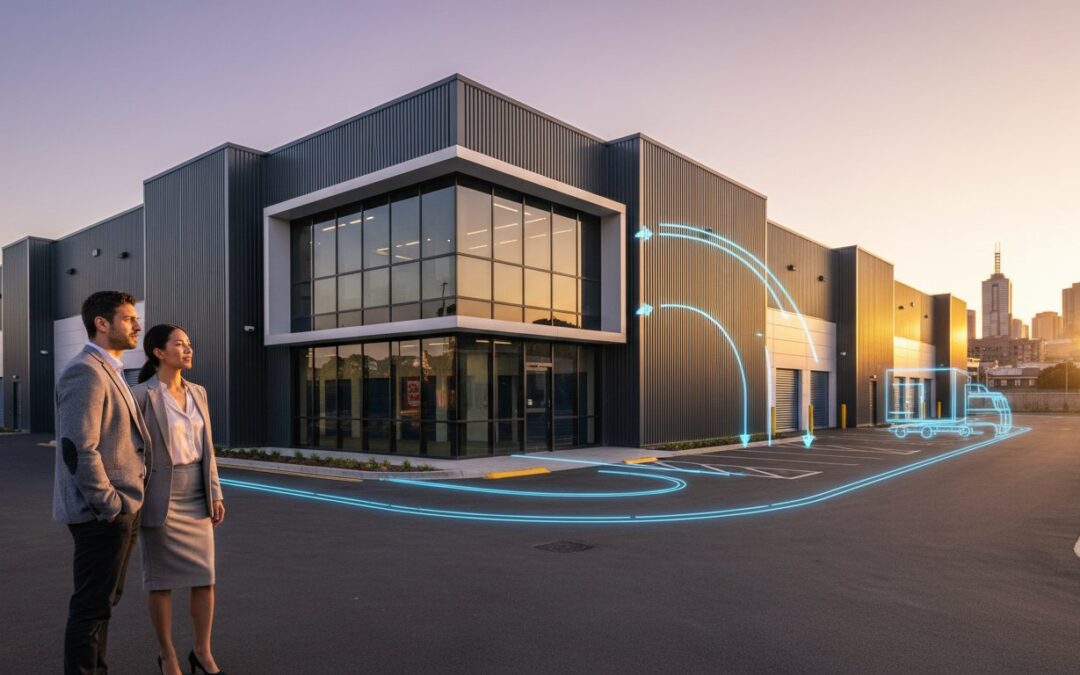
Every square metre of land you lose to unnecessary parking spaces is a direct hit to your project’s total yield. In many Australian local government areas, developers face DA delays of 6 months or more simply because their initial traffic data failed to address Council concerns regarding heavy vehicle access. You understand that a self-storage project lives or dies by its operational efficiency. A poorly planned site layout doesn’t just frustrate customers; it leads to costly over-engineering that wastes developable land.
Securing a compliant traffic report for self-storage facility developments is the most effective way to mitigate these risks and move through the planning phase without friction. We’ll show you how to master the technical requirements and Council expectations needed to secure your development approval faster. This guide details the essential components of a Traffic Impact Assessment (TIA). We cover how to optimize vehicle flow and meet Australian Standards like AS 2890.1 to maximize your site’s potential.
Key Takeaways
- Understand how a professional Traffic Impact Assessment (TIA) aligns with Australian planning schemes to streamline your Development Application (DA) process.
- Learn to calculate precise trip generation rates and peak hour impacts tailored specifically to the unique operational hours of self-storage land use.
- Ensure site compliance with AS 2890.2 by using Swept Path Analysis to accommodate the specific requirements of removalist trucks and trailers.
- Discover how to justify parking shortfalls through empirical demand assessments within a comprehensive traffic report for self-storage facility.
- Identify the benefits of hiring a sector-specific traffic engineer who manages your project from the initial quote through to final technical completion.
Table of Contents
-
Why Your Self-Storage Facility Needs a Professional Traffic Report
-
Key Technical Components of a Self-Storage Traffic Assessment
-
Choosing the Right Traffic Engineer for Your Storage Project
Why Your Self-Storage Facility Needs a Professional Traffic Report
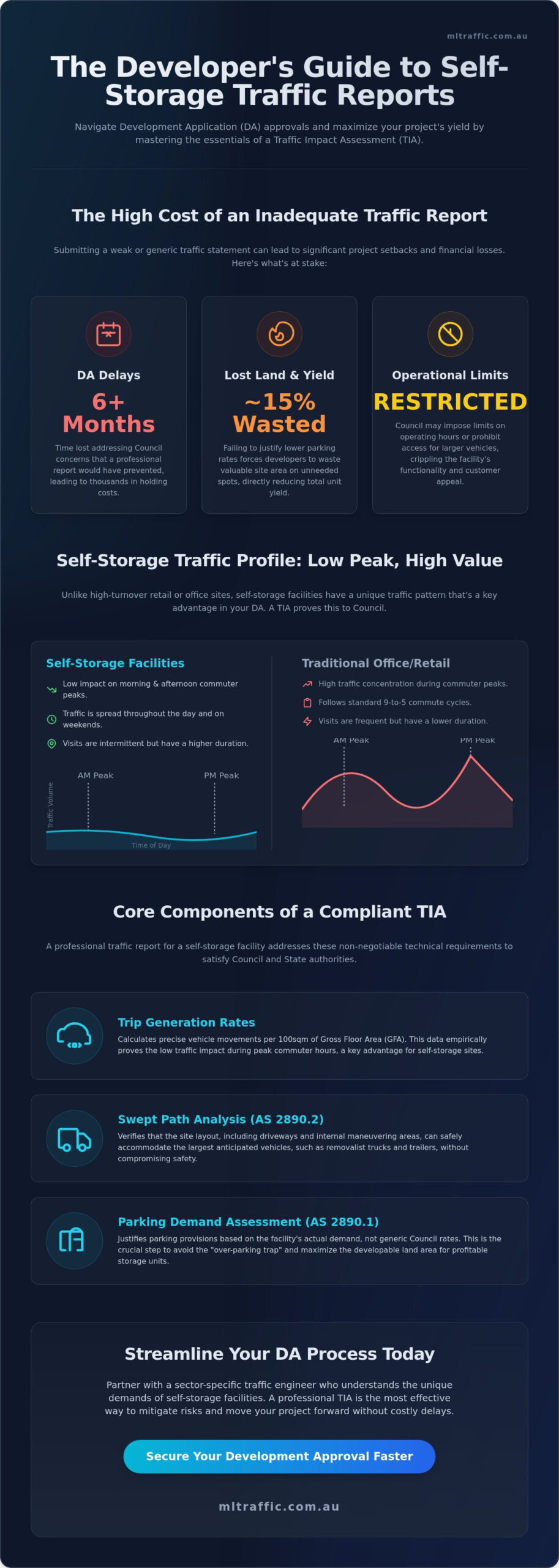
A Traffic Impact Assessment (TIA) is a technical study required by Australian planning authorities to evaluate how a proposed development affects the local transport network. For developers, a professional traffic report for self-storage facility projects is a critical component of the Development Application (DA). Unlike high-turnover retail sites, self-storage facilities generate low peak-hour volumes but require precise assessments for heavy vehicle movements. Traffic engineering principles ensure that entry and exit points handle the specific demands of removalist trucks and trailers without compromising safety on public roads.
Council planners use these reports to verify that the project complies with the local Environmental Planning Instrument (EPI). Since 2005, our team has observed that storage sites are scrutinized differently than offices because their traffic patterns are unique. They don’t follow standard 9-to-5 commute cycles. Instead, they rely on intermittent, high-duration visits. To better understand how these sites operate during an inspection, watch this helpful video:
Common triggers for a mandatory traffic report for self-storage facility include sites exceeding 1,000 square metres of Gross Floor Area (GFA) or developments located on State-controlled roads. If the proposal involves a change of use from a traditional warehouse to a multi-level self-storage facility, Council will almost always require a formal TIA to justify the intensification of the land use. Our traffic engineering services provide the technical data needed to satisfy these requirements.
Meeting Council and State Planning Requirements
Self-storage developers must demonstrate a clear nexus between the facility’s scale and its traffic generation. A TIA forms a core part of the Statement of Environmental Effects (SEE) by proving the site won’t cause gridlock. Compliance with Australian Standards, specifically AS 2890.1 for off-street car parking and AS 2890.2 for commercial vehicles, is non-negotiable. These standards dictate everything from driveway gradients to the width of internal manoeuvring areas. Precise data ensures the project meets the specific benchmarks set by individual local government areas.
The Consequences of an Inadequate Traffic Statement
Submitting a weak report leads to immediate Requests for Further Information (RFIs). In jurisdictions like NSW or QLD, an RFI can delay a project by 60 to 90 days, costing thousands in holding costs. Poor data often results in Council imposing restrictive operational hours or limiting access for larger vehicles. Even worse is the "over-parking" trap. If a consultant fails to argue for lower parking rates based on actual storage demand, Council may force the developer to waste 15% of the site area on unnecessary parking spots. This directly reduces the total storage unit yield and the project’s overall profitability.
Key Technical Components of a Self-Storage Traffic Assessment
A comprehensive traffic report for self-storage facility developments must address specific metrics that differ from standard industrial applications. The assessment focuses on the relationship between floor area and vehicle frequency. Unlike high-turnover retail sites, self-storage traffic is typically spread throughout the day, with low impact on the morning and afternoon commuter peaks.
Trip Generation: Why Storage is Unique
Trip generation rate is the number of vehicle movements per 100sqm of GFA. Self-storage facilities exhibit a unique profile compared to traditional warehousing or distribution centres. While a standard warehouse might involve frequent heavy vehicle movements for logistics, storage sites primarily serve private residents and small business owners. Data from the Self Storage Association and regional databases indicate that these sites generate significantly lower traffic volumes during standard commuter peak hours than other industrial uses.
Our engineers utilize the RMS Guide to Traffic Generating Developments and updated regional surveys to establish accurate rates for each project. For a typical facility, peak hour movements rarely exceed 0.1 to 0.2 trips per 100sqm of GFA. This low intensity often mitigates the need for the major road upgrades that other commercial developments might trigger. It’s a key advantage when presenting a case to Council or planning panels.
Intersection and Road Network Analysis
We analyze the surrounding road network to ensure existing infrastructure can support the development. For higher-intensity sites or those located near congested arterial roads, SIDRA modelling is required. This software provides a detailed analysis of intersection capacity, calculating delays, queue lengths, and the overall level of service. It allows us to prove that the facility won’t create bottlenecks at local junctions.
Safety assessments also extend to "active transport" links. We evaluate pedestrian safety and bicycle paths to ensure the proposed driveway entry doesn’t compromise local movement. Sight distance is a critical technical factor. Every traffic report for self-storage facility approval must confirm that entry and exit points meet AS 2890.1 standards. This involves meticulous measuring of clear lines of sight for exiting drivers to identify approaching traffic and pedestrians. We ensure that landscaping, signage, and building structures don’t obstruct these vital sightlines.
If your project requires technical validation to meet Council requirements, our traffic engineering services provide the authoritative documentation needed for a successful DA submission.
Vehicle Access and Swept Path Analysis for Storage Sites
Ensuring heavy vehicles can navigate a site is a mandatory requirement for any professional traffic report for self-storage facility. We use Swept Path Analysis to simulate exactly how removalist trucks, vans, and trailers move through the proposed layout. This technical assessment identifies potential "pinch points" where a vehicle might clip a curb, gate post, or building corner during a turn. Without this data, a DA is likely to be rejected by Council due to safety and operational concerns.
All designs must comply with AS 2890.2, the Australian Standard for commercial vehicle facilities. Our engineers distinguish between the "Design Vehicle" and the "Check Vehicle" during the planning phase. The Design Vehicle, often an 8.8-metre Medium Rigid Vehicle (MRV) for storage sites, must be able to navigate the facility with standard clearances. The Check Vehicle, such as a 12.5-metre Heavy Rigid Vehicle (HRV), is used to ensure that larger trucks can technically enter and exit the site in an emergency or for rare deliveries, even if the fit is tighter and requires more complex maneuvering.
Designing for Removalist Trucks and Vans
Self-storage facilities must accommodate a diverse fleet. We typically assess three standard vehicle sizes: the 6.4-metre Small Rigid Vehicle (SRV), the 8.8-metre MRV, and occasionally the HRV. Our team uses AutoTURN software to simulate these real-world movements with precision. This simulation accounts for the vehicle’s turning circle, steering lock, and body overhang. Our swept path analysis ensures site safety by verifying that customers can access their units without obstructing the primary thoroughfare or creating hazardous bottlenecks. We also check that internal link roads provide enough width for a parked van and a passing vehicle where necessary.
Driveway Design and Access Compliance
Driveway widths are calculated based on the swept path of the largest expected vehicle. In constrained urban sites, managing two-way flow is a critical challenge. We design for adequate queuing space between the property boundary and the security gate. This prevents vehicles from backing up onto public roads, which is a major safety violation in the eyes of road authorities. A detailed traffic report for self-storage facility will specify these queuing lengths based on peak hour arrival rates. If the site layout is narrow, we may incorporate passing bays or signal-controlled one-way sections to maintain safe internal circulation without compromising the number of storage units available on the ground floor.
Parking Demand Assessment vs. Council Mandates
Local Council Development Control Plans (DCPs) often apply generic parking rates that fail to reflect the operational reality of self-storage. Many Councils attempt to apply "warehouse" or "light industrial" rates, which might require one parking space per 100 square metres of Gross Floor Area (GFA). For a 5,000sqm facility, this results in a requirement for 50 spaces. This is excessive and leads to wasted land. A professional traffic report for self-storage facility uses empirical data to justify a significant reduction in these mandates.
We focus on Car Parking Demand Assessments that compare Council requirements against actual peak occupancy rates. Our data shows that even large-scale facilities rarely have more than 5 to 8 vehicles on-site simultaneously. By proving that the actual demand is lower than the mandate, we help developers maximise their leasable area while remaining compliant with traffic safety standards.
The Argument for Reduced Parking Rates
Traditional retail or office parking ratios don’t apply here. Self-storage is a low-intensity land use with minimal staff and staggered customer visits. Most facilities operate with only 1 or 2 employees on-site. Peak periods typically occur on Saturday mornings, but even then, the turnover is high and the stay duration is low.
-
Staffing: Automated or remotely managed facilities require almost zero permanent staff parking.
-
Customer Behaviour: Most clients visit their units less than once a month.
-
Peak Occupancy: Industry data indicates a typical demand of 0.5 to 1 space per 1,000sqm of GFA.
While we argue for fewer spaces, every bay provided must still meet the geometric requirements of the AS 2890.1 parking design guide. This ensures that the parking provided is functional and safe for all users.
Loading Dock and Service Area Functionality
In self-storage, the loading area is the primary point of activity. Customers don’t use standard parking bays; they use loading docks to move goods directly into units or lifts. A comprehensive traffic report for self-storage facility integrates these loading areas into the overall parking strategy. We treat these as de-facto parking spaces to meet the functional needs of the site.
Designers must prioritise clearance heights. High-top vans and Small Rigid Vehicles (SRVs) require a minimum vertical clearance of 3.5 metres, though 4.5 metres is preferred for larger trucks. We use swept path analysis to prove that these vehicles can enter and exit the site in a forward direction. This is a non-negotiable requirement for most Australian Councils. Additionally, we ensure that accessible parking complies with AS 2890.6, providing the necessary 2.4-metre wide shared zone for side-loading wheelchairs.
Get an accurate assessment of your site’s parking needs. Contact ML Traffic Engineers to discuss your parking demand justification.
Choosing the Right Traffic Engineer for Your Storage Project
Selecting a consultant for your development application (DA) requires more than just comparing fee proposals. Technical precision in a traffic report for self-storage facility is the difference between a swift approval and a costly Request for Further Information (RFI) from Council. Self-storage sites have unique trip generation profiles that generalist engineers often miscalculate. We focus on the specific operational needs of storage, ensuring that parking demand and vehicle movements align with actual industry data rather than generic warehouse templates.
The "ML Traffic Signature" is our commitment to accountability. In many large firms, a senior partner signs the quote while a junior graduate performs the actual assessment. We don’t operate that way. The engineer who quotes your work is the one who conducts the Vehicle Swept Path Assessment and writes the final report. This hands-on approach ensures that technical nuances aren’t lost in delegation. With Michael Lee and Benny Chen bringing between 30 and 40 years of individual experience to every project, your DA submission is backed by decades of technical authority.
Professional certification provides the necessary weight to your submission. Our engineers hold RPEQ (Registered Professional Engineer of Queensland) and NER (National Engineering Register) status. These qualifications are essential for compliance with Australian Standards, specifically AS 2890.1 for parking facilities. When a certified expert signs off on your TIA, it signals to Council that the site design is safe, functional, and compliant with all statutory requirements.
Expertise in Diverse Land-Use Assessments
Since 2005, we’ve provided assessments for over 10,000 sites across Australia. This vast experience includes complex mixed-use developments where self-storage units are integrated with retail or office tenancies. These "multi-use" sites require a sophisticated understanding of how different traffic flows interact during peak periods. We calculate shared parking credits and access requirements to ensure the storage component doesn’t compromise the viability of other tenancies. You can explore our full range of traffic engineering services to see how we manage these technical challenges.
Streamlining the Approval Process
Our role extends beyond technical drafting; we act as your advocate during the public exhibition and Council review phases. We maintain proactive communication with Council traffic departments to resolve potential objections before they become formal roadblocks. If community concerns arise regarding heavy vehicle movements or local congestion, we provide the empirical data needed to mitigate those fears. This results-oriented approach moves your project from a preliminary site check to a final TIA report with minimal friction. Contact ML Traffic Engineers for a direct quote and expert advice from our principals.
Secure Your Self-Storage DA with Technical Precision
A professional traffic report for self-storage facility developments is the critical link between your site design and council approval. Precise swept path analysis and parking demand assessments ensure your project complies with technical requirements and Australian Standards like AS 2890.1. Neglecting these components often leads to costly design revisions or significant project delays during the DA process.
ML Traffic Engineers has delivered expert transport planning for over 15 years. We’ve successfully managed traffic requirements for more than 10,000 development sites across Australia. Our senior engineers handle every detail personally. The consultant who provides your quote is the expert who does the actual technical work. This hands-on approach removes unnecessary firm bureaucracy and ensures technical accuracy for your storage project. We focus on delivering results that satisfy both council mandates and your operational needs.
Get a Traffic Report Quote from our Senior Engineers
We’re ready to help you move your development forward with confidence.
Frequently Asked Questions
Is a traffic report always required for a self-storage facility DA?
A traffic report for self-storage facility is almost always mandatory for a Development Application (DA) in Australia. Local Councils require formal documentation to verify that the proposed development won’t negatively impact road safety or the performance of the local road network. Even if your facility is small, you’ll likely need a Traffic Impact Statement to satisfy planning requirements and address potential access issues.
How much does a traffic report for a self-storage facility typically cost?
The cost of a traffic report for self-storage facility varies based on the project’s scale and the specific requirements of the local Council. Factors like the number of storage units, the complexity of site access, and the need for intersection modeling will influence the final fee. You should request a site-specific quote from an experienced engineer to ensure all technical requirements are covered without hidden costs.
What is the "trip generation rate" used for self-storage in Australia?
Traffic engineers typically refer to the Transport for NSW (TfNSW) Guide to Traffic Generating Developments for these figures. For self-storage facilities, the peak hour trip generation rate is often calculated at 0.1 trips per 100 square metres of Gross Floor Area (GFA). This low rate is a key piece of evidence we use to demonstrate that your facility won’t cause significant congestion on surrounding streets.
Can I use a general civil engineer for my traffic report?
It’s not recommended to use a general civil engineer for this specialized task. Most Councils require reports prepared by qualified traffic engineers who specialize in transport planning and vehicle dynamics. Specialized consultants have the expertise to perform complex Swept Path Analysis and ensure compliance with AS 2890.1 standards. At ML Traffic Engineers, the consultant who provides your quote is the expert who performs the technical work.
How long does it take to prepare a Traffic Impact Assessment?
Preparation of a standard Traffic Impact Assessment (TIA) usually takes 10 to 15 business days. This period allows for a thorough site inspection, data collection, and the creation of technical diagrams. If your project requires 24-hour traffic counts or detailed intersection modeling using SIDRA software, the timeframe may extend to accommodate data collection and analysis.
What happens if the Council objects to the traffic findings in the report?
If a Council officer objects, your traffic engineer will provide a formal technical response to address the specific concerns. This might involve providing additional evidence through a Parking Demand Assessment or refining the driveway design to improve sight lines. We use our 20 years of experience to negotiate with Council authorities and resolve technical disputes through data-driven engineering solutions.
Does the report cover the construction phase of the storage facility?
A standard TIA focuses on the operational phase once the facility is open to the public. However, Councils often require a Construction Traffic Management Plan (CTMP) as a separate condition of your DA approval. The CTMP outlines how heavy vehicles will enter the site and how safety will be managed during the building process to protect the public and local infrastructure.
How many parking spaces are usually required for a self-storage unit?
Parking requirements are set by the local Council’s Development Control Plan (DCP), but self-storage rates are generally low. Most DCPs require 1 space per 300 to 500 square metres of GFA, plus designated spaces for staff. We often argue for a reduction in these rates by demonstrating that self-storage users have low overlap and don’t require the same parking volume as retail or office developments.
Which areas do you cover?
We are traffic engineers servicing Melbourne, Sydney, Brisbane, Gold Coast, Hobart, Perth, Adelaide, Darwin, Canberra and surrounding areas.

Disclaimer
The content on www.mltraffic.com.au, including all technical articles, guides, and resources, is provided for general informational and educational purposes only. It is not intended to constitute professional advice in traffic engineering, transportation planning, development approvals, or any other technical or legal field.
While ML Traffic Engineers makes every reasonable effort to ensure the accuracy, completeness, and timeliness of the information published, we do not provide any warranties or representations (express or implied) regarding its reliability, suitability, or availability for any particular purpose. Any reliance you place on the content is strictly at your own risk.
In no event shall ML Traffic Engineers, its directors, employees, authors, or affiliates be liable for any direct, indirect, incidental, special, consequential, or punitive damages (including, without limitation, loss of profits, data, or business opportunities) arising out of or in connection with the use of, or inability to use, any information provided on this website.
The articles and guides on this site are not a substitute for engaging a qualified, registered professional traffic engineer (such as an NPER or RPEQ engineer) to assess your specific project requirements. For tailored advice, compliance assessments, or traffic engineering services, please contact a competent professional.
This disclaimer may be updated from time to time without notice. By accessing or using this website, you agree to be bound by the most current version of this disclaimer.
