

Why pay for the same traffic analysis three times just because your project has three stages? Most developers find the transition from a Concept DA to stage-specific requirements a bureaucratic minefield. You’ve likely faced Council delays because of cumulative impact concerns or felt the sting of redundant reporting costs that eat into your margins. It’s frustrating when a lack of clarity between a full Traffic Impact Assessment and a simple top-up statement brings your project continuity to a standstill.
At ML Traffic Engineers Australia, we specialise in helping developers secure a traffic report for staged development applications that satisfies regulatory authorities while protecting project viability. This guide details how to navigate the complexities of traffic reporting for multi-stage projects to ensure Council compliance and project continuity. You’ll gain clarity on when a “top-up” traffic statement is sufficient versus a full TIA, alongside strategies for a cost-effective engineering approach. By establishing a robust Master Plan traffic strategy early, you can benchmark cumulative impacts and simplify future approvals, ensuring the project moves from initial concept to final occupancy without unnecessary friction.
Key Takeaways
- Understand the distinction between Master Plan requirements and stage-specific assessments to eliminate redundant reporting costs.
- Learn why a traffic report for staged development applications must account for cumulative impact by modelling the fully completed development from the outset.
- Identify the specific triggers that allow for a concise traffic statement instead of a full Traffic Impact Assessment (TIA) during subsequent stages.
- Discover how direct access to senior principals ensures technical consistency and project continuity throughout the multi-year development lifecycle.
Understanding the Traffic Report for Staged Development Applications
A staged development application divides a large-scale project into manageable phases, typically beginning with a Concept DA followed by detailed Stage DAs. This structure introduces unique traffic implications that a standard Traffic Impact Assessment (TIA) cannot always resolve. While a typical TIA assesses a single completion date, a traffic report for staged development applications must account for the incremental increase in vehicle movements over several years. It requires a dynamic approach to modelling that aligns with the project’s evolving master plan.
Council planners do not view stages in isolation. They prioritise the cumulative impact on the local road network. This methodology ensures that the initial approval doesn’t create a bottleneck when the final stage is delivered. This focus on total site capacity is a standard requirement within the broader Environmental Impact Assessment framework. Our senior engineers specialise in these complex cumulative models, ensuring your master plan remains viable through every phase of construction.
The Burden of Proof in Staged Approvals
Councils demand rigorous evidence of long-term road network capacity before granting initial concept approval. There’s a significant risk of “locking in” a site layout or intersection design in Stage 1 that becomes inadequate by Stage 4. Providing this proof requires meticulous data analysis and a deep understanding of future infrastructure projects in the surrounding area. Consistency is vital. Using the same expert from the Master Plan through to the final occupancy certificate prevents the conflicting data that often triggers Council RFI (Request for Further Information) delays.
Regulatory Compliance and Australian Standards
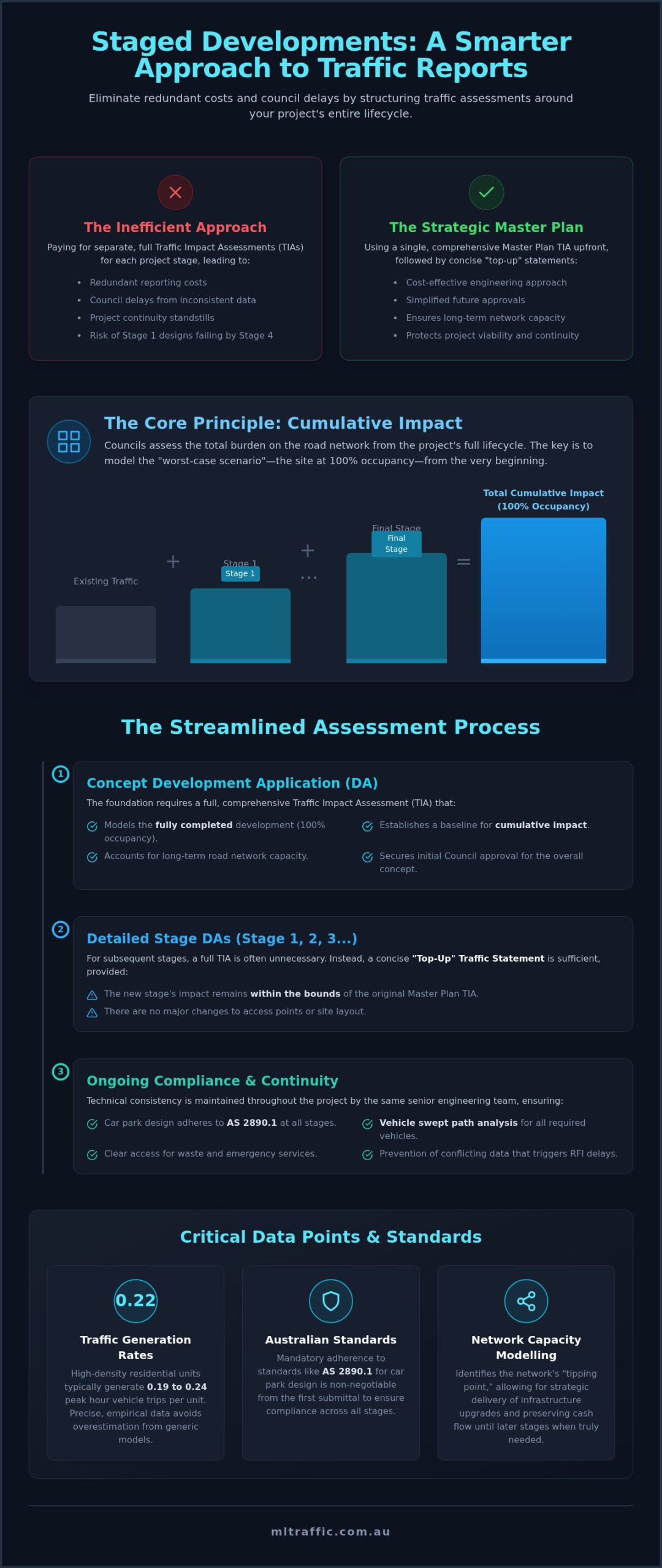
Adherence to Australian Standards is mandatory for every phase of a multi-stage project. We ensure all car park design elements meet AS 2890.1 requirements from the first submittal. This includes performing vehicle swept path analysis for both the intermediate stages and the final built form. Waste management vehicles and emergency services must have clear access at every point of the project’s timeline. Failing to account for these movements early can lead to expensive redesigns when Council identifies non-compliance in later stages. Detailed traffic engineering services provide the technical foundation needed to avoid these setbacks.
Cumulative Impact: The Core of Staged Traffic Assessments
Cumulative impact is the total burden placed on the road network by a project’s full lifecycle. For developers, this means a traffic report for staged development applications must model the “worst-case scenario” from the outset. This represents the site at 100% occupancy. Council requires this foresight to ensure the surrounding intersections don’t fail as subsequent stages come online. Benchmarking existing traffic flow before Stage 1 begins is critical. It establishes a baseline that accounts for local growth and other nearby developments already in the planning pipeline.
Traffic Generation Rates for Phased Delivery
Calculating trip generation for each phase requires high precision. You can’t simply apply a blanket rate. Different land uses within a single stage, such as a mix of retail and residential, create varying peaks. According to industry data for the Australian context, high-density residential units typically generate between 0.19 and 0.24 peak hour vehicle trips per unit. We use empirical data to justify these rates, often proving that staged sites produce lower generation than generic models suggest. This technical accuracy is a core component of Queensland’s Guide to Traffic Impact Assessment, which provides a framework for assessing staged impacts.
Intersection and Network Capacity Modelling
Network modelling identifies the exact tipping point where existing infrastructure can no longer support additional volume. For a traffic report for staged development applications, this allows for a strategic approach to infrastructure delivery. You might be able to defer major intersection upgrades until Stage 3 or 4, provided the initial stages don’t exceed capacity. This strategy preserves cash flow while ensuring long-term compliance. Our senior principals perform this complex modelling directly, ensuring there are no gatekeepers between you and the technical data. If you’re planning a multi-phase project, it’s beneficial to discuss your master plan with an engineer early in the design process.
Concept DAs vs. Detailed DAs: Reporting Requirements
The distinction between a Concept Development Application (DA) and a Detailed DA is a frequent source of confusion for developers. A Concept DA serves as the Master Plan. It establishes the high-level transport strategy for the entire site before any specific building design is finalised. Conversely, a Detailed DA focuses on the granular engineering requirements of a single phase. Successfully managing a traffic report for staged development applications requires understanding how these two documents interact to provide a seamless approval pathway.
Council planners use the Concept DA to assess the long-term viability of the project. If the broad transport strategy is flawed, subsequent stages will face constant resistance. A strong Concept TIA simplifies future submissions by resolving major infrastructure concerns early. This ensures that when you submit for Stage 2 or 3, the discussion is limited to site-specific details rather than reopening debates about total traffic volumes. It’s the most effective way to ensure your traffic report for staged development applications remains consistent throughout the project life cycle.
The Master Plan Traffic Strategy
A Master Plan strategy sets the framework for site access, car parking demand, and internal circulation. It aims to secure an “in-principle” agreement from Council on the total traffic volumes the site will generate. This prevents Council from requesting new intersection analyses for every minor stage. For a deeper look at these requirements, refer to our Traffic Impact Assessment: The Definitive Guide. Establishing these parameters early provides certainty for the project’s long-term feasibility.
Detailed Design and Swept Path Analysis
While the Concept DA deals with strategy, the Detailed DA deals with execution. Stage 1 infrastructure must support the operational needs of the final stage. We conduct rigorous swept path analysis to verify that heavy vehicles can navigate the site during all construction phases. Refining the car park design here ensures compliance with AS 2890.1, preventing costly retrofits. Every detailed stage plan must be cross-referenced against the original Master Plan to maintain technical consistency.
Identifying the exact moment a project requires an updated traffic report for staged development applications is essential for maintaining project momentum. Not every stage requires a full-scale Traffic Impact Assessment. If the proposed stage aligns with the approved Concept DA, a concise Traffic Statement is often sufficient. This document confirms that the previous modelling remains valid and no new impacts are expected. However, several specific triggers necessitate a more substantial reporting update:
- Increases in land use density that exceed the original trip generation benchmarks.
- Shifts in land use type, such as converting a residential component into a commercial centre.
- Significant modifications to site access points or internal road hierarchies.
- Changes to the surrounding external road network that weren’t anticipated in the original Master Plan.
Staying within the “trip budget” established in your Concept DA is the most effective way to avoid redundant reporting costs. When you exceed these benchmarks, Council will likely require a new intersection analysis to verify that the local network can still handle the additional volume.
Dealing with Council Requests for Information (RFI)
Councils often issue an RFI if they perceive a gap between the Master Plan and the current stage details. A common reason for this is the “cumulative impact” of other nearby developments approved since your initial Concept DA. Defending your original modelling requires a senior expert who can speak directly to Council engineers without the filter of junior staff. We specialise in defending these technical models, ensuring your project isn’t unfairly penalised for external network changes. Consistent traffic engineering services throughout the project lifecycle ensure that the person who built the model is the one defending it.
Infrastructure Contribution and Voluntary Planning Agreements (VPA)
Accurate traffic data is the primary leverage in VPA negotiations. Your traffic report for staged development applications directly influences the calculation of developer contributions. If your data proves that Stage 1 has minimal impact on a specific intersection, you can often negotiate to defer major road upgrades until later phases. This strategy protects your upfront capital and improves project feasibility. We provide the technical evidence needed to justify these timing offsets during negotiations. If you’ve received an RFI or are entering VPA discussions, contact our senior engineers to review your current reporting strategy.
How ML Traffic Engineers Organise Staged Assessments
ML Traffic Engineers Australia organises its consultancy around the long-term requirements of multi-phase projects. We treat the traffic report for staged development applications as a dynamic technical framework rather than a static document. This approach ensures technical continuity from the initial Master Plan through to the final occupancy certificate. Our methodology focuses on resolving Council objections early by providing rigorous data that anticipates future network conditions and infrastructure needs.
We specialise in liaising directly with Council engineers to address parking shortfalls or traffic flow concerns. By maintaining a single point of technical accountability, we prevent the data discrepancies that often occur when multiple firms handle different stages of the same site. Every design we produce, from driveway grades to internal circulation, adheres strictly to the latest Australian Standards, specifically AS 2890.1 for off-street car parking. This meticulous attention to compliance protects your project from expensive redesigns in later phases.
Direct Access to Senior Traffic Experts
The complexity of staged DAs requires a level of expertise that junior staff cannot provide. At ML Traffic Engineers Australia, our senior principals perform the technical work directly. This “no-gatekeepers” model means you speak to the person actually performing the modelling and analysis. Having a consistent point of contact over several years is invaluable for large-scale developments where project memory is vital for defending original benchmarks. You can learn more about our team and experience to see how our 15+ years of consultancy benefits your project delivery.
Comprehensive Suite of Engineering Services
A successful traffic report for staged development applications must integrate multiple engineering disciplines to satisfy Council requirements. We provide a full suite of services to support every phase of your project:
- Detailed Car Park Design and compliance reviews for all parking layouts.
- Vehicle Swept Path Analysis for heavy vehicles and emergency services.
- Intersection Analysis and detailed capacity modelling.
- Preparing Traffic Management Plans for construction and operational stages.
This integrated approach ensures that the traffic strategy approved in the Concept DA is physically achievable in the detailed construction plans. We eliminate the risk of design failures by verifying all vehicle movements before Stage 1 commences. Contact us today to discuss your staged development needs and ensure your project remains compliant from start to finish.
Secure Project Continuity for Your Multi-Stage Development
Managing the complexities of multi-phase projects requires a strategic approach to cumulative impact modelling. By establishing a robust Master Plan early, you ensure each subsequent stage proceeds without the delay of redundant assessments or unexpected infrastructure costs. Technical consistency remains the foundation of successful staged approvals. A high-quality traffic report for staged development applications serves as more than just a compliance document; it’s a financial safeguard for your project’s entire lifecycle.
ML Traffic Engineers Australia provides over 15 years of experience in Australian traffic engineering. Our senior principals perform all technical work directly. This ensures meticulous adherence to AS 2890.1 and precise swept path analysis for every construction phase. This principal-led approach eliminates gatekeepers and provides the technical authority needed to resolve Council objections efficiently. Don’t let bureaucratic delays stall your progress. Get a compliant traffic report for your staged development from ML Traffic Engineers Australia. With a clear traffic strategy in place, you can move forward with confidence and certainty.
Frequently Asked Questions
Does a staged development need a new traffic report for every single stage?
No, a new full report isn’t always mandatory for every phase. If the specific stage remains consistent with the parameters established in the initial Concept DA, a concise Traffic Statement may suffice. This document verifies that the original modelling remains valid and no new impacts are anticipated. However, any deviation from the approved master plan regarding land use or density will likely trigger the need for an updated traffic report for staged development applications.
What is the difference between a Traffic Impact Assessment and a Traffic Statement for a staged DA?
A Traffic Impact Assessment (TIA) is a comprehensive study typically required for the initial Master Plan or Concept DA. It models the cumulative impact of the entire project. In contrast, a Traffic Statement is a shorter compliance document used for subsequent stages. It confirms that the proposed stage fits within the trip budget and parking rates approved in the original TIA. This distinction helps developers manage reporting costs throughout the project’s multi-year lifecycle.
How does Council calculate cumulative traffic impact for phased projects?
Council calculates cumulative impact by analysing the total traffic volume generated by the site at full completion. This worst-case scenario is then added to existing background traffic and the predicted growth from other approved developments in the vicinity. They use this data to determine if local intersections will fail at any point during the phased delivery. This methodology ensures that the road network remains functional once the final stage is occupied and fully operational.
Can I defer road upgrade requirements to the final stage of my development?
Deferring road upgrades is often possible if your technical modelling demonstrates that the early stages don’t exceed the existing network capacity. We use granular modelling to identify the exact tipping point where an upgrade becomes essential for safety or flow. This allows you to negotiate the timing of infrastructure delivery within a Voluntary Planning Agreement (VPA), potentially preserving capital for the initial phases of construction while ensuring long-term compliance with local planning requirements.
What happens if the traffic generation for Stage 1 is higher than predicted in the Master Plan?
If Stage 1 generates more traffic than predicted, you’ll likely face a Request for Information (RFI) from Council. This discrepancy can invalidate the cumulative modelling for all future stages. You’ll need an engineer to update your traffic report for staged development applications to reflect the higher generation rates. This often involves re-evaluating intersection capacity and potentially accelerating the delivery of road upgrades to maintain the safety and efficiency of the surrounding road network.
Is swept path analysis required for every stage of a multi-building development?
Yes, swept path analysis is critical for every stage to ensure operational continuity. While the final built form is the primary focus, each intermediate stage must allow safe access for waste collection vehicles, emergency services, and delivery trucks. Construction traffic also needs clearly defined routes that don’t conflict with occupied buildings. We perform these analyses for every phase to ensure the site remains functional and compliant with Australian Standards throughout the entire construction period.
How do changes in local road conditions affect my approved staged traffic report?
Changes in local road conditions, such as new intersections or altered speed limits, can impact the validity of your approved report. If the baseline data used in your original modelling is no longer accurate, Council may require a top-up assessment. This involves updating the traffic counts and re-running the capacity models to ensure your project’s impact is still manageable. Regular monitoring of the surrounding road network helps anticipate these requirements before they cause significant project delays.
Can a traffic engineer help negotiate developer contributions for staged projects?
Traffic engineers provide the technical evidence required to negotiate developer contributions and VPAs. By accurately quantifying the specific impact of your project on local infrastructure, we can ensure your contributions are proportional and fair. This data allows you to challenge generic Council estimates that may overstate your project’s burden on the road network. Having a senior expert lead these discussions provides the technical authority needed to secure more favourable financial terms.

Disclaimer
The content on www.mltraffic.com.au, including all technical articles, guides, and resources, is provided for general informational and educational purposes only. It is not intended to constitute professional advice in traffic engineering, transportation planning, development approvals, or any other technical or legal field.
While ML Traffic Engineers makes every reasonable effort to ensure the accuracy, completeness, and timeliness of the information published, we do not provide any warranties or representations (express or implied) regarding its reliability, suitability, or availability for any particular purpose. Any reliance you place on the content is strictly at your own risk.
In no event shall ML Traffic Engineers, its directors, employees, authors, or affiliates be liable for any direct, indirect, incidental, special, consequential, or punitive damages (including, without limitation, loss of profits, data, or business opportunities) arising out of or in connection with the use of, or inability to use, any information provided on this website.
The articles and guides on this site are not a substitute for engaging a qualified, registered professional traffic engineer (such as an NPER or RPEQ engineer) to assess your specific project requirements. For tailored advice, compliance assessments, or traffic engineering services, please contact a competent professional.
This disclaimer may be updated from time to time without notice. By accessing or using this website, you agree to be bound by the most current version of this disclaimer.
