

Your subdivision’s profitability often hinges on a single document that many developers treat as a formality until the Council issues a formal rejection. A single technical oversight in traffic data can trigger a mandatory intersection upgrade costing upwards of A$250,000, effectively stalling your project. We understand the pressure to deliver a compliant traffic report for subdivision nsw is high, particularly when facing the rigorous technical standards set by Transport for NSW (TfNSW). Since 2005, we’ve seen how poorly prepared applications lead to “stop-the-clock” delays that derail financial projections.
It’s essential to get the technical details right the first time to avoid these unexpected costs. This guide will help you master the regulatory requirements needed to ensure a seamless Development Application process. You’ll gain expert insights into optimizing road layouts and parking demand to clear Council hurdles while minimizing infrastructure contribution costs. We’ll examine the specific criteria used for site assessments, including vehicle swept path analysis and sight-line requirements under Australian Standard 2890.1.
Key Takeaways
- Understand why a Traffic Impact Assessment (TIA) is a mandatory component for DA approval to satisfy NSW Council requirements for road safety and capacity.
- Learn to identify the essential technical components of a TIA, including site-specific traffic counts and NSW land-use trip generation calculations.
- Navigate the regulatory hierarchy between Local Council Development Control Plans (DCPs) and Transport for NSW (TfNSW) guidelines to ensure full compliance.
- Discover the professional steps required to secure a comprehensive traffic report for subdivision nsw, from initial speed surveys to stakeholder consultation.
- Recognise the value of direct principal involvement to ensure the engineer who quotes your project is the one performing the technical assessment.
Table of Contents
- Why a Traffic Report is Critical for Subdivision Approval in NSW
- Essential Components of a Subdivision Traffic Impact Assessment
- Navigating NSW Regulatory Standards and Council Requirements
- Securing Your Traffic Report: The Professional Process
- Partnering with ML Traffic Engineers for NSW Subdivision Success
Why a Traffic Report is Critical for Subdivision Approval in NSW
A traffic report for subdivision nsw is a mandatory technical component of the Traffic Impact Assessment (TIA) required for most Development Applications (DAs). NSW Councils and Transport for NSW (TfNSW) operate under strict guidelines to ensure that new residential or commercial lots don’t compromise the existing road network. This report isn’t a mere formality; it’s a data-driven document that proves a development is safe and viable. It provides the technical evidence needed to satisfy the requirements of the Environmental Planning and Assessment Act 1979.
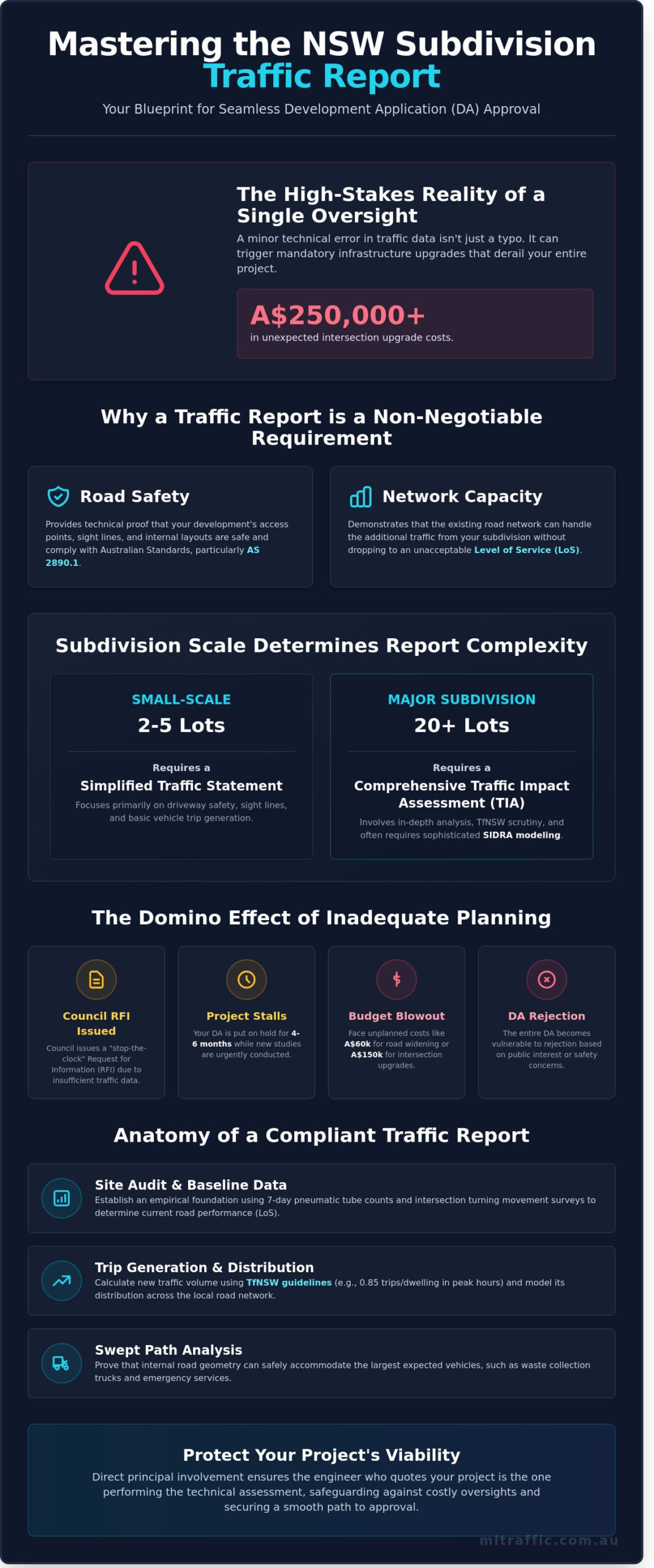
Councils prioritize two main factors: road safety and network capacity. If a new subdivision adds even 10 vehicle movements per hour to a local intersection already operating at Level of Service (LoS) D, the project faces immediate scrutiny. A professional report mitigates these risks by identifying potential bottlenecks before they become legal liabilities. It acts as a technical safeguard for developers, ensuring that all proposed access points and internal road layouts comply with Australian Standards, specifically AS 2890.1. Detailed assessments from qualified traffic engineers provide the assurance that your project won’t be derailed by unforeseen infrastructure demands.
The Link Between Subdivision Scale and Traffic Requirements
The complexity of your traffic report for subdivision nsw depends directly on the project’s scale. Small-scale developments, typically between 2 and 5 lots, might only require a simplified Traffic Statement. This document focuses on driveway safety and basic trip generation. However, major residential subdivisions with 20 or more lots trigger the need for a comprehensive Traffic Impact Assessment. If a project exceeds specific thresholds, such as 200 or more allotments in certain regional areas, it may be classified as “State Significant.” These developments undergo intense scrutiny from TfNSW and require sophisticated SIDRA modeling to predict impacts on state-managed roads.
Consequences of Inadequate Traffic Planning
Inadequate traffic planning often results in a Council issuing a Request for Information (RFI). This doesn’t just add administrative work; it can stall a project for 4 to 6 months while new studies are conducted. The financial implications are often severe. Without a proactive report, you might be forced into unplanned infrastructure contributions, such as a A$150,000 intersection upgrade or A$60,000 in road widening costs that weren’t in the initial budget. Furthermore, an incomplete traffic analysis weakens the Statement of Environmental Effects (SEE), making the entire DA vulnerable to rejection based on public interest or safety concerns. Meticulous planning at the start is the only way to protect project viability.
Essential Components of a Subdivision Traffic Impact Assessment
A professional traffic report for subdivision NSW must provide a technical bridge between the proposed development and the existing road network. This process begins with an audit of current road conditions and traffic volume data. Engineers typically conduct seven-day pneumatic tube counts or intersection turning movement surveys to establish an accurate baseline. This data determines the current Level of Service (LoS) for nearby intersections, ranging from LoS A (good) to LoS F (unsatisfactory). Without this empirical foundation, Council cannot assess how the additional load will affect local safety and transit times.
Trip Generation and Distribution Models
Engineers calculate the volume of new traffic using the TfNSW (formerly RMS) Guide to Traffic Generating Developments. For a standard low-density residential subdivision, the guide typically suggests a rate of 0.85 trips per dwelling during peak hours. However, these figures require adjustment based on location. Regional subdivisions often show higher vehicle dependency compared to metropolitan Sydney developments near transit hubs. We analyze peak hour flows and weekend variations to ensure the local road network can absorb the maximum projected demand without failing. This data is then distributed across the network based on likely travel patterns toward employment zones and schools.
Swept Path Analysis and Internal Road Design
Internal road geometry must accommodate more than just passenger vehicles. A critical part of the traffic report for subdivision NSW is proving that waste collection trucks and emergency services can navigate the site safely. We utilize specialized software to perform a Swept Path Analysis, which simulates the turning circles of an 8.8m medium rigid vehicle or a 12.5m heavy rigid vehicle. This analysis dictates the width of cul-de-sacs and the placement of mountable kerbs. All designs must achieve strict compliance with Australian Standards and local Council engineering specifications to prevent future operational failures.
Parking Demand and Provision
Modern subdivisions must balance private vehicle storage with the need for clear, navigable streets. We evaluate parking requirements by comparing local environmental plan (LEP) rates against actual demand. The layout of off-street parking, including driveway gradients and garage setbacks, is governed by AS 2890.1. Our assessments also address visitor parking and bicycle storage, which are increasingly mandatory in medium-density subdivisions. Proving that a development won’t result in overspill onto public roads is essential for securing DA approval. If you need a technical review of your site plan, you can view our full range of traffic engineering services to see how we assist with compliance.
The final assessment combines these components to determine if intersection upgrades, such as new turn lanes or signals, are required. This data-driven approach ensures the subdivision remains functional for decades while meeting all NSW regulatory benchmarks.
Navigating NSW Regulatory Standards and Council Requirements
NSW subdivision approvals rely on a strict hierarchy of regulatory instruments. Developers must align their proposals with the Environmental Planning and Assessment Act 1979, specifically focusing on Section 4.15. A professional traffic report for subdivision nsw addresses these statutory requirements by evaluating how new lot yields affect the existing road network. This assessment isn’t just a local requirement; it’s a legal necessity to prove the development serves the public interest and maintains safety standards.
The Local Traffic Committee (LTC) functions as a technical advisory body to the Council. It consists of representatives from the Council, NSW Police, TfNSW, and the local Member of Parliament. While the LTC doesn’t approve the DA itself, it reviews all proposed changes to traffic control devices, such as new stop signs, line marking, or restricted parking zones. Your traffic report must provide the technical justification these stakeholders require to support your subdivision. We ensure every data point is defensible to prevent delays during the committee review phase.
Traffic data acts as the foundation for other specialist studies. Acoustic consultants use our vehicle trip generation numbers to model noise impacts on future residents. Civil engineers rely on our swept path analysis to determine the turning radii of waste collection vehicles and emergency services. This coordination ensures the subdivision design is functional and compliant across all engineering disciplines.
Local Government vs. State Road Requirements
State road concurrence is a common hurdle for developers. If your site frontages a classified road, Transport for NSW (TfNSW) must provide concurrence under Section 138 of the Roads Act 1993. Local Environmental Plans (LEPs) dictate land use, while Development Control Plans (DCPs) provide the granular technical requirements for driveway widths and internal road geometry. Traffic threshold triggers vary significantly; some Sydney councils require a full traffic report for any subdivision exceeding 5 lots, while regional jurisdictions might set the limit at 15 lots. It’s vital to check the specific DCP for your Local Government Area (LGA) before commencing site plans.
Australian Standards for Access and Safety
Safety is validated through strict adherence to Australian Standards. AS 2890.1 governs off-street parking, while AS 2890.2 covers heavy vehicle requirements for service and delivery areas. Every access point requires a sight distance assessment to ensure Safe Intersection Sight Distance (SISD) meets the criteria based on the 85th percentile speed of the passing traffic. Professional Traffic Engineering ensures these certifications are met before the DA is lodged. We focus on achieving compliance with AS 1742.2 for all new intersections to guarantee long-term safety for the future community. Failure to meet these standards often results in a Request for Further Information (RFI), which can stall a project for months.
Securing Your Traffic Report: The Professional Process
Securing a traffic report for subdivision nsw involves a rigorous technical workflow that converts raw field data into a compliant planning document. It’s not a generic paperwork exercise; it’s a site-specific engineering challenge. The process begins with an initial site inspection and data collection. This phase includes automated traffic counts and radar speed surveys to establish baseline conditions. We consult with Council and Transport for NSW (TfNSW) early to align with local planning controls and regional transport strategies. After data analysis, we draft the technical report and perform internal road safety checks. The process concludes by managing Council’s Requests for Further Information (RFI) during the DA assessment period.
Data Collection and Site Assessment
Council requirements for NSW reports are strict. Traffic count data must be recent, typically collected within the last 12 to 24 months. Outdated data from three or four years ago leads to immediate rejection by assessing officers. We conduct sight-line assessments at every proposed entry point to ensure compliance with AS 2890.1 standards. We also identify physical constraints like bus stops, power poles, or existing pedestrian crossings. These factors dictate the feasible location of your subdivision’s access roads. We use Sidra Intersection software to model how your development impacts local flow during the 8:00 AM and 5:00 PM peak periods.
Mitigation Strategies and Infrastructure Planning
If your project increases local traffic volume by even 5 percent, you’ll likely need mitigation strategies. This often involves proposing road widening, new turning lanes, or intersection upgrades. We help you negotiate Section 7.11 developer contributions, ensuring you only pay for your fair share of infrastructure. For the construction phase, we design Traffic Guidance Schemes (TGS) to manage heavy vehicle movements and ensure worker safety. This proactive planning prevents costly stop-work orders once construction begins. Our reports include detailed plans for these improvements to satisfy Council’s engineering requirements.
Working with a Traffic Consultant
A principal-led approach is vital for successful Council negotiations. At ML Traffic Engineers, the consultant who provides your quote is the one who performs the work. This ensures accountability and technical depth during meetings with Council engineers. Review the ML Traffic services to see how our expertise in Swept Path Analysis and Car Parking Demand Assessments integrates into your project team. Provide a clear brief including your site plan and expected lot yield. This helps us minimize report revisions and keeps your project costs under control. Direct access to our principals means you get answers without waiting for junior staff to consult their managers.
For expert assistance with your development application, contact our senior engineers for a direct consultation on your subdivision project.
Partnering with ML Traffic Engineers for NSW Subdivision Success
ML Traffic Engineers has operated within the NSW planning landscape since 2005. We provide the technical expertise required to secure a traffic report for subdivision nsw that satisfies both local Council requirements and Transport for NSW standards. Our firm maintains a proven track record, having completed more than 10,000 successful site assessments across the state. We don’t rely on a tiered management system that separates clients from the experts. The traffic consultant who provides your quote is the same professional who performs the technical work. This direct accountability ensures your project benefits from senior-level insights throughout the entire process.
Why ML Traffic Engineers?
We offer a deep understanding of Traffic Impact Assessments for Australian developers. Your project is handled directly by our principals, Michael Lee or Benny Chen. Each principal brings between 30 and 40 years of experience to the table. We use industry-standard tools like AutoTURN for precise Swept Path Analysis. This technical rigour is applied across all subdivision categories:
- Residential multi-lot estates and dual occupancies.
- Commercial and retail subdivisions.
- Industrial parks and large-scale warehouse developments.
- Specialist land-uses including childcare, medical centers, and places of worship.
Our experience ensures that your traffic report for subdivision nsw addresses specific site constraints, such as driveway ramp grades and sight-line assessments, in strict accordance with AS 2890.1. We focus on private clients who need reliable results for their development applications.
Streamlining Your DA Approval
Our proactive approach centers on resolving Council objections before they arise. We analyze your site’s layout early in the design phase to identify potential traffic flow issues. By addressing these factors before the formal submission, we reduce the risk of costly delays or Requests for Further Information (RFI) from planning authorities. We provide comprehensive support starting from the initial fee proposal through to the final DA determination. Our reports are direct, authoritative, and designed to facilitate a smooth approval process. To discuss the specific traffic requirements for your next subdivision project, reach out to our team via the ML Traffic Contact page.
Secure Your Subdivision Approval with Expert Traffic Engineering
Navigating the technical complexities of NSW regulatory standards requires precision and a deep understanding of Council requirements. A comprehensive traffic report for subdivision nsw ensures your development meets AS 2890.1 compliance and addresses vehicle swept paths accurately. Delays often stem from inadequate documentation. Partnering with specialists who’ve assessed over 10,000 sites since 2005 mitigates this risk. Every driveway ramp grade and sight-line assessment matters for a successful DA outcome.
At ML Traffic Engineers, we provide direct access to our Principal Engineers who bring over 15 years of firm experience to every project. We operate on a straightforward principle: the traffic consultant who provides your quote is the one who does the work. This level of accountability ensures your subdivision project remains on track and meets all technical transport planning obligations. Don’t leave your application to chance when you can leverage decades of professional engineering expertise.
Get a Professional Traffic Report Quote for Your Subdivision
Your path to a successful subdivision approval starts with accurate data and professional reliability.
Frequently Asked Questions
Is a traffic report mandatory for all subdivisions in NSW?
A traffic report for subdivision NSW is mandatory for most developments, though the specific scope depends on your Local Environmental Plan (LEP) and Development Control Plan (DCP). Even a simple dual occupancy or 2-lot split often requires a Traffic Impact Statement to address driveway safety and access. Failure to provide this technical documentation results in a “Request for Further Information” (RFI) from Council, which delays your DA approval by weeks or months.
How much does a traffic report for a subdivision cost?
Professional fees for a standard subdivision traffic report typically range between A$1,800 and A$4,500 plus GST. Costs fluctuate based on the number of proposed lots and the complexity of the intersection analysis required. For a basic 2-lot to 5-lot subdivision, expect a fee toward the lower end; however, projects requiring SIDRA intersection modelling or extensive traffic counts will often exceed A$6,000 depending on the site’s location. Data collection (required for SIDRA modelling) in regional areas incurs additional travel disbursement costs to the order of $3,000 + GST (air fares, time away from base) to be confirmed at the time of commission.
How long does it take to prepare a subdivision traffic assessment?
Preparation of a standard assessment takes between 10 and 15 business days. This timeframe includes site inspections, data collection, and drafting the technical report. If your project requires new traffic counts, add 5 to 7 days for the data collection company to deploy sensors and process the results. We ensure the traffic consultant who provides your quote also performs the technical work to maintain this schedule and ensure accuracy.
Can I use a general civil engineer instead of a traffic specialist?
Most NSW Councils require reports from a qualified traffic engineer with specific experience in transport planning and road safety. While civil engineers handle drainage and roads, they often lack the specialized accreditation or SIDRA software expertise needed for complex traffic impact modelling. Using a non-specialist increases the risk of rejection. Over 85% of our corrective work involves fixing reports initially prepared by unqualified generalists that failed to meet Council standards.
What happens if Council rejects my traffic report?
If Council rejects your report, they’ll issue a formal Request for Further Information (RFI) or a Deferral notice. You typically have 21 days to provide a technical response or an amended Traffic Impact Assessment (TIA). Our team reviews the Council engineer’s specific objections, such as sight-line issues or non-compliance with AS 2890.1, and provides a revised assessment to resolve the dispute and keep the DA moving forward.
Does a 2-lot subdivision require a full Traffic Impact Assessment?
A 2-lot subdivision rarely requires a full Traffic Impact Assessment; instead, a concise Traffic Impact Statement (TIS) is usually sufficient. This document focuses on driveway safety, vehicle swept paths, and compliance with AS 2890.1 standards for off-street parking. While it’s less intensive than a full TIA for a 50-lot estate, it’s still a mandatory technical requirement for DA approval in 95% of NSW local government areas.
How long is a traffic count survey valid for in NSW?
Traffic count data is generally considered valid for 24 to 36 months by most NSW road authorities. If significant development has occurred in the immediate area since the last count, Council will likely demand fresh data. We recommend using data no older than 2 years to ensure your traffic report for subdivision NSW remains defensible and accurate during the formal assessment process.
What is the difference between a Traffic Management Plan and a Traffic Impact Assessment?
A Traffic Impact Assessment (TIA) analyzes the permanent effect of the completed subdivision on the local road network. In contrast, a Traffic Management Plan (TMP) or Traffic Control Plan (TCP) focuses on the temporary safety measures required during the construction phase. You’ll need the TIA for your Development Application (DA) and the TMP later to satisfy Construction Certificate (CC) conditions before work begins on site.
Whereabouts in NSW do you cover?
We are traffic engineers servicing Sydney, Newcastle, Wollongong, Central Coast, Tweed Heads, Coffs Harbour, Port Macquarie, Nowra-Bomaderry, Wagga Wagga, Dubbo, Tamworth, Albury, Orange, Bathurst, Queanbeyan, Broken Hill, Armidale, Goulburn, Forster, Taree, Lismore, Byron Bay, Mudgee, Griffith, Cooma.
Disclaimer
The content on www.mltraffic.com.au, including all technical articles, guides, and resources, is provided for general informational and educational purposes only. It is not intended to constitute professional advice in traffic engineering, transportation planning, development approvals, or any other technical or legal field.
While ML Traffic Engineers makes every reasonable effort to ensure the accuracy, completeness, and timeliness of the information published, we do not provide any warranties or representations (express or implied) regarding its reliability, suitability, or availability for any particular purpose. Any reliance you place on the content is strictly at your own risk.
In no event shall ML Traffic Engineers, its directors, employees, authors, or affiliates be liable for any direct, indirect, incidental, special, consequential, or punitive damages (including, without limitation, loss of profits, data, or business opportunities) arising out of or in connection with the use of, or inability to use, any information provided on this website.
The articles and guides on this site are not a substitute for engaging a qualified, registered professional traffic engineer (such as an NPER or RPEQ engineer) to assess your specific project requirements. For tailored advice, compliance assessments, or traffic engineering services, please contact a competent professional.
This disclaimer may be updated from time to time without notice. By accessing or using this website, you agree to be bound by the most current version of this disclaimer.
