
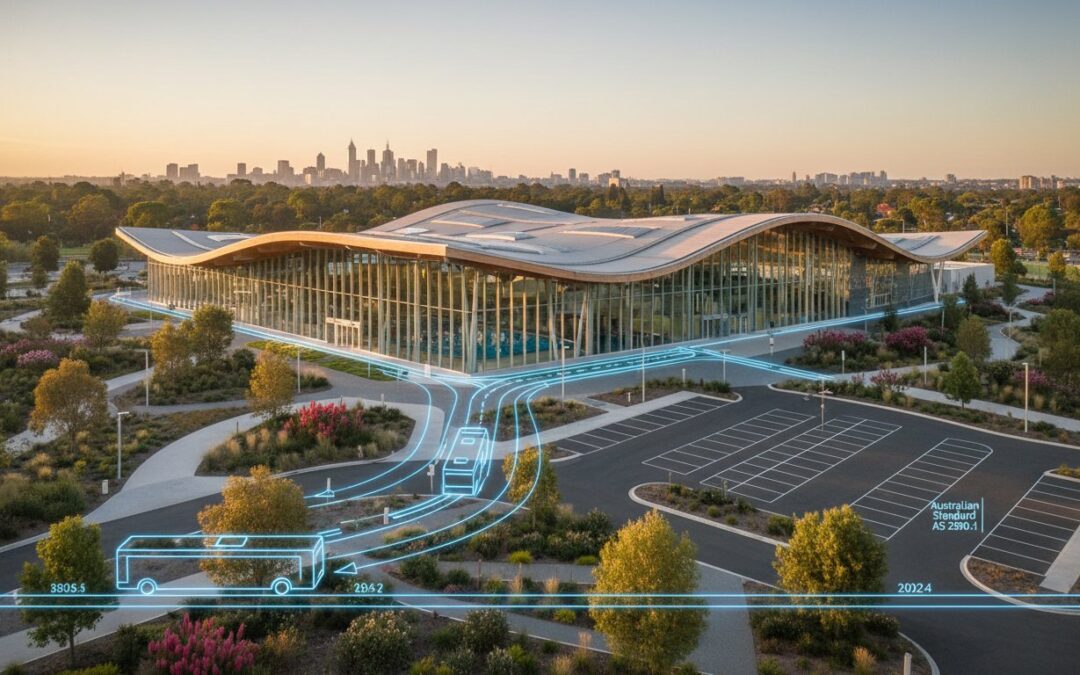
A single miscalculation in your peak-hour parking demand can stall a multi-million dollar aquatic facility development for six months or more. You understand that securing DA approval in 2026 requires more than standard architectural plans. It demands technical precision that satisfies Council’s strict safety and access standards. Providing a comprehensive traffic report for swimming pool complex developments is the only way to address these bureaucratic requirements head-on. We recognize the frustration of facing a Request for Further Information (RFI) because your data didn’t account for seasonal peaks or complex school bus movements. It’s a common hurdle that leads to unnecessary delays and budget blowouts.
This guide explains exactly what your report must include to ensure a successful application the first time. You’ll learn how to satisfy Council requirements for parking, vehicle swept paths, and pedestrian safety. We provide clear guidance on applying Australian Standards like AS 2890.1 to large-scale aquatic facilities. This article covers the essential components of a compliant Traffic Impact Assessment (TIA) to ensure your project moves forward without technical setbacks or safety concerns.
Key Takeaways
- Understand why Councils prioritize specialized assessments for high-occupancy aquatic facilities to ensure your DA meets strict local requirements.
- Learn how to accurately model trip generation and baseline traffic counts to prove your development won’t congest existing road networks.
- Discover the specific formulas for calculating parking demand based on pool surface area and ensure full compliance with AS 2890.1:2004 standards.
- Identify why a traffic report for swimming pool complex must include swept path analysis to facilitate safe access for buses and service vehicles.
- Leverage senior engineering expertise and over 10,000 successful site assessments to streamline your approval process and avoid costly design revisions.
Why a Traffic Report for a Swimming Pool Complex is Critical for DA Approval
A traffic report for swimming pool complex is a technical Traffic Impact Assessment (TIA). It evaluates how an aquatic facility affects the local road network. These developments are unique because they don’t follow standard office or retail peak hours. Instead, they experience high-occupancy surges during summer heatwaves and weekend swim meets. Councils prioritize these reports to prevent localized gridlock and maintain public safety.
The core of this work relies on Traffic engineering principles. We focus on the safe movement of vehicles and pedestrians around high-use recreational zones. A standard traffic statement isn’t enough for a 2026 DA submission. You need a comprehensive report that accounts for specific trip generation rates and seasonal fluctuations.
To better understand the fundamentals of this assessment, watch this technical overview:
Professional assessments differentiate between a simple parking count and a deep-dive analysis. If a facility plans for 500 visitors but only provides 40 car spaces, the local council will likely reject the application. We look at the legal and safety implications of these surges to ensure your project meets all regulatory benchmarks. Failing to account for a 40 degree day in January can lead to dangerous illegal parking on local verges, creating liability issues for the developer.
Understanding the Council’s Requirements
Councils identify specific triggers for a TIA in recreational developments. Usually, these include proximity to major intersections or a set increase in daily traffic volume. Our reports integrate directly with your Statement of Environmental Effects (SEE). We ensure every traffic report for swimming pool complex complies with local planning schemes and national transport guidelines. This includes adherence to:
- Local Environmental Plans (LEP) and Development Control Plans (DCP).
- Australian Standards for parking facilities (AS 2890.1).
- Austroads Guide to Traffic Management.
- State-specific transport authority guidelines.
The Cost of Inadequate Traffic Planning
Inadequate planning leads to expensive DA delays. In 2024, traffic-related issues remain a top reason for councils to issue a Request for Further Information (RFI). This can push your timeline back by 12 to 20 weeks. Community concerns regarding street congestion are often the loudest during the public exhibition phase. A professional traffic assessment service provides the data needed to resolve these objections early. Smart site access isn’t just about compliance; it’s about the long-term operational success of the facility.
Key Components of a Traffic Impact Assessment (TIA) for Aquatic Centres
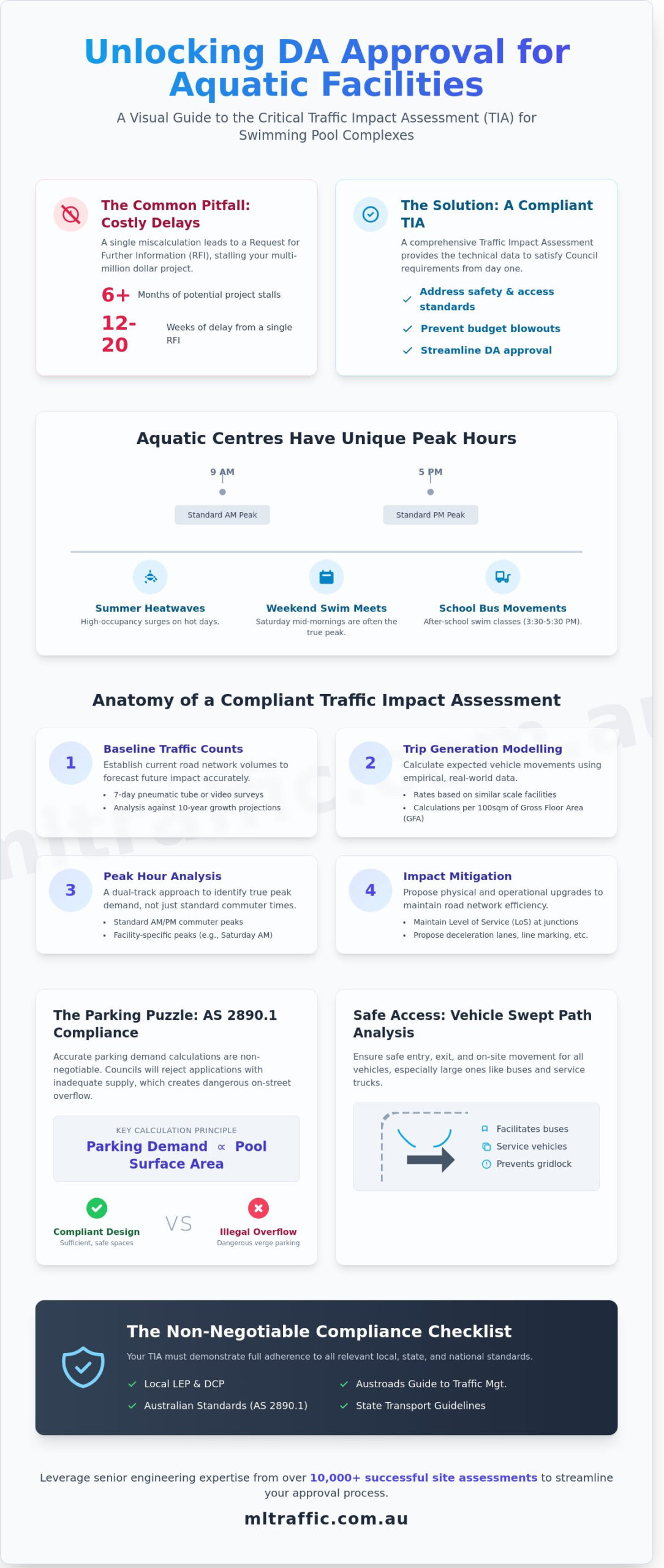
A comprehensive traffic report for swimming pool complex developments must address four technical pillars. First, baseline traffic counts involve 7-day pneumatic tube or video surveys to establish current volumes on fronting roads. We analyze these against 10-year growth projections to ensure the 2026 DA submission remains valid through the construction phase. Trip generation modelling follows, using empirical data from similar scale facilities to calculate expected vehicle movements per 100sqm of Gross Floor Area (GFA).
Peak hour analysis requires a dual-track approach. Standard morning and afternoon commuter peaks often clash with swim school drop-offs between 3:30 PM and 5:30 PM. However, Saturday mid-morning peaks usually represent the highest demand for aquatic centres. Impact mitigation strategies focus on maintaining Level of Service (LoS) at nearby junctions. This involves proposing physical upgrades like dedicated deceleration lanes or updated line marking to prevent queueing on arterial roads.
Modelling Seasonal and Event-Based Peaks
Aquatic centres experience extreme variance in demand. A standard Tuesday in July differs significantly from a 35-degree Saturday in January. We use historical data from the Bureau of Meteorology and local school schedules to model ‘worst-case’ scenarios. This includes 1,000-visitor swimming carnivals that can increase local traffic by 400% over a 2-hour window. Our 2026-ready modelling accounts for these surges to ensure the site’s access points don’t fail during major events.
Intersection and Road Network Capacity
We evaluate intersection performance using Sidra Intersection software. This tool assesses degree of saturation, delay, and queue lengths for all movements. We pay close attention to right-turn entries, as these often cause the most friction in the road network. All internal car park layouts and access driveways must achieve compliance with AS 2890.1 to prevent internal congestion from spilling onto public streets. If the modelling shows a delay increase of more than 15 seconds per vehicle, we recommend specific signal adjustments or road widening. For detailed technical advice on your site’s specific needs, explore our traffic engineering services.
- Baseline Data: Captures the existing 85th percentile speeds and volume.
- Trip Modelling: Uses RTA Guide to Traffic Generating Developments standards.
- Queue Analysis: Ensures right-turn bays are long enough to prevent through-lane blockage.
- Safety Audits: Evaluates sight-lines for exiting vehicles and pedestrian crossing points.
Assessing Parking Demand and Compliance with AS 2890.1
Calculating the correct parking provision for a recreational facility requires a data-driven approach. Most Australian councils determine parking requirements based on the water surface area of the pools or the total patron capacity. For instance, a common metric involves providing one space per 30 square metres of pool surface area. A traffic report for swimming pool complex developments must justify these figures against local Environmental Planning Instruments (EPIs) to ensure the site doesn’t overflow into residential side streets.
Designers must ensure every parking bay and access ramp adheres to AS 2890.1:2004 standards. This includes specific requirements for B85 and B99 vehicle templates. Beyond standard bays, the 2026 DA landscape demands strict adherence to AS 2890.6 for disabled parking. These spaces require dedicated shared zones and proximity to the main entrance. You also need to allocate pram spaces near entry points to accommodate families, which is a core demographic for aquatic centres. Modern complexes now integrate bicycle parking and end-of-trip facilities, such as lockers and showers, to meet sustainable transport targets.
Managing Car Park Circulation and Safety
High-turnover sites benefit from one-way circulation systems. These designs reduce conflict points and simplify the search for a parking bay. Two-way aisles are acceptable but require wider dimensions to maintain safety. Child safety is the priority in aquatic centre car parks. We design for clear sightlines at every pedestrian crossing point. This prevents accidents involving small children who are often obscured by parked SUVs. Signage and pavement markings must be clear, durable, and reflective. We specify R-series regulatory signs to ensure traffic flow remains predictable during peak Saturday morning swimming lessons.
Parking Demand Reductions and Green Travel Plans
If your site cannot physically accommodate the full parking quota, we provide technical justifications for a shortfall. Proximity to high-frequency public transport, such as a train station within 400 metres, allows for significant demand reductions. A Green Travel Plan (GTP) acts as a formal commitment to reducing car dependency. This plan might include carpool incentives for staff or the implementation of shuttle bus services during regional swim meets. These strategies demonstrate to Council that the traffic report for swimming pool complex approval has considered the broader transport network. We focus on realistic, measurable outcomes that reduce pressure on local road infrastructure while maintaining site accessibility.
Vehicle Access and Swept Path Analysis for Complex Sites
A technical traffic report for swimming pool complex developments must prove that every intended vehicle can enter, circulate, and exit the site in a forward direction. We use specialized CAD-based software to simulate these movements through a swept path analysis. This assessment is mandatory for DA approval because it identifies potential “pinch points” before construction begins. In 2026, Councils require zero-margin-for-error documentation regarding heavy vehicle encroachment on pedestrian zones or opposing traffic lanes.
Emergency vehicle access remains a non-negotiable component of the traffic report. We design for the 8.8m Medium Rigid Vehicle (MRV) typically used by Fire and Rescue services or the specific dimensions of a standard ambulance. Beyond turning circles, we assess driveway ramp grades to ensure compliance with AS 2890.1. This prevents vehicle scraping, particularly for low-clearance passenger cars and emergency response units. A 1:20 grade is often required for the first 6 metres of the property boundary to maintain safe sight lines and smooth transitions.
Bus and Coach Maneuverability
Swimming complexes rely on school group attendance, which necessitates access for 12.5m or 14.5m coaches. We map the turning circles for these vehicles to ensure they don’t mount kerbs or strike signage. Drop-off and pick-up zones must be long enough to accommodate multiple coaches simultaneously without blocking the main thoroughfare. We also conduct sight distance assessments at entrance points to verify that bus drivers have at least 115 metres of clear visibility when exiting onto a 60km/h road.
Service and Delivery Vehicle Planning
Operational logistics for a pool complex involve high-frequency chemical deliveries and waste collection. These require dedicated loading zones designed under AS 2890.2 standards for heavy vehicles. We ensure that a 12.5m Heavy Rigid Vehicle (HRV) can maneuver into a loading bay without interfering with public parking or pedestrian paths. It’s essential to separate these service movements from the main visitor flow to mitigate risk. Our engineers verify that overhead clearances meet the minimum 4.5 metres required for waste compactors and delivery trucks.
Precise engineering prevents costly redesigns during the construction phase. If you need technical certainty for your DA submission, contact our senior traffic engineers to discuss your site layout.
Expert Traffic Engineering for Your Project: The ML Traffic Difference
ML Traffic Engineers has been trading since 2005, providing technical expertise for thousands of development applications. We bring over 15 years of senior-level experience to every traffic report for swimming pool complex project. Our track record includes more than 10,000 successful site assessments across Australia. This volume of work means we understand the specific requirements local Councils demand for 2026 DA approvals. We don’t guess at compliance; we apply proven data and engineering standards to secure your project’s future.
Accountability is the foundation of our service model. The engineer who provides your quote is the same professional who performs the technical analysis and writes the report. We don’t use junior hand-offs or offshore data processing. You’ll have direct access to senior principals who manage the process from initial design concepts through to final Council approval. This ensures that technical queries from authorities are handled by the expert who actually conducted the assessment, reducing delays and potential friction during the RFI process.
Comprehensive support is standard with our engagement. We provide guidance from the earliest design stages, identifying potential access issues before they become costly mistakes. Our team works with your architects to optimize driveway grades, swept paths, and parking layouts. We’ve seen how poorly planned entrance points can stall a development. Our goal is to provide a clear, technical path to approval that balances regulatory requirements with your project’s commercial feasibility.
Our Specialized Traffic Services
We provide Traffic Impact Assessments specifically tailored to high-turnover recreational land uses. Swimming pool complexes present unique challenges, including peak-hour swim school traffic and specialized parking demand. Our services include:
- RPEQ and registered professional certification for all Australian states.
- Detailed Vehicle Swept Path Assessments for emergency and service vehicles.
- Sight-line assessments to ensure safe entry and exit from the site.
- Compliance reviews against AS 2890.1 and local planning schemes.
Our solutions prioritize cost-effectiveness without compromising on safety or compliance. We focus on practical engineering that meets the scrutiny of Council traffic departments while protecting your development goals.
Get Started on Your Traffic Report
Securing a traffic report for swimming pool complex approval starts with a precise project brief. To provide an accurate quote, we need your preliminary site plan and a description of the proposed facilities. We look at the number of pools, spectator seating capacity, and projected staff numbers to model trip generation accurately. This data allows us to determine the exact scope of work required for your specific location.
Don’t leave your traffic requirements to chance. Early engagement often leads to better design outcomes and fewer Council objections. Contact our expert team to discuss your DA requirements today. We’ll provide a direct quote and a clear timeline for your site assessment.
Secure Your 2026 DA Approval with Technical Precision
Securing DA approval for large-scale aquatic facilities in 2026 requires technical accuracy that satisfies both Council planners and safety standards. You must demonstrate strict compliance with AS 2890.1 and provide a rigorous parking demand assessment that accounts for peak weekend usage. A professional traffic report for swimming pool complex developments mitigates the risk of Council requests for further information and prevents costly design errors during the vehicle access phase.
ML Traffic Engineers brings certainty to your project. We’ve assessed over 10,000 sites across Australia since 2005. You won’t deal with junior staff or administrative gatekeepers. Our senior principals, Michael Lee and Benny Chen, personally manage every assessment to ensure your swept path analysis and site access plans meet every regulatory hurdle. It’s a simple promise: the traffic consultant who provides your quote is the one who does the work.
Get a Professional Traffic Report Quote for Your Development
We look forward to helping you move your aquatic development from the drawing board to successful construction.
Frequently Asked Questions
When is a full traffic report required for a swimming pool development?
A full Traffic Impact Assessment (TIA) is required when the proposed development exceeds local council thresholds for trip generation or alters site access. In most Australian jurisdictions, this occurs if the facility generates more than 50 peak-hour vehicle movements or includes more than 20 parking spaces. Projects involving major intersections or state-managed roads always require a detailed report to ensure road safety and network capacity.
How many parking spaces are required for a commercial swimming pool complex?
Parking requirements vary by Local Government Area (LGA) and are calculated based on the water surface area or total patron capacity. For example, many NSW councils require 1 space per 30 square metres of water surface area or 1 space per 5 patrons. Our team assesses the specific Development Control Plan (DCP) for your site to ensure the design complies with Australian Standard AS 2890.1.
What is a swept path analysis and why does my pool complex need it?
A swept path analysis uses CAD software to simulate the turning movements of the largest vehicle expected on-site, such as an 8.8-metre medium rigid vehicle for chemical deliveries. This ensures that trucks and emergency vehicles can enter, turn, and exit the site in a forward direction without striking curbs or structures. It’s a mandatory component for DA approval to prove the site layout is functional.
Can we use existing parking data for a pool expansion DA?
You can use existing data only if it was collected within the last 3 years and reflects current traffic conditions. For a swimming pool complex expansion, councils usually require fresh traffic counts to account for 2026 growth projections and local road changes. We conduct new 7-day pneumatic tube counts or manual turning movement surveys to provide the most accurate evidence for your application.
How long does it take to prepare a Traffic Impact Assessment for Council?
A standard Traffic Impact Assessment typically takes 10 to 15 business days to complete once we receive your final site plans. This timeframe includes the collection of traffic volume data, analysis of the proposed layout, and drafting the technical report. Complex projects requiring intersection modelling or consultation with state road authorities may require an additional 10 days for technical processing.
Does the report cover pedestrian safety for children at the facility?
Yes, pedestrian safety is a critical component of a traffic report for swimming pool complex developments. We evaluate sight-line requirements at driveway exits according to AS 2890.1 to ensure drivers see pedestrians on the footpath. The report also details internal pedestrian crossings and “kiss and ride” zones to manage the high volume of children moving between vehicles and the facility entrance.
What happens if our site doesn’t meet the standard parking requirements?
If your site cannot accommodate the number of spaces mandated by the DCP, we prepare a Parking Demand Assessment to justify a lower provision. We use empirical data from similar facilities or proximity to high-frequency public transport to prove that actual parking demand will be lower than council’s theoretical rates. This technical justification is a common method for securing DA approval on constrained urban sites.
Are traffic reports for swimming pools different from other commercial sites?
Traffic reports for swimming pools are unique because they must account for specific peak periods like school carnivals or Saturday morning lessons. Unlike a standard office block, a pool complex has high turnover rates and requires specific parking provisions for coaches and emergency vehicles. Our reports focus on these operational peaks to ensure the local road network handles the concentrated surge in traffic volume.

Disclaimer
The content on www.mltraffic.com.au, including all technical articles, guides, and resources, is provided for general informational and educational purposes only. It is not intended to constitute professional advice in traffic engineering, transportation planning, development approvals, or any other technical or legal field.
While ML Traffic Engineers makes every reasonable effort to ensure the accuracy, completeness, and timeliness of the information published, we do not provide any warranties or representations (express or implied) regarding its reliability, suitability, or availability for any particular purpose. Any reliance you place on the content is strictly at your own risk.
In no event shall ML Traffic Engineers, its directors, employees, authors, or affiliates be liable for any direct, indirect, incidental, special, consequential, or punitive damages (including, without limitation, loss of profits, data, or business opportunities) arising out of or in connection with the use of, or inability to use, any information provided on this website.
The articles and guides on this site are not a substitute for engaging a qualified, registered professional traffic engineer (such as an NPER or RPEQ engineer) to assess your specific project requirements. For tailored advice, compliance assessments, or traffic engineering services, please contact a competent professional.
This disclaimer may be updated from time to time without notice. By accessing or using this website, you agree to be bound by the most current version of this disclaimer.
