

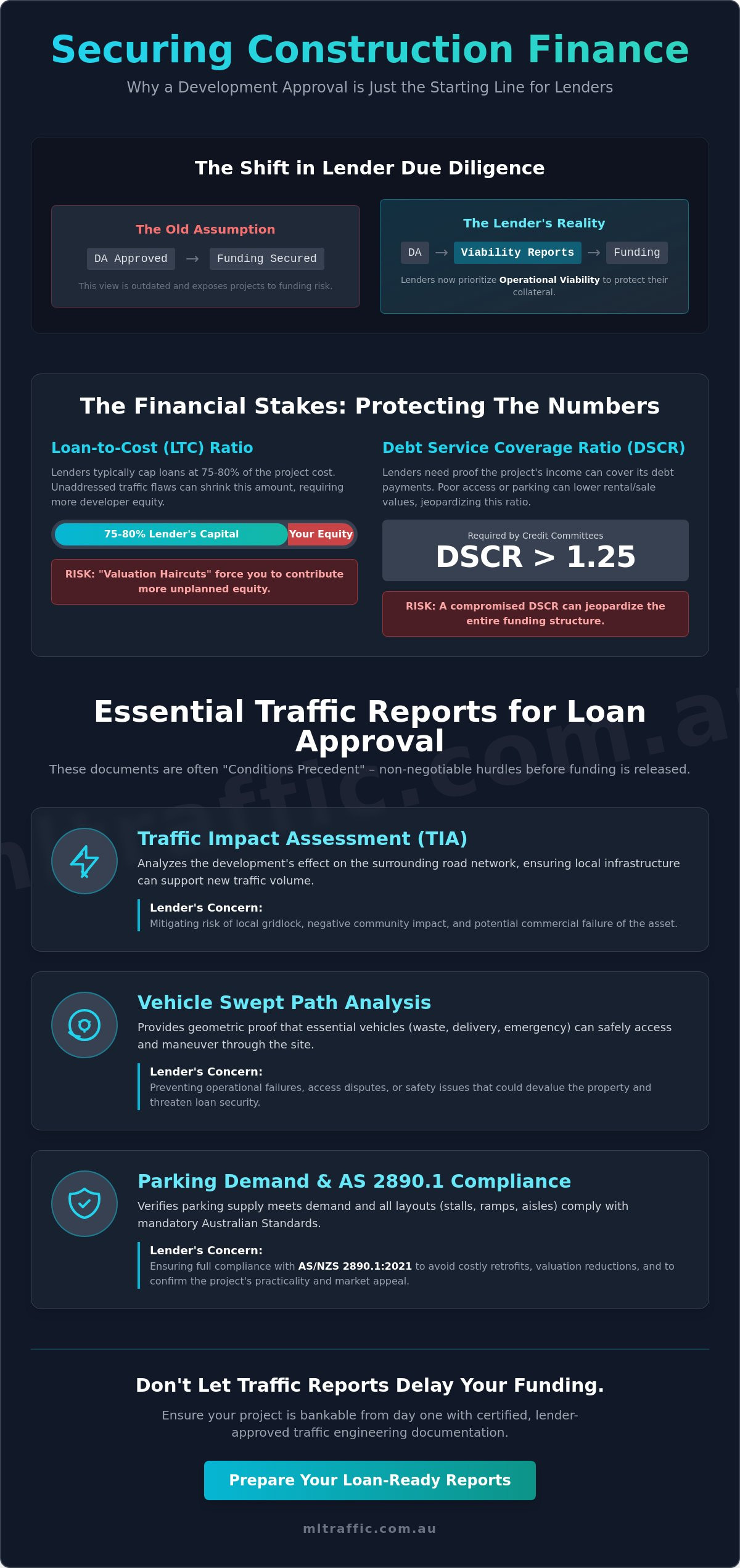
A Development Approval is no longer the final hurdle for securing project finance; it’s merely the starting point for rigorous lender due diligence. In early 2026, banks and private lenders are prioritizing operational viability over simple permits to protect their collateral. Understanding the specific traffic report requirements for construction loans is essential for developers who need to satisfy credit committees and avoid funding delays. Lenders often cap loan-to-cost ratios at 75 to 80 percent. Any ambiguity regarding site access or parking compliance can lead to a lower valuation or an outright rejection of the facility.
You likely recognize that clearing the DA stage doesn’t automatically mean your project is bankable in the eyes of a risk assessor. This article provides a comprehensive checklist of the technical traffic engineering reports and compliance standards, such as AS/NZS 2890.1:2021, required to secure construction funding in Australia. We will detail how specific assessments, from vehicle swept path analysis to parking demand, impact your risk profile and what you must provide to ensure a faster loan settlement.
Key Takeaways
- Understand how lenders utilize Traffic Impact Assessments to mitigate financial risk and confirm project feasibility.
- Identify the specific traffic report requirements for construction loans to ensure your documentation meets the rigorous standards of bank credit committees.
- Recognize the importance of Vehicle Swept Path Analysis in proving operational access for heavy vehicles and avoiding funding delays.
- Learn how compliance with AS 2890.1 for off-street parking prevents valuation adjustments that could reduce your total loan facility.
- Access a structured checklist for preparing loan-ready technical reports that satisfy both municipal authorities and financial institutions.
Why Lenders Require Traffic Reports for Construction Loans
Lenders view technical documentation as a safeguard for their capital. While a Development Approval (DA) confirms that a local council permits the project, it doesn’t always satisfy a bank’s internal risk committee. Financial institutions use traffic reports to verify that a development is operationally viable and won’t face access issues that could devalue the asset. Specific traffic engineering data ensures the proposed density is sustainable within the existing road network. Failure to meet the traffic report requirements for construction loans can lead to “valuation haircuts.” This occurs when the lender reduces the loan amount because the project’s parking or access constraints limit its market appeal or violate AS/NZS 2890.1:2021 standards.
To better understand how construction financing works and why these reports matter, watch this helpful video:
Risk Mitigation and Project Viability
A Traffic Impact Assessment (TIA) proves the site can handle the intended traffic volume without failing. Lenders prioritize this because a project that causes local gridlock or lacks sufficient parking faces a higher risk of commercial failure. We ensure that waste collection and delivery vehicles can navigate the site safely post-construction through detailed analysis. This prevents future litigation or access disputes with neighbors or local authorities that could threaten the security of the loan. Meticulous planning at the outset protects the developer’s equity and the lender’s interest. With loan-to-cost (LTC) ratios typically capped at 75 to 80 percent, any perceived risk in site functionality can force a developer to contribute more equity than planned.
Conditions Precedent (CPs) for Construction Funding
Loan offer documents often include specific “Conditions Precedent” that must be met before the first drawdown. These CPs frequently mandate the submission of certified traffic engineering reports. Lenders require these documents to confirm that the final construction drawings comply with all regulatory standards. The timeline for these submissions is strict; missing a technical certification can delay funding for weeks. Our Traffic Engineering services provide the precise documentation needed to clear these hurdles. By addressing the traffic report requirements for construction loans early, developers maintain their project timeline and avoid the costs associated with delayed settlements. Lenders also look for a debt service coverage ratio (DSCR) above 1.25. If poor traffic design impacts the rental yield or sale price of the units, this ratio is compromised, jeopardizing the entire funding structure.
Essential Traffic Engineering Reports for Loan Approval
Lenders require technical proof of site functionality before they release the first drawdown of a facility. While many developers focus on progress payment stages like slab or frame, the traffic report requirements for construction loans must be satisfied during the pre-construction phase. Banks and private financiers look for specific documents that prove the project is operationally sound and compliant with national standards. Without these reports, a project’s risk profile increases, often leading to unfavorable loan terms or reduced capital availability.
The documentation suite typically includes four primary technical assessments. Each serves a specific purpose in the lender’s risk mitigation strategy. These reports don’t just satisfy council requirements; they provide the bank’s credit committee with the assurance that the asset’s value won’t be compromised by access or parking failures.
Traffic Impact Assessments (TIA)
The TIA is the primary document for lender review. It analyzes the effect of the development on the surrounding road network and ensures the local infrastructure can support the new traffic volume. Lenders look for standardized components, including trip generation rates and intersection analysis, to confirm the project is viable. We follow methodologies similar to those found in Purdue University’s Guide to Traffic Impact Analysis to ensure every report is technically robust. For a detailed breakdown of what these reports contain, you can review our Traffic Impact Assessment Guide for Australian developers.
Swept Path Analysis and Access
Physical access is a critical risk factor that financiers scrutinize heavily. We use AutoTURN software to demonstrate vehicle maneuverability across the site. Lenders require documented proof that service vehicles, such as garbage trucks and fire appliances, can enter and exit the property in a forward direction. This is a non-negotiable safety and operational requirement. Compliance with AS 2890.2 for commercial loading docks is also essential. If a heavy vehicle cannot safely navigate the site, the project may face future litigation or operational bottlenecks. This directly impacts the long-term value of the lender’s collateral.
Beyond access, a Car Parking Demand Assessment is often required if the proposed parking numbers differ from statutory requirements. Validating these numbers against actual usage data prevents “valuation haircuts” where a lender reduces the loan amount due to perceived parking shortages. Finally, a Construction Traffic Management Plan (CTMP) manages risk during the build phase itself. This ensures that the construction process doesn’t create liabilities that could halt the project. Securing a professional Traffic Impact Assessment early in the process is the most effective way to satisfy your lender’s technical requirements and move toward financial close.
Compliance Standards: AS 2890 and Parking Demand
Lenders prioritize assets that meet national safety and accessibility standards to protect their long-term investment. In the Australian development sector, this means strict adherence to the AS 2890 suite is a core component of the traffic report requirements for construction loans. While a local council might grant a permit based on planning merit, a lender’s technical auditor will verify that the car park design is physically functional. If a parking facility is difficult to navigate or fails to meet bay dimension standards, the property’s marketability drops. This technical failure directly correlates to financial risk for the institution providing the capital.
AS 2890.1: Residential and Commercial Parking
AS/NZS 2890.1:2021 governs the design and layout of off-street parking facilities. It sets mandatory requirements for aisle widths, circulation roadways, and parking bay dimensions. We certify these elements to ensure the layout is physically viable for the intended user class. Lenders fear non-compliant parking layouts because they introduce significant legal risk and potential liability for accidents. A certified Guide to AS 2890.1 Compliance helps developers understand these technical hurdles before they reach the credit committee. Additionally, projects must satisfy AS 2890.6:2022 for accessible parking spaces. Failure to provide compliant disabled parking can halt a project’s final certification, preventing the lender from exiting the loan through a sale or refinance.
Parking Demand vs. Council Requirements
A common friction point in construction financing is the gap between council mandates and market expectations. Local authorities often push for reduced parking numbers to encourage public transport use. However, lenders focus on the end-user’s needs. If a high-end residential project lacks sufficient parking for its demographic, the lender may apply a “valuation hair-cut.” This reduces the total loan amount regardless of the project’s paper value.
A Car Parking Demand Assessment bridges this gap by providing empirical data to justify specific parking ratios. We analyze actual usage patterns and local demographics to prove that the proposed parking is adequate for the site’s density. This assessment allows developers to balance high construction costs with the lender’s demand for a marketable asset. By addressing these traffic report requirements for construction loans early, you provide the bank with the technical assurance they need to approve the full facility amount. Our senior engineers certify these designs, ensuring that the same expert who assesses the demand also validates the physical car park design.
Checklist: Preparing Your Traffic Documentation for Funding
Lenders require a specific technical dossier before they approve the first drawdown of a facility. Standard identity and income checks are insufficient for professional developers. You must demonstrate that the physical site is operationally sound and compliant with all regulatory mandates. Meeting the traffic report requirements for construction loans involves coordinating several specialized assessments to ensure the lender’s collateral is protected. Use the following checklist to prepare your documentation for credit committee review.
- Step 1: Obtain a certified Traffic Impact Assessment (TIA). This report must verify that the local road network can support the project’s trip generation without compromising safety or infrastructure capacity.
- Step 2: Complete Vehicle Swept Path Analysis. You must provide technical drawings proving that waste collection vehicles, delivery trucks, and emergency appliances can navigate the site in a forward direction.
- Step 3: Verify Driveway Ramp Grade Assessment. All vertical transitions must comply with AS/NZS 2890.1:2021 to prevent vehicle scraping and ensure safe access for all user classes.
- Step 4: Prepare a Construction Traffic Management Plan (CTMP). This document outlines how you will manage site access, loading zones, and pedestrian safety during the build phase.
- Step 5: Secure a certification letter from a qualified Traffic Engineer. A formal statement of compliance from a senior principal is often the final requirement to trigger loan settlement.
Pre-Funding Technical Requirements
Review your Development Approval (DA) for any “Deferred Commencement” items or traffic-related conditions. Lenders prioritize these clauses because they can halt construction if left unaddressed. Ensure all technical reports are signed by a qualified senior principal to provide the necessary level of accountability. Most Australian lenders require reports to be dated within 6 to 12 months. If your assessments are older, you may need an update or a letter of reliance to confirm the data remains relevant to current traffic conditions. This attention to detail prevents administrative delays during the final stages of the loan application.
Managing the Construction Phase
A robust traffic strategy reduces site liability and can positively influence insurance premiums. You will likely require a Traffic Guidance Scheme (TGS) to obtain road occupancy permits for heavy machinery or material deliveries. These schemes provide the specific signage and lane management layouts used by on-site teams. Integrating these requirements into a comprehensive Construction Management Plan ensures the project remains compliant with state regulations throughout the build. If you need to finalize your technical dossier, contact our senior principals to discuss your specific lender requirements.
Navigating Loan Requirements with ML Traffic Engineers Australia
Successfully meeting the traffic report requirements for construction loans requires a consultancy that understands the intersection of civil engineering and project finance. ML Traffic Engineers Australia provides the technical precision and regulatory expertise necessary to satisfy bank credit committees and private lenders. We have over 15 years of experience assisting developers in navigating these requirements across every Australian state and territory. Our reports are engineered to be loan-ready, addressing the specific risk mitigation concerns that financiers prioritize during their due diligence process. We maintain a proven track record of securing both Council approvals and lender sign-offs for projects of all scales.
The ML Traffic Engineers Australia Advantage for Developers
Timing is a critical factor when managing funding deadlines and settlement dates. Our firm prioritizes fast turnaround times to ensure your technical documentation doesn’t become a bottleneck for your capital drawdowns. A core pillar of our service is the personnel continuity promise. The senior expert who initiates your project and reviews your lender’s specific conditions will be the same professional performing the technical analysis and signing the final certification. This approach eliminates the communication gaps often found in larger firms and ensures total accountability for the technical data provided to your financier.
Our practical experience is exhaustive. We’ve successfully delivered technical reports for a vast range of project environments, including multi-unit residential flat buildings, commercial office towers, industrial warehouse estates, retail shopping centers, childcare facilities, medical clinics, service stations, fast-food outlets, tourist developments, and complex mixed-use urban infill projects. This extensive history across diverse land-use categories ensures that we understand the specific traffic report requirements for construction loans relevant to your particular sector. We apply this deep-seated expertise to every assessment, from driveway ramp grade certifications to complex intersection analysis.
Get Your Project Funded
Securing a lender-compliant traffic report begins with a direct consultation with our leadership. We provide direct access to our senior principals, allowing you to resolve urgent lender queries or technical challenges without navigating layers of junior staff. This direct line of communication is essential when a credit committee requires immediate clarification on swept path analysis or parking demand justifications to finalize a valuation. We focus on providing the facts and certifications required to prove operational viability and secure your funding.
To request a quote, provide our team with your current site plans and any specific traffic-related conditions listed in your loan offer or DA. We’ll review these documents and provide a clear proposal for the necessary technical assessments. Whether you require a Traffic Impact Assessment (TIA), Vehicle Swept Path Analysis, or a certified Car Park Design, we ensure the output meets the highest professional standards. Contact ML Traffic Engineers Australia to discuss your construction loan requirements and ensure your technical dossier is ready for financial close.
Secure Your Project Funding with Technical Precision
Satisfying the traffic report requirements for construction loans is a critical step in de-risking your development for financial institutions. Providing certified documentation that adheres to AS/NZS 2890.1:2021 and proves physical access via swept path analysis protects your project’s valuation. These technical assessments ensure the site is operationally viable; this directly influences the lender’s credit committee decisions and prevents settlement delays.
ML Traffic Engineers offers over 15 years of industry experience and national Australian compliance expertise. Our firm provides direct senior principal involvement to ensure every report meets the most rigorous lender standards. This hands-on approach guarantees that your technical dossier is accurate and delivered to meet tight settlement deadlines. We prioritize accountability and technical excellence to help you clear every funding hurdle.
Request a Lender-Compliant Traffic Report Today to secure your project’s funding and move toward construction. We’re ready to provide the technical certainty your financier demands.
Frequently Asked Questions
Do I need a new traffic report for my loan if I already have DA approval?
Lenders typically require technical reports to be dated within 6 to 12 months to ensure the data remains relevant to current road conditions. Even if you have DA approval, a bank’s credit committee may request a letter of reliance or an updated assessment if the original study is aged. This ensures the technical data accurately reflects the project’s risk profile at the time of funding.
What is the difference between a TIA and a Swept Path Analysis?
A Traffic Impact Assessment (TIA) evaluates the development’s effect on the external road network and surrounding infrastructure capacity. In contrast, a Vehicle Swept Path Analysis focuses on internal maneuvering. It uses software like AutoTURN to prove that specific vehicles, such as garbage trucks or fire appliances, can physically navigate the site without conflict.
How long does it take to prepare a traffic report for a lender?
Preparation times generally range from one to three weeks depending on the project’s complexity and the specific data required. Urgent lender queries or tight settlement deadlines often necessitate faster turnaround times. Providing complete site plans and existing DA conditions during the initial consultation helps expedite the engineering process.
Will a bank accept a traffic report from any engineer?
Banks and private lenders require reports from qualified traffic engineers with appropriate professional indemnity insurance and a proven track record. They prioritize firms with specific experience in the Australian regulatory environment. Using a seasoned expert ensures the documentation satisfies the traffic report requirements for construction loans without triggering additional technical audits.
Does AS 2890 compliance affect my construction loan approval?
Compliance with AS/NZS 2890.1:2021 is a core technical requirement for loan approval. If a car park design fails to meet these national standards, lenders may view the asset as a liability due to potential safety risks or reduced marketability. Technical certification of aisle widths and bay dimensions is essential for satisfying the bank’s risk committee.
What happens if my traffic report identifies access issues?
Access issues identified in a report must be addressed through design modifications or mitigation strategies before funding is released. Lenders won’t settle on a facility if a project has fundamental operational flaws, such as inadequate heavy vehicle turnarounds. Identifying these issues early allows for design adjustments that protect the project’s financial viability.
Can a traffic report help increase my project’s valuation?
A comprehensive traffic report can prevent “valuation haircuts” by proving the site meets high-demand parking and access requirements. By demonstrating that the project justifies parking numbers via a Demand Assessment, you provide the valuer with the technical assurance needed to support a higher asset price. This directly impacts the total capital you can secure.
Are construction traffic management plans required before the first draw-down?
Construction Traffic Management Plans (CTMP) are frequently listed as a Condition Precedent in loan offer documents. Lenders require these plans to ensure the build phase doesn’t create unmanaged liabilities or access disputes. Fulfilling the traffic report requirements for construction loans includes detailing how site safety and road occupancy will be managed from the first day of construction.

Disclaimer
The content on www.mltraffic.com.au, including all technical articles, guides, and resources, is provided for general informational and educational purposes only. It is not intended to constitute professional advice in traffic engineering, transportation planning, development approvals, or any other technical or legal field.
While ML Traffic Engineers makes every reasonable effort to ensure the accuracy, completeness, and timeliness of the information published, we do not provide any warranties or representations (express or implied) regarding its reliability, suitability, or availability for any particular purpose. Any reliance you place on the content is strictly at your own risk.
In no event shall ML Traffic Engineers, its directors, employees, authors, or affiliates be liable for any direct, indirect, incidental, special, consequential, or punitive damages (including, without limitation, loss of profits, data, or business opportunities) arising out of or in connection with the use of, or inability to use, any information provided on this website.
The articles and guides on this site are not a substitute for engaging a qualified, registered professional traffic engineer (such as an NPER or RPEQ engineer) to assess your specific project requirements. For tailored advice, compliance assessments, or traffic engineering services, please contact a competent professional.
This disclaimer may be updated from time to time without notice. By accessing or using this website, you agree to be bound by the most current version of this disclaimer.
