
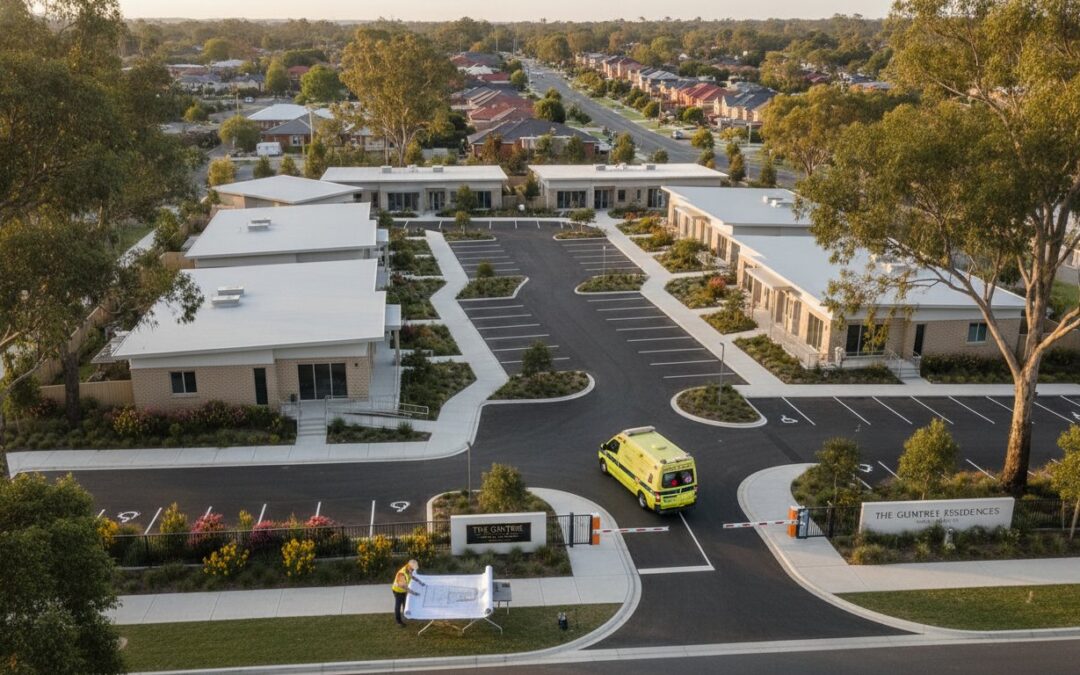
A retirement village is often unfairly judged by its scale rather than its actual impact on the local road network. While neighbours and Councils frequently fear a surge in local congestion, the reality is that these developments typically generate significantly fewer vehicle trips than standard residential dwellings. Securing a successful Development Application (DA) requires more than just general assumptions; it demands a technical traffic report for seniors living and retirement villages that proves this lower impact through verified data and professional analysis.
You’re likely facing the challenge of balancing efficient car park design with strict requirements for emergency vehicle access and community expectations. We know that navigating these technicalities is the difference between a project that stalls and one that proceeds to construction. This guide explains how specialised assessments balance lower trip generation rates with the rigorous safety standards mandated by Australian Standards. We’ll examine the role of swept path analysis, parking demand assessments, and intersection modelling in achieving a seamless approval process.
Key Takeaways
- Understand why a specialised traffic report for seniors living and retirement villages is essential to address Council concerns regarding local traffic impact and site access.
- Learn how to leverage lower peak-hour trip generation rates to justify infrastructure requirements while accurately meeting resident and visitor parking demand.
- Ensure your development complies with mandatory Australian Standards, including AS 2890.1 and AS 2890.6, to provide safe and accessible parking facilities.
- Discover how vehicle swept path analysis models critical ambulance and service vehicle access to ensure every unit entrance is reachable in an emergency.
- Identify how direct access to senior traffic engineers streamlines the DA process by providing technical accountability and expert oversight from the outset.
The Role of a Traffic Report for Seniors Living Developments
A Traffic Impact Assessment (TIA) for retirement villages is a technical document that quantifies the vehicle movements generated by a proposed development. Unlike standard residential projects, these developments require a nuanced approach that accounts for the specific demographic of the occupants. A professional traffic report for seniors living and retirement villages provides the evidence base needed to justify parking reductions and trip rate assumptions. It acts as a bridge between the developer’s vision and the Council’s regulatory requirements.
Councils often view new developments through the lens of potential congestion. A specialised report addresses these concerns by providing empirical data on how seniors actually use the road network. Residents in these communities typically avoid peak-hour travel, meaning their impact on local traffic flow is minimal during the most critical times of day. Engaging a traffic engineer during the initial site planning phase prevents costly redesigns. It ensures that driveway locations, internal roads, and parking layouts are optimised before the DA is submitted.
Securing Council Approval for Retirement Villages
Most Council assessments rely on a Statement of Environmental Effects (SEE). Without a robust traffic report, the SEE lacks the technical weight to overcome community objections regarding road safety and parking. When a project reaches a local planning panel, the traffic consultant’s findings become expert evidence. We focus on the low-impact nature of seniors housing, demonstrating that these developments generate fewer trips per unit than standard townhouses or apartments. This data-driven approach is essential for securing approval in established residential areas where neighbours are sensitive to increased vehicle activity.
The Expertise of a Traffic Consultant
General civil engineering firms often lack the specialised modelling tools required for complex traffic assessments. Professional traffic engineer services provide the technical depth needed to navigate state-specific guidelines and Australian Standards. At ML Traffic Engineers, our principals work directly on every project, ensuring that the traffic report for seniors living and retirement villages reflects over 15 years of industry experience. We understand the specific trip generation rates used by state authorities and how to apply them to your specific site context. This ensures your project isn’t penalised by outdated or overly conservative traffic estimates. Our “no-gatekeepers” approach means the expert who starts your project is the one who completes the technical work, providing continuity and accountability through the entire DA process.
Trip Generation and Parking Demand in Retirement Communities
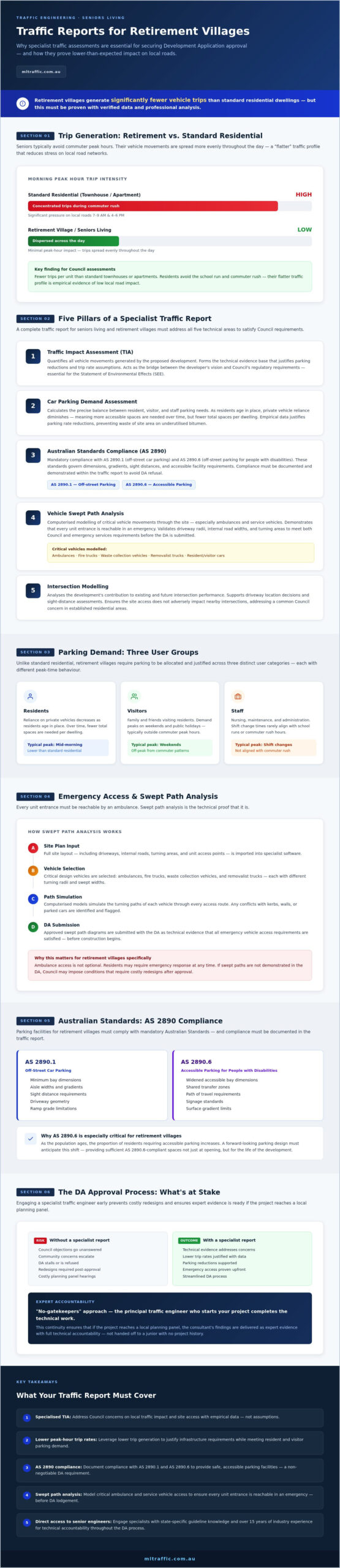
Standard residential developments create significant pressure on the road network during the morning and afternoon peaks. A traffic report for seniors living and retirement villages highlights that these communities operate differently. Data from state transport authorities confirms that seniors typically undertake fewer trips during commuter peak hours. Instead, their vehicle movements are distributed more evenly throughout the day. This flatter traffic profile is a critical piece of evidence when negotiating with Council planners who may be concerned about local road capacity.
Calculating parking demand requires a precise balance between resident, visitor, and staff requirements. As residents age in place, their reliance on private vehicles often diminishes. This transition means that a development may require more accessible parking over time but fewer total spaces per dwelling. If you’re looking to optimise your site layout while maintaining compliance, our team can provide a detailed Car Parking Demand Assessment to support your DA. We use empirical data to justify a reduction in standard parking rates, preventing the waste of valuable site area on underutilised bitumen.
Peak Hour vs. Off-Peak Traffic Patterns
Retirement communities don’t follow the traditional tidal flow of suburban traffic. While staff shift changes for nursing or maintenance personnel do occur, these movements rarely align with the local school run or commuter rush. This lack of peak-hour intensity is a core component of modern traffic engineering for the seniors living sector. By modelling these specific patterns, we can demonstrate that the development’s impact on intersection performance is often negligible. We focus on the actual operational hours of the facility to provide a realistic picture of vehicle activity.
Optimising Parking Layouts for Older Residents
Designers must prioritise functionality and accessibility over sheer volume. Visitor parking is particularly important in this sector, as social connection is a key feature of retirement living. However, these spaces must be strategically located to ensure they don’t interfere with internal vehicle circulation or emergency access. Compliance with local government parking codes is non-negotiable, but a well-researched traffic report for seniors living and retirement villages provides the flexibility to adjust ratios where the data supports it. We ensure that every car park design meets the specific physical needs of older drivers, including wider bays and flatter gradients that exceed basic regulatory requirements.
Ensuring Compliance with Australian Standards (AS 2890)
Adherence to national regulatory frameworks is the foundation of any successful development application. For projects in the aged care and retirement sector, a traffic report for seniors living and retirement villages must demonstrate strict compliance with the AS 2890 series. These standards dictate the physical geometry of the site, ensuring that parking areas and access ways are safe for all users. Failure to meet these technical requirements often results in Council refusal or expensive, late-stage redesigns that can jeopardise project timelines.
While AS 2890.1 (Off-street car parking) provides the general requirements for parking facilities, AS 2890.6 (Parking facilities for people with disabilities) is non-negotiable for seniors living. These developments require a higher proportion of accessible spaces with specific shared zones and vertical clearances. Our approach involves integrating these requirements into the initial Car Park Design to ensure the site functions efficiently from day one. We focus on the practicalities of the physical environment, such as ensuring gradients are manageable for residents with limited mobility.
AS 2890.1: Parking Space and Aisle Dimensions
Seniors housing requires a more generous approach to spatial design than standard high-density residential blocks. Achieving AS 2890.1 compliance involves more than just meeting minimum bay sizes; it requires an understanding of the “User Class” and the associated manoeuvring requirements. We often recommend wider parking bays and aisles to accommodate the larger door opening circles required by older drivers. Additionally, a detailed Driveway Ramp Grade Assessment is essential to prevent vehicle scraping, particularly where basement parking is utilised on sloping sites.
Pedestrian Safety and Accessibility
Safety within a retirement village extends beyond the vehicle. A professional traffic report for seniors living and retirement villages must evaluate the interaction between cars and pedestrians. We conduct rigorous Sight Distance Assessments at all internal intersections and driveway exits to ensure drivers have a clear line of sight to residents walking through the site. Safe walking paths must be clearly delineated, well-lit, and logically connected to unit entrances. Effective wayfinding and clear signage reduce driver confusion and lower the risk of low-speed collisions within the facility.
Emergency Access and Swept Path Analysis
A swept path analysis is the most critical technical component of a traffic report for seniors living and retirement villages. It provides a computer-simulated model of vehicle movements to ensure the physical layout of a site can accommodate the vehicles required for its operation. In the retirement sector, this goes beyond simple car movements. We must prove that emergency services and heavy service vehicles can navigate the site safely and efficiently without risk of collision or property damage.
Using industry-standard AutoTURN software, we model the specific turning envelopes of vehicles like ambulances, fire trucks, and waste collection vehicles. This verification is essential because retirement village layouts often feature narrower internal roads or complex courtyard designs to create a more residential feel. Without precise modelling, these design choices can inadvertently block life-saving access. Council planners will not grant approval until they see definitive proof that emergency vehicles can reach every part of the development.
Ambulance and Fire Brigade Requirements
Emergency vehicle access is a mandatory safety requirement that Councils scrutinise with high intensity. We model the swept paths for the largest ambulances used by state health services to ensure they can reach every individual unit entrance. This includes verifying that the vehicle can turn around at the end of a cul-de-sac or navigate a “through-access” route without reversing long distances. Vertical clearance is another critical factor; we check that every basement entry or covered drop-off point provides sufficient height for a fire truck or high-roof ambulance. Our reports provide the exact turning radii and clearance data needed to satisfy these safety benchmarks.
Waste Management and Service Vehicles
Efficient waste collection is an operational necessity that must be balanced with resident safety. We model the swept paths for Heavy Rigid Vehicles (HRV) to ensure garbage trucks can enter and exit the site in a forward direction. This often involves designing dedicated loading zones or turning heads that are separate from resident parking areas. By integrating these requirements into the initial car park design, we prevent the common issue of service vehicles mounting kerbs or blocking internal traffic flow. We also prepare a detailed Waste Management Plan to support your DA, ensuring all service vehicle movements are documented and compliant.
Ensuring your development meets these rigorous standards is vital for a successful DA. If you require technical verification for your site layout, contact ML Traffic Engineers for a professional Vehicle Swept Path Analysis. We provide the technical evidence Council requires to prove your site is safe and accessible for all essential services.
Securing Your DA: The ML Traffic Engineers Approach
A successful development application hinges on the quality of the technical evidence provided. ML Traffic Engineers has over 15 years of experience delivering specialised assessments specifically for the aged care and retirement sector. We understand that a traffic report for seniors living and retirement villages must be technically sound, meticulously researched, and defensible at a planning panel. Our national reach allows us to support developers across every Australian state, ensuring your project complies with both state-based trip generation guidelines and local Council requirements.
A comprehensive Traffic Impact Assessment is a strategic tool for any developer. It identifies potential access issues or parking shortfalls during the design phase, allowing for adjustments before they become costly roadblocks. By providing empirical data that proves the low-impact nature of seniors housing, we help our clients negotiate parking reductions and infrastructure contributions. This data-driven approach often increases the developable area of a site, providing a direct commercial benefit while maintaining high safety standards.
Personnel Continuity and Accountability
Our “no-gatekeepers” philosophy is a core part of our professional identity. This approach ensures you have direct access to the senior principals who are actually performing the technical work. Unlike larger, impersonal firms where projects are often delegated to junior staff, we promise personnel continuity from start to finish. The expert who initiates the relationship and understands your project goals is the same person who conducts the swept path analysis and writes the final report. This structure provides a high level of accountability and ensures that technical questions from Council officers receive immediate, expert answers.
Next Steps for Your Development
Engaging our team early in the planning process provides the best results for your site layout. To provide an accurate quote for your traffic report for seniors living and retirement villages, we generally require the following information:
- A current site plan or proposed architectural layout.
- The total number of independent living units (ILU), serviced apartments, or beds.
- Details of communal facilities, such as clubhouses or medical consulting rooms.
- Staffing levels and expected shift times.
- The project location and specific Council jurisdiction.
We’re ready to provide the technical expertise needed to secure your DA. Contact us today via our contact page to discuss your project requirements. We’ll provide a clear, results-oriented proposal that ensures your development is supported by deep-seated expertise and reliable traffic engineering data.
Advancing Your Seniors Living Development
Securing approval for retirement living projects requires a precise balance of technical compliance and operational efficiency. We have explored how accurate trip generation data justifies parking reductions and how swept path analysis ensures critical emergency vehicle access. Adhering to the AS 2890 series remains the non-negotiable foundation for safe, accessible site design. A professional traffic report for seniors living and retirement villages acts as the essential evidence base to overcome Council objections and community concerns.
ML Traffic Engineers brings over 15 years of Australian engineering expertise to your project. We offer national service coverage and ensure direct principal involvement in every report we produce. This “no-gatekeepers” approach provides the technical accountability necessary for a successful DA. Contact our senior engineers for a Traffic Report quote to begin your assessment. Our team is ready to provide the meticulous, results-oriented data your development requires to move forward with confidence.
Frequently Asked Questions
Why is a traffic report different for a retirement village compared to a normal apartment block?
Retirement villages generate a different traffic profile because residents typically avoid travelling during morning and afternoon peak hours. A traffic report for seniors living and retirement villages focuses on these off-peak movements and the specific operational requirements of the facility. Unlike standard apartments, these reports prioritise ambulance access and visitor parking demand over high-volume commuter flow.
Does a seniors living development require more or less parking than standard residential?
Seniors living developments generally require less resident parking than standard residential units due to lower car ownership rates among older demographics. However, they often necessitate a higher proportion of accessible spaces and visitor parking. We use empirical data to justify a lower overall parking rate to Council, ensuring the site layout is efficient without compromising accessibility.
What is a swept path analysis, and why do I need it for an ambulance?
Swept path analysis uses computer modelling to verify that specific vehicles can navigate the internal road network without hitting obstacles. In a retirement setting, this is mandatory to prove that an ambulance can reach every unit entrance and turn around safely. It ensures that narrow driveways or tight corners don’t impede emergency services during a critical response.
What Australian Standards must a retirement village car park comply with?
Retirement village car parks must comply with the AS 2890 series, specifically AS 2890.1 for off-street parking and AS 2890.6 for people with disabilities. These standards dictate bay dimensions, aisle widths, and gradients. Our reports verify that every aspect of the design meets these national requirements to avoid Council refusal and ensure resident safety.
Can a traffic report help reduce my developer contributions to Council?
A professional traffic report can help reduce developer contributions by proving the development has a lower impact on local road infrastructure than standard residential projects. Councils often calculate fees based on expected trip generation. By providing evidence of reduced peak-hour movements, we can negotiate a fairer contribution rate that reflects the actual burden on the network.
What happens if my site has limited street frontage for access?
Sites with limited street frontage require a detailed Sight Distance Assessment to ensure vehicles can enter and exit the property safely. We model driveway locations and internal circulation to maximise safety despite the restricted access. This often involves specific intersection analysis to ensure that merging traffic doesn’t create a hazard for existing road users.
How long does it take to prepare a Traffic Impact Assessment for a seniors living project?
The timeframe for a Traffic Impact Assessment typically depends on the complexity of the site and the availability of architectural plans. Most reports for seniors living projects are completed within two to four weeks. This allows for rigorous data collection, intersection modelling, and swept path verification to ensure the final document is ready for DA submission.
Will the traffic report address construction traffic as well as resident traffic?
A standard Traffic Impact Assessment focuses on operational traffic, but we can address construction traffic requirements if requested by Council. This may involve a separate Traffic Guidance Scheme to manage heavy vehicle movements during the building phase. Providing this information early helps demonstrate a comprehensive management plan for the entire project lifecycle.

Disclaimer
The content on www.mltraffic.com.au, including all technical articles, guides, and resources, is provided for general informational and educational purposes only. It is not intended to constitute professional advice in traffic engineering, transportation planning, development approvals, or any other technical or legal field.
While ML Traffic Engineers makes every reasonable effort to ensure the accuracy, completeness, and timeliness of the information published, we do not provide any warranties or representations (express or implied) regarding its reliability, suitability, or availability for any particular purpose. Any reliance you place on the content is strictly at your own risk.
In no event shall ML Traffic Engineers, its directors, employees, authors, or affiliates be liable for any direct, indirect, incidental, special, consequential, or punitive damages (including, without limitation, loss of profits, data, or business opportunities) arising out of or in connection with the use of, or inability to use, any information provided on this website.
The articles and guides on this site are not a substitute for engaging a qualified, registered professional traffic engineer (such as an NPER or RPEQ engineer) to assess your specific project requirements. For tailored advice, compliance assessments, or traffic engineering services, please contact a competent professional.
This disclaimer may be updated from time to time without notice. By accessing or using this website, you agree to be bound by the most current version of this disclaimer.
