

A generic traffic report template is often the fastest route to a Request for Information (RFI) that stalls your development for months. When weighing the choice of a traffic report template vs professional consultant, it’s easy to understand why the lower upfront cost of a DIY form is tempting for smaller projects. You want to minimize expenses and avoid the friction of complex bureaucracy. However, most downloadable templates are designed for simple traffic management at work sites, not the rigorous Traffic Impact Assessment (TIA) required for development approval.
Submitting documentation that fails to address the 2024 NSW Guide to Transport Impact Assessment or the latest 2026 Austroads standards puts your entire project at risk. This guide demonstrates why generic shells lead to Council rejection and how professional engineering expertise secures approval on your first attempt. We’ll examine the technical requirements of AS2890, the necessity of specialized software like SIDRA for intersection analysis, and the cost-effective documentation strategies that meet legal standards while minimizing your project risk.
Key Takeaways
- Understand why static templates fail to meet the mandatory technical requirements of Australian Standards AS2890.1 and AS2890.2.
- Evaluate how the decision between a traffic report template vs professional consultant affects your project timeline and the likelihood of receiving a Council Request for Information (RFI).
- Recognize the necessity of specialized software outputs, including Vehicle Swept Path Analysis and Intersection Analysis, for a compliant development application.
- Identify the significant liability risks and project delays caused by submitting reports that lack professional certification and appropriate insurance coverage.
- Learn how senior engineering oversight ensures that assessments for car parking demand and driveway grades satisfy regulatory authorities on the first attempt.
The Appeal of a Traffic Report Template: Cost-Saving vs. Regulatory Reality
A traffic report template is a pre-formatted document designed to provide a structural shell for Traffic Impact Assessment (TIA) data. Many developers seek these templates to reduce upfront consultancy costs, especially for minor Development Application (DA) submissions where the perceived impact is low. While these documents provide an organized layout, they often lead to a visual versus technical trap. A professional layout does not guarantee technical compliance. A report may look structured while failing to apply fundamental Traffic engineering principles to the specific site constraints.
In 2026, Council expectations have reached a peak of technical scrutiny. Planners no longer accept generic statements regarding traffic impact and parking demand. They require data-driven evidence that aligns with the February 2026 Austroads updates. The choice between a traffic report template vs professional consultant often determines whether a project proceeds or enters a costly cycle of Requests for Information (RFIs).
To better understand the difference between a generic shell and professional oversight, watch this video on consulting frameworks:
When a Template Seems Sufficient
There are limited scenarios where a basic template might serve as an initial starting point for internal review. These include:
- Minor change of use applications where the proposed activity generates negligible traffic increases compared to the previous use.
- Preliminary internal feasibility studies conducted before a formal submission to determine if a site is viable.
- Projects where no physical changes to property access, driveway ramps, or existing parking configurations are proposed.
Even in these cases, the template only provides the structure. The user remains responsible for the accuracy of the technical data. Most Council planners will still require a certified report to finalize the approval.
The Reality of Council Planning Schemes
Australian planning schemes are increasingly specific about who can author a TIA. Most jurisdictions require a qualified professional, typically a chartered transport engineer, to sign off on technical documentation. A generic template cannot replicate the professional judgment required for a Statement of Environmental Effects. It lacks the nuance needed for complex site assessments.
Templates fail to address site-specific geographic constraints such as:
- Existing sight distance obstructions that require a specialized assessment.
- Complex intersection geometries that demand SIDRA modeling.
- Specific driveway ramp grades that must comply with AS 2890.1.
Relying on a traffic report template vs professional consultant often overlooks these critical regulatory triggers. Professional engineering ensures that the documentation accounts for every nuance of the local planning scheme. You can view our full range of technical traffic engineering services to see the depth of analysis required for modern DAs.
What a Generic Template Lacks: Technical Compliance and Standards
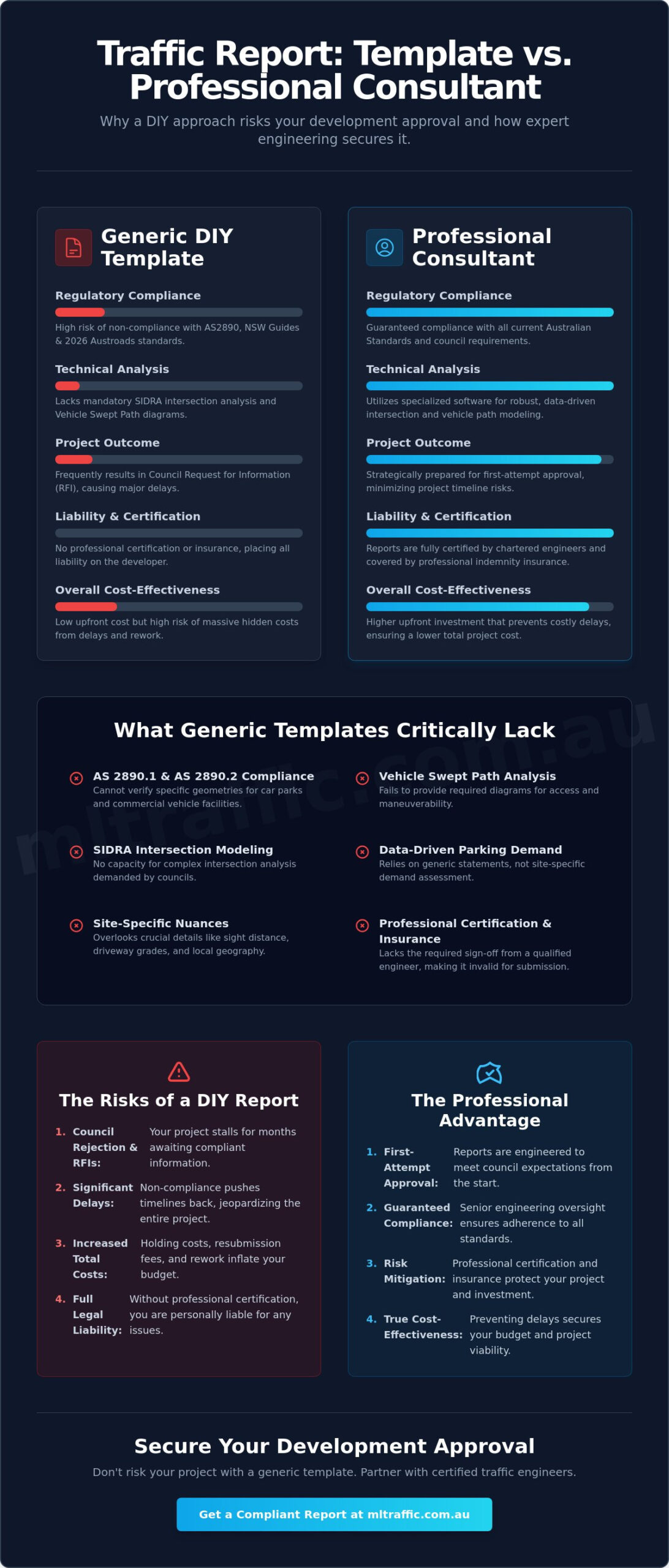
A standard document shell provides the headings for a report, but it cannot perform the engineering calculations required for Australian Standards compliance. When evaluating a traffic report template vs professional consultant, the primary deficiency lies in technical depth. Most templates lack the capacity to address the rigorous requirements of AS 2890.1 for off-street car parking and AS 2890.2 for commercial vehicle facilities. These standards dictate specific geometries that a static template simply cannot verify.
Council planners expect detailed data that aligns with the official government guide for traffic impact assessments. This includes data-driven Parking Demand Assessments tailored to specific land-use categories rather than generic estimates. Professional consultants use field measurements to conduct intersection analysis and sight distance assessments. These tasks require physical site inspections and technical expertise that a pre-formatted document doesn’t provide.
The Necessity of Swept Path Analysis
Static diagrams included in basic templates are insufficient to prove vehicle maneuverability on a constrained site. Council requirements often mandate a Swept Path Analysis using specialized software like AutoTURN. This analysis simulates the actual turning paths of specific design vehicles, such as the B99 car or a Heavy Rigid Vehicle (HRV). If your report doesn’t demonstrate that a waste collection vehicle or a delivery truck can enter and exit in a forward direction, your DA will likely be stalled. A consultant provides these dynamic simulations to ensure your driveway and loading areas function correctly in the real world.
AS 2890 Compliance: Beyond the Layout
Meeting national standards involves more than just drawing parking lines. It requires precise calculation of driveway ramp grades and transition zones to prevent vehicle scraping. Ensuring parking space dimensions and headroom clearances meet the AS 2890.1 standards is a legal necessity. A template won’t tell you if your structural columns interfere with the required door-opening clearances or if your aisle widths are sufficient for the classification of the car park. Professional oversight ensures every millimeter of your car park design is compliant, reducing the risk of costly redesigns after submission. For projects with complex site geometry, you can request a professional assessment to confirm your design meets these technical benchmarks.
Comparison Framework: Template vs. Professional Consultant
Choosing between a traffic report template vs professional consultant often comes down to a choice between immediate savings and long-term project viability. While a template allows for the rapid generation of a document shell, it provides zero protection against technical scrutiny. Speed of document creation is irrelevant if the speed of Council approval is compromised. A template is a static tool, whereas a consultant offers dynamic problem-solving for specific site constraints that generic shells cannot address.
Professional engineers operate under a strict Code of Ethics for Engineers, which ensures that safety and technical integrity are paramount. When you hire an expert, they assume professional liability for the data provided. An individual using a template assumes all personal liability without the backing of Professional Indemnity (PI) insurance. This distinction becomes critical if a Development Application (DA) is challenged in court, as a template provides no expert witness capability to defend the design.
The ‘Hidden’ Work of a Consultant
A professional does more than fill out forms; they perform the technical labor that happens behind the scenes. This includes liaising directly with Council traffic officers to identify and pre-empt potential objections before the formal submission. Consultants interpret complex local government traffic data and regional growth projections that aren’t included in public templates. By providing comprehensive Professional Traffic Engineering Services, a consultant adds technical weight to your application that planners recognize and respect. This proactive approach often prevents the standard cycle of project delays.
Decision Matrix for Developers
To determine the best path for your project, evaluate the following three factors:
- Scale of development: Single dwellings on standard lots may face lower scrutiny, but multi-unit complexes, childcare centers, or commercial developments always require professional certification.
- Site complexity: If your site involves narrow access points, steep driveway ramps, or existing traffic safety issues, a template will fail to provide the necessary engineering solutions.
- Timeline sensitivity: If your project financing or construction schedule cannot afford a six-week delay caused by a preventable Request for Information (RFI), a consultant is a mandatory investment.
The upfront cost of a consultant is a risk mitigation strategy. It transforms an uncertain submission into a compliant technical package, ensuring that your project moves through the planning phase without unnecessary friction.
The Risks of DIY Traffic Reports: RFIs and Liability
Choosing a traffic report template vs professional consultant often seems like a cost-saving measure until the first Council response arrives. Submitting a DIY report carries significant financial and legal risks that many developers overlook. The most immediate risk is the “Second Cost.” This occurs when a developer pays for a template or spends internal resources on a DIY submission, only to have it rejected. At that point, you must hire a professional consultant to rectify the errors and rebuild Council’s confidence. This doubling of effort and expense is a common outcome for non-certified reports.
Beyond the immediate financial loss, there are safety implications to consider. Self-certifying non-compliant access or parking layouts creates a permanent liability. If a driveway ramp grade is too steep or a sight distance is obstructed, the physical risk to users is real. A template cannot verify the safety of these elements; only a qualified engineer can ensure the design protects both the public and the developer.
Understanding Council RFIs
A Request for Information (RFI) is a formal pause in the development assessment process. In Australian jurisdictions, common triggers for traffic-related RFIs include:
- Insufficient data on existing traffic volumes or peak hour periods.
- Lack of technical compliance with AS 2890 dimensions and clearances.
- Failure to provide a dynamic vehicle swept path analysis for waste and delivery vehicles.
An RFI doesn’t just ask for more information; it stops the clock on your application. This delay increases your holding costs and pushes back your construction commencement date. Once a Council planner identifies fundamental technical flaws in a template-based report, they lose confidence in the entire submission. Patching a flawed report is often more difficult and time-consuming than starting from scratch with professional engineering oversight.
Liability and Professional Accountability
Liability is the most critical risk of self-certification. If a developer submits a report for non-compliant access or parking and an accident occurs on-site later, the legal responsibility falls on the person who certified the design. A generic template lacks Professional Indemnity (PI) insurance. Without this coverage, you’re personally exposed to litigation and damages. This is a major gap that DIY approaches cannot bridge.
A report signed by a certified Traffic Engineer provides a layer of legal protection. Professional consultants carry substantial PI insurance that covers their technical assessments and designs. At ML Traffic Engineers Australia, we emphasize direct access to senior principals. This ensures that a seasoned expert with decades of experience is personally accountable for your project’s technical integrity. We don’t use gatekeepers or junior staff for critical technical work, ensuring every report meets the highest professional standards.
If you’ve received a Council RFI or want to avoid the risks of a DIY submission, you can contact our senior engineers for a professional review of your project requirements.
Securing Approval with ML Traffic Engineers Australia
ML Traffic Engineers Australia brings over 15 years of experience to the development sector. We understand the specific technical requirements of Australian Councils across every state and territory. When you evaluate the choice of a traffic report template vs professional consultant, the primary difference is the depth of technical defense we provide. We deliver robust engineering solutions that withstand the scrutiny of planning officers. Our methodology focuses on minimizing Requests for Information (RFIs) to keep your project timeline on track.
Our comprehensive service suite addresses every phase of the planning process. We perform detailed Traffic Impact Assessment (TIA) Reports, Vehicle Swept Path Analysis, and Car Parking Demand Assessments. We also specialize in Driveway Ramp Grade Assessments, Sight Distance Assessments, and Intersection Analysis. This range of capability ensures that no technical detail is overlooked. We handle projects across all land-use categories, including residential, commercial, industrial, and childcare developments.
We maintain a “Senior Expert” promise. Your project is never delegated to junior staff or administrative assistants. Senior principals manage every technical assessment from initiation to completion. This hands-on approach ensures a high level of accountability and technical integrity. By choosing a traffic report template vs professional consultant, you’re choosing between a generic shell and the direct expertise of seasoned professionals who understand the nuances of current national standards.
Our National Approach to Traffic Engineering
We support developers across Australia with localized regulatory knowledge. Whether your project is a single dwelling or a large-scale industrial complex, we provide the technical certainty required for approval. Our team stays current with the latest state-specific guidelines, such as the 2024 NSW Guide to Transport Impact Assessment and the February 2026 Austroads updates. You can read more about our technical methodology in our Traffic Engineering Guide.
Next Steps for Your DA Submission
Securing a professional fee proposal is a straightforward process. To start your Traffic Impact Assessment, we typically require the site address, architectural plans, and a description of the proposed land use. Our team will review these details and provide a clear scope of work tailored to your project’s specific constraints. Contact our senior team today for a confidential project review to ensure your DA submission meets all regulatory standards on the first attempt.
Ensuring Technical Certainty for Your Development
A template provides a structural shell, but it cannot perform the engineering calculations required for Australian Standards. The comparison of a traffic report template vs professional consultant confirms that technical certainty is the only reliable path to Council approval. Professional oversight ensures your parking layouts comply with AS 2890 and successfully pass AutoTURN simulations. This proactive approach eliminates the common triggers for Requests for Information (RFIs) and protects you from the legal liabilities of self-certification.
ML Traffic Engineers offers 15+ years of Australian consultancy experience. We guarantee senior principal involvement on every project to maintain accountability and technical depth. Our specialists focus on achieving first-time approval through meticulous vehicle swept path analysis and data-driven car parking demand assessments. Don’t risk your project timeline on a generic document when you can access seasoned engineering expertise.
Protect your development from unnecessary delays and holding costs. Get a Professional Traffic Assessment for Your DA Approval. We’re ready to help you secure a successful outcome.
Frequently Asked Questions
Can I prepare my own traffic impact statement for a small development?
You can technically draft your own statement, but most Australian Councils mandate that a qualified professional prepares all technical documentation. Even small developments must adhere to rigorous AS 2890 standards for parking and access. A DIY report often lacks the necessary engineering calculations and professional certification, which typically leads to an immediate Request for Information (RFI) or total rejection of the application.
What are the most common reasons Councils reject DIY traffic reports?
Rejections frequently stem from a lack of adherence to mandatory Australian Standards, specifically AS 2890.1 and AS 2890.2. Other common triggers include missing vehicle swept path analysis and the absence of professional indemnity insurance. Councils prioritize public safety and technical liability; they rarely accept reports that don’t provide data-driven evidence of safe vehicle movements and compliant parking configurations.
Does a traffic report template include Swept Path Analysis?
No, a static template cannot provide a vehicle swept path analysis. This specific assessment requires specialized CAD-based software to simulate the actual turning movements of design vehicles on your site plan. When comparing a traffic report template vs professional consultant, the template’s inability to prove vehicle maneuverability is a critical technical gap that often results in stalled development approvals.
How much does a professional traffic consultant cost compared to a template?
Templates are often free or low-cost, while professional consultancy fees are determined by the specific complexity and scale of your project. The cost of hiring a consultant includes technical expertise, specialized software modeling, and the assumption of professional liability. Investing in an expert prevents the significantly higher costs associated with holding fees, project delays, and the need to rectify a rejected DIY submission.
Do I need a traffic engineer for a change of use application?
Most change of use applications require a traffic engineer to assess potential increases in parking demand and traffic generation. Even if you aren’t proposing physical changes to the building, Council must verify the existing infrastructure can accommodate the new operational load. A professional assessment ensures your proposal meets the specific requirements of the local planning scheme and current transport guidelines.
What software do professional traffic engineers use for reports?
Engineers utilize SIDRA Intersection for modeling traffic flow and capacity, alongside AutoTURN for vehicle swept path analysis. These industry-standard tools generate the precise, data-driven evidence that Councils demand for modern developments. This technical modeling is a primary differentiator in the traffic report template vs professional consultant debate, as generic templates offer no such analytical or predictive capability.
Is a traffic report mandatory for all Development Applications (DA)?
Mandatory requirements depend on the local government area and the scale of the proposed development. However, a formal Traffic Impact Assessment (TIA) is standard for most commercial, industrial, or multi-unit residential projects. Council planners use these reports to evaluate the impact on the surrounding road network and to ensure that the site design provides safe and efficient access for all users.
How long does it take for a professional consultant to prepare a TIA report?
Preparation times vary based on project complexity and whether the assessment requires physical traffic counts or intersection modeling. A standard report typically takes between one and two weeks to finalize. This timeframe includes the collection of site data, technical analysis, and the preparation of a compliant report that meets all regulatory standards for a successful Council submission.

Disclaimer
The content on www.mltraffic.com.au, including all technical articles, guides, and resources, is provided for general informational and educational purposes only. It is not intended to constitute professional advice in traffic engineering, transportation planning, development approvals, or any other technical or legal field.
While ML Traffic Engineers makes every reasonable effort to ensure the accuracy, completeness, and timeliness of the information published, we do not provide any warranties or representations (express or implied) regarding its reliability, suitability, or availability for any particular purpose. Any reliance you place on the content is strictly at your own risk.
In no event shall ML Traffic Engineers, its directors, employees, authors, or affiliates be liable for any direct, indirect, incidental, special, consequential, or punitive damages (including, without limitation, loss of profits, data, or business opportunities) arising out of or in connection with the use of, or inability to use, any information provided on this website.
The articles and guides on this site are not a substitute for engaging a qualified, registered professional traffic engineer (such as an NPER or RPEQ engineer) to assess your specific project requirements. For tailored advice, compliance assessments, or traffic engineering services, please contact a competent professional.
This disclaimer may be updated from time to time without notice. By accessing or using this website, you agree to be bound by the most current version of this disclaimer.
