

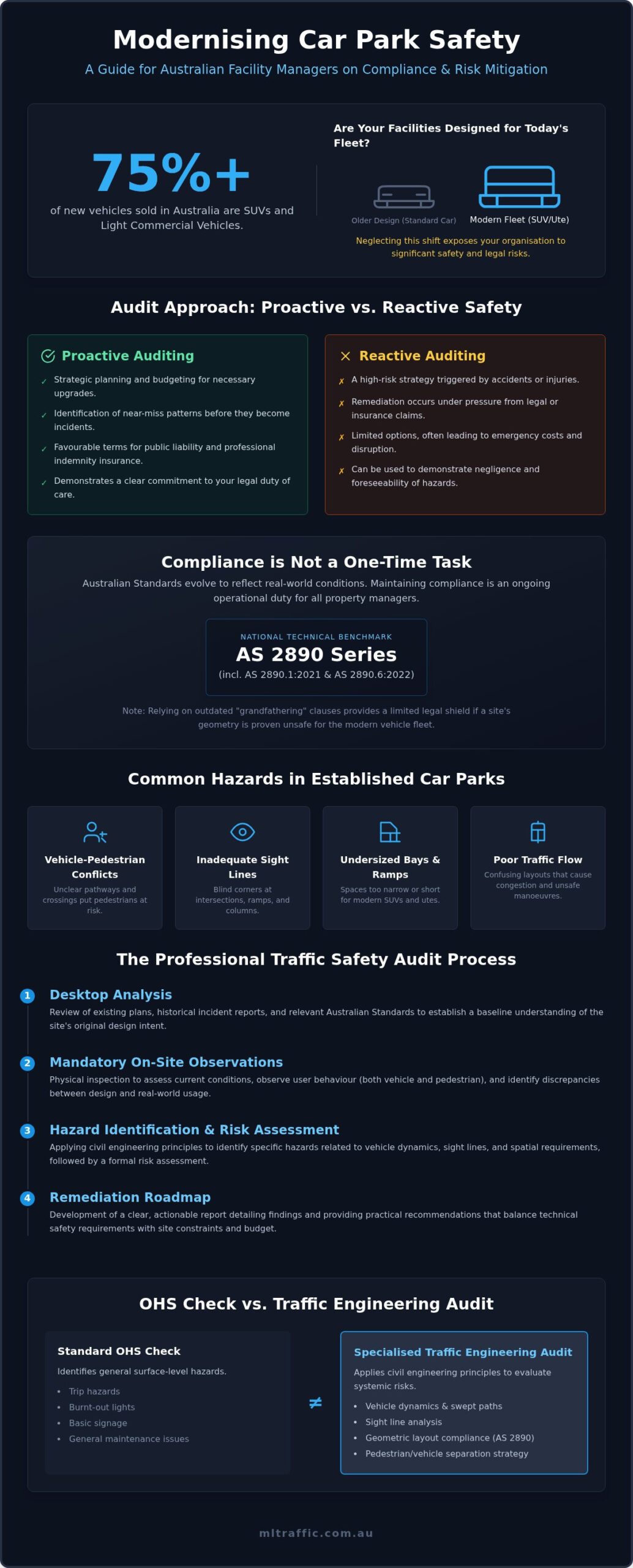
What if the parking facility you’ve managed for years is no longer fit for purpose under current Australian Standards? With SUVs and light commercial vehicles now making up over 75% of new car sales in Australia, many older sites struggle to accommodate the modern fleet. Neglecting your car park design for safety and compliance doesn’t just frustrate drivers; it exposes your organisation to significant legal and financial risks. We understand that keeping up with the transition from AS 2890.1:2004 to the mandatory 2021 updates can feel like a bureaucratic minefield, especially when trying to resolve complex pedestrian and vehicle conflicts in confined spaces.
You deserve a clear path to safety that removes the guesswork from facility management. This article provides a comprehensive guide on how professional traffic safety assessments identify hidden hazards and ensure your site meets the rigorous demands of AS 2890.6:2022 and other critical regulations. By following this roadmap, you’ll learn how to mitigate liability, improve traffic flow, and create a more reliable experience for every user. We’ll examine the technical requirements for modern vehicle dimensions and the steps necessary to secure an authoritative safety sign-off from experts who handle your project personally from inception to completion.
Key Takeaways
- Identify the technical differences between a standard OHS check and a specialised traffic engineering audit for established facilities.
- Learn how to align existing assets with current Australian Standards, including AS 2890.1:2021, to ensure car park design for safety and compliance.
- Recognise common operational hazards such as vehicle-pedestrian conflicts and environmental factors that increase public liability.
- Understand the structured audit process that combines desktop analysis with mandatory on-site observations for accurate hazard identification.
- Gain insights into developing a remediation roadmap that balances technical safety requirements with site constraints and budget realities.
Understanding Traffic Safety Assessments for Existing Car Parks
A traffic safety assessment for an established facility is a specialised technical review designed to identify physical and operational risks. It is distinct from a general Occupational Health and Safety (OHS) check. While a standard OHS inspection might identify a trip hazard or a burnt-out light, a traffic engineering audit applies civil engineering principles to evaluate vehicle dynamics, sight lines, and pedestrian-vehicle separation. Understanding Car Parks requires looking beyond surface-level maintenance. It involves assessing whether the original geometry still functions safely under current conditions.
Usage patterns in Australian facilities change over time. The surge in SUV and light commercial vehicle sales means many older bays and ramps are no longer fit for purpose. Periodic reviews are essential to ensure the site remains functional. The person in management or control of the car park holds the primary responsibility for these reviews. They must ensure that car park design for safety and compliance is maintained as an ongoing operational priority rather than a one-time construction requirement.
The Legal Duty of Care for Property Owners
Under Australian workplace health and safety laws, property owners and facility managers have a non-delegable duty of care to provide a safe environment for all users. A professional assessment serves as a critical risk mitigation tool. It provides documented evidence that the management is proactively identifying and addressing hazards. If an accident occurs, the consequences of non-action are severe. Legal liability often hinges on whether a hazard was foreseeable. Ignoring outdated layouts or failing to address known “near-miss” areas can lead to significant litigation, heavy fines, and voided insurance policies. Our ML Traffic Engineers Australia team provide the technical certainty needed to meet these legal obligations.
Proactive vs. Reactive Safety Audits
Waiting for a serious collision or pedestrian injury before reviewing your site is a high-risk management strategy. Reactive audits often occur under the pressure of legal proceedings or insurance claims, which limits your remediation options. Proactive auditing offers several advantages:
- Insurance and Liability: Regular audits can lead to more favourable professional indemnity and public liability terms.
- Identifying Near-Miss Patterns: Engineers can spot patterns in tyre marks, scraped columns, or erratic pedestrian movements before they result in a serious incident.
- Strategic Planning: You can budget for necessary upgrades over time rather than facing emergency repair costs.
At ML Traffic Engineers Australia, we ensure that the senior principal who initiates your project is the one performing the technical work. This personnel continuity promise ensures that complex site histories and specific management concerns are never lost in a corporate hierarchy.
The Regulatory Framework: AS 2890 Compliance for Operational Sites
The AS 2890 series serves as the national technical benchmark for car park design for safety and compliance. While many property managers believe their facilities are protected by “grandfathering” clauses, this concept offers limited legal shield if the site geometry fails to accommodate the modern vehicle fleet. The 2021 update to AS/NZS 2890.1 reflects a significant shift in vehicle size trends. Since SUVs and light commercial vehicles now constitute over 75% of new car sales in Australia, older sites often lack the spatial allocation required for safe manoeuvring. Maintaining compliance is not just a construction requirement; it is an ongoing obligation for commercial and residential strata managers to mitigate risk.
Local councils frequently request updated traffic assessments for existing sites during tenancy changes or minor renovations. This ensures that the “as-built” environment remains functional under current usage patterns. Failing to meet these standards can result in project holding costs exceeding $5,000 per day if compliance issues stall a development application or occupancy permit. A professional audit verifies that your facility aligns with the latest regulatory expectations, protecting both the user and the owner.
AS 2890.1: Off-Street Car Parking Standards
Reviewing bay dimensions and aisle widths against AS 2890.1 is a critical component of any operational audit. In established multi-level sites, we frequently identify non-compliant ramp grades and inadequate headroom that lead to vehicle damage. Compliance with AS 2890.6:2022 for disabled parking is also mandatory. This requires specific shared zones and bollard placements that were often omitted in older layouts. Ensuring these spaces meet the 2022 benchmarks is essential for equitable access and legal protection.
AS 2890.2: Commercial Vehicle Facilities
Managing heavy vehicle movements requires a precise technical approach. We evaluate loading dock safety to ensure modern delivery vans can enter and exit without encroaching on pedestrian paths or general traffic. The Safe Work Australia Traffic Management Guide emphasises the necessity of physical separation between service vehicles and the public. Height clearances must be verified against current B99 design vehicle benchmarks to prevent infrastructure damage. If you are concerned about your facility’s current compliance status, you can contact our senior principals for a direct technical review of your site.
Common Safety Hazards in Established Car Parking Facilities
Accidents in Australian parking facilities are rarely random events. They typically result from identifiable failures in car park design for safety and compliance that have developed as the site ages. Environmental factors often degrade over time, creating new risks that weren’t present at the time of construction. For instance, inadequate drainage can lead to ponding, which increases the risk of vehicle skidding and pedestrian slips. Similarly, lighting systems that don’t meet current lux level requirements significantly reduce a driver’s ability to see pedestrians in dark corners or transition zones.
We frequently observe ‘informal’ parking habits in poorly managed facilities. When drivers perceive the designated layout as difficult or inaccessible, they often park in non-designated areas, such as near fire exits or on internal curves. This behaviour restricts sightlines and narrows the effective aisle width for other users. Professional engineers use site data, such as physical damage to columns or tyre scraping on walls, to pinpoint these high-risk zones. These physical markers provide undeniable proof that the current configuration is failing to accommodate the actual traffic mix on-site.
Pedestrian-Vehicle Conflict Points
The most critical hazard in any car park is the intersection of walking paths and driving aisles. Shared zones often fail because they lack clear definition or physical protection. Our Sight Distance Assessment services specifically target these areas to ensure drivers have sufficient reaction time when exiting driveways or turning corners. Effectiveness is significantly improved when management implements physical barriers, such as heavy-duty bollards or raised kerbing, to separate vulnerable users from moving vehicles. These measures provide a redundant layer of safety that paint alone cannot offer.
Signage and Line Marking Deficiencies
Line marking and signage are the primary tools for organising traffic flow. In many older Australian sites, directional signage is either faded, obstructed, or inconsistent with standard Australian road rules. This lack of clarity leads to driver confusion and erratic movements. Effective car park design for safety and compliance requires standardising symbols and colours to ensure they’re instantly recognisable to all users. High-visibility line marking must be maintained to define bays, no-parking zones, and pedestrian crossings clearly. When these visual cues fail, the risk of low-speed collisions increases dramatically. Our senior principals at ML Traffic Engineers Australia personally inspect these elements on-site to ensure your facility provides clear, unambiguous guidance to every visitor.
How a Professional Traffic Safety Audit is Conducted
Professional traffic engineers employ a systematic methodology to evaluate car park design for safety and compliance in existing facilities. This process begins with a risk assessment framework that categorises identified hazards from ‘Low’ to ‘Extreme’. By ranking risks this way, we provide facility managers with a clear priority list for remediation. A ‘High’ or ‘Extreme’ risk, such as a blind corner with high pedestrian volume, requires immediate intervention. Conversely, ‘Low’ risks might be managed through routine maintenance or long-term capital planning.
We pair comprehensive desktop reviews of original architectural plans with intensive on-site observations. Plans often fail to reflect the “as-built” reality or the modifications made over decades of operation. Traffic data collection is also a vital component of the audit. By measuring peak-hour demand, we determine if the facility’s capacity is being exceeded. Excessive demand often leads to the erratic driver behaviour and ‘informal’ parking habits discussed in previous sections. Our technical approach ensures that every recommendation is backed by empirical data rather than subjective observation.
Site Inspection and Data Collection
During the site inspection, we measure physical dimensions to the millimetre. We compare aisle widths, bay lengths, and ramp grades against current AS 2890 requirements. Engineers observe real-world driver behaviour to identify ‘bottleneck’ areas where congestion leads to driver frustration and risk-taking. We also check lighting levels at critical junctions and pedestrian crossings using calibrated lux metres. Visibility is assessed from the driver’s eye height to ensure sightlines aren’t obstructed by structural columns, landscaping, or poorly placed signage.
Technical Analysis and Swept Path Analysis
Technical analysis involves digitising the site layout to run vehicle simulations. We use specialised software to perform Swept Path Analysis, which identifies hidden collision risks in tight spaces. This is particularly important for older car parks built before the current trend of larger vehicles. We test worst-case scenarios to ensure that emergency and service vehicles can still access the site without being blocked by standard traffic. If your facility has never undergone a technical simulation, you can request a vehicle swept path analysis from our senior principals to verify your site’s operational safety.
Navigating Compliance and Remediation with Expert Guidance
Translating audit findings into an actionable remediation plan requires more than just listing non-compliances. It involves developing a prioritised roadmap that addresses the most critical hazards first. We understand that established sites often face rigid physical constraints, such as structural columns or fixed boundary walls. These limitations can make literal adherence to new-build standards difficult. In these instances, our engineers identify equivalent safety outcomes. This might involve modifying traffic flow direction or implementing structural protections where bay dimensions are fixed. Balancing car park design for safety and compliance with existing budget and site realities is a core competency of a specialised traffic engineering consultancy.
A formal traffic safety report serves as an essential document for insurance renewals and local council queries. It provides a defensible record that management is fulfilling its duty of care. When hazards are identified, having a professional remediation strategy in place demonstrates proactive risk management. This technical documentation is often the deciding factor in mitigating legal liability following a site incident. Engaging an expert ensures your remediation steps are technically sound and legally robust.
Developing a Traffic Management Plan (TMP) for Existing Sites
Operational safety extends beyond physical geometry. A Traffic Management Plan establishes the rules for daily site use. It defines speed limits, one-way flows, and parking durations. These plans significantly improve daily operations by reducing the driver confusion and ‘informal’ parking habits discussed in previous sections. It’s vital to review these plans whenever site occupancy or use-types change. For example, a shift from retail to commercial office space will alter peak demand periods and vehicle types. This change requires an updated operational strategy to maintain site safety.
Engaging ML Traffic Engineers Australia for Your Assessment
With over 15 years of experience in the Australian market, ML Traffic Engineers Australia provides the technical depth required for complex compliance audits. We specialise in ensuring sites align with AS 2890.1 and AS 2890.2 while providing practical, site-specific solutions. A key benefit of our consultancy is direct principal involvement. The expert who initiates your project is the one who performs the technical work and signs off on your safety report. This personnel continuity promise ensures accountability and professional rigour at every stage. We invite you to organise a traffic safety assessment with our senior principals to secure your facility’s operational future.
Securing the Operational Future of Your Facility
Managing an established parking asset requires vigilance beyond routine maintenance. As Australian vehicle dimensions continue to grow, technical assessments ensure your facility remains functional and safe. A professional audit provides the empirical evidence needed to satisfy council requirements, insurance providers, and workplace health and safety obligations. By identifying high-risk conflict points and verifying sightlines, you move from a reactive management style to a proactive, risk-averse operation. This structured approach is the only way to ensure your infrastructure accommodates the modern fleet without compromising user safety.
Maintaining car park design for safety and compliance is a continuous duty for property owners and strata managers. ML Traffic Engineers Australia brings over 15 years of specialised experience to every audit, providing detailed compliance checks against AS 2890.1 and AS 2890.2. Our personnel continuity promise ensures that you receive direct principal-led assessments for every project, with no gatekeepers between you and the expert performing the technical work. Request a Traffic Safety Assessment from ML Traffic Engineers Australia to establish a clear remediation roadmap for your site. Professional engineering guidance provides the certainty you need to manage your parking infrastructure with confidence.
Frequently Asked Questions
Is a traffic safety assessment mandatory for existing car parks?
Yes, it is effectively a requirement under Australian Work Health and Safety (WHS) legislation. Property owners and managers hold a non-delegable duty of care to provide a safe environment for all users. Failing to identify and mitigate foreseeable risks, such as vehicle-pedestrian conflicts, leaves your organisation liable for significant legal and financial penalties following an incident.
How often should a car park safety audit be performed?
We recommend a comprehensive technical audit every three to five years or whenever the site’s usage patterns change. Since SUVs and light commercial vehicles now constitute over 75% of new car sales in Australia, older layouts often become hazardous as the vehicle mix evolves. Regular reviews ensure your facility remains functional and safe for modern drivers.
Does my car park have to meet current AS 2890 standards if it was built years ago?
Existing sites must align with current standards if a safety hazard is identified or if the site undergoes a change in use or minor renovation. Relying on “grandfathering” is a high-risk legal strategy. Courts and councils often reference the latest benchmarks, such as AS/NZS 2890.1:2021, to determine if a facility manager has taken reasonable steps to ensure safety.
What is the difference between an OHS check and a traffic safety assessment?
A traffic safety assessment is a specialised engineering review, whereas an OHS check is a general workplace inspection. Our audits apply civil engineering principles to car park design for safety and compliance. We evaluate technical elements like vehicle swept paths, ramp grades, and sightlines that a standard OHS inspector isn’t qualified to assess.
Can a traffic safety assessment help reduce my insurance premiums?
Proactive auditing often leads to more favourable professional indemnity and public liability insurance terms. Insurers value documented risk mitigation strategies. By addressing the specific hazards identified in an expert engineering report, you demonstrate a commitment to safety that reduces the probability of expensive litigation and successful claims against your policy.
How long does it take to complete a full safety audit of a car park?
A standard safety audit typically takes between one and two weeks from the initial briefing to the final report delivery. This timeframe includes the desktop review of existing plans, the mandatory on-site inspection, and the technical analysis phase. More complex multi-level facilities or large shopping centres may require additional time for detailed data collection.
What are the most common safety issues found in Australian car parks?
The most frequent issues include inadequate pedestrian-vehicle separation and non-compliant disabled parking shared zones. We often find that older car park design for safety and compliance fails to meet the mandatory AS 2890.6:2022 standards for accessible parking. Obstructed sightlines at driveway exits and faded line marking are also prevalent hazards in established sites.
Will a safety assessment require me to reduce the number of parking bays?
A safety assessment doesn’t always result in a reduction of parking capacity. While increasing bay widths to meet modern standards can sometimes impact the total count, engineers often find alternative safety outcomes. These solutions might include implementing one-way traffic flows, installing physical bollards, or reorganising the layout to improve safety without losing valuable parking spaces.

Disclaimer
The content on www.mltraffic.com.au, including all technical articles, guides, and resources, is provided for general informational and educational purposes only. It is not intended to constitute professional advice in traffic engineering, transportation planning, development approvals, or any other technical or legal field.
While ML Traffic Engineers makes every reasonable effort to ensure the accuracy, completeness, and timeliness of the information published, we do not provide any warranties or representations (express or implied) regarding its reliability, suitability, or availability for any particular purpose. Any reliance you place on the content is strictly at your own risk.
In no event shall ML Traffic Engineers, its directors, employees, authors, or affiliates be liable for any direct, indirect, incidental, special, consequential, or punitive damages (including, without limitation, loss of profits, data, or business opportunities) arising out of or in connection with the use of, or inability to use, any information provided on this website.
The articles and guides on this site are not a substitute for engaging a qualified, registered professional traffic engineer (such as an NPER or RPEQ engineer) to assess your specific project requirements. For tailored advice, compliance assessments, or traffic engineering services, please contact a competent professional.
This disclaimer may be updated from time to time without notice. By accessing or using this website, you agree to be bound by the most current version of this disclaimer.
